Siena AI vs Yuma AI: which ecommerce support agent wins?

Riellvriany Indriawan

Katelin Teen
Last edited September 22, 2026

Siena AI vs Yuma AI at a glance
Both tools skew to the same buyer: a growing consumer brand on Shopify with a support queue full of "where is my order," returns, and subscription changes. Here's how they line up on the dimensions that actually move a buying decision.
| Dimension | Siena AI | Yuma AI | eesel |
|---|---|---|---|
| Built for | Consumer brands / DTC ecommerce | Ecommerce / Shopify DTC | Any team, any helpdesk |
| Billing unit | Per automated conversation (resolved or not) | Per full resolution (no human touch) | Per ticket handled |
| Headline rate | $0.90 + $750/mo platform fee | $0.55 to $1.20 (drops with volume) | $0.40, no platform fee |
| Public pricing | Quote-gated (units disclosed) | Public tiers, 3 plans | Fully public |
| Commitment | Platform fee, no fixed term stated | 12-month commitment | None |
| Free path | Demo only | 30-day trial (after a demo) | $50 free, no credit card |
| Helpdesks | Gorgias, Zendesk, Kustomer, Gladly, Dixa | Gorgias, Zendesk, Kustomer, Salesforce | Gorgias, Zendesk, Freshdesk, Help Scout + more |
| Simulation before go-live | Not documented | Replay historical tickets | Simulate on your ticket history |
| Best for | A full CX platform beyond support | High-volume "pay for wins" brands | Trying it free without a sales call |
| G2 rating | 4.8/5 (28 reviews) | 4.8/5 (~16 reviews) | Newer, fewer reviews |
What Siena AI is
Siena calls itself "the AI CX operating system for consumer brands," and that framing is the point. It was founded in 2022 by Andrei Negrau and Lisa Popovici, and it's less a single support bot than a set of agents running under one intelligence layer: a Customer Service agent, a Shopping agent for product recommendations, a Reviews agent, a QA agent, plus Topics Explorer for voice-of-customer analysis and a Memory layer.
For the day-to-day support work, Siena handles the usual ecommerce load: order tracking, returns, address updates, refunds, replacements, and subscription changes like skip/pause/swap. It leans hard on brand voice through a feature it calls AI Personas, which tune the agent's tone to your customer language, and it explains every human handoff with a note through what it calls Collaborative AI Routing.
Where Siena genuinely shines is the integration catalog around subscriptions and retention. It connects to Recharge, Skio, Smartrr, Ordergroove, Stay AI, and Prive, plus returns via Loop Returns and AfterShip and reviews via Okendo and Yotpo. If your revenue runs on a subscription box, that depth is real and it matters.
On results, Siena's marketing leans on strong numbers: brands automating up to 80% of interactions, a +94.7% average CSAT lift, and a self-reported 4.81/5 CSAT across 50,000+ surveys. Its Coterie case study reports 60 to 65% of email volume automated. Treat the headline percentages as best-case ceilings, but the customer stories are concrete.
What Yuma AI is
Yuma is narrower and, honestly, that's a feature. It's built purpose-first for ecommerce and splits the customer journey into three agents: Support AI for post-purchase tickets, Sales AI for pre-purchase product questions on the storefront, and Social AI for moderating Facebook and Instagram. A layer called Ask Yuma reads your handled tickets and suggests new automations you could turn on.
The core of Yuma is its resolution loop. On a "where is my order" ticket, it reads the order, checks the policy, pulls live carrier data, drafts an on-brand reply, and only sends after a stack of quality checks. It's SOC 2 Type II certified, holds a 5.0 on the Shopify App Store, and processes support across 180+ languages and 25+ channels.
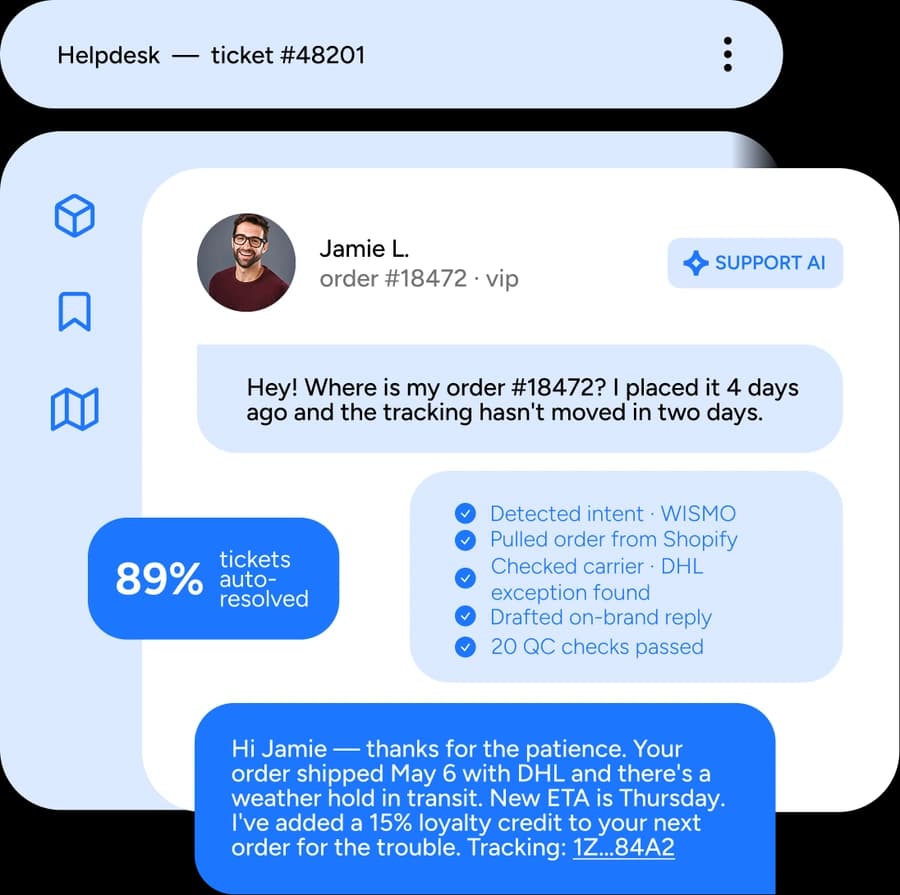
The part I respect most is how careful Yuma is about going live. It runs a gradual rollout from 0% to 100% autonomy with around 25 human reviews before full autonomy, low-volume stores can replay historical tickets to validate first, and every reply passes 15 to 20 quality-control checks across multiple models, with Fact Snippets that insert verified policies verbatim and Hard Limits that cap refund or coupon values. That's the kind of guardrail that comes from watching AI get things wrong, which mirrors why we built simulation into eesel.
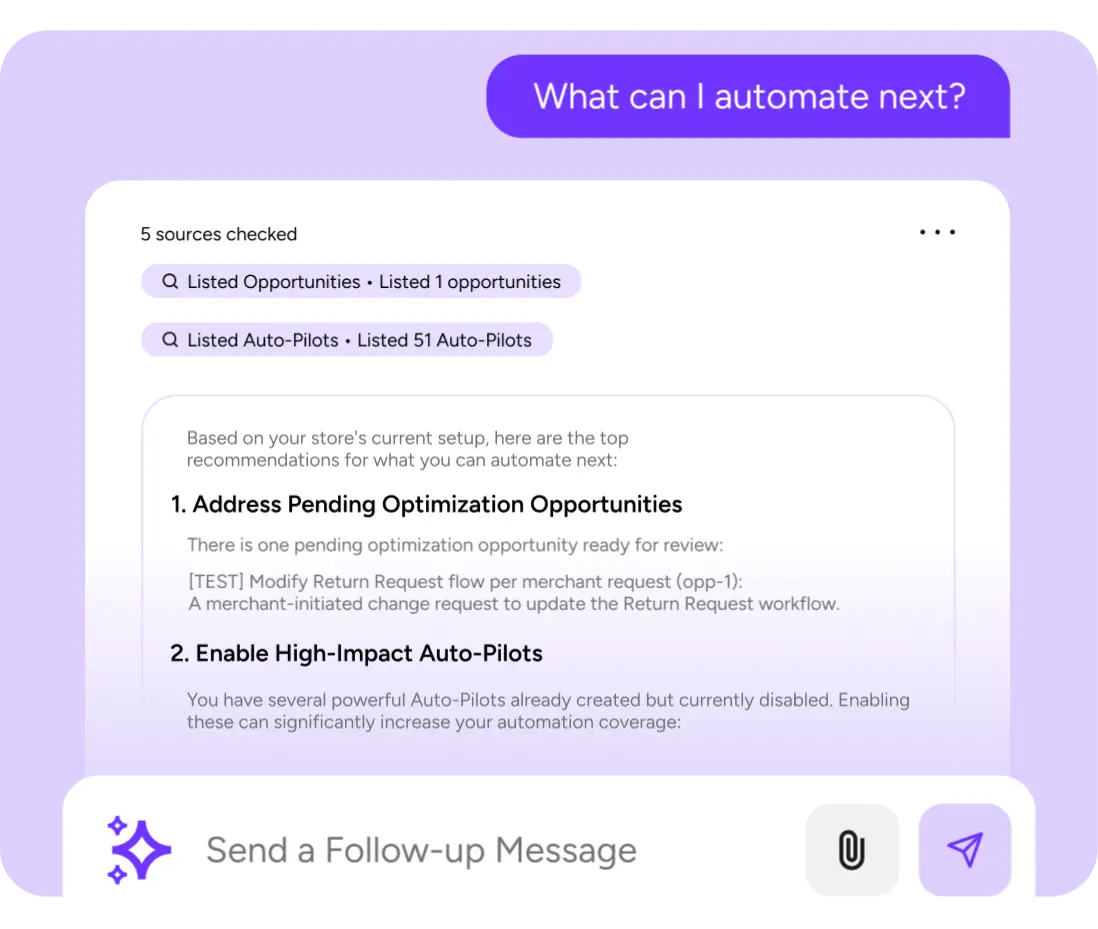
Yuma's proof is customer-story heavy. EvryJewels reports 89% automation and 63% cost savings across 150k+ tickets a month, Clove reports 3x ROI in 90 days, and Tediber cut first response time from 72 hours to under one. These are vendor-published, but they name real brands and real numbers.
How they actually bill you (the part that decides it)
This is where a Siena AI vs Yuma AI decision is really made, because the two tools bill on completely different units, and Yuma's model changed in 2026.
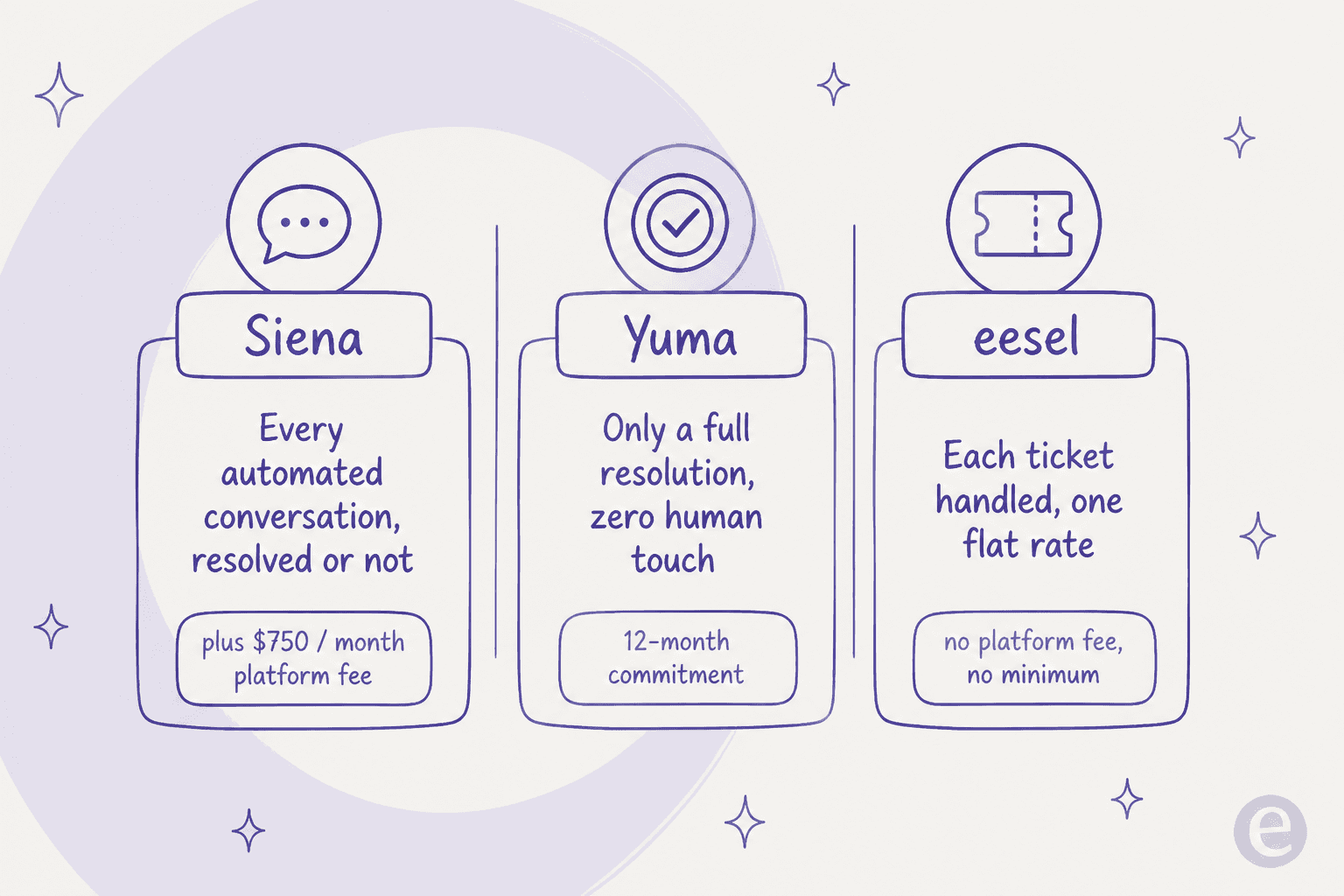
Siena bills per conversation, plus a platform fee. Its pricing page discloses a $750/month platform fee and $0.90 per automated ticket, with the final quote gated behind a sales form. Crucially, Siena has written a whole argument against outcome-based pricing: it charges per conversation whether or not the issue was resolved, on the logic that your cost-per-resolved-issue drops as the AI gets better. That's a defensible stance, but it means you pay even on conversations the AI didn't close.
Yuma bills only for full resolutions. As of 2026, Yuma publishes real tiers: a "full resolution" is a ticket handled end to end with no human at any point, and if a human touches it, it doesn't count. Starter is $14,400/year ($1.20 per resolution, 12,000 resolutions), Growth is $40,000/year ($0.83), and Scale is $90,000/year (~$0.75), with the rate falling toward a $0.55 floor past 120,000 resolutions. There's no implementation fee and a 30-day free trial, but every plan is a 12-month commitment paid upfront, and the monthly-plan overage is a flat $1.50 per ticket.
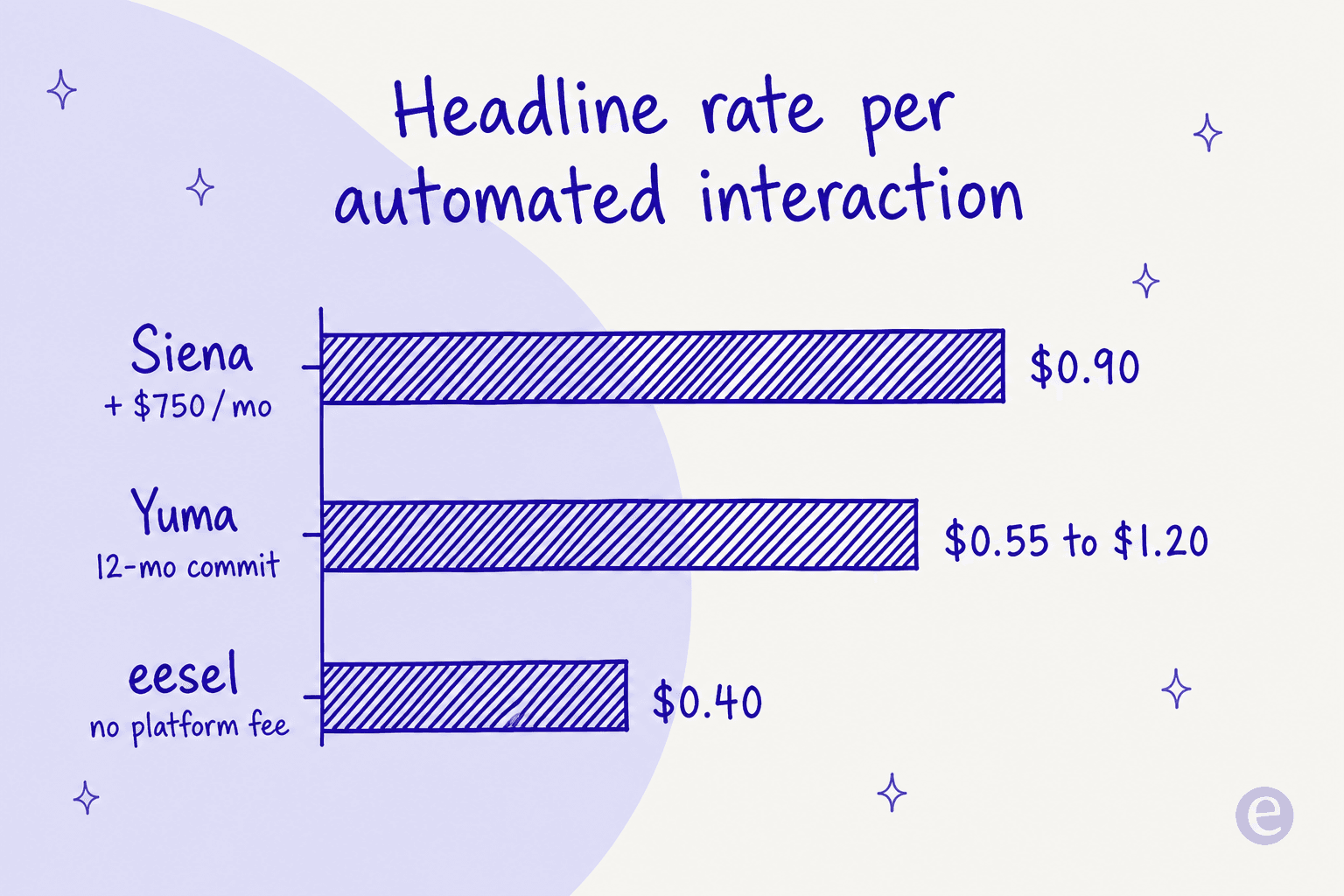
Neither model is wrong, they just reward different situations. Yuma's "pay for wins" pricing is genuinely appealing if you can hit the volume to justify a $14,400 floor. Siena's per-conversation model is simpler to forecast but stacks a fixed fee on top. The one thing both share is a sales gate: you're booking a demo before you see a firm number.
Here's a quick way to sanity-check what you'd actually pay at your volume. Plug in a monthly number and compare the three.
Where each one actually fits
Strip away the feature lists and the choice comes down to two axes: how locked-in you are to ecommerce, and whether you can try before you buy.
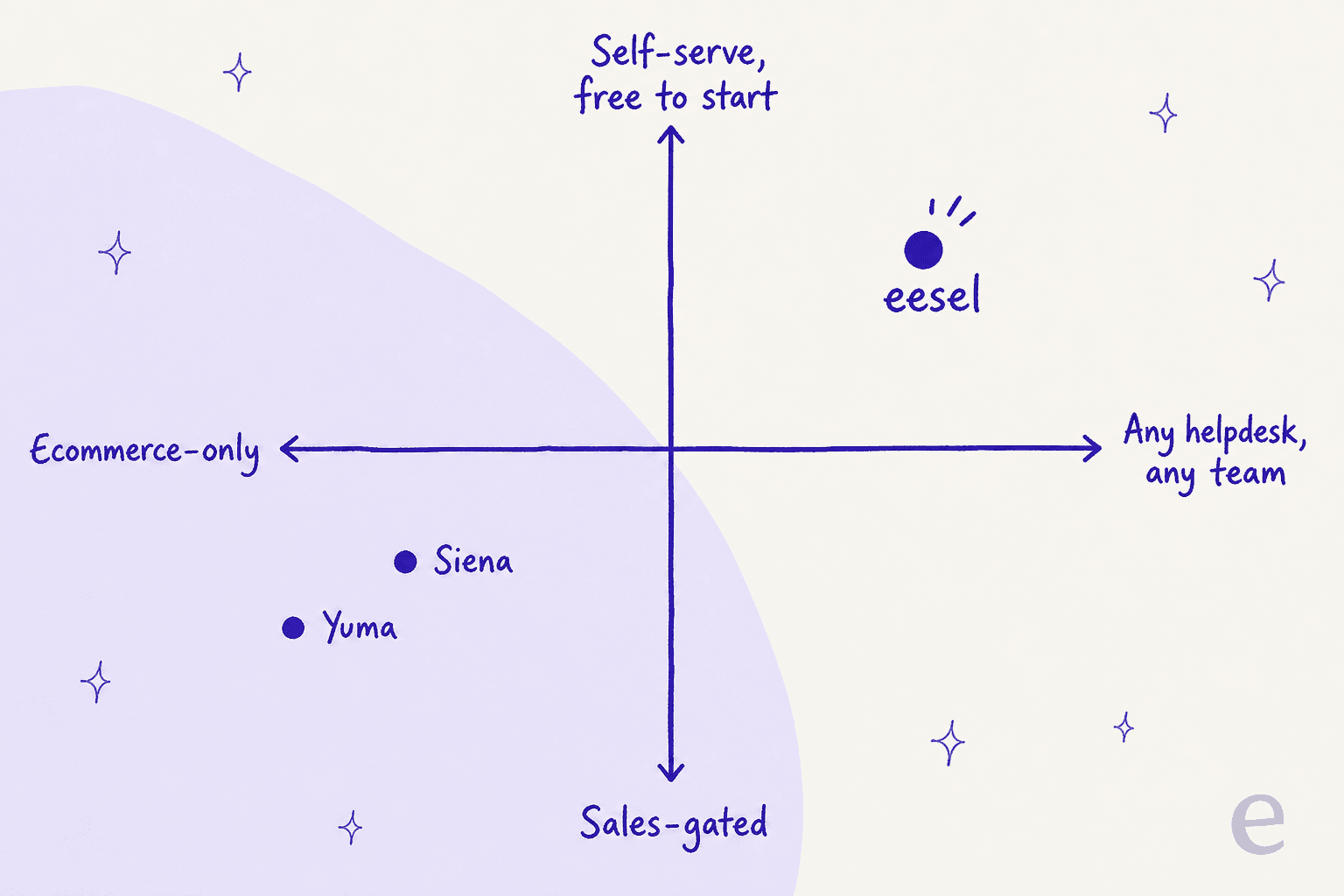
Both Siena and Yuma are excellent if you live entirely inside the Shopify DTC world. Their integrations, their language, their case studies, all of it assumes you're selling physical products to consumers. If that's you, they're purpose-built and you should demo both.
The moment your support spans more than ecommerce, though, that focus becomes a wall. A brand that also runs a B2B portal, an IT service desk, or support in a non-Shopify helpdesk is fitting a round peg into an ecommerce-shaped hole. That's the gap a helpdesk-agnostic agent fills, and it's also why the "book a demo to see a price" gate on both tools is worth flagging: you can't quietly kick the tires before committing.
What users actually say
Both tools hold a 4.8/5 on G2, which tells you the buyers who stuck around are happy. The interesting signal is in the complaints, because they're consistent and they're the same failure mode you should test for.
On Siena, the loudest praise is brand-voice fidelity and cost displacement:
"Siena has allowed us to significantly decrease our BPO hours while simultaneously increasing our positive customer interactions."

But the most-repeated complaint is escalation and routing: Siena sometimes keeps responding after a ticket should have gone to a human, or closes an out-of-scope ticket instead of handing it off. The single lowest-rated review on the profile is built entirely around that:
"Good 93% of the time, really bad the other 7%."
On Yuma's reviews, the pattern rhymes. Reviewers praise the automation depth and easy onboarding, but the single most-cited criticism is accuracy: despite the 15-to-20 quality checks, occasional off-brand or incorrect replies still surface and need human oversight. Yuma's own pricing page fronts a strong customer line to counter that concern:
"AI is our secret weapon this BFCM. Yuma handled inquiries equal to nearly 50 agents, keeping satisfaction sky-high in our busiest season."
Alejandro Reyes, EvryJewels (customer testimonial published by Yuma)
The takeaway across both: the risk isn't the 90% of tickets the AI nails, it's the tail. Whichever you pick, the deciding factor is how well you can see and control what the AI does before it talks to a real customer.
Try eesel
If the through-line of both tools bothered you, the sales gate and the ecommerce lock-in, that's the gap eesel is built for. eesel is an AI teammate platform, and its AI helpdesk teammate does the same core job as Siena and Yuma: it joins your existing support queue, looks up orders, tags tickets, and drafts or sends replies in your brand voice.
The differences are the three things a Siena-vs-Yuma shopper keeps running into. First, it's helpdesk-agnostic, plugging into Gorgias, Zendesk, Freshdesk, Help Scout and 1,000+ tools rather than assuming Shopify. Second, it's self-serve and free to start: $50 of usage, no credit card, no demo required, so you can simulate the agent on your own past tickets and see exactly how it would have answered before it goes live. Third, the pricing is flat and public: 40¢ per ticket handled, no platform fee, no per-seat charge, no minimum, and no 12-month commitment.
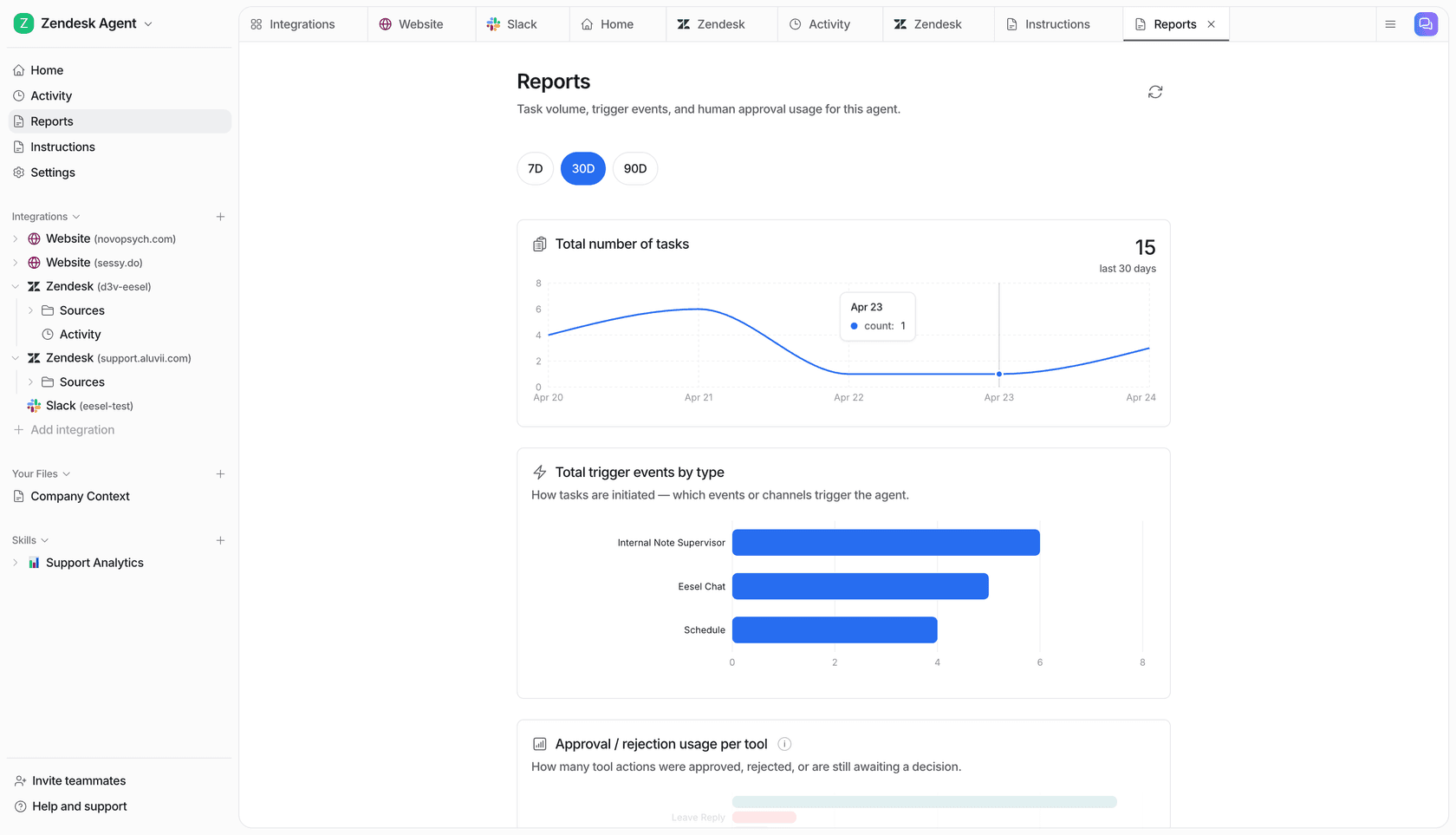
For an ecommerce brand that's still small, or one whose support reaches beyond Shopify, that combination usually pencils out better than a $750/month floor or a $14,400/year bundle. You can start free and route a slice of your tickets to see the numbers on your own data before you commit to anything.
Frequently Asked Questions
What is the difference between Siena AI and Yuma AI?
How much does Yuma AI cost?
Is Siena AI or Yuma AI better for a small Shopify store?
Do Siena AI and Yuma AI work with Gorgias and Zendesk?
What happens if the AI gives a wrong answer to a customer?



Article by
Riellvriany Indriawan
Riell is a designer and writer at eesel AI with about two years of experience researching CX platforms, AI chatbots, and helpdesk software. She combines her design background with a sharp eye for how these tools actually look and feel in practice — making her comparisons unusually visual and user-focused.