Gorgias AI vs Yuma AI: which ecommerce support agent wins in 2026?

Riellvriany Indriawan

Katelin Teen
Last edited September 22, 2026

The one-line difference most comparisons miss
I spend my days in a support queue, so the first thing I check on any tool like this is where it actually plugs in. That's the real fork here, and a lot of "Gorgias AI vs Yuma AI" write-ups skip it.
Gorgias is a helpdesk. You migrate your email, chat, and social into it, and the AI Agent is a feature inside that platform. Yuma is not a helpdesk. It connects on top of Gorgias, Zendesk, Gladly, Kustomer, or Re:amaze and resolves tickets inside the tool you already run. That means these two aren't strictly rivals, plenty of brands run Yuma on Gorgias. When you're comparing them, you're really comparing "replace my helpdesk" against "add autonomous resolution to my helpdesk."
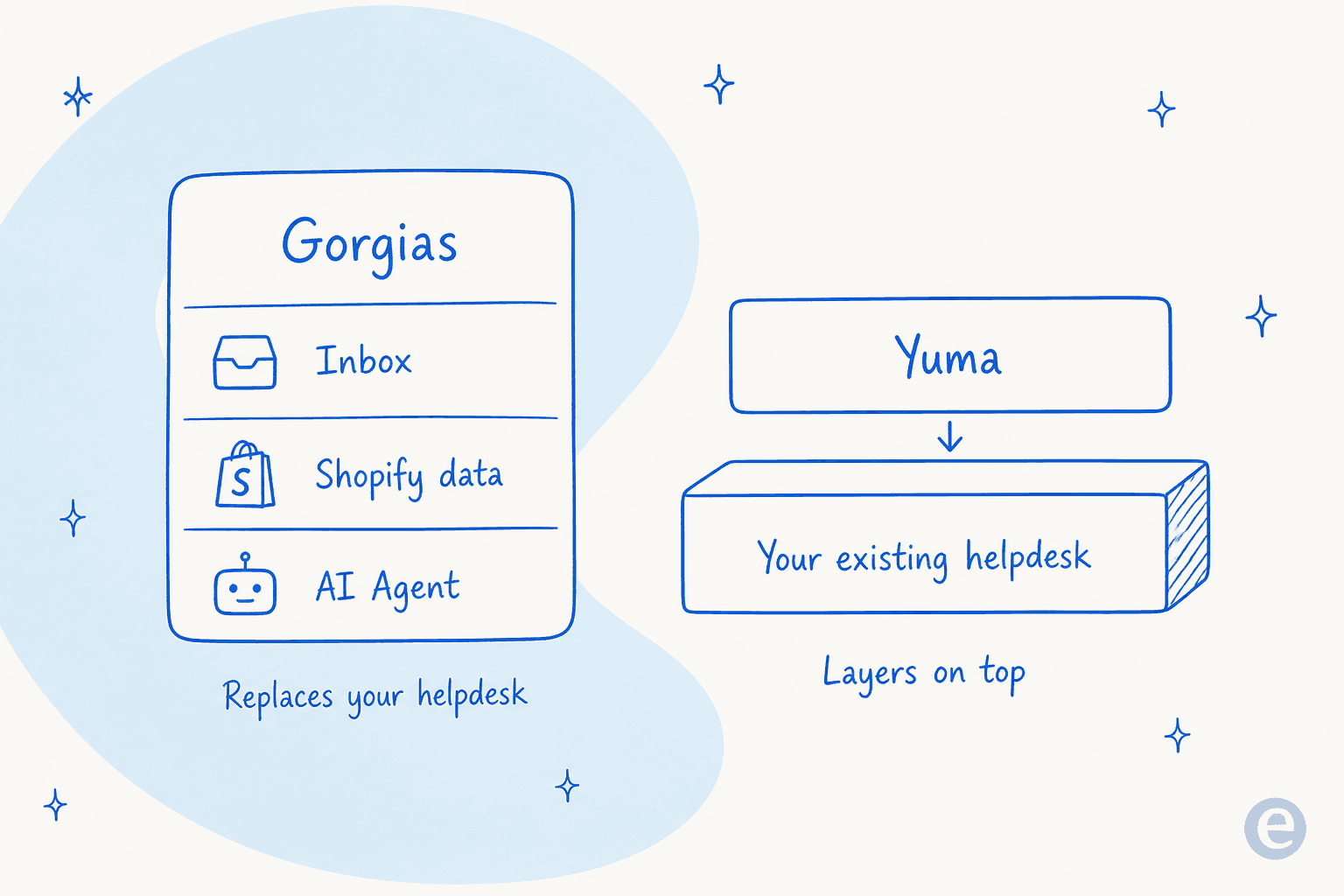
That single distinction decides most of the rest: the pricing shape, the migration cost, and who each one is genuinely for.
What Gorgias AI actually is
Gorgias is an ecommerce-first helpdesk that unifies email, live chat, SMS, WhatsApp, Instagram, Facebook, and TikTok into one inbox, then trains an AI Agent on top of your store. It's Shopify-native: orders, customers, and store data live inside Gorgias with a one-click install and no data syncing, and it says it powers 40% of Shopify brands across 15,000+ stores.
The AI Agent is the part that matters here. Built on a direct OpenAI partnership and pre-trained on more than a billion ecommerce conversations, it doesn't just draft replies, it takes actions inside the ticket: tracking orders, processing returns and refunds, editing orders and subscriptions, and generating discounts, then escalating to a human with context when it's out of its depth.
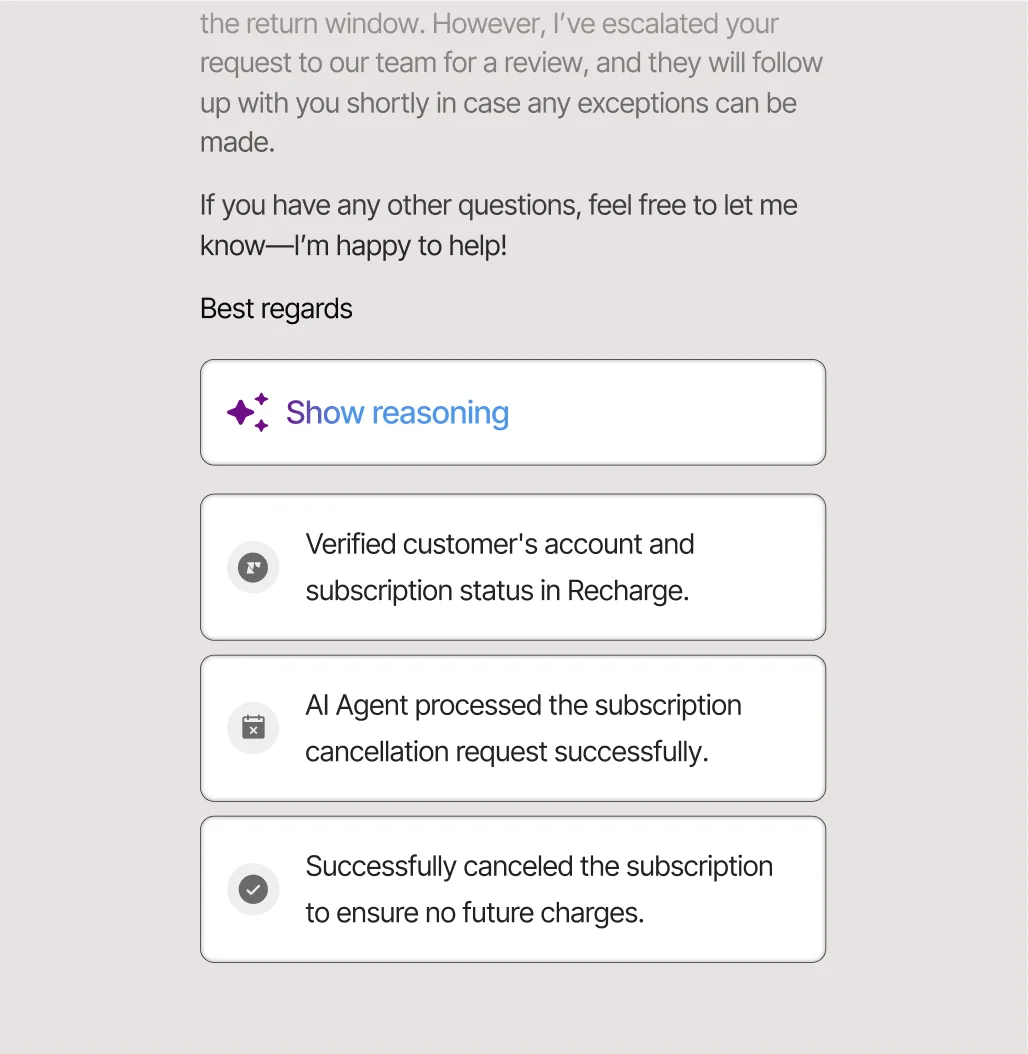
What you're buying, then, is an all-in-one: the inbox, the Shopify actions, and the automation on one platform and one bill. The tradeoff is that to get the AI you commit to Gorgias as your helpdesk, which is a bigger move than adding a feature.
What Yuma AI actually is
Yuma is an AI support automation platform, not a helpdesk, purpose-built for ecommerce and layered on your existing stack. It came out of Y Combinator's W23 batch, raised $5M in October 2024, and is run by three-time founder Guillaume Luccisano. Its pitch is "resolve, don't deflect," with a headline claim of up to 89% autonomous resolution.
The core product, Support AI, plugs into your helpdesk and resolves post-purchase work end-to-end, WISMO, returns, refunds, cancellations, and subscription or address changes, using 100+ ready-to-use actions with quality checks on each reply. Around it sit Sales AI (a pre-purchase product Q&A widget), Social AI, a Chat AI widget, and "Ask Yuma," a conversational layer that builds automations from plain-English SOPs.
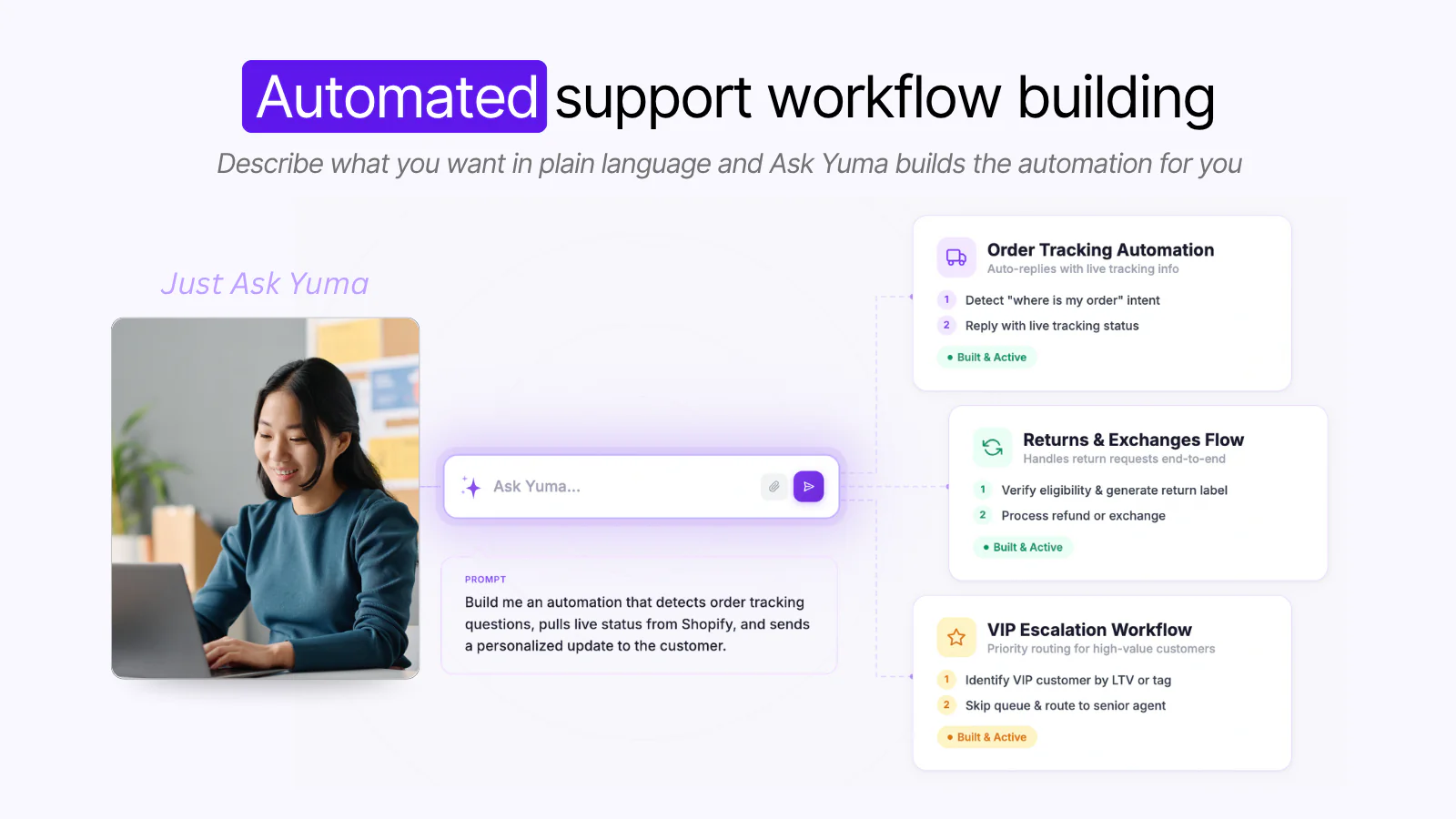
So Yuma is narrower and deeper: it doesn't want to be your inbox, it wants to close tickets inside whatever inbox you've got. That keeps your existing setup intact, but it means Yuma is an added cost on top of your current helpdesk bill, not a replacement for it.
The billing units are not the same thing
This is where I see the most confusion, and it's the most important part of the whole comparison. Gorgias and Yuma both price around "automation," but they count completely different things, so comparing the raw per-unit numbers is comparing apples to oranges.
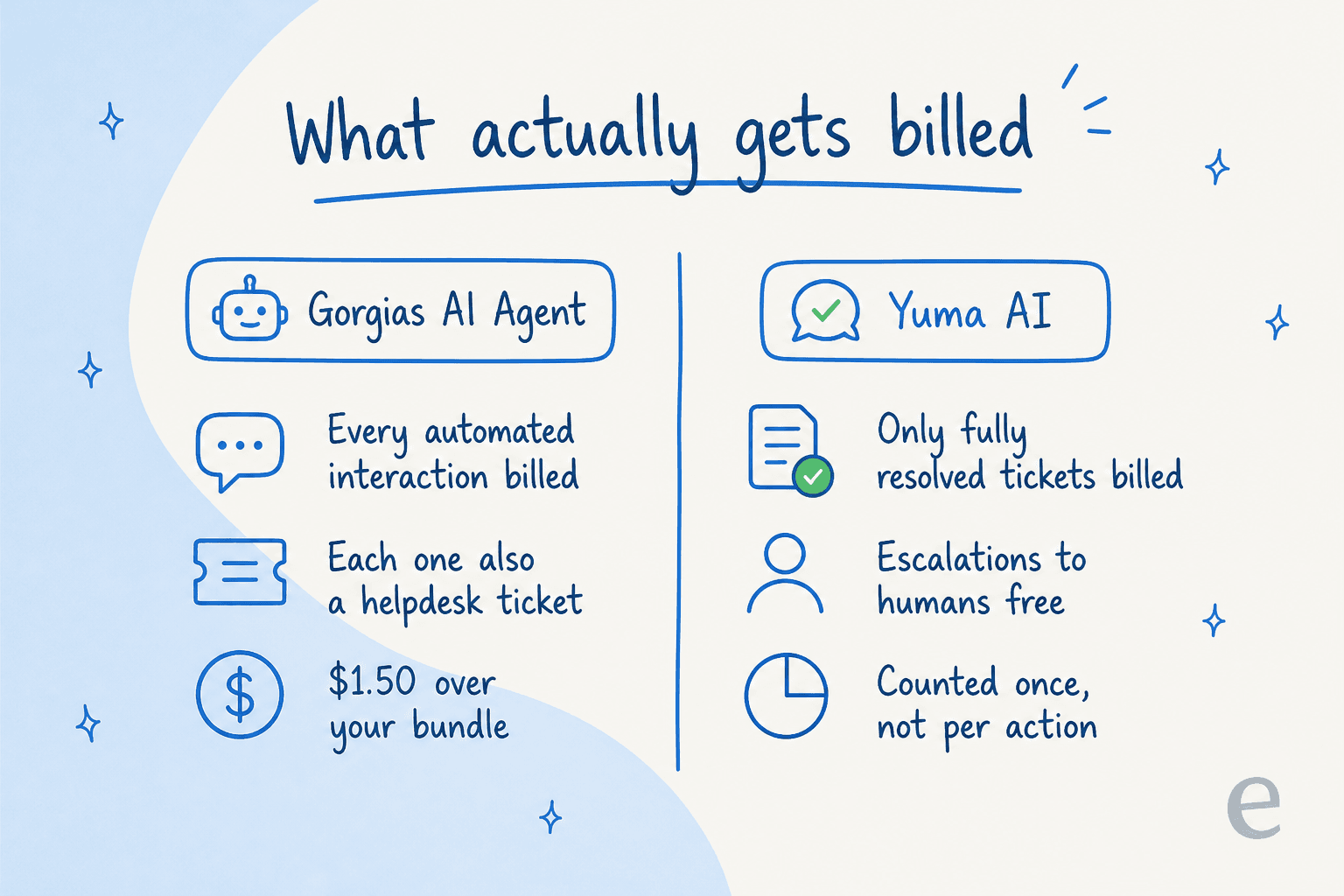
Gorgias bills per automated interaction. Every time the AI Agent engages counts, and, importantly, each of those interactions also counts as a billable helpdesk ticket against your plan. Go over your bundled interactions and it's $1.50 each.
Yuma bills per fully resolved ticket. In its own words, a resolution is "counted once per ticket that's fully resolved, not every time Yuma comes back to take another action on the same conversation," and the moment a human steps in, that ticket is excluded from your usage. Escalations and unresolved conversations are free.
That difference cuts both ways. Yuma's model means you never pay for a bot that failed and handed off, which is genuinely reassuring. But it also means Yuma has to fully close the loop to earn its fee, so the headline per-resolution rate looks higher than Gorgias' per-interaction rate even when the outcomes are similar. Read the unit before you read the number.
Pricing, side by side
Let's put real figures down. Gorgias publishes a full self-serve rate card; the AI Agent is included on every tier with a bundled allotment of interactions.
| Gorgias plan | Monthly (billed annually) | Tickets / month | AI Agent per interaction | Helpdesk overage |
|---|---|---|---|---|
| Starter | $40 | 50 | $1.00 | $0.40 / ticket |
| Basic | $77 ($924/yr) | 300 | $0.90 | $0.40 / ticket |
| Pro | $471 ($5,652/yr) | 2,000 | $0.90 | $0.36 / ticket |
| Advanced | $1,227 ($14,724/yr) | 5,000 | $0.85 | $0.36 / ticket |
| Enterprise | Custom | 5,000+ | Custom | Custom |
Over your bundled AI interactions, every plan charges $1.50 per automated interaction. Full detail is in our Gorgias AI Agent pricing breakdown.
Yuma historically hid its rate behind a "talk to us," but it now publishes illustrative outcome-based tiers. Every plan carries a 12-month commitment paid upfront, and you pay only for fully automated resolutions.
| Yuma illustrative tier | Annual price | Approx. per resolution |
|---|---|---|
| Entry | $14,400/yr | ~$1.20 |
| Mid | $40,000/yr | ~$0.83 |
| High | $90,000/yr | ~$0.75 |
| 120,000+ resolutions/yr | Custom bundle | toward $0.55 floor |
On the Shopify App Store, Yuma also lists a Small Merchant plan at $850/month and a Medium Merchant plan at $1,200/month, each with a 14-day trial. Monthly plans bill extra full resolutions at a flat $1.50; annual plans simply pause when you hit your bundle.
Two things stand out. First, Yuma's 12-month upfront commitment is a very different risk profile from Gorgias' month-to-month self-serve tiers. Second, Yuma's floor really does drop with scale, which is the whole design of the model.
Where each one wins
Here's how I'd actually split them, based on the layer each one lives at and how they bill.
| Dimension | Gorgias | Yuma |
|---|---|---|
| Category | Full ecommerce helpdesk + AI | AI resolution layer on your helpdesk |
| Best for | Brands without a helpdesk, or wanting AI + inbox in one | Brands with a helpdesk and real ticket volume |
| Setup | Migrate your inbox to Gorgias | Connect on top of existing helpdesk |
| Billing unit | Per automated interaction (also a ticket) | Per fully resolved ticket (escalations free) |
| Entry cost | From $40/mo, month-to-month | 12-month commitment; ~$850/mo+ via Shopify |
| Actions in-ticket | Refunds, order edits, subscriptions, discounts | Refunds, returns, cancels, subscription/address changes |
| Native channels | Email, chat, SMS, social, voice add-on | Uses your helpdesk's channels |
The community reads it the same way. On a Reddit thread weighing Shopify helpdesks, one operator put the Gorgias case cleanly:
"I've been around ecommerce for 10+ years and this is honestly how I'd choose: 40%+ tickets need Shopify actions → I'd lean Gorgias. Mostly conversational support → Zendesk is fine."

The recurring Gorgias caution in the same discussions is cost creep: "the price adds up quick once your volume grows," which is exactly what the per-interaction-plus-ticket billing does at scale.
Yuma's reviewers, meanwhile, are candid that the payoff is real but volume-gated. A retail reviewer who liked the product still flagged the model:
"The pricing model is rather strict. You need a significant volume of tickets to make it truly cost-effective, or at least be in a strong growth trajectory so that it becomes profitable over time... it's not the most suitable solution if you're just starting out or handling low volumes."

And on results, the honest operator numbers land below the 89% headline but are still strong once you've done the setup work:
"After working and spending quite some time setting up everything, we have managed to automatize more than 50% of our customer requests... I would say that the ROI of Yuma is about 4x to 6x. Companies telling you that automating customer service with AI in one or a few hours are just trying to sell you something."
What it costs as you scale
Both models get cheaper per unit as you grow, but they get there differently. Gorgias eases from $1.00 down to $0.85 per interaction across its tiers; Yuma starts higher per resolution but falls further, toward a $0.55 floor at serious volume.
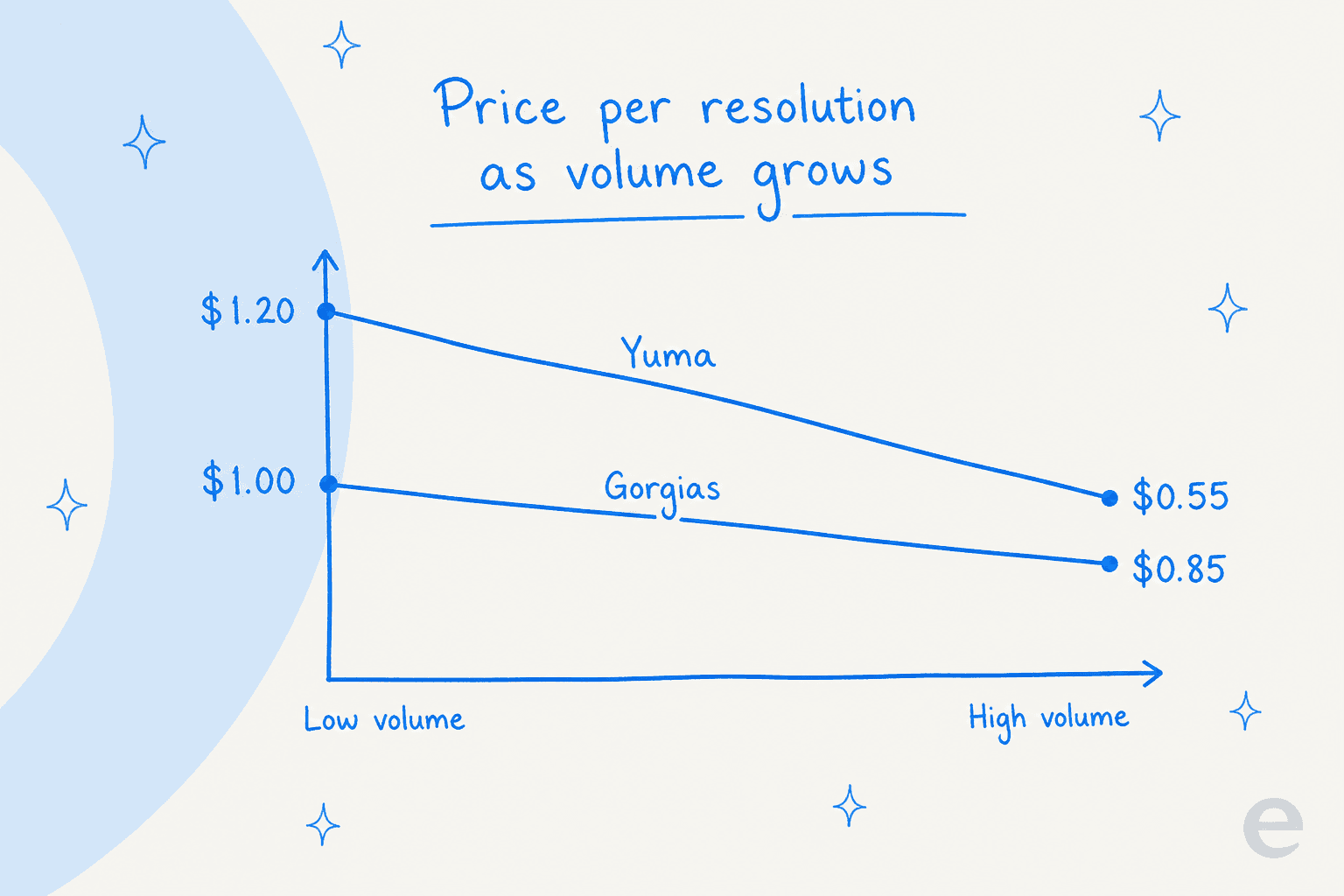
The catch with a simple line like this is the unit again. A Gorgias "interaction" and a Yuma "resolution" aren't the same amount of work, and Gorgias' interactions also eat into your ticket allowance. If you want a genuinely apples-to-apples cost, model it on your ticket mix, how many need real Shopify actions, how many are one-touch FAQs, and what your escalation rate looks like, rather than trusting either per-unit figure on its own.
Try eesel
If the "replace it or bolt onto it" choice feels like a false binary, that's because there's a third option. eesel is an AI helpdesk teammate that layers onto the helpdesk you already run, Gorgias included, so you get autonomous resolution without a migration, the way Yuma does, but without being locked to Shopify-only stores or a 12-month commitment to find out if it works.
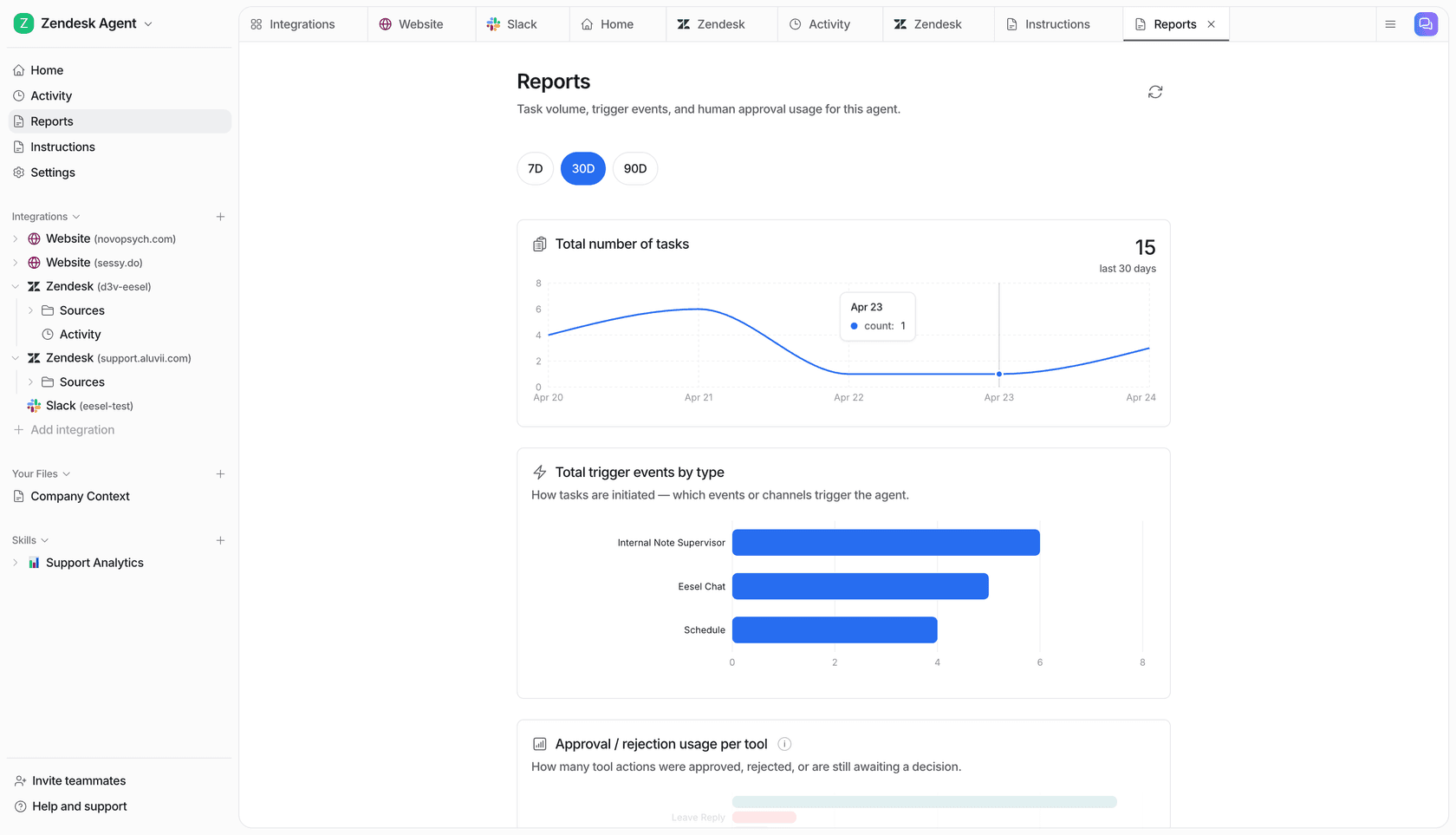
Two things I'd flag for anyone weighing Gorgias AI vs Yuma AI. First, eesel trains on your past tickets, help center, and docs, then lets you simulate it against your real historical tickets before it answers a single live customer, so you see the resolution rate and the exact replies up front instead of flipping a switch and hoping. Second, it prices on usage without a separate per-resolution surcharge stacked on top, which sidesteps the "every interaction is also a ticket" math. You can try it for free on your own queue and check the numbers yourself.
Frequently asked questions
What is the main difference between Gorgias AI and Yuma AI?
Gorgias is a full ecommerce helpdesk with an AI Agent built in, so you run your inbox and your automation on one platform. Yuma is an AI layer that sits on top of a helpdesk you already have (including Gorgias itself), so in a Gorgias AI vs Yuma AI decision you are really choosing between replacing your helpdesk and adding autonomous resolution on top of it.
How much does Gorgias AI cost per resolution?
Gorgias includes the AI Agent on every plan and charges per automated interaction: $1.00 on Starter, $0.90 on Basic and Pro, and $0.85 on Advanced, then $1.50 for each interaction over your bundle. Each automated interaction also counts as a billable helpdesk ticket, which is easy to miss. Our Gorgias pricing breakdown walks through a worked example.
Is Yuma AI worth it for a small Shopify store?
Probably not yet. Yuma's outcome-based pricing and 12-month commitment reward high volume, and G2 reviewers say it isn't cost-effective if you are just starting out or handling low volumes. If your ticket count is small, an unbundled per-ticket tool or an ecommerce AI chatbot that layers on your current setup is usually the safer start. Our Yuma alternatives post has more options.
Can Yuma AI run on top of Gorgias?
Yes. Yuma connects on top of Gorgias, Zendesk, Gladly, Kustomer and Re:amaze rather than replacing them, so plenty of brands run Yuma inside a Gorgias inbox. That is also why a straight Gorgias AI vs Yuma AI framing can be a category error: one is the helpdesk, the other is the automation layer.
What is a good Gorgias AI and Yuma AI alternative?
eesel is an AI helpdesk teammate that layers onto the helpdesk you already run, prices on usage without a per-resolution surcharge, and lets you simulate on your real past tickets before it replies to anyone. It isn't Shopify-locked, so it fits brands on Zendesk or Freshdesk too. See how it compares in our Gorgias alternatives roundup.



Article by
Riellvriany Indriawan
Riell is a designer and writer at eesel AI with about two years of experience researching CX platforms, AI chatbots, and helpdesk software. She combines her design background with a sharp eye for how these tools actually look and feel in practice — making her comparisons unusually visual and user-focused.