The 10 best AI for ecommerce returns in 2026 (ranked and compared)

Riellvriany Indriawan

Katelin Teen
Last edited October 14, 2026

The two things people mean by "AI for returns"
Before the rankings, the distinction that decides everything. When someone searches for AI for returns, they mean one of two jobs, and almost no single tool nails both.
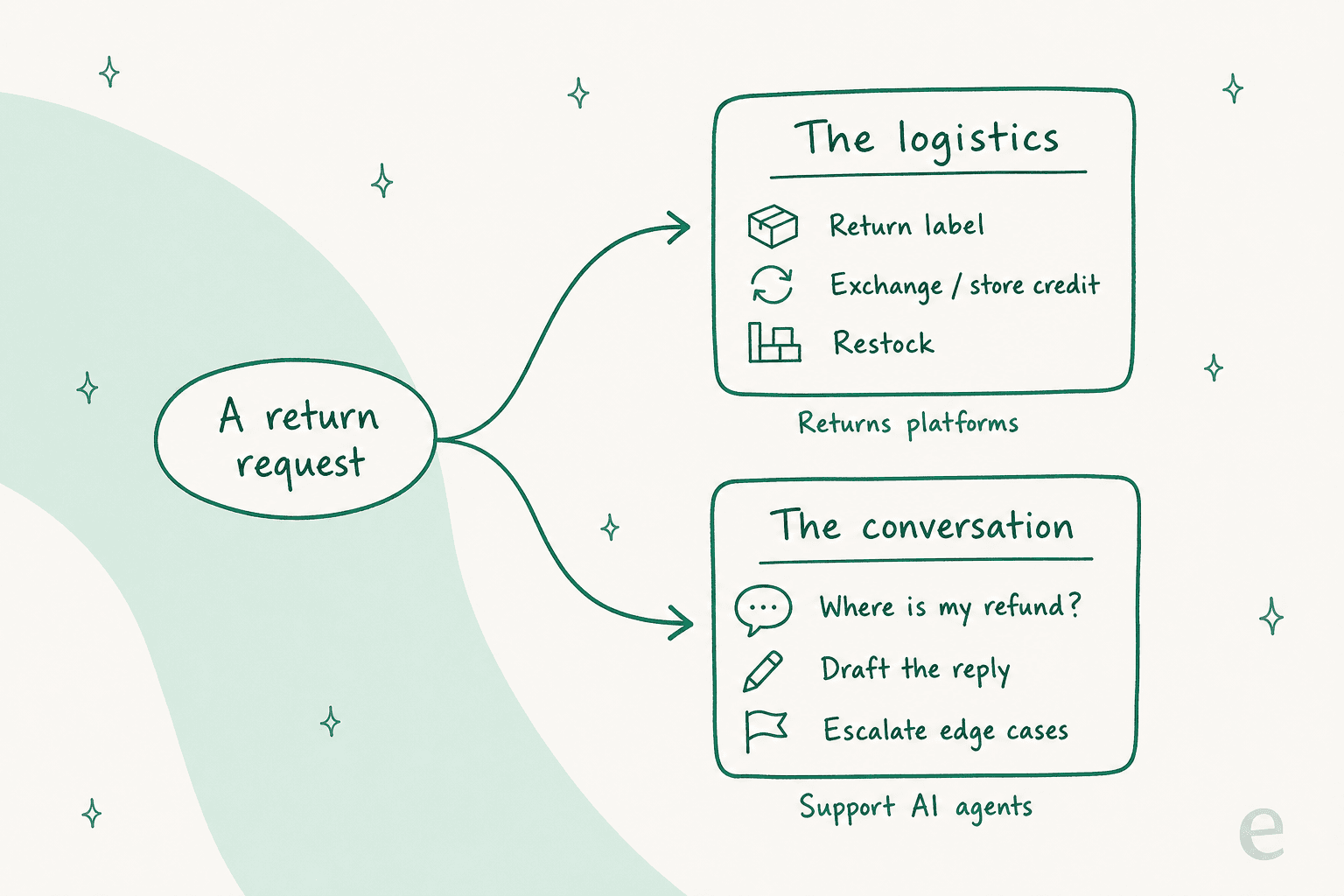
The logistics. A shopper wants to send something back. A returns platform (what vendors call returns management software) gives them a branded self-service portal, generates the carrier label, nudges them toward an exchange or store credit instead of cash, and routes the parcel through reverse logistics. The "AI" here is mostly a rules engine plus some fraud scoring. It's excellent at the warehouse-and-policy side and knows nothing about answering a customer's actual message.
The conversation. A shopper emails "I want to return order #44433, it doesn't fit." A support AI agent reads the order, checks whether it's inside the return window, and either issues the label and refund or drafts a reply for a human. This is the tier-1 ticket work that eats your team's day, and it's what ticket-automation tools are built for.
Here's the part most roundups skip: these two categories increasingly overlap at the edges. Returns platforms are bolting on chat; support AI agents can trigger a return action through a Shopify or returns-app integration. But their center of gravity is different, and that difference is what should drive your pick. If your team is drowning in messages, buying a slicker returns portal won't save them. If your warehouse is choking on manual RMAs, a chatbot won't fix that either.
What I looked for
I've spent years putting AI on live support queues, and returns are where confident-sounding bots get people in trouble fastest, because a wrong answer here costs real money (an over-refund, a wrongly approved exchange). So I weighed these tools on more than a feature checklist:
- Does it actually take the action, or just talk? The gap between "drafts a nice reply about your return policy" and "reads the order, generates the label, issues the refund" is the whole ballgame.
- Can it read live order data? A returns answer is worthless without the order. Shopify, WooCommerce, or Magento connectivity is table stakes.
- How does it price returns work? Per resolution, per resolved ticket, or per return processed. These are not the same unit, and the wrong one gets expensive fast.
- What stops it from over-refunding? Refund caps, confidence thresholds, a clean escalation path, and ideally the ability to test it against your history before go-live.
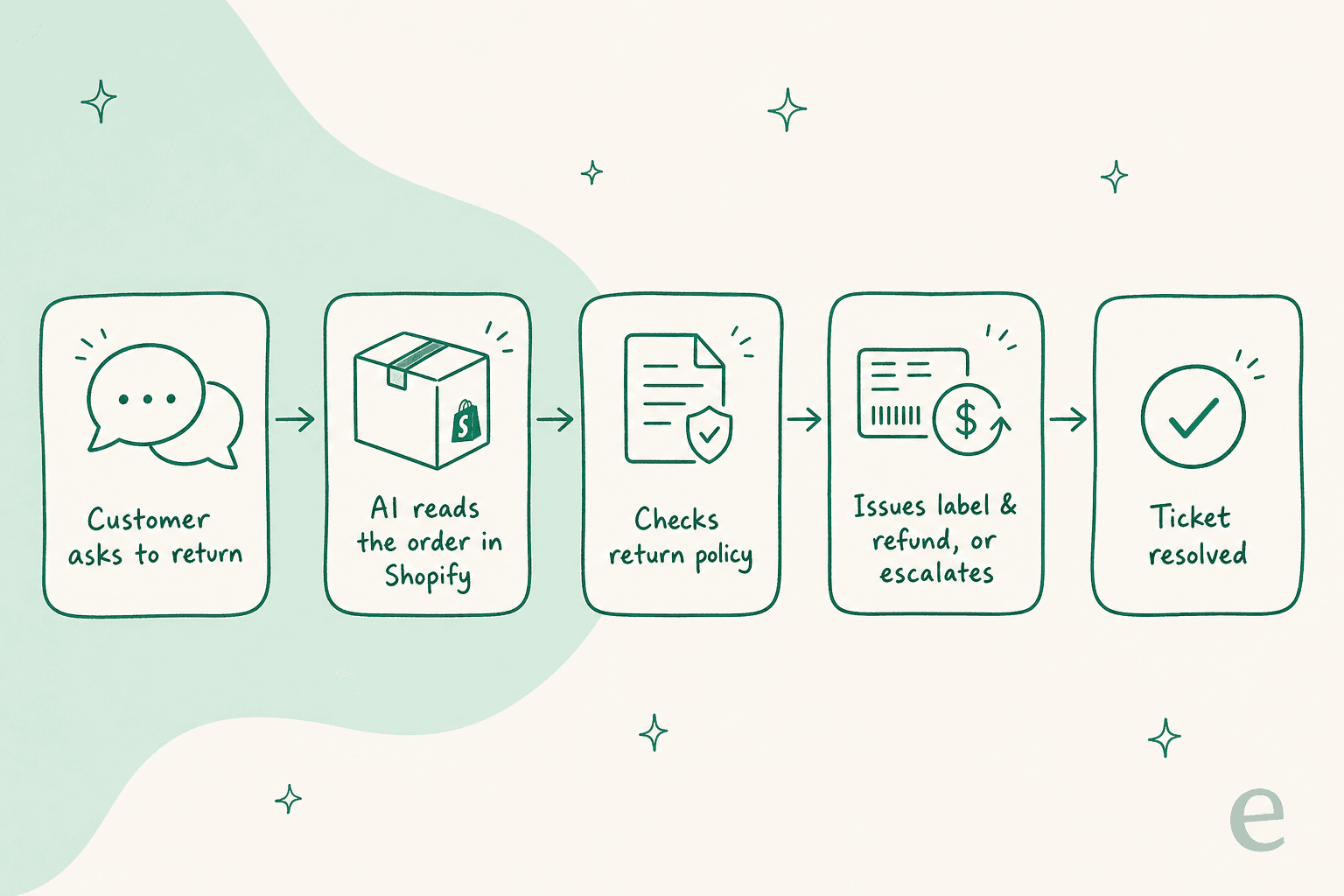
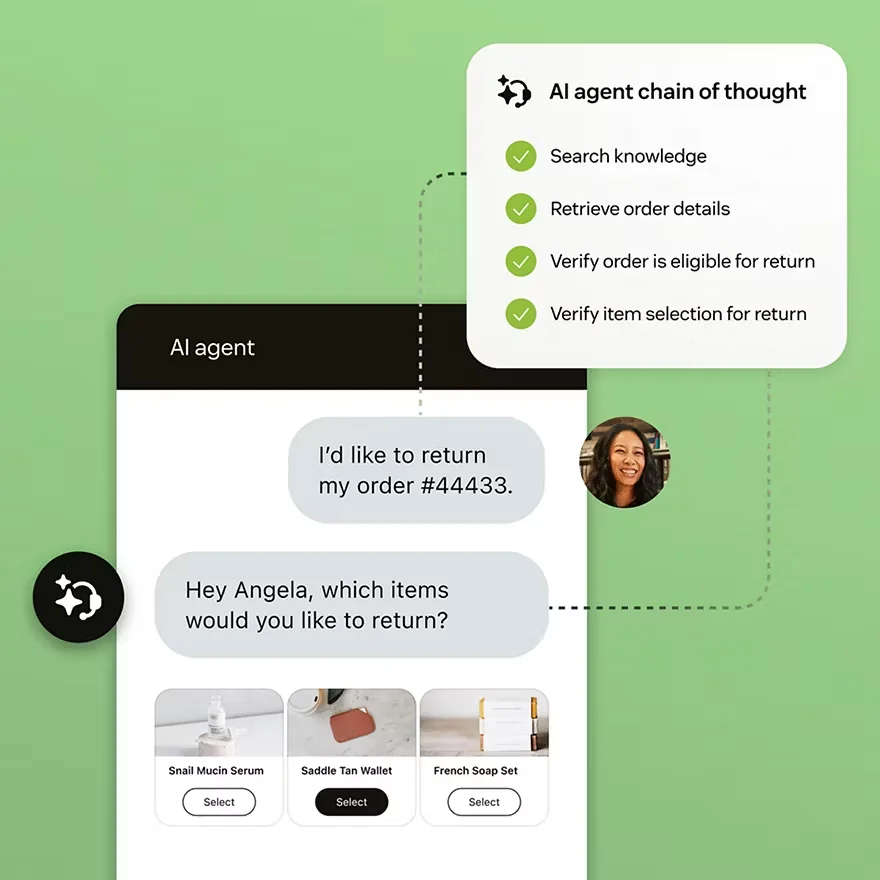
That loop above is the one every support AI on this list is trying to close end-to-end. The tools that only make it three steps in (read, check, then hand to a human) are still useful; they just save less.
The best AI for returns at a glance
| # | Tool | Best for | Category | Billable unit | Starting price | Shopify | Free trial |
|---|---|---|---|---|---|---|---|
| 1 | eesel AI | AI on your existing helpdesk | Support AI | Credits (1 per ticket or chat) | From $299/mo (500 credits), no seats | Yes | 100 free credits |
| 2 | Gorgias | Shopify brands wanting chat + returns in one | Support AI | Per automated interaction | $40/mo (incl. AI) | Native | Yes |
| 3 | Richpanel | AI-native helpdesk with a savings guarantee | Support AI | Fixed + AI included | Custom (fixed) | Native | Yes |
| 4 | Yuma AI | Bolting deep AI onto Gorgias/Zendesk | Support AI | Per resolution (quote) | Quote only | Native | 30 days |
| 5 | Zendesk AI | Larger, omnichannel teams already on Zendesk | Support AI | Per seat + per resolution | $19/agent/mo | Add-on | 14 days |
| 6 | Loop Returns | Shopify-native returns logistics + exchanges | Returns platform | Per return (quote) | Free / $155/mo | Native | Demo-led |
| 7 | ReturnGO | Exchange-first returns across any platform | Returns platform | Per return volume | $147/mo | Yes | 14 days (Shopify) |
| 8 | AfterShip Returns | Budget returns automation + tracking suite | Returns platform | Per return | $16/mo | Certified | Yes |
| 9 | Narvar | Enterprise returns with fraud prevention | Returns platform | Quote | Quote only | Ask sales | Demo-led |
| 10 | ReturnLogic | Returns priced per return, no subscription | Returns platform | Per return | $0.25 to $3.90 per return | Native | No |
A quick note on that table: the first five resolve the customer conversation, the last five run the logistics. Read the "billable unit" column carefully, because it's the number that actually determines your bill. More on that in the cost section near the end.
Which returns AI fits you?
Before you scroll all ten, this quick picker points you at the right shortlist. Pick the headache that sounds most like your week.
1. eesel AI
Best for: teams that want AI to resolve return tickets inside the helpdesk they already run, without ripping anything out.
I work at eesel, so take the byline into account, but I'll keep the claims to what the product actually does and cite the rest. eesel AI is a support AI agent that joins your existing helpdesk as a real agent rather than a bolt-on chat widget. On Gorgias, it reads tickets, drafts and sends replies, updates tags and status, and pulls Shopify order data into every reply. On Shopify directly, it reads your catalog, orders, and FAQs to handle returns, exchanges, and order questions on autopilot.

The reason I put it first for the conversation job isn't the resolution rate (though 85%+ tier-1 resolution in the first week on Gorgias is real). It's the simulation mode. Returns are exactly where an over-eager bot causes damage, so being able to replay it against thousands of your past return tickets, see how it would have handled each, find the gaps, and fix them before a customer is on the other end is the single feature I'd refuse to launch returns automation without. It's the difference between hoping and knowing.
Features:
- Joins Zendesk, Freshdesk, Gorgias, Front, and more as an AI agent, so there's no rip-and-replace.
- Reads Shopify, WooCommerce, Magento, BigCommerce, and Recharge order data to action returns and refunds.
- Simulation on past tickets before go-live; gradual rollout so you only route the tickets you trust.
- Confidence-based routing that drafts instead of sending when it's unsure, which is your guard against a bad refund.
- 80+ languages out of the box, learned from your multilingual ticket history.
Pricing: one fixed monthly price, from $299/month for 500 credits (1 credit per ticket or chat), with no per-seat fees and no platform fee. Free until you've used 100 credits. Pay a year upfront and get two months free; SSO and MFA are add-ons from $199/month.
Our take: if you already have a helpdesk and your problem is the flood of return messages, this is where I'd start, because it's the one tool here you can prove out on your own historical returns before trusting it live. It won't run your reverse logistics or cut carrier rates, so pair it with a returns platform if that's your bottleneck too.
2. Gorgias
Best for: Shopify and ecommerce brands that want the AI and the helpdesk in one bill, with the AI taking real order actions.
Gorgias is the ecommerce-native helpdesk, and it claims to power support for 40% of Shopify brands. Its AI Agent works across email, chat, social, and SMS, and the post-purchase side is built exactly for this list: it resolves order tracking, returns, refunds, and subscription edits by taking actions in connected tools, not just replying. Because it pulls live Shopify order and inventory data into the ticket, its return answers are grounded in the actual order.
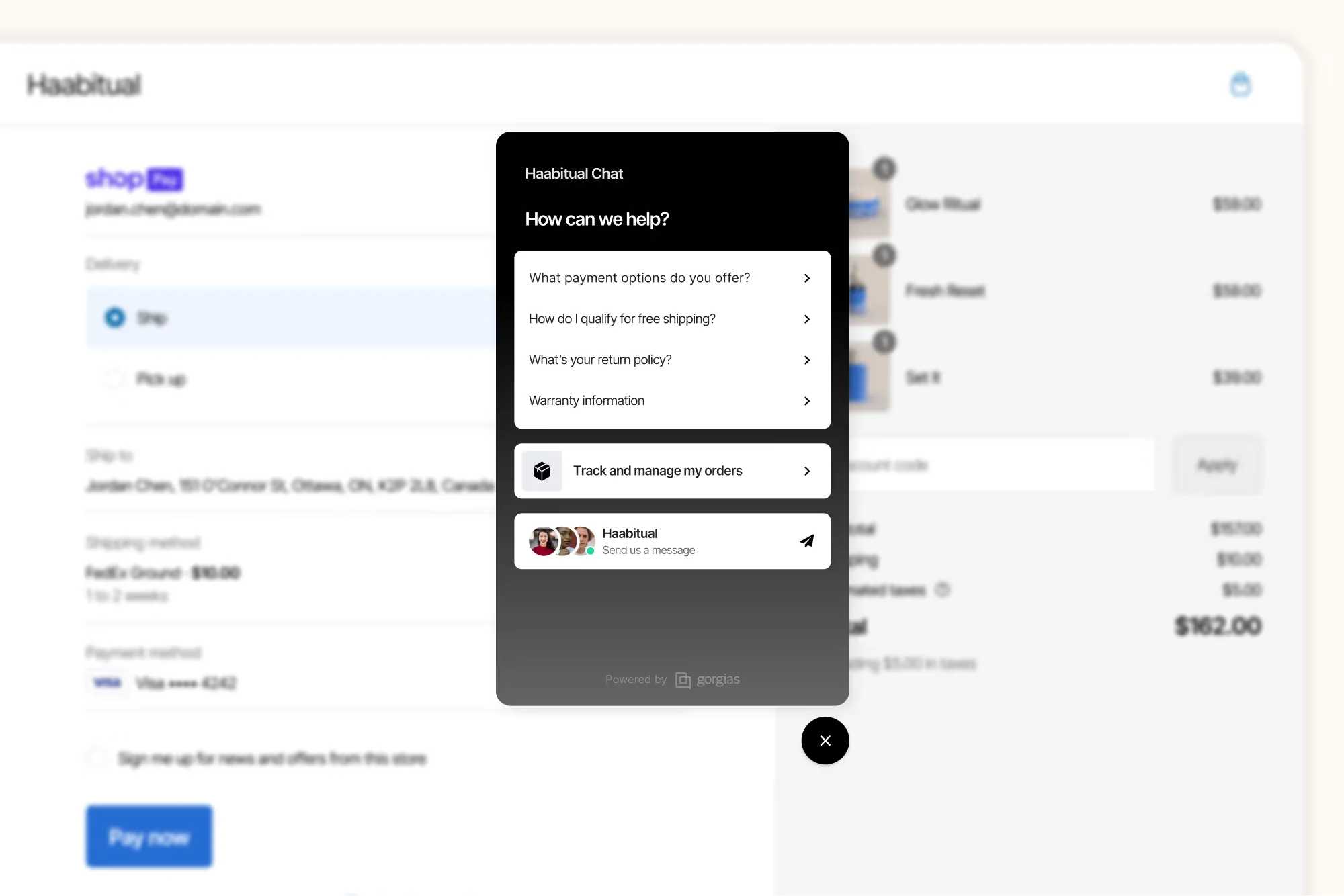
It's genuinely strong, and reviewers agree: Gorgias holds 4.6/5 across roughly 547 G2 reviews. The honest catch is cost as you scale, which the community says plainly.
"Gorgias is awesome if you're super deep into Shopify workflows... The downside is the price adds up quick once your volume grows."

Features: omnichannel inbox with live Shopify data; AI Agent that issues refunds and edits orders; pre- and post-purchase modes; a 254-app integration library on every plan.
Pricing: plans start at $40/mo (Starter) and run to $1,430/mo (Advanced), billed by ticket volume with no per-seat fee. Each plan bundles some automated interactions, and the rate per automated interaction is $1.00 on Starter, $0.90 on Basic and Pro, and $0.85 on Advanced.
Our take: for a Shopify brand that wants chat and returns in a single ecommerce-tuned tool, Gorgias is the obvious pick, and its AI actually acts on orders. Just model the per-interaction math at your real volume before you sign, because that's where the bill grows. If you like Gorgias but want a fixed monthly price, eesel runs inside Gorgias with no per-interaction charges.
3. Richpanel
Best for: brands that want an AI-native helpdesk built around a hard savings guarantee.
Richpanel positions itself as a combined helpdesk and AI agent rather than a helpdesk with AI bolted on, and it leads with a blunt promise: cut tickets by 50% and support costs by 30%, guaranteed. Its central hook is a money-back "Double-Savings Offer", at least 30% automation within the first 30 to 60 days or a full refund, even on an annual contract. For returns specifically, its AI agents take end-to-end actions (refunds, cancellations) and its self-service portal handles order status and returns, with customers reporting 65% self-service resolution.
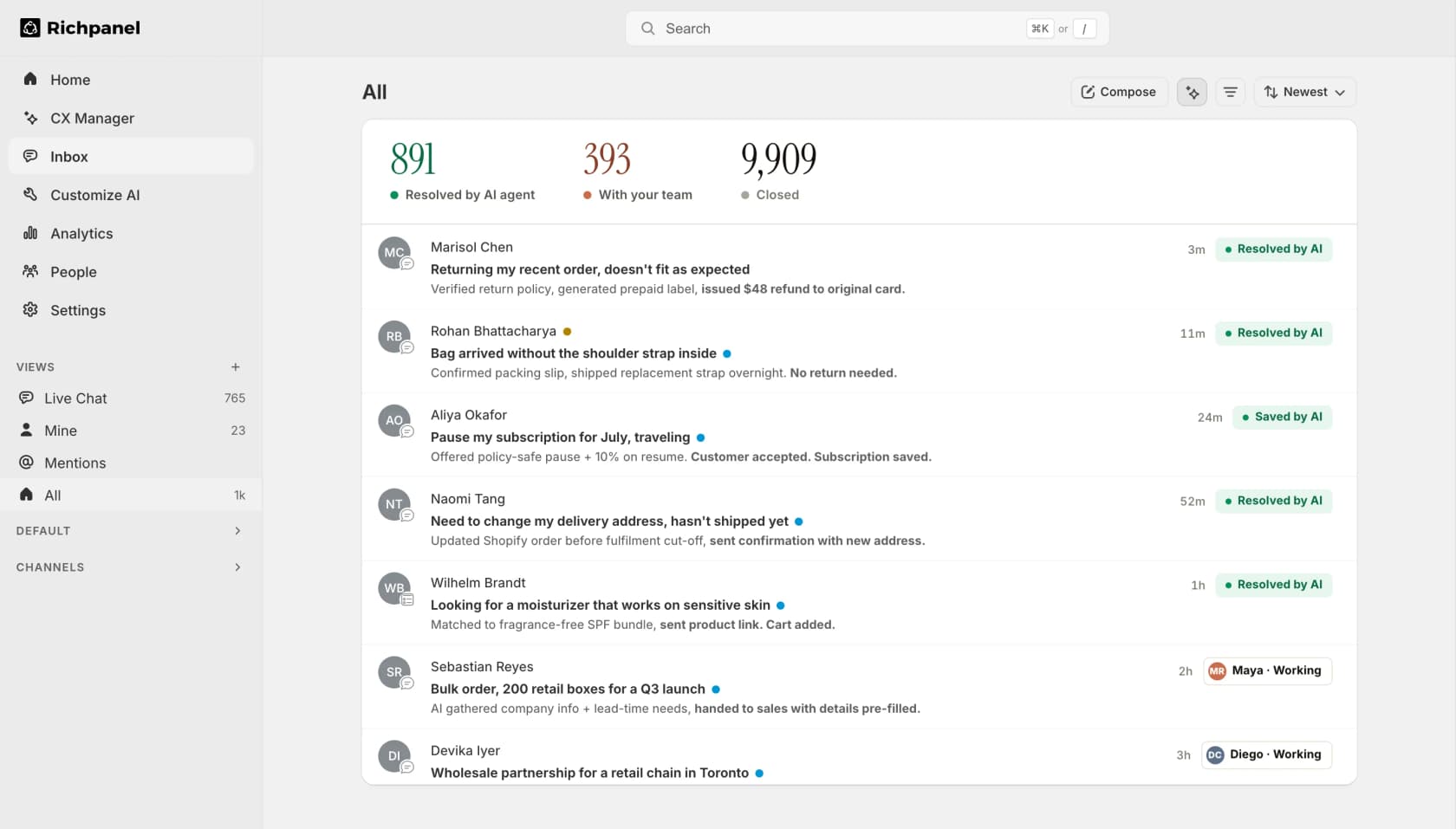
The proof points it publishes are specific, which I appreciate: Ridge saved around $500k on hiring costs, Jones Road lifted its Trustpilot score from 2.2 to 4.0 in 60 days, and Snow cut tickets 40% after moving from Gorgias.
Features: AI agents that resolve rather than deflect; a copilot ramp-up mode that drafts every reply before going autonomous; self-service returns portal; a migration wizard from Zendesk, Gorgias, and Help Scout; revenue-from-support analytics.
Pricing: Richpanel prices as a fixed plan with the AI included (no separate per-resolution add-on billed on top), and points to being "2-3x more cost effective" than bolting a separate AI onto your helpdesk. Exact numbers are quote-based, so get it in writing against your volume.
Our take: the savings guarantee makes Richpanel one of the lower-risk ways to try AI-native support automation, and the fixed-plus-included pricing sidesteps the per-resolution creep that stings on other tools. The trade-off is that, like Gorgias, it's a full helpdesk switch, so it's a bigger commitment than layering AI onto what you have.
4. Yuma AI
Best for: high-volume ecommerce teams that want to bolt deep automation onto Gorgias, Zendesk, or Kustomer.
Yuma AI doesn't replace your helpdesk; it plugs into it as an automation layer, with a purpose-built Support AI for post-purchase work: WISMO, returns, refunds, cancellations, and subscription changes. Its returns loop is properly end-to-end (eligibility check, return type, label via your returns provider, customer instructions, shipment follow-up, refund), and it reads live Shopify data both ways.
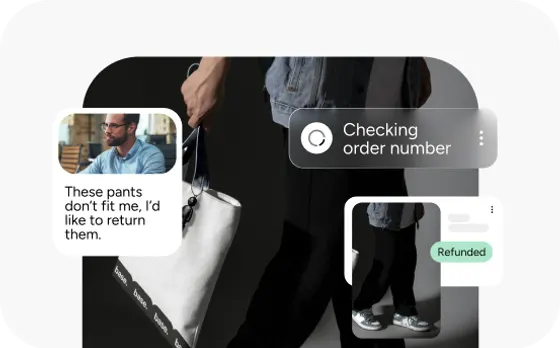
What I like is the safety scaffolding: a gradual rollout from 0% to 100% with human reviews, "Fact Snippets" that insert verified policies verbatim, and "Hard Limits" that cap refund and coupon values. Named results are strong (Petlibro hit 79% automation and skipped three planned hires). It sits at 4.8/5 on G2 across about 16 reviews, though the most-cited complaint is occasional accuracy slips, and the pricing is opaque.
Features: end-to-end returns automation; autonomous or draft mode with a confidence threshold; multimodal (reads images, PDFs, video in-thread for defect claims); native Gorgias, Zendesk, Kustomer, Salesforce, and Recharge integrations; a drag-and-drop workflow builder.
Pricing: quote-gated and performance-based: you pay only for tickets the AI fully resolves, with a 30-day free trial and a 100% ROI guarantee. There's no public per-resolution number, and reviewers note it needs real volume to pencil out.
Our take: for a large Shopify brand on Gorgias or Zendesk that wants the deepest ecommerce automation and doesn't mind a sales call, Yuma is a serious contender. If you'd rather not lock returns to an ecommerce-only, helpdesk-limited layer, or you want to trial without a sales call, eesel is the more flexible alternative and is helpdesk-agnostic.
5. Zendesk AI
Best for: larger, omnichannel support teams already standardized on Zendesk.
If you're already on Zendesk, its AI agents resolve self-service questions across channels and surface knowledge to human agents inside the Agent Workspace. For returns, the AI agent walks the same loop as the others: it reads the order, verifies eligibility, and guides the return. The screenshot below is Zendesk's own demo of exactly that, chain-of-thought and all.
Zendesk is the incumbent for a reason (deep omnichannel coverage, a mature knowledge base, and enterprise controls), and customers like Tesco grew self-service from 30% to 73% over three years. The catch for ecommerce returns is that Zendesk isn't ecommerce-native: the deep Shopify order context that Gorgias has out of the box needs configuration, and pricing stacks per seat and per resolution.
Features: omnichannel AI agents; a knowledge base that feeds both AI and human replies; generative tools that turn past tickets into help-center content; enterprise SSO and admin controls.
Pricing: Suite plans start at $55/agent/mo (Suite Team, billed yearly) with the knowledge base included; the entry Support Team plan is $19/agent/mo but excludes it. AI automated resolutions are billed on top per resolution. A 14-day free trial is available.
Our take: for a big team already living in Zendesk, its AI agents handle returns competently and keep everything in one platform. But for a Shopify-first brand starting fresh, an ecommerce-native tool gets you to good returns handling faster. If you're staying on Zendesk but want fixed-price AI that reads Shopify orders, eesel layers onto Zendesk and I've written up the Zendesk ecommerce returns angle separately.
6. Loop Returns
Best for: Shopify brands that want best-in-class returns logistics with exchange-first, revenue-retention flows.
Now we cross into the other category. Loop is a returns and post-purchase operations platform built Shopify-first, and its whole philosophy is retention over refunds: its flows push shoppers toward exchanges and store credit so brands keep the revenue. This is not a support inbox; it's the machinery behind the return itself.
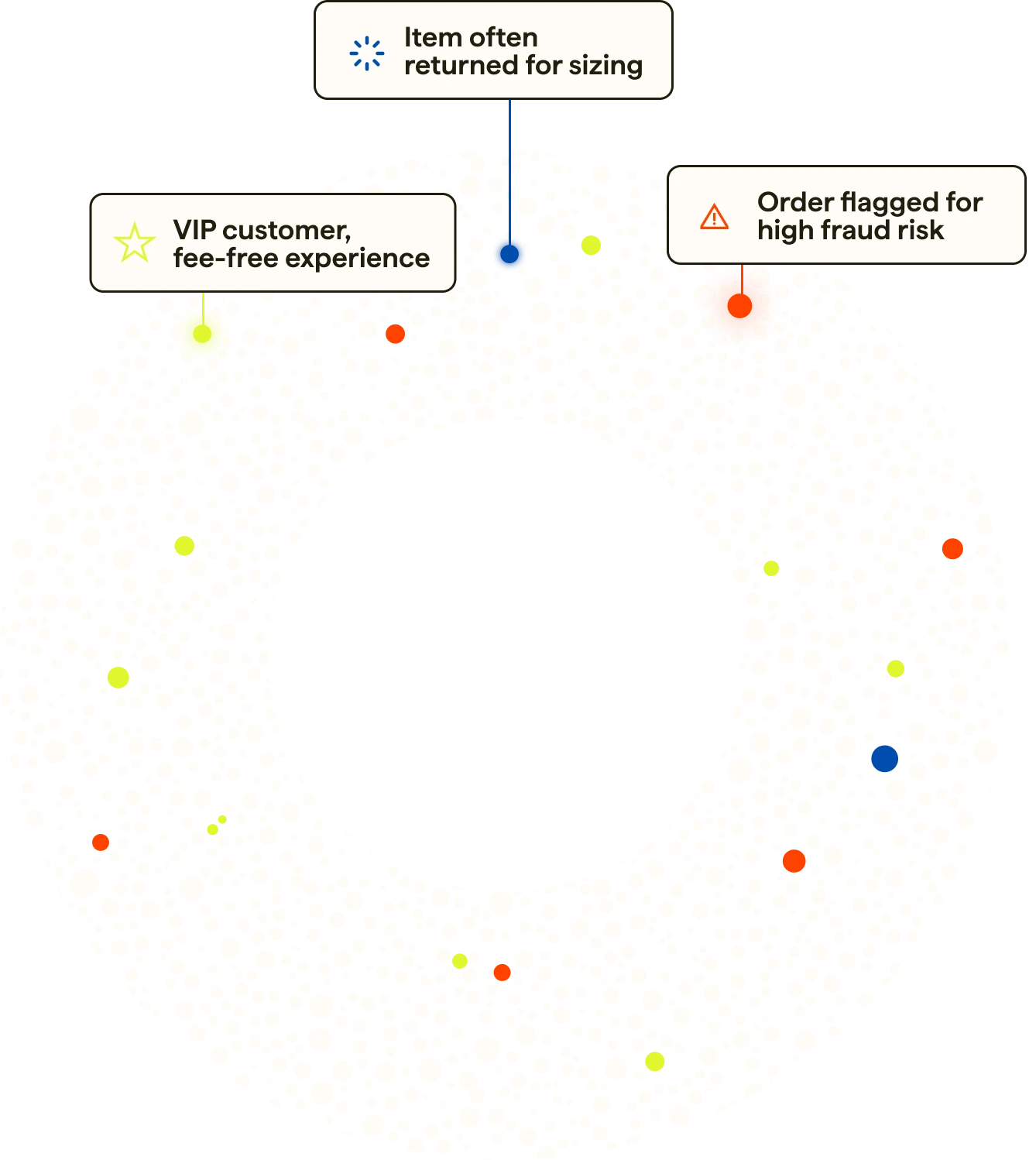
Its AI is Loop Intelligence, a data-network engine trained on 100M+ returns and 200M+ shoppers that predicts outcomes and auto-optimizes policies. Loop cites a 76% reduction in WISMO tickets and 10+ hours saved per CS agent per week. Shopify brands go live in 15 to 45 days out of the box; other platforms are a custom build.
Features: exchange-first return flows, store credit, and gift returns; Shop Now, Instant Exchange, and Bonus Credit upsell tools; a Workflows automation engine; fraud prevention; branded tracking; reverse-logistics label routing.
Pricing: demo-led, with three tiers: a free Checkout+ plan, Essential at $155/mo, and Advanced at $340/mo (which unlocks the revenue-recovery tools). Published prices are floors; real cost is quote-negotiated by volume.
Our take: if your bottleneck is the returns operation (labels, exchanges, keeping revenue in the business), Loop is the category leader for Shopify, and the exchange-first flows genuinely recover money. It won't answer your "where's my refund?" tickets, so run a support AI for the conversations alongside it.
7. ReturnGO
Best for: brands on any platform (not just Shopify) that want exchange-first returns with a flexible rules engine.
ReturnGO is the platform-agnostic answer to Loop: a returns and exchanges platform trusted by 2,700+ brands that's Shopify-first but integrates with Magento, BigCommerce, WooCommerce, Wix, and more. Same retention philosophy (nudge shoppers to exchanges, store credit, and "Shop Now" instead of cash), delivered through a branded self-service portal called Edge. It cites 39% retained revenue and a $1.95 revenue lift per return.
Its automation is a clean Trigger → Condition → Action rules engine (auto-refund, auto-exchange, auto-approve). One honest caveat: ReturnGO's "AI" is narrower than the marketing implies. AI Insights is a beta analytics module gated to Enterprise, and Return Automations is a deterministic rules engine, not a conversational agent. That's fine for logistics, but don't expect it to answer customer messages.
Features: exchange suite (variant, product, any-to-any, instant); smart refund alternatives (store credit, gift cards, bonus credit); warranty portal and order modification; helpdesk integrations with Gorgias, Zendesk, Freshdesk, and Re:amaze; multi-carrier shipping labels.
Pricing: three volume-tiered plans, all routing to "Request a Quote": Premium from $147/mo, Pro from $297/mo, and custom Enterprise for 10,000+ returns/year. Watch the heavy add-on model (packing slips, item validation, instant exchanges, and carrier integrations are extras on lower tiers), so the sticker understates real cost. The 14-day free trial is Shopify-only.
Our take: ReturnGO is the returns platform I'd shortlist if I weren't on Shopify, or if I wanted deeper exchange flexibility across a mixed stack. Price it with the add-ons included, and pair it with a helpdesk AI for the return conversations it doesn't touch.
8. AfterShip Returns
Best for: brands that want affordable returns automation, especially if they already use AfterShip Tracking.
AfterShip Returns is the returns product inside AfterShip's wider post-purchase suite (Tracking, Shipping, Protection), and it's the budget-friendly entry to this category. Same playbook as the others: push exchanges and store credit over refunds, automate policy enforcement, and manage reverse logistics in one portal. It's used by brands like Gymshark and TOMS, and cites 50% revenue retained with exchanges and a 50% cut in processing time.
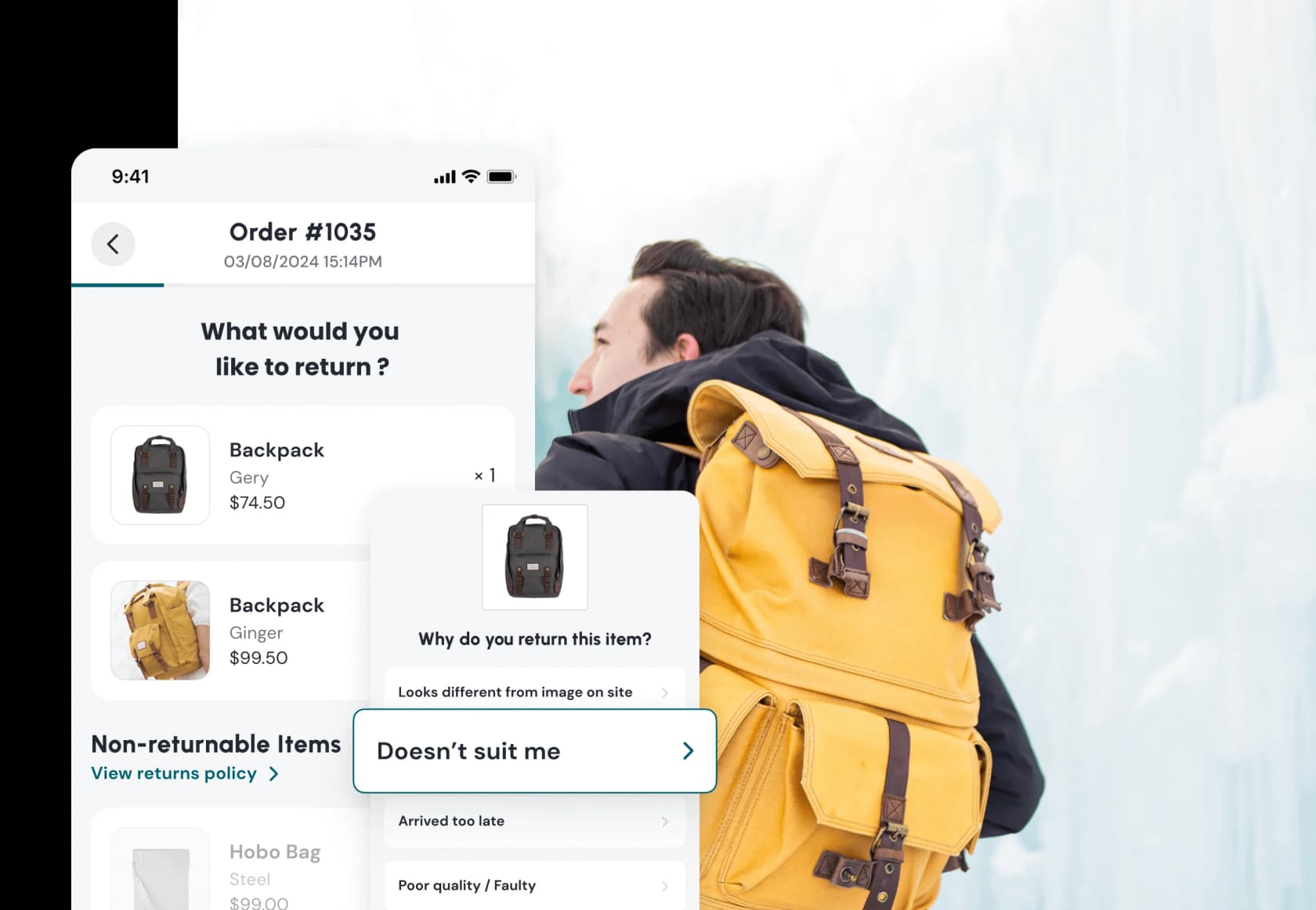
The AI and fraud tooling live on the higher tiers: AI-powered exchanges and Return Fraud Management (wardrobing and empty-box detection, weight-discrepancy checks, auto-blocklists) start on Premium. A neat wrinkle is its Return Care option, where shoppers pay a small opt-in fee at checkout (up to 73% opt in) that funds the Premium plan at $0/mo for the merchant.
Features: rules-based automation by return reason, window, and eligibility; AI-powered exchanges; return fraud management; branded returns portal on your domain; 68-carrier label generation and printerless QR drop-off; green returns and gift returns.
Pricing: genuinely accessible: Essentials from $16/mo (240 returns/year, $0.50 per extra return), Premium from $99/mo (1,200 returns/year, $1.00 per extra), and custom Enterprise. Billed by return volume, monthly or annually.
Our take: for a smaller or cost-conscious brand, AfterShip is the easiest returns platform to justify, and the tracking-plus-returns bundle is convenient if you're already on AfterShip. The AI is more automation-rules than intelligence, so like the others in this group, it handles the parcel, not the customer's message.
9. Narvar
Best for: large retailers that want returns, fraud prevention, and post-purchase AI in one enterprise suite.
Narvar sells post-purchase software to large retailers, and its returns product is Narvar Shield, a returns management platform with fraud prevention built in. The brands on its site include Levi's, Sephora, Lululemon, and Dyson. Shield cites 60% of revenue retained through exchanges and gift cards and 40% savings in reverse logistics.
Its AI is IRIS, a proprietary intelligence layer that Narvar says processes more than 74 billion consumer interactions a year to detect fraud in real time. Shield can block high-risk returns, ask for extra verification, or adjust refund timing based on risk. Narvar has also added an agentic layer with an agent called NAVI that answers tracking questions, offers a size exchange when an item doesn't fit, and approves missing-package claims inside Salesforce, Zendesk, and Microsoft Dynamics. Of the returns platforms here, it reaches furthest into the customer conversation.
Features: branded returns and exchanges with gift cards; IRIS fraud scoring on return history, claims, and payment signals; return eligibility enforcement; reverse-logistics routing with consolidated shipping; the NAVI agent for tracking, exchanges, and claims.
Pricing: Narvar doesn't publish pricing. It's demo-led, so you'll need a demo and a quote.
Our take: Narvar fits a large retailer with high return volume, real fraud exposure, and an enterprise service stack. If you want published pricing you can model up front, Loop, ReturnGO, or AfterShip are easier to price. Its agent covers set post-purchase moments like tracking, exchanges, and claims, so for the open-ended return questions in your inbox you'd still pair it with a support AI for the conversations.
10. ReturnLogic
Best for: Shopify and BigCommerce brands that want returns management priced per return, with no subscription.
ReturnLogic is a returns management platform for ecommerce brands such as Outdoor Research and The Sak. It gives shoppers a white-label returns center, nudges them toward exchanges with bonus credit and free shipping on exchanges, and tracks each item from shipping to warehouse to back in stock. It cites a 30% decrease in returns and $5.00 more profit per return on average across its merchants.
The automation is rules-based: you set automated rules and policies, and it can process the refund or exchange automatically once the return package is in transit. On Shopify, it's a native integration that auto-approves a return or flags it for review, then creates the exchange as a Shopify draft order. It also lists integrations with BigCommerce and helpdesks like Gorgias, Gladly, and Freshworks.
Features: branded returns center; exchange incentives (bonus credit, free shipping on exchanges); automated approval and processing; disposition management and return status tracking; printerless QR returns; warranty and bundled returns; returns analytics.
Pricing: the pricing page lists a usage-based plan with no subscription or platform fee, from $3.90 down to $0.25 per return, plus a custom Enterprise plan. The FAQ on the same page still says ReturnLogic starts at $299/month on a 12-month contract, so confirm which applies when you get a quote. There's no free trial.
Our take: ReturnLogic suits a brand that wants returns cost to track return volume rather than a monthly tier. Like the other platforms in this group, its automation runs on rules you set and handles the parcel, so pair it with a support AI for the return conversations.
What it actually costs
Here's the trap I watch brands walk into: comparing sticker prices across these ten when they're not measuring the same thing. The billable unit is different in each category, and that's what decides your bill.
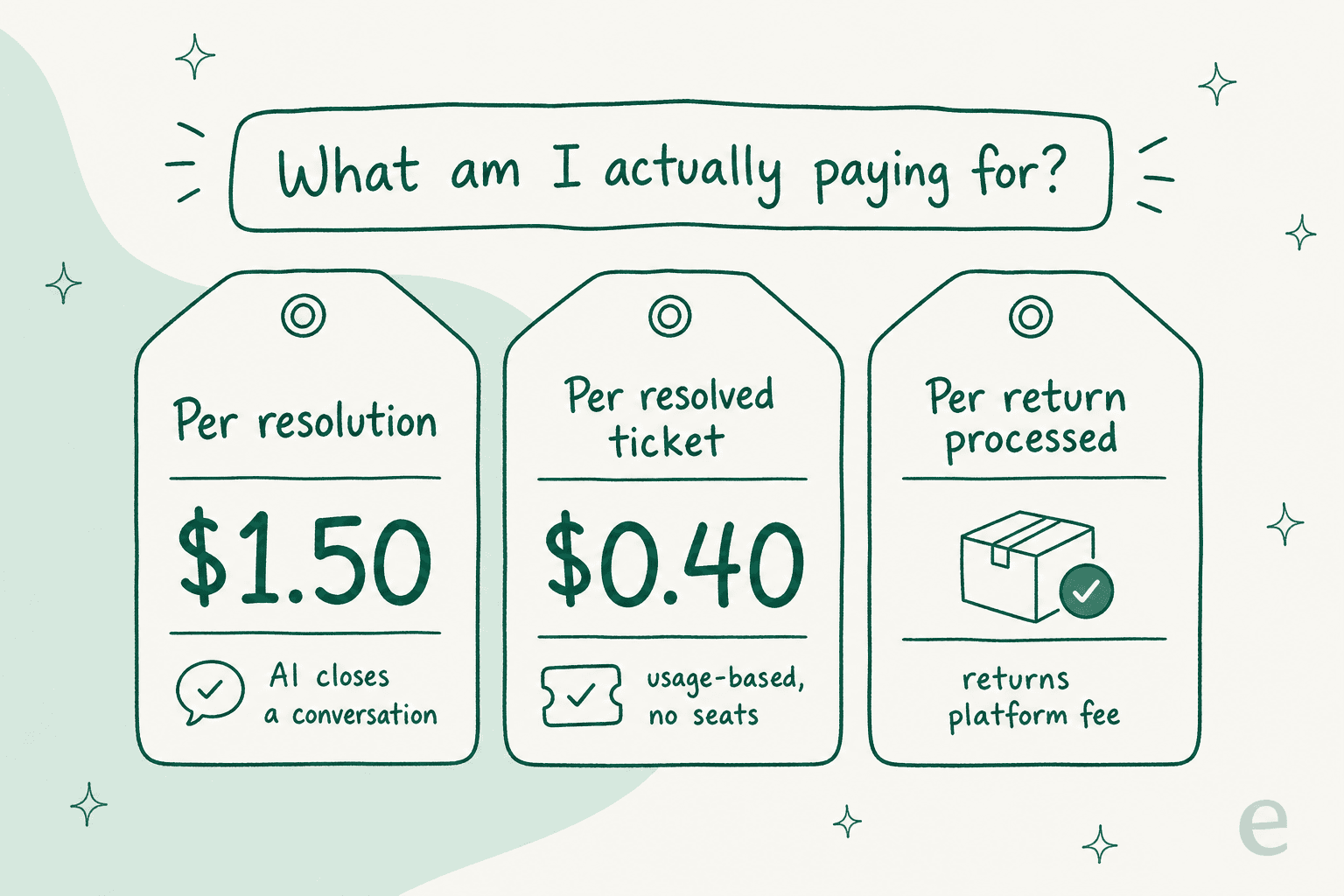
A worked example. Say you get 2,000 return-related tickets a month. On a per-interaction model at $0.90, automating all of them is roughly $1,800/mo in AI charges (on top of the helpdesk base). On eesel's 2,500-credit plan, the same 2,000 is $999/mo, with no seat fees layered on. A returns platform isn't even billing the same event; it charges per return processed (the label and RMA), so it sits next to, not instead of, your support AI cost.
The takeaway isn't "cheapest wins." It's that a per-resolution tool and a per-ticket tool can quote similar-looking numbers and land nearly 2x apart once your volume is real. Run your actual monthly return volume through each model before you decide, and read my full guide to reducing ticket volume with AI for the levers that move that number down.
Try eesel for return tickets
If the half of the returns problem hurting you is the ticket flood (the "where's my refund?", "can I exchange the size?", "my order arrived damaged" messages), that's the exact job eesel AI is built for. It joins the helpdesk you already run, reads your Shopify, WooCommerce, or Magento order data, and resolves the return conversation end-to-end, drafting when it's unsure and escalating the edge cases cleanly.
The part I'd actually pitch you on, having watched confident bots go wrong on returns, is that you can simulate it on your own past return tickets first, see exactly how it would have handled each one, and only then flip it live on the tickets you trust. It's free to try with 100 credits, with no per-seat fees and no rip-and-replace. Point it at Shopify, Gorgias, or Zendesk and let it take the returns tickets your team dreads off their plate.