Salesforce Agentforce pricing: the real 2026 cost

Kurnia Kharisma

Katelin Teen
Last edited July 14, 2026
How much does Agentforce cost?
Let's answer the search first, then unpack it. As of 2026, Salesforce Agentforce pricing comes in a few flavours you can mix depending on the use case:
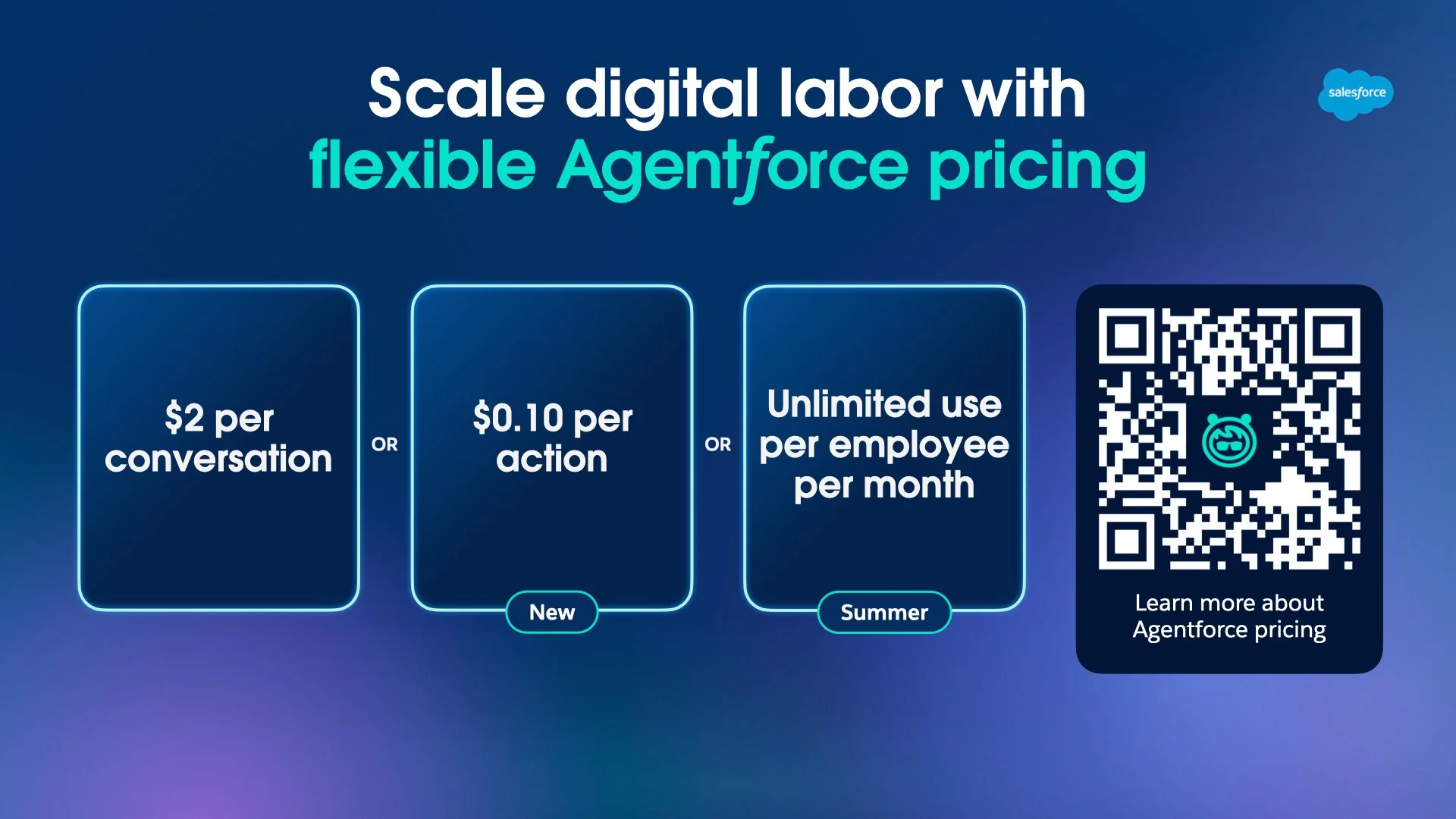
- Salesforce Foundations is the free on-ramp at $0. You get the Agent Builder, Prompt Builder, Agent Script, and the Coworker and Vibes tools, so you can build and test before you pay a cent.
- Conversations bill a flat $2 per conversation, the model Agentforce launched with in 2024.
- Flex Credits bill $0.10 per action ($500 per 100,000 credits), the newer usage model Salesforce now pushes as the default.
- Agentforce User License adds employee access at $5 per user per month, but it still draws down Flex Credits on top.
- Flat-fee add-ons give unmetered use at $125 per user per month (Sales, Service, Field Service) or $150 for Industries.
- Agentforce 1 Editions bundle everything from $550 per user per month with 2.5M Flex Credits per org per year.
That is a lot of doors into the same product, and picking the wrong one is where budgets go sideways. The rest of this post walks each model, the costs Salesforce doesn't put on the slide, and how to figure out which one actually fits you.
The full Agentforce pricing table
Here is every public Agentforce price in one place (USD, from the live Agentforce pricing page; Salesforce notes prices are subject to change and to "contact a sales representative for detailed pricing information").
| Model | Price (USD) | Billable unit | What you get |
|---|---|---|---|
| Salesforce Foundations | $0 | Free | Agentforce Builder, Prompt Builder, Agent Script, Coworker, Vibes |
| Flex Credits | $500 per 100,000 credits ($0.005/credit; ~$0.10/action) | Per action | Customer + employee agents, Voice, Digital Wallet, Pre-Purchase / Pre-Commit / PayGo |
| Conversations | $2 per conversation | Per conversation | Customer-facing agents; Pre-Purchase only |
| Agentforce User License | $5 user/mo (requires Flex Credits) | Per user/mo + metered | Company-wide employee access, limited CRM objects, metered usage |
| Agentforce add-ons | $125 user/mo | Per user/mo (flat) | Unmetered use across Sales / Service / Field Service |
| Industries add-ons | $150 user/mo | Per user/mo (flat) | Unmetered use + industry-specific AI |
| Agentforce 1 Editions | from $550 user/mo | Per user/mo | Add-on included + 2.5M Flex Credits/org/year |
A few rules that live in the fine print and matter more than the headline numbers:
- You can't mix Flex Credits and Conversations in the same org.
- Unused Flex Credits don't roll over into the next term.
- Exceeding your Flex Credit balance has no penalty, but overage is billed monthly in arrears at your contracted rate.
- The $5 user license is not standalone; it needs Flex Credits behind it to actually run anything.
Flex Credits, explained without the mental math
Flex Credits are the model Salesforce is steering everyone toward, so it's worth getting straight. The Salesforce 360 blog lays out the mechanics: each action costs $0.10, and one action equals 20 Flex Credits. Since credits are sold at $500 per 100,000, a single credit is $0.005, and 20 of them make the $0.10 per action. An "action" is any function the agent runs to fetch information or do a task, and credits are fungible across Actions, Prompts, Translations, and Voice.
The important nuance: you are billed per action, not per answer. A one-action FAQ reply is cheap. A multi-step task fans out into several actions, and the meter climbs with it.
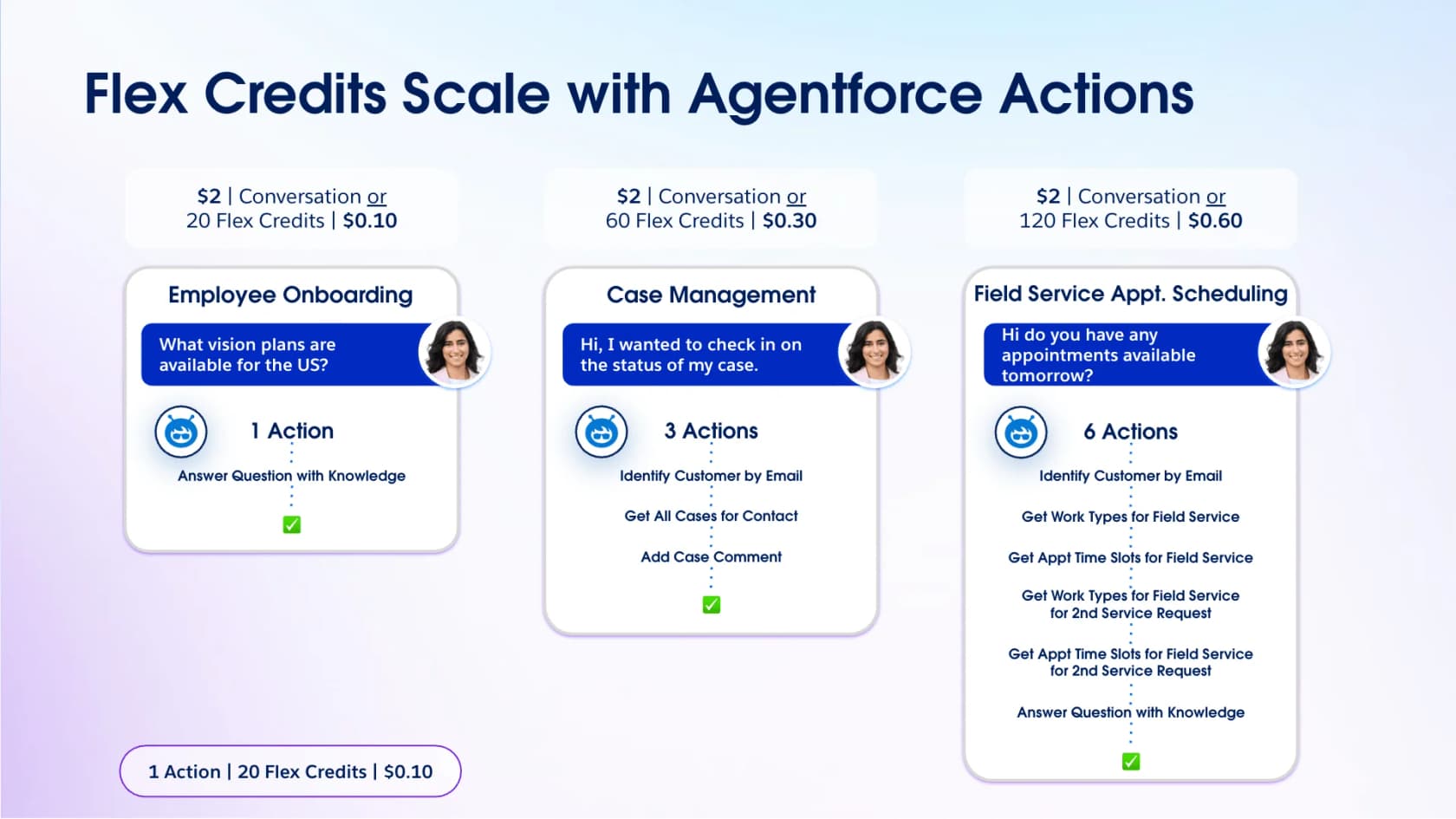
Salesforce's own examples make the range concrete: an employee onboarding question is 1 action ($0.10), a case-status lookup is 3 actions ($0.30), and a field-service scheduling request that identifies the customer, checks work types, and pulls time slots is 6 actions ($0.60). Scale those up and the monthly figures get real fast: the case-handling example lands at $1,800 a month across 100 users.
This is the design goal Salesforce is proud of, and it is genuinely fairer than a flat fee in one sense: simple tasks cost less, complex tasks cost more, so you pay closer to the value delivered. The trade-off is that "how many actions will a real ticket take?" is a question most buyers can't answer before they've run it for a month, which is exactly where the forecasting pain starts.
Conversations vs Flex Credits: which model, when
Both consumption models are still on the menu, and they suit different jobs.
The old $2 per conversation model is flat: whether the customer asks your store hours or triggers a gnarly multi-system troubleshoot, it's $2 either way. Salesforce's own analogy is that this is like paying a flat rate no matter the job. It's simplest for a single, external-facing, high-volume chatbot where every conversation is roughly the same shape, and it's Pre-Purchase only.
Flex Credits win when you're running multiple use cases with wildly different complexity, or lots of cheap one-action interactions where $2 each would be overkill. Salesforce's SDR example makes the point: an exchange that would cost $2 as a conversation "could be executed in 3-6 actions at a cost of $0.30-$0.60" on Flex Credits.
The rub: because you can't run both in one org, this is a real commitment, not a toggle. Switch from Conversations to Flex Credits later and you have to swap out every existing Agentforce Conversation SKU. Pick deliberately.
The costs nobody puts on the slide
Here's the part that trips up budgets. The $0.10 and $2 figures are the tip of the iceberg, not the bill.
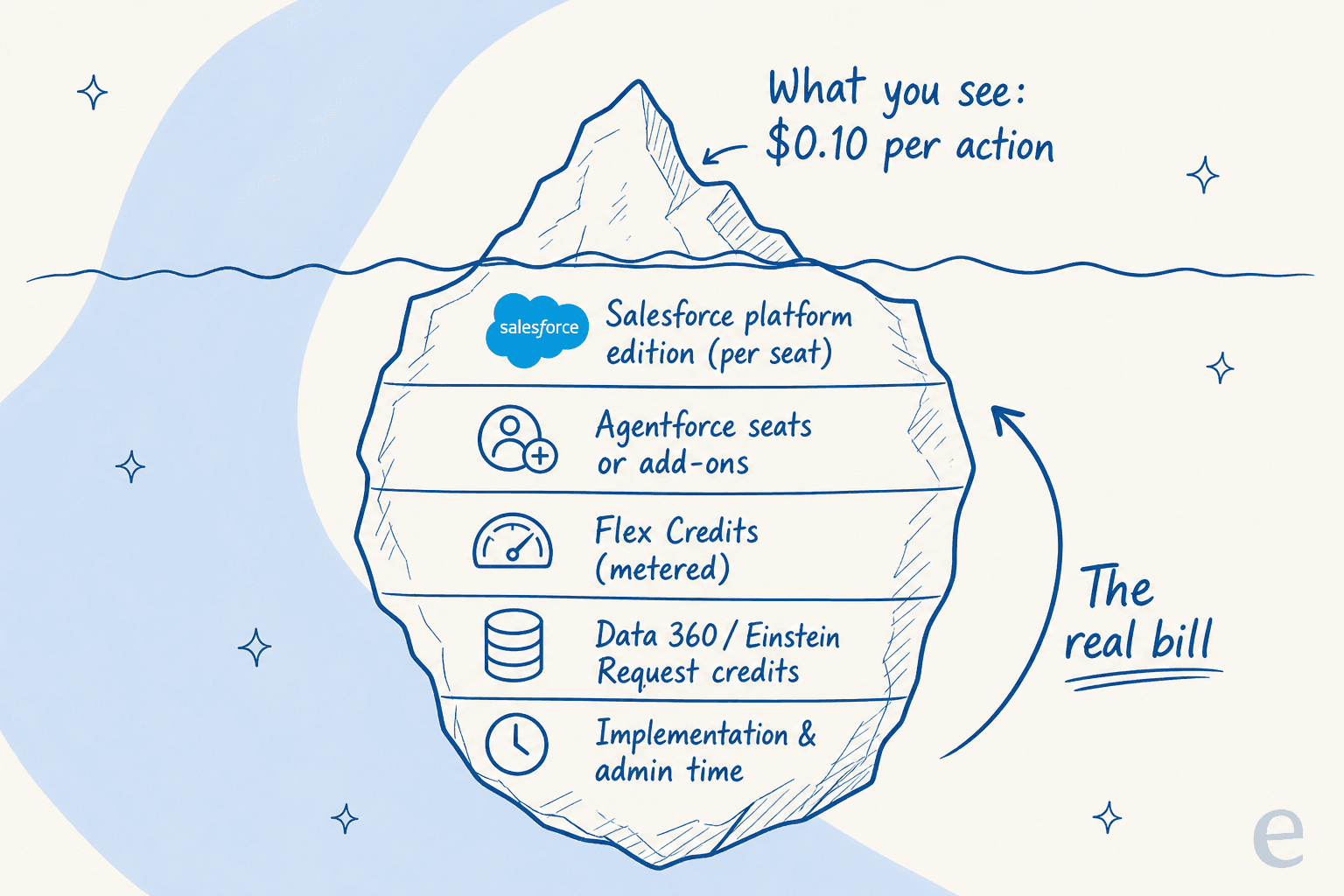
Underneath the metered charge sits a stack of costs the pricing page doesn't foreground:
- Einstein Requests and Data 360 credits. As one r/salesforce admin spelled out, "Agentforce also consumes Einstein Requests anytime LLM is called. Note it will also consume data service credits depending on usage." Salesforce's worked examples even carry a disclaimer that they "do not include other costs like Data 360 credits or other consumption services."
- The underlying Salesforce edition. Agentforce rides on top of your CRM. The per-seat platform licensing (Enterprise, Unlimited, or an Agentforce 1 Edition) is a separate line before you touch a single agent action.
- Implementation and admin. Building, grounding, and governing agents in Agent Builder is real work, and the broader Salesforce line's number-one complaint on G2 (4.4/5) is cost and configuration effort.
- Wasted spend on loops and errors. Because you're metered per action, an agent that loops or misfires still bills. One G2 reviewer put it bluntly: "Due to the pricing per dialogue, any loops or logic failures quickly 'eat up' the budget."
None of this makes Agentforce a bad product. But it does explain why the single most repeated line in the community is that the real number is genuinely hard to pin down before you're already spending.
"Not even Salesforce can tell you how much Agentforce will cost. They are too busy marketing and selling it to worry about a pesky detail like how much it will cost their customers to buy, implement, and use."

What Agentforce actually costs: run your own numbers
Rather than trust an abstract estimate, plug in your own volume. This calculator compares the Flex Credits and Conversations models side by side, using Salesforce's real $0.10-per-action and $2-per-conversation rates.
Two things usually jump out when people play with this. First, Flex Credits only stays cheaper than $2 while interactions are simple; the break-even is 20 actions, and real support tasks climb toward it faster than you'd think. Second, neither number includes the credits, seats, and setup from the section above, so treat whatever it shows as a floor, not a quote.
Which Agentforce pricing model fits you?
Stepping back from the math, here's the quick read on who each model is actually for.
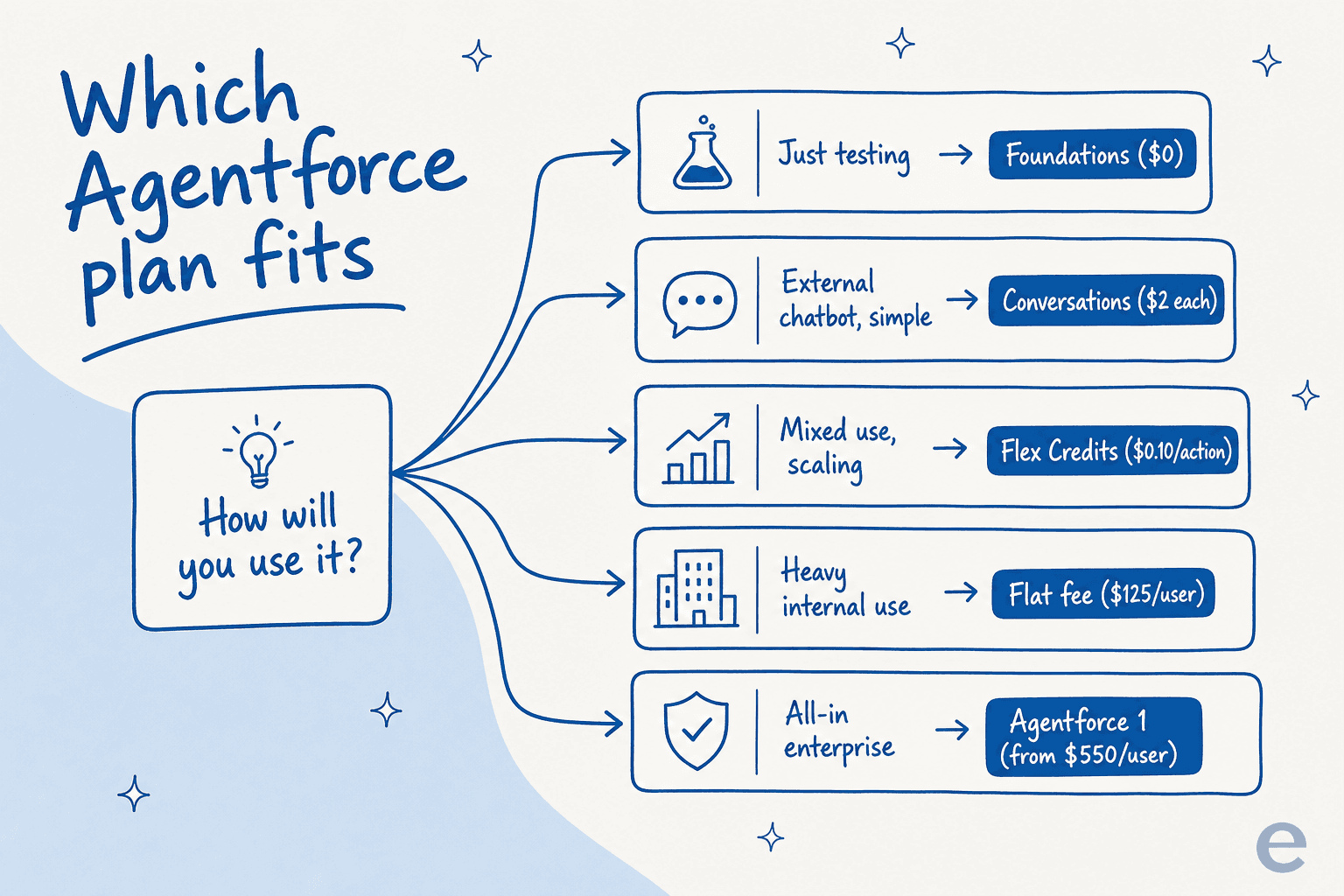
- Just kicking the tires? Start on Foundations ($0) and build in Agent Builder before you commit budget.
- One simple, high-volume external chatbot? Conversations ($2 each) is predictable if every chat is the same shape.
- Mixed use cases, still scaling? Flex Credits ($0.10/action) aligns spend to complexity, if you can stomach forecasting it.
- Heavy, everyday internal use? The $125/user flat fee removes the metering anxiety for known, high-usage teams.
- All-in on Salesforce as your agent platform? Agentforce 1 Editions (from $550/user) bundle the add-on plus 2.5M credits a year.
What people actually say about the price
The product reviews are broadly positive on capability. The pricing is where the tone shifts, and it's remarkably consistent across r/salesforce and G2.
"I was looking at agentforce recently and also read those costs and thought for any org this could rapidly become hellishly expensive... Its going to be potentially a big spend and big risk."
"The pricing structure can be confusing, especially when estimating costs for agent interactions at scale."

"Pricing is where organizations need to evaluate carefully... My present company has taken Agentforce but my previous company which was smaller did not buy an Agentforce licenses because of the high cost involved."
The through-line isn't "it's overpriced," it's "we can't tell what it'll cost." For a team that just wants tickets handled without a spreadsheet full of credit assumptions, that uncertainty is the actual dealbreaker.
Try eesel AI for predictable AI support
I've spent the last few years watching teams roll AI onto live support queues, and the single most common thing that stalls a rollout isn't accuracy, it's a bill nobody can forecast. Credits you have to size in advance, meters that tick on every internal action, follow-ups that cost extra: that's the anxiety we deliberately designed out of eesel AI.
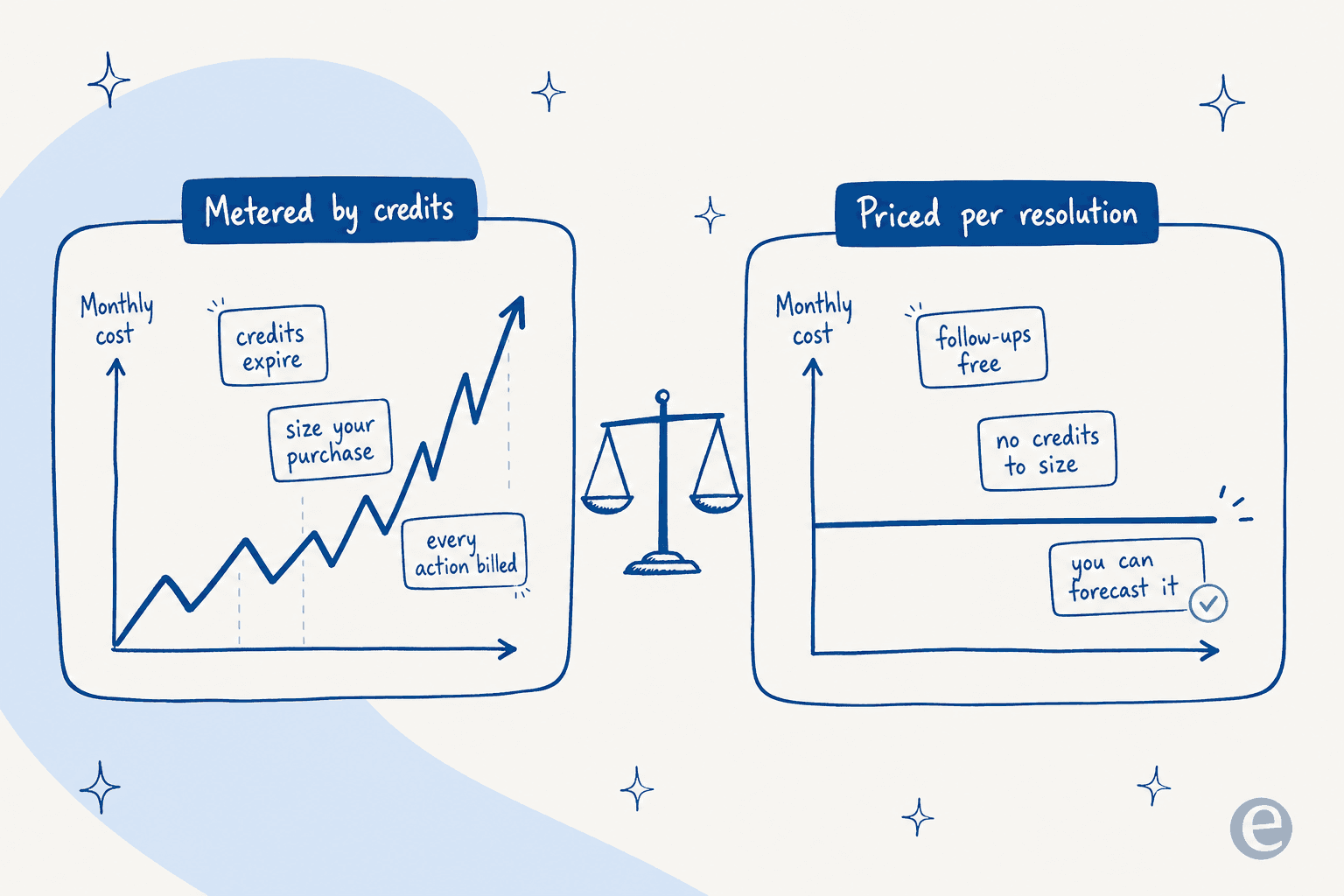
eesel prices per resolution, in a unit you already think in, with no seat fees and no charge for the agent's follow-up actions within a ticket. You connect your helpdesk (including Salesforce), it trains on your past tickets, and you can simulate the whole thing on your real ticket history before it ever answers a customer, so you see the resolution rate and the cost before you commit. No credits to size, no "join the research project" leap of faith.

If Agentforce's power is appealing but its pricing model makes your finance team nervous, that predictability is the whole point. You can see the pricing up front and try eesel free.