7 best Claude Tag alternatives for team AI in 2026

Riellvriany Indriawan

Katelin Teen
Last edited July 17, 2026
Why people look past Claude Tag
First, credit where it's due. When Anthropic shipped Claude Tag in June 2026, Andrej Karpathy called it the "3rd major redesign of LLM UIUX," and Anthropic says 65% of its own product team's code now flows through the internal version. As a way to delegate messy, multi-step work to an AI that lives where your team already talks, it's a real step forward.
I've spent the last three-plus years putting AI agents on live support queues, and the thing I've learned the hard way is that "smart general assistant" and "reliable support agent" are different jobs. A support team doesn't need something that can also draft a PR. It needs something that reads a customer's angry message about a double charge, checks the order, drafts the right reply in the customer's tone, and either sends it or escalates when it isn't sure. That's a narrow, high-stakes job, and it's where the generalist framing starts to strain.
Here's what actually pushes support and ops teams to look for a Claude Tag alternative:
- It's Enterprise and Team only. Claude Tag is in beta for Claude Enterprise and Team plans. If your team isn't already on one of those, you can't use it, full stop.
- The pricing is a question mark. Anthropic hasn't published a per-seat or per-token rate. It's "token-based spending with administrative controls." VentureBeat flagged the cost profile as a real buyer risk, and on Hacker News the "token guzzler" worry was the top reaction.
"The concern is it parsing all messages across N channels plus ambient monitoring is going to consume a lot of tokens."
- It's a generalist, not a support agent. There's no simulation against your historical tickets, no deflection or CSAT reporting, no confidence-based routing built for support. It answers in a thread; it doesn't run your Zendesk queue.
- It replaced the old Claude in Slack app. Claude Tag replaces the previous Claude in Slack integration, with a 30-day opt-in migration window, so even happy Claude-in-Slack users are being nudged onto a new billing model.
None of that makes Claude Tag bad. It makes it the wrong tool if your goal is resolving support at a predictable cost. So let's look at the tools that are.
How I picked and compared these
I weighted four things a support or ops buyer actually cares about: does it resolve tickets (not just chat), can it work where your team already is (Slack, your helpdesk, or both), is the pricing something you can read on a page, and how fast can you get value without a six-month rollout. Every price below is from the vendor's own page or verifiable procurement data, and I've linked the source on each.
| Tool | Best for | AI pricing model | Starting price | Self-serve | Works in Slack | Helpdesk-native | Deployment speed |
|---|---|---|---|---|---|---|---|
| eesel | Support teams wanting AI in Slack + helpdesk | Fixed monthly, credits | From $299/mo (500 credits) | Yes | Yes | Yes | Minutes to days |
| Glean | Enterprise-wide knowledge assistant | Per-seat + credits | Quote only (~$50k+/yr) | No | Yes | No | Weeks+ |
| Moveworks | Large-enterprise IT/HR employee support | Per employee/year | Quote only (~$130k median) | No | Yes | No | Months |
| Ada | High-volume autonomous CX | Per resolution | ~$1.50 / resolution | No | No | Partial | Weeks |
| Agentforce | Salesforce shops | Per conversation / credits | $2 / conversation | Partial | No | Yes (Salesforce) | Weeks+ |
| Freddy AI | SMBs on Freshworks | Per session | $0.49 / session | Yes | No | Yes (Freshworks) | Days |
| Forethought | Outcome-based ticket automation | Platform + outcome | Quote only | No | No | Yes | Weeks |
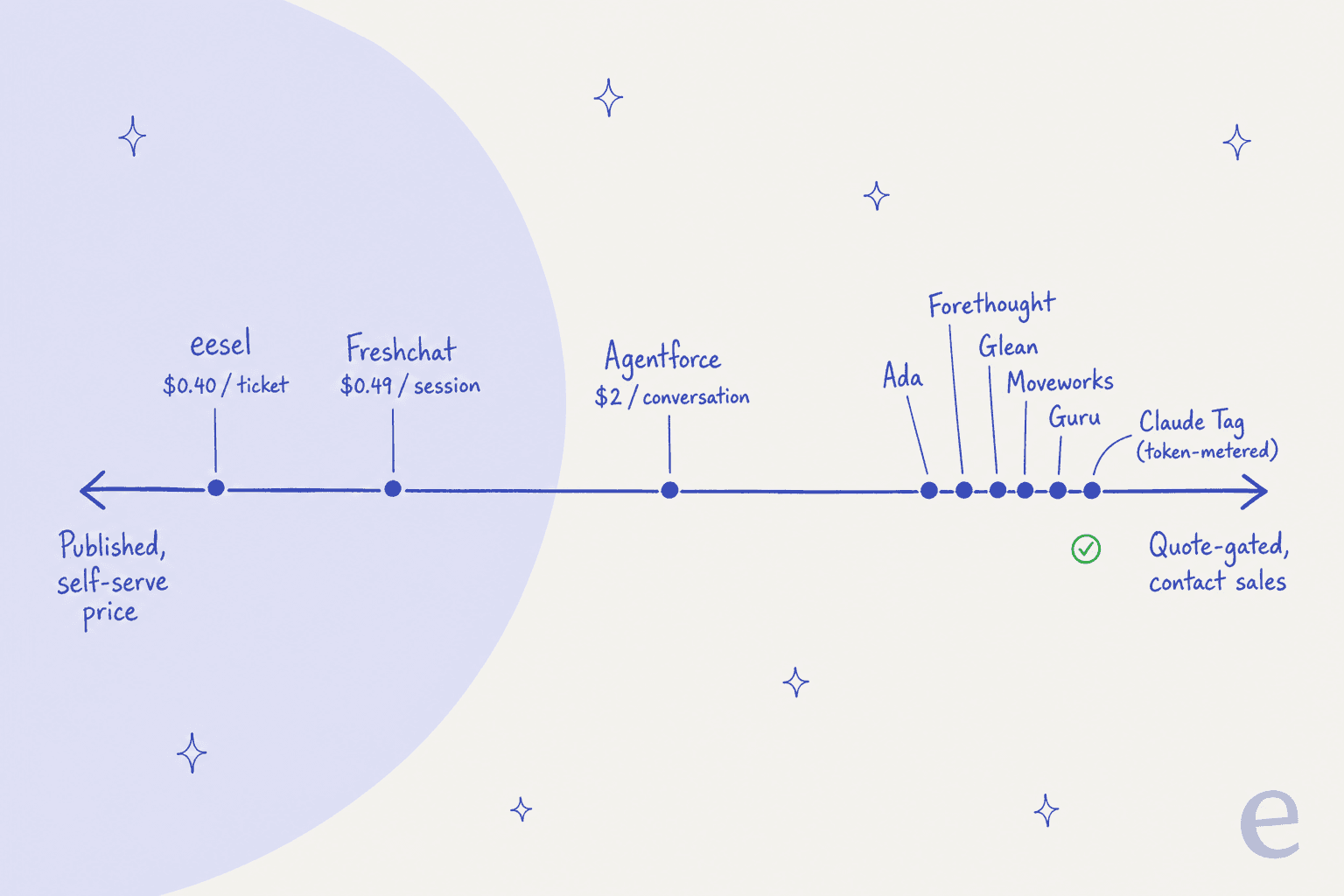
One pattern jumps out before you even read the reviews: which of these you can price yourself, and which force a sales call.
1. eesel AI
Best for: support and ops teams that want AI both inside Slack and inside their helpdesk, without an enterprise contract.
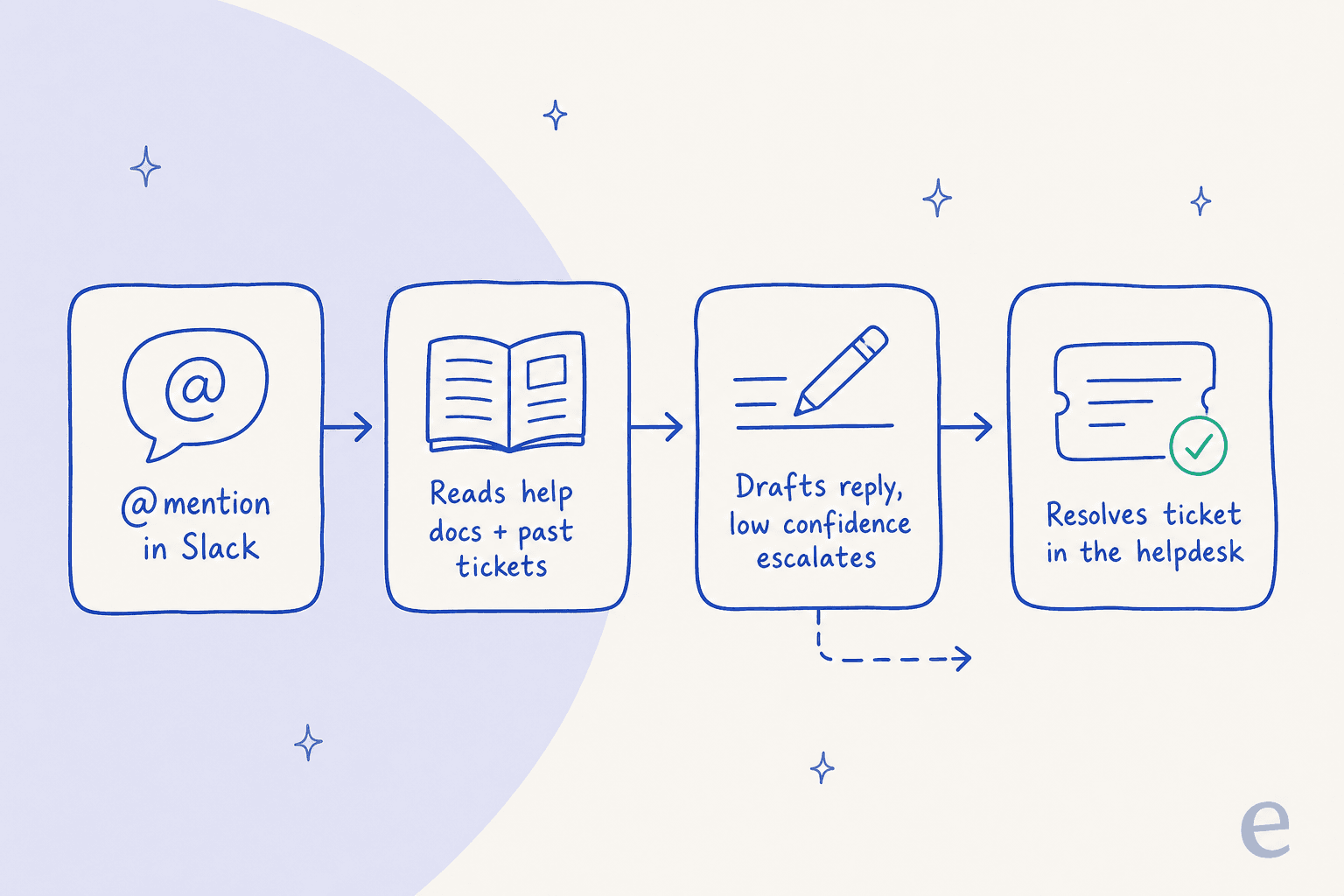
This is the tool I'd reach for first if you're leaving Claude Tag because you actually want tickets resolved. eesel joins Slack as a real AI teammate you @mention in any channel or DM, and it also connects to your helpdesk, so it can draft and resolve tickets in Zendesk, Freshdesk, and others without anyone leaving Slack. That "answers in Slack and closes the ticket in the helpdesk" combination is the exact gap Claude Tag leaves open.
The part that makes it credible for support is the safety loop. eesel learns from your past tickets and help docs on day one, uses confidence thresholds so low-confidence questions become a draft or an escalation instead of a guess, and lets you simulate against historical tickets before it ever touches a live customer. I've watched confident-sounding bots quietly give wrong answers, and simulation-before-go-live is the single feature that stops that from happening in production.
Features: native Slack AI agent, 100+ integrations, 80+ languages, simulation mode, confidence-based routing, automatic knowledge-base article drafting, and theme analysis on your ticket history.
Pros: self-serve and live in minutes; resolves tickets, doesn't just chat; predictable per-ticket price; works for both external support and internal IT/HR questions.
Cons: it's a support and ops specialist, so it won't write your product code the way Claude Tag will. If you wanted the coding teammate, this isn't a like-for-like swap.
Pricing: one fixed monthly price on the Teammate plan, from $299/month for 500 credits (1 credit per ticket or chat), no per-seat fees, no platform fee, with a free plan of 100 credits and no card. SSO and MFA are optional add-ons from $199/month, and HIPAA is available on request.
Verdict: for teams whose real goal was "AI that handles support in the tools we already use," eesel is the most direct upgrade from Claude Tag, because it keeps the Slack habit and adds the ticket resolution Claude Tag was never built for. Gridwise saw eesel resolve 73% of tier-1 requests in the first month, and Smava runs a fully automated agent on 100,000+ German-language tickets a month.
2. Glean
Best for: large organizations that want one permissions-aware AI assistant across every internal app.

If the thing you actually liked about Claude Tag was "one assistant that knows everything the company knows," Glean is the closest true peer. It builds a permissions-enforced knowledge graph from 100+ connectors including Slack, then layers enterprise search, an AI assistant, and a no-code agent builder on top. It's raised a $150M Series F at a $7.2B valuation and passed $100M ARR, so this is a serious platform.
Features: enterprise search, Glean Assistant, agent builder, deep connector library, strict permission enforcement so people only see what they already can.
Pros: genuinely broad; strong at knowledge-base style answers across scattered tools; permissions handled well.
Cons: it's an internal-knowledge assistant, not a customer-support resolver, so it doesn't run your ticket queue. And it's enterprise-only.
Pricing: Glean publishes no prices. It's per-seat plus a metered "FlexCredits" layer, and secondary sources put the real floor around a ~100-seat, ~$50,000+/year commitment. That's a heavy lift to even evaluate.
Verdict: a strong pick if you're a big company that wants an org-wide brain and can absorb a five-figure contract. For a support team that just wants tickets closed, it's more platform than you need.
3. Moveworks
Best for: large enterprises automating internal IT, HR, and finance requests in Slack or Teams.
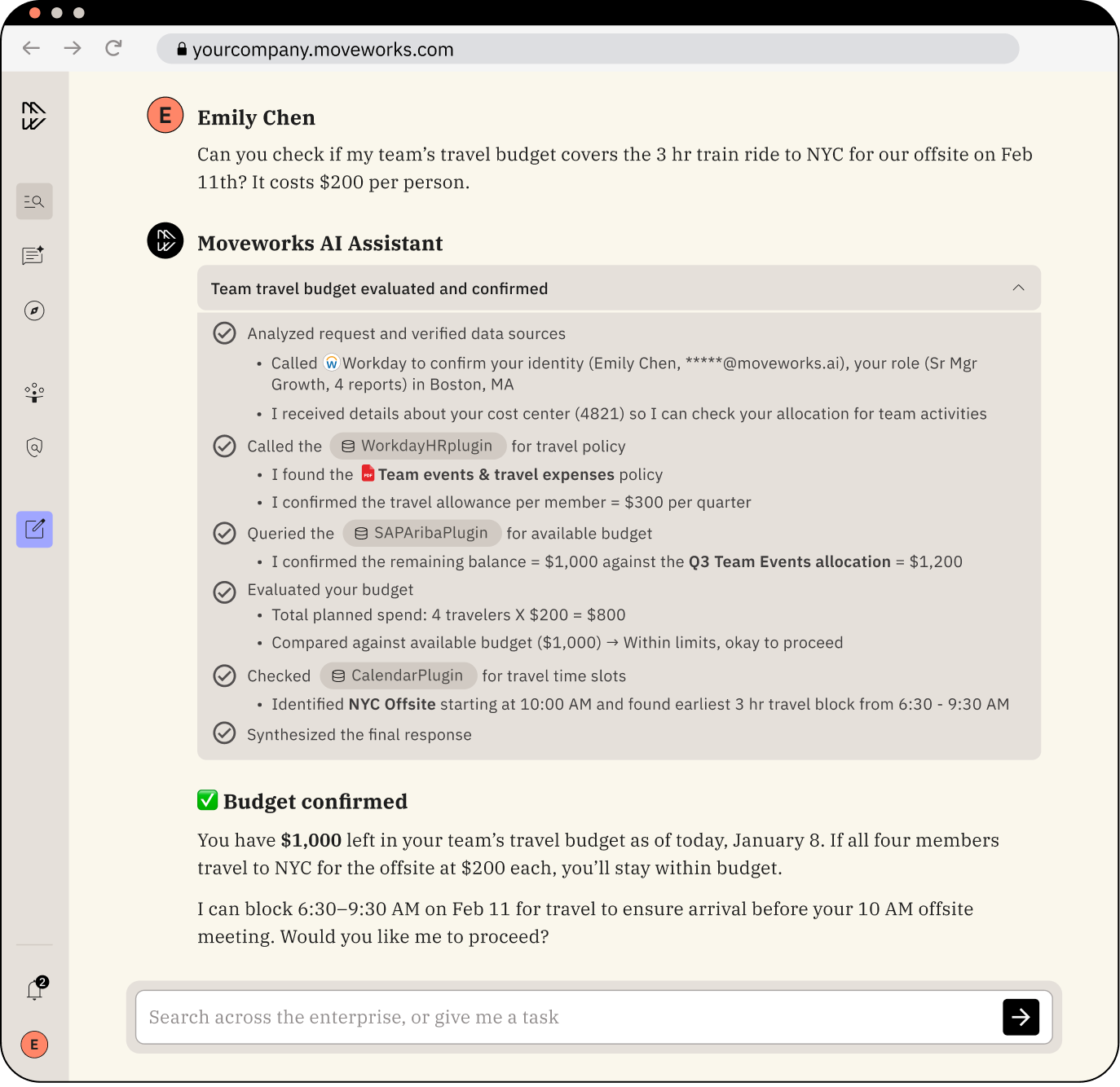
Moveworks is the enterprise employee-support version of the Claude Tag idea: a conversational front door where staff ask natural-language questions and the AI acts across internal systems. It was acquired by ServiceNow for ~$2.85B and now sits inside ServiceNow's agentic portfolio.
Features: agentic reasoning engine, deep IT/HR/finance action library, Slack and Teams front ends, strong analytics.
Pros: proven at scale (Procore reports ~4,000 operator hours saved per quarter); handles genuinely complex employee workflows.
Cons: it's built for employee support, not customer support; long deployment; heavy contract.
Pricing: private and quote-based, billed on total employee headcount. Procurement data via Vendr shows a ~$130,000 median annual contract. If you're weighing it against similar tools, our Aisera vs Moveworks breakdown helps.
Verdict: the right answer for a big enterprise standardizing internal support, especially if you're already a ServiceNow shop. Overkill and over-budget for most customer-facing support teams.
4. Ada
Best for: high-volume consumer brands that want autonomous customer-service resolution across every channel.
Unlike the first three, Ada is squarely a customer-support tool, so it's a more direct functional swap for the "resolve tickets" job. It runs omnichannel across chat, email, voice, WhatsApp, SMS, and more, and its Playbooks feature lets you give the agent step-by-step procedures for complex inquiries.

Features: Conversation Hub (omnichannel + multilingual), Playbooks, Actions, a developer toolkit with APIs and MCP.
Pros: mature autonomous resolution; strong multichannel coverage; good for large CX operations.
Cons: built for scale, and priced for it. Ada's own pricing page says it's "a great fit for companies with at least 300,000 annual customer service conversations."
Pricing: no public list. Consumption-based at roughly $1.50 per resolution (the $1 to $3.50 band resellers quote), with a ~$30,000/year floor and a ~$70,000 median contract. Our Ada CX review and Ada pricing breakdown go deeper, and if you're comparing head-to-head, Ada vs eesel lays out the cost math.
Verdict: a solid choice if you're a large brand with hundreds of thousands of conversations a year. If you're smaller, per-resolution pricing at that floor gets expensive fast, and you'll want a lighter Ada alternative.
5. Salesforce Agentforce
Best for: teams already living inside Salesforce.

Agentforce is Salesforce's agentic AI, grounded in CRM and Data 360 data. If Salesforce is already your system of record, an agent that reads and acts on that data natively is a real advantage, and it powers everything from customer service to employee support.
Features: Atlas reasoning engine, prebuilt Service and Sales agents, no-code builder, deep Salesforce grounding.
Pros: unbeatable if your data already lives in Salesforce; broad action library; a free Foundations starter tier.
Cons: the pricing is a maze, and it only makes sense inside the Salesforce ecosystem.
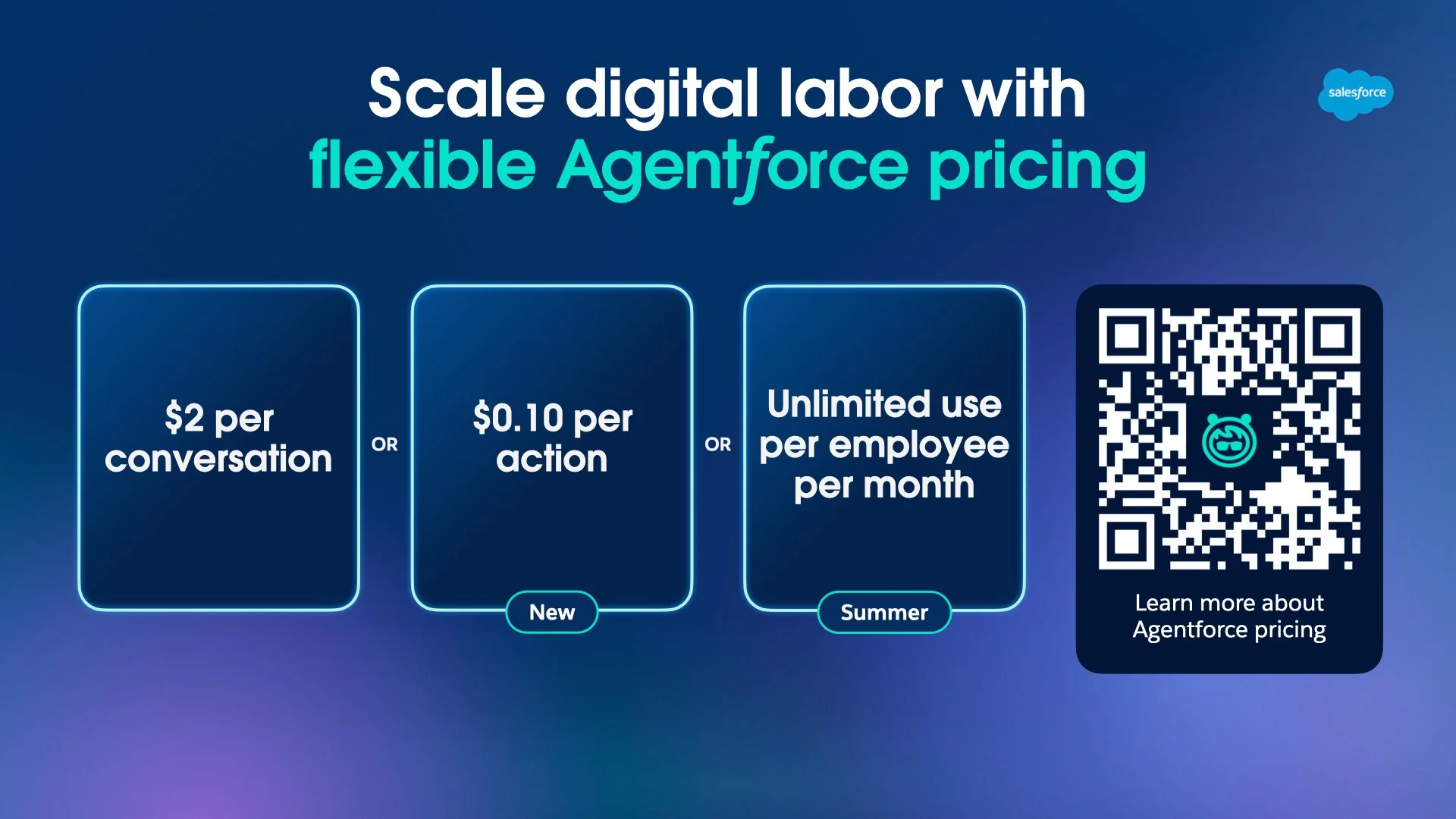
Pricing: three overlapping models: $2 per conversation, or Flex Credits at $0.005/credit (a typical action is 20 credits = $0.10), or a $125/user/month flat add-on. Unused credits don't roll over, and you can't mix conversations and credits in one org. For the full math, see our guide to the best AI for Salesforce Service Cloud.
Verdict: the obvious pick for a Salesforce-first org. For anyone else, the credit accounting alone is a reason to look elsewhere, which is a big part of why eesel keeps it simple: one credit is one ticket or chat, however long it runs.
6. Freddy AI (Freshworks)
Best for: small and mid-size teams on Freshworks that want a published, predictable AI price.
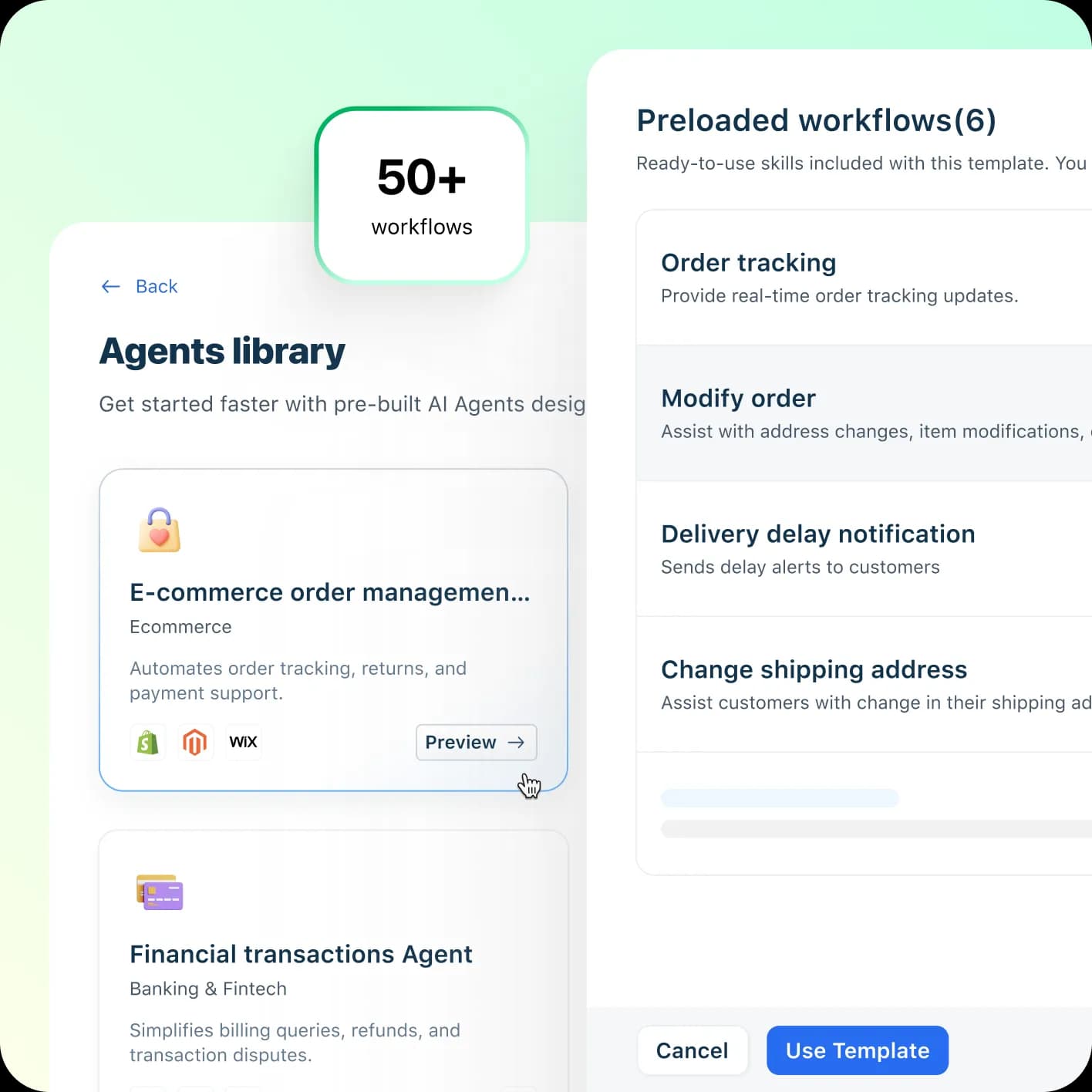
Freddy AI is the autonomous agent inside Freshworks' Freshchat and Freshdesk Omni suite. Freshworks claims it resolves up to 80% of queries, and the big appeal here is honesty about price: unlike almost everything else on this list, Freshworks actually publishes its AI rate.
Features: no-code agent studio, 50+ prebuilt workflows, omnichannel (WhatsApp, Messenger, Instagram, SMS), knowledge-base training.
Pros: transparent per-session pricing; genuinely quick to stand up; fine for SMB volumes.
Cons: you're best off already on Freshworks; the 80% resolution figure is a vendor self-claim, not an independent benchmark.
Pricing: the Freddy AI Agent is $0.49 per session (first 500 free, then $49 per 100 sessions), on top of Freshchat seats starting at $19/agent/month. Our Freddy AI pricing and Freddy AI review posts have the details.
Verdict: a sensible, affordable pick if you're a smaller team already in the Freshworks world. If you're not, buying into a whole suite just for the AI agent is a lot.
7. Forethought
Best for: support teams that want to pay for outcomes rather than seats.
Forethought is a support-native AI platform organized around four jobs it calls Discover, Solve, Triage, and Assist: it surfaces content gaps, resolves tickets, routes them intelligently, and helps human agents. It leans hard on outcome framing, advertising 15x average ROI and up to 98% resolution (both vendor self-reported).
Features: autonomous resolution (Solve), ticket triage, agent assist, and Discover, which analyzes real conversations to draft knowledge-base articles automatically.
Pros: purpose-built for support; the outcome-pricing pitch appeals to teams tired of paying per seat; good analytics.
Cons: no self-serve and no public price; the model is a blend of platform fees and outcome-based charges, with possible overage.
Pricing: quote-only. Every plan shows "Get a Quote," and Forethought describes it as "a blend of platform access fees and an outcome-based pricing cost." See our Forethought review, Forethought pricing guide, and the best Forethought competitor comparison.
Verdict: a legitimate support-AI choice, especially if outcome pricing matches how your finance team thinks. Just budget time for the sales cycle, since you can't try it or see a price without one.
So which Claude Tag alternative should you pick?
The honest answer depends on what you liked about Claude Tag in the first place.
If you loved having a general AI teammate in Slack for engineering and knowledge work, Claude Tag is still probably your tool, or Glean if you want something broader and permissions-aware across the whole company. If you're a giant enterprise automating internal employee questions, Moveworks. If your world is Salesforce, Agentforce.
But if you're reading a post about Claude Tag alternatives because what you actually need is AI that resolves customer support at a price you can predict, then the pattern across this list is clear: pick a tool that was built for support, works where your team already is, and shows you its price. For most teams, that's eesel, and it's why I put it first.
eesel: AI in Slack that closes the ticket

eesel keeps the one thing Claude Tag got right, an AI you can @mention right in Slack, and adds the thing it's missing: it resolves the ticket in your helpdesk, learns from your real ticket history, and lets you simulate the rollout on past conversations before a single customer sees it. No enterprise-only gate, no token guesswork, just one credit per ticket, from $299 a month, that you can read on the pricing page.
It plugs in in minutes and behaves like a new hire that already knows your help center. You can try eesel free, no credit card, and simulate it against your own tickets to see the resolution rate before you commit.
Frequently Asked Questions
What is Claude Tag and why would I need a Claude Tag alternative?
@Claude inside Slack to delegate work. It's excellent for engineering and knowledge tasks, but it's a generalist, it only runs on Claude Enterprise and Team plans, and it's billed on token usage. Teams look for a Claude Tag alternative when they need AI that actually resolves support tickets inside a helpdesk with predictable pricing, like an AI helpdesk agent.How much does Claude Tag cost?
Is there a Claude Tag alternative that works in Slack for customer support?
@mention, and it also drafts and resolves tickets in Zendesk, Freshdesk, and other helpdesks. See eesel for Slack and our roundup of the best AI for Slack support.