AI for chargeback customer inquiries: what it can and can't do

Riellvriany Indriawan

Katelin Teen
Last edited September 22, 2026

What a chargeback actually is (and why it lands on your desk)
I work the support queue, so let me start with the distinction that trips up half of these tickets. A refund is something you hand back to the customer directly. A chargeback is the customer going around you to their bank to reverse the charge.
When that happens, the issuer creates a formal dispute on the card network that immediately reverses the payment and pulls the amount plus a fee out of your balance. And here's the part agents miss: once a dispute is open, you can't issue a refund outside the dispute process. So the well-meaning reply of "no problem, I'll refund you right now" is not just unhelpful, it's impossible until the customer withdraws the dispute. The bank, not you, controls the outcome.
That's why payment disputes are a support problem before they're a finance problem. The customer almost always messages you first, confused or angry, and what your agent types back decides whether it stays a quick fix or becomes a formal chargeback. The three states you'll actually see look like this:
| Refund | Inquiry | Chargeback | |
|---|---|---|---|
| Who starts it | You, for the customer | The bank, pre-dispute | The bank, formally |
| Your money | You choose to return it | Not pulled during review | Pulled immediately, plus a fee |
| Can you refund directly? | Yes | Yes, and a full refund ends it | No, not while it's open |
| Who decides | You | You can resolve it | The bank, final, no appeal |
The inquiry is the one people sleep on. It's a pre-dispute nudge where no money moves yet, and it's your last cheap exit before a real chargeback lands with its fee attached. That timing is the whole reason AI is useful here, and we'll come back to it.
Why chargeback inquiries quietly eat the support queue
If you've never run a queue, chargebacks sound like a rare edge case. They aren't. They're a recurring, repetitive stream, and they cost you twice: once when you help the customer, and again when you fight the dispute weeks later.
The volume is the first surprise. One merchant put the recurrence plainly:
"Our AOV is <$150 and we're getting 3-5 chargebacks a week. It's a small percent of total orders, but something we'd like to deal with effectively nonetheless. At the moment, we're just spending time putting together the shipping evidence and disputing the chargebacks that way."

Then there's the time cost per dispute, which is wildly out of proportion to the ticket value. This is the quote that could be the thesis of the whole post:
"Tracking screenshot, order confirmation, refund policy, shipping proof, customer emails, and timeline summary. All for a $42 order that was clearly delivered. By the time I finished uploading everything into stripe, I realized i'd spent more on labor than the dispute itself."
28 minutes of an agent's day for a $42 order. And that same thread asks the exact question this post is here to answer: "how many of you are actually calculating whether it's worth the time? Or are we manually grinding through every single dispute no matter the size?"
There's also the emotional edge, because payment disputes bring out the worst tickets you'll get all week:
"Another customer just cussed me out on the phone and threatened a chargeback because they ordered the wrong product and said it was my fault despite having all of the product info they needed. How do you folks put up with this sh*t?"
This is the shape of the problem, and it maps almost perfectly onto what AI is good and bad at. The repetitive lookups and the evidence grind are automatable. The angry-human moment and the money decision are not. So the interesting question isn't "can AI do chargebacks" but "which half."
What AI can and can't do with a chargeback
Let me draw the line clearly before anyone oversells you, because a lot of "chargeback AI" marketing blurs it on purpose.
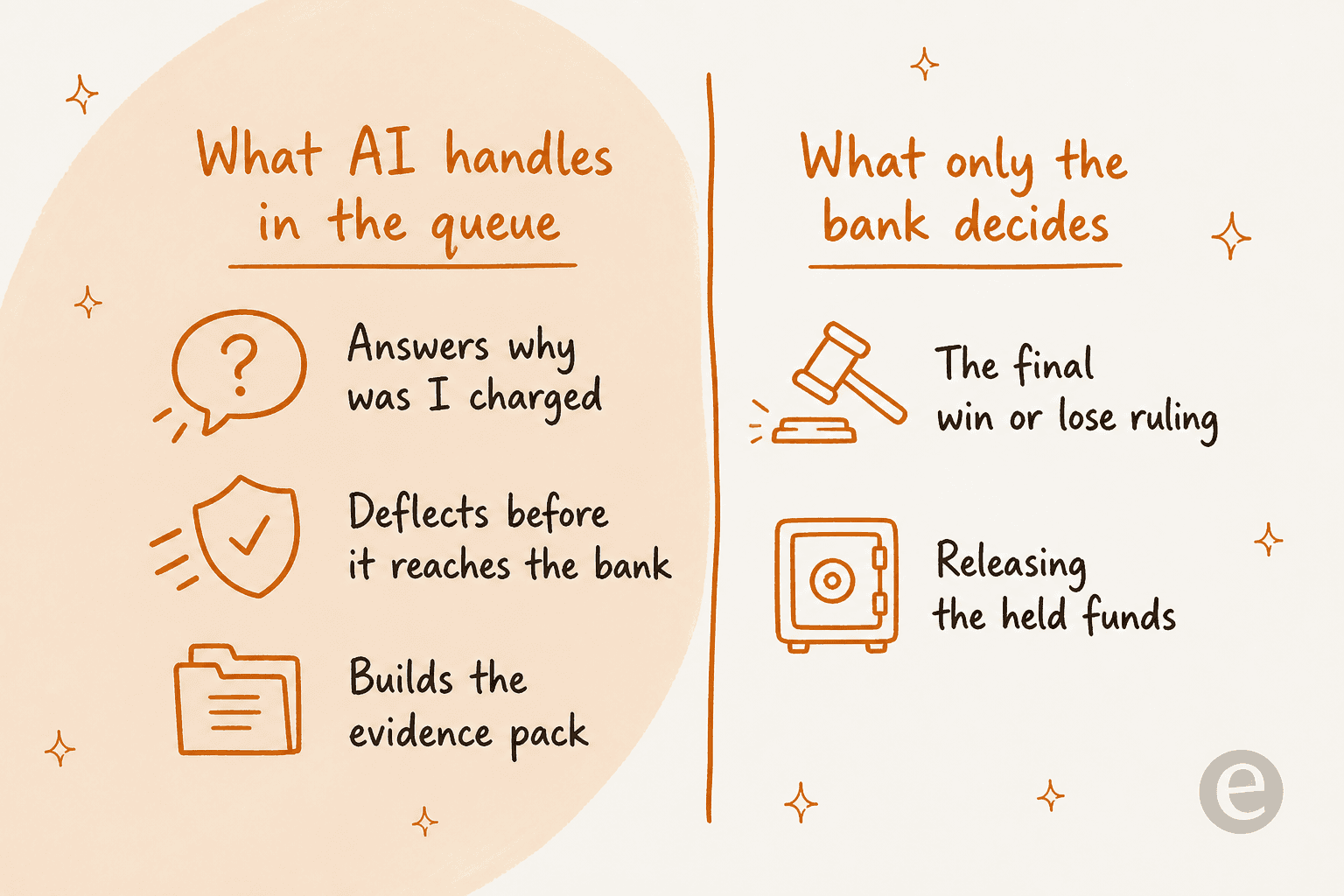
The bank's ruling is genuinely out of reach. Stripe facilitates the case but has no influence over the outcome, which is at the sole discretion of the account owner's bank, and once a dispute is lost it's final for all parties. No AI, and no human, changes that. Any tool promising to "win your chargebacks automatically" is really promising to submit evidence faster, which is a real thing but a smaller thing.
What lives on the automatable side is everything that happens in your support queue:
- Answering the payment question. "Why was I charged twice?", "Where's my refund?", "What is this charge?" are lookups, not judgment calls. AI can read the order and the payment status and answer in seconds.
- Deflecting before it escalates. Card networks expect the customer to contact you first, before filing a dispute. A fast, accurate first reply during the inquiry window is often what stops a chargeback fee from ever landing. That's classic tier-1 deflection.
- Building the evidence pack. The only way to overturn a dispute is submitting evidence, and the evidence is stuff AI can gather: tracking, delivery confirmation, order details, customer comms, your refund policy. It can't decide the case, but it can do the 28 minutes of assembly in seconds.
That's the mental model. AI is a queue teammate here, not a judge. Keep that framing and you'll set it up in the right places.
Where AI actually earns its keep
There are two moments in a dispute's life where AI saves the most time, and they're different jobs. Here's the flow end to end.
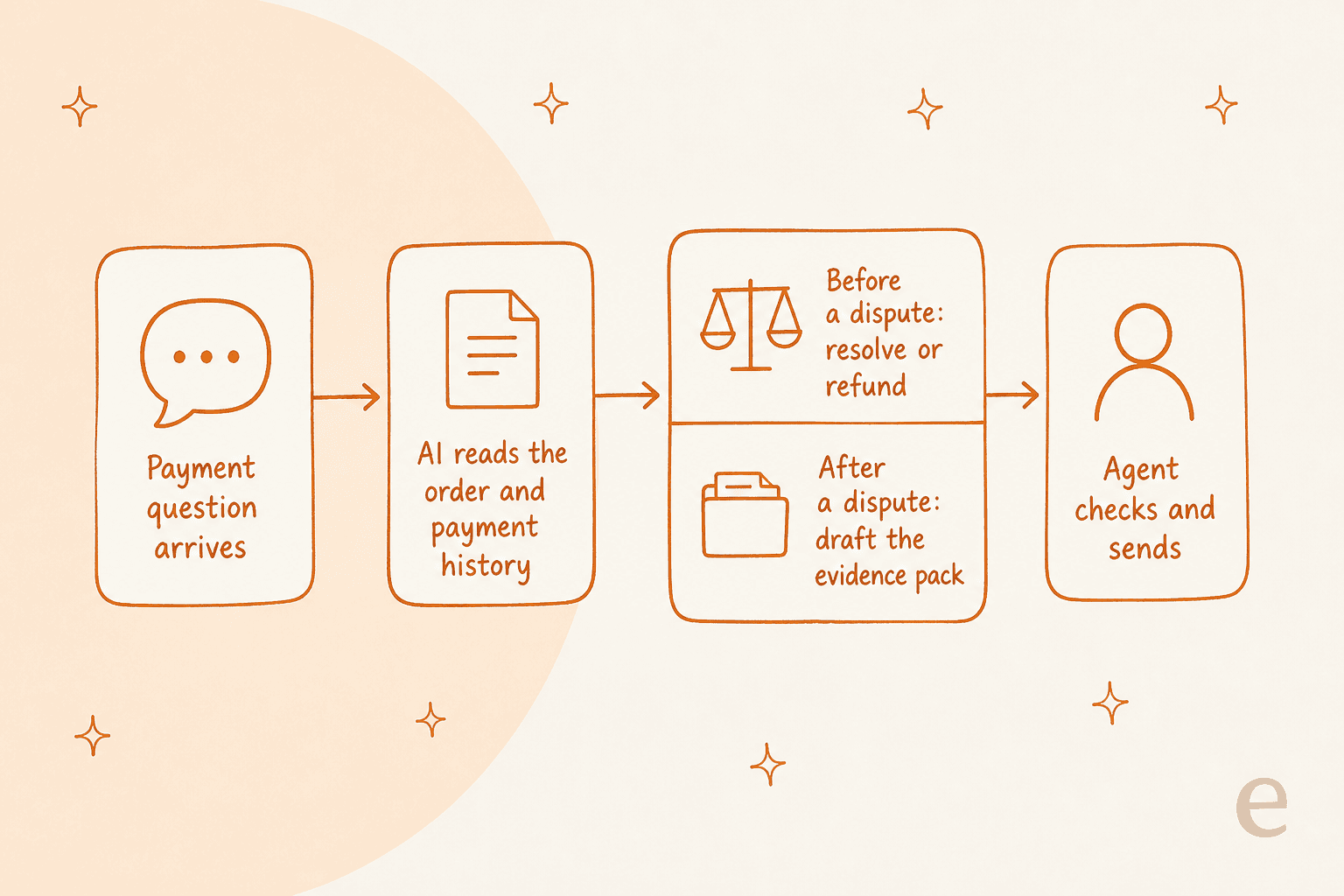
Before the dispute: catch the "why was I charged" message
Most chargebacks are born as an ordinary support ticket. The customer doesn't recognize a charge, or thinks they were double-billed, or wants to know where their order is. Left in a queue for a day, that confusion turns into a bank dispute. Answered in two minutes with the actual order pulled up, it turns into nothing, which is really just first-contact resolution applied to money questions.
This is where AI trained on your own data shines, because the answer needs real context, not a canned macro. An AI teammate that can look up the order and tracking and see the payment status can say "you were charged $60 on Sept 3 for order #DL-4821, it shipped Sept 4, here's the tracking" instead of "let me check with the team." A lot of these are really refund-request or order-tracking questions wearing a scary "I'll dispute this" hat, and clearing them fast is the single biggest lever you have on your chargeback rate. Worth remembering: a won dispute still counts toward your dispute rate, so the one you prevent is worth more than the one you win.
During the dispute: assemble the evidence pack
Once a formal chargeback is filed, the clock starts. On Stripe you usually get 7 to 21 days to respond, and Shopify describes the same window. Miss it and you automatically lose. You also get only one shot at submitting, so the evidence has to be complete the first time.
That evidence is exactly what an AI teammate is good at pulling together. Shopify already auto-populates order data like tracking, fulfillment date, and the customer's IP, and for "product not received" disputes it even includes AI-generated insights. An AI layer on your helpdesk extends that to the softer evidence the bank actually reads: the support conversation showing you tried to help, the refund policy the customer agreed to, the delivery confirmation. It drops a labelled, formatted draft in front of your agent to review and send.
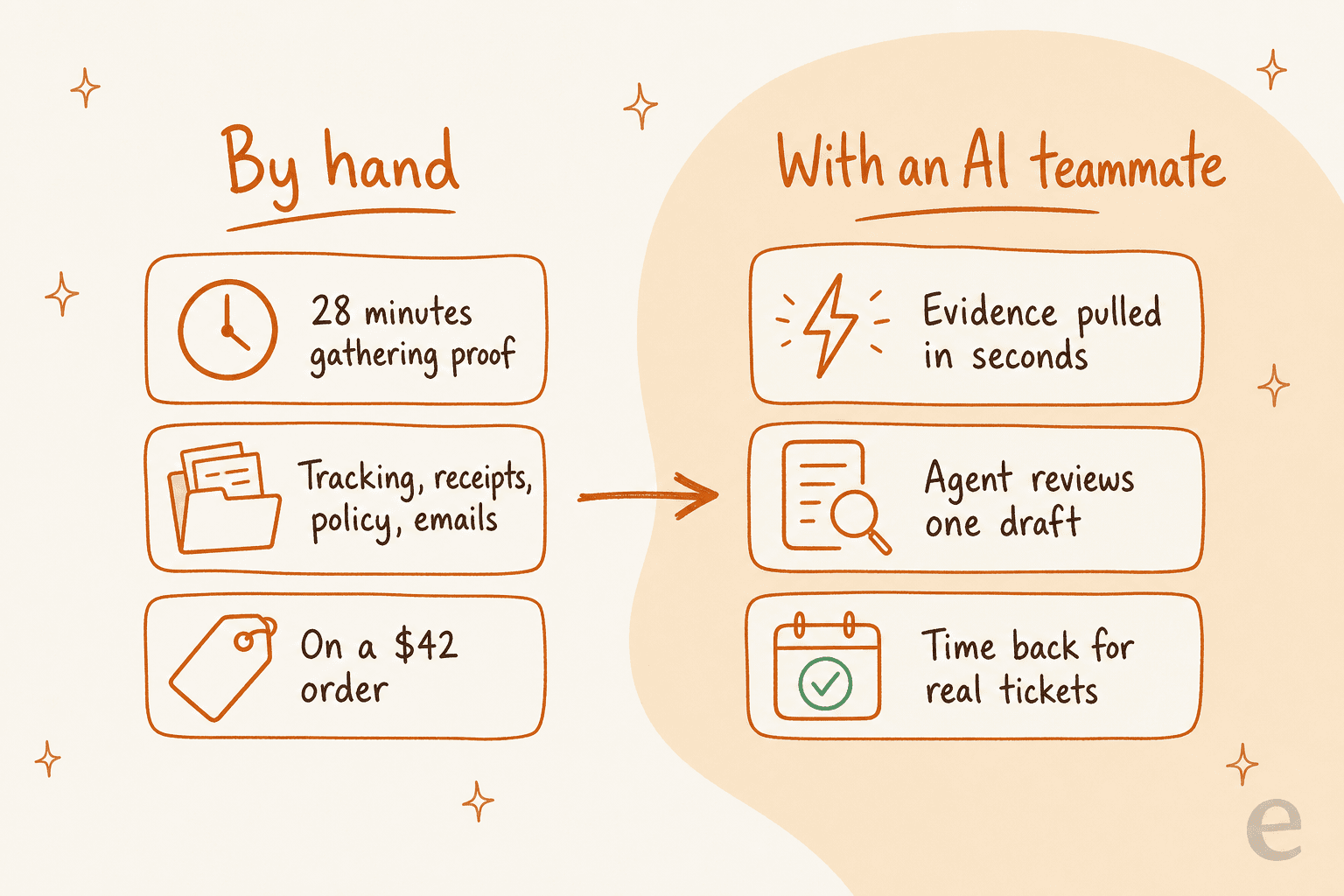
The 28-minutes-for-$42 problem is precisely this step, and it's the one teams tell you they want gone. As one merchant put it on r/ecommerce after switching to automated evidence collection: "I've never felt better with everything being automatically collected and submitted."
One honest caveat, from the same buyers. Automation that still makes your team do the work isn't automation. A Trustpilot reviewer of a dedicated dispute tool warned that "you still need to provide all the proofs since their VA aren't doing much." The test for any tool here is whether it actually reads your order and conversation data, or just gives you a nicer form to fill in yourself.
Which disputes are even worth fighting
Back to that Reddit question: are you grinding through every dispute regardless of size? You shouldn't be, and this is a decision AI can tee up but a human should own. Different dispute categories have very different odds, so pick your battles. Here's a quick way to think it through.
The pattern to notice: the "worth fighting" answer almost always hinges on evidence you either have or don't, and gathering it is the automatable part. What's left, the call on whether to write off a small one, is a five-second human decision once the AI has laid out what you're holding.
Where you still want a human
I'd be lying if I said set it and forget it. The categories where AI should draft but never auto-send:
- Anything that moves money. A reply that promises a refund or admits fault should get a human's eyes. Start any rollout in draft mode.
- Suspected fraud and high-value orders. The stakes and the nuance are both too high for autopilot, and these are where seller protection rules get fiddly.
- The genuinely angry customer. AI can gather the facts, but a person often needs to take the emotional temperature down. Our take on handling angry customers with AI is that the tool preps the agent, it doesn't replace them.
The good news is you don't have to guess where the line is. This is why testing on your own history matters: run the AI over past disputes, see where it was right and where it wasn't, and only automate the categories it nails. We've watched confident-sounding bots give wrong answers on live queues, which is why every rollout should be simulated against real past tickets first rather than switched on and hoped for.
Try eesel for payment-dispute tickets
If your dispute tickets live in a helpdesk already, you don't need a separate chargeback tool bolted on the side. eesel is an AI teammate that joins the support queue you already run, whether that's Zendesk, Freshdesk, Gorgias, or Help Scout, and answers the "why was I charged" tickets with the real order pulled from Shopify in front of it.
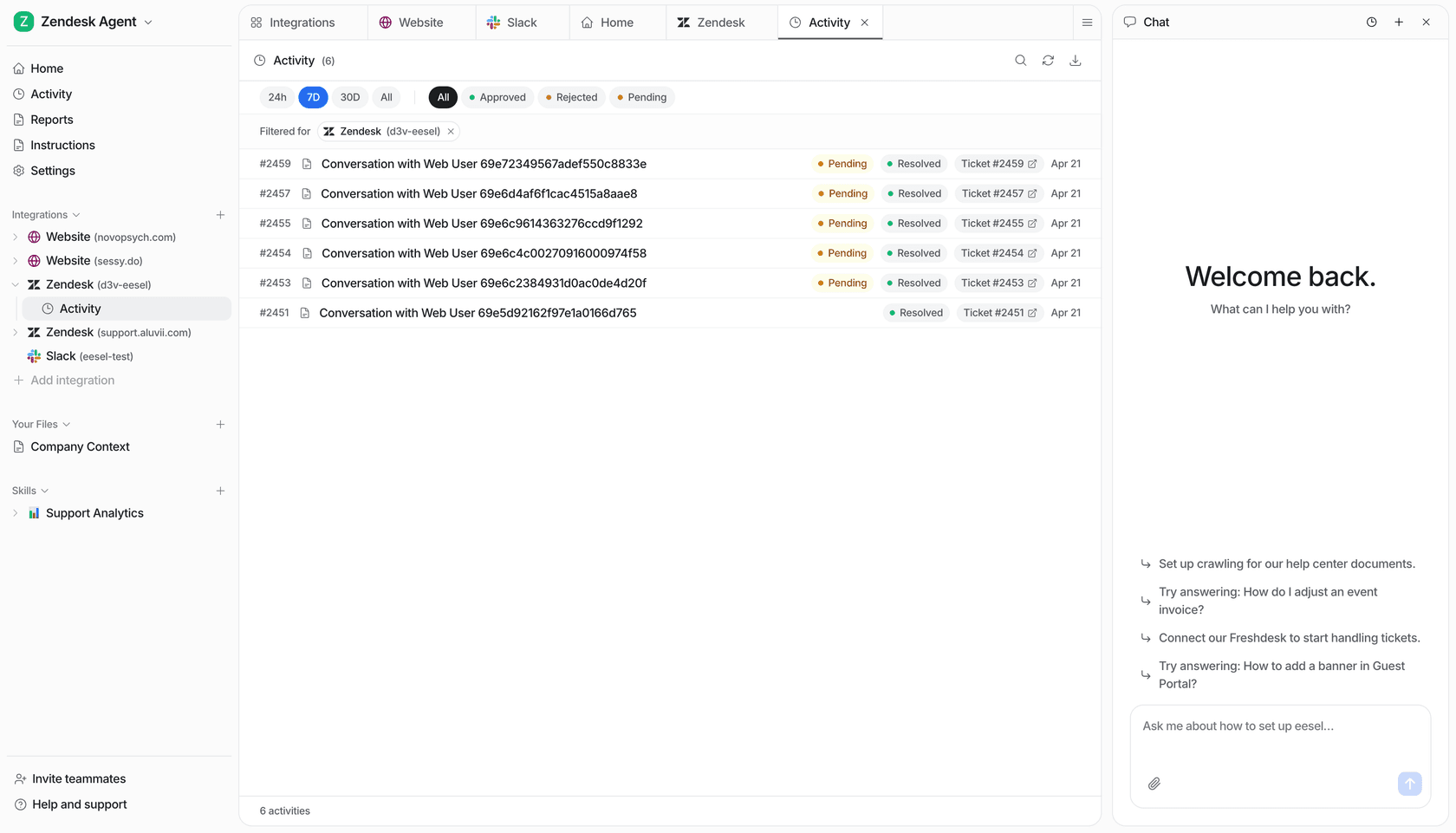
Three things make it fit this job specifically. It trains on your past tickets and help center, so its dispute replies sound like your team, not a generic script, which matters because on a real e-commerce inbox that approach produced useful drafts on 93.8% of refund tickets. It runs in draft mode with per-category control, so the evidence gathering and the "where's my refund" answers get automated while the money-moving replies wait for a human.
And its pricing is 40 cents per ticket handled, not per seat and not per resolution, so a queue with a few disputes a week plus all the refund and order questions around them stays cheap. You can simulate it on your own past disputes before it ever replies to a customer, and it goes live in minutes. It's free to try.
Frequently Asked Questions
Can AI handle chargeback customer inquiries end to end?
Does AI actually reduce chargebacks, or just the busywork?
How much does it cost to automate payment-dispute tickets?
What is the difference between a refund and a chargeback for a support agent?
Can I test AI on my own chargeback tickets before it replies to customers?
Which payment-dispute questions should AI never answer on its own?


Article by
Riellvriany Indriawan
Riell is a designer and writer at eesel AI with about two years of experience researching CX platforms, AI chatbots, and helpdesk software. She combines her design background with a sharp eye for how these tools actually look and feel in practice — making her comparisons unusually visual and user-focused.