Replicant pricing in 2026: what it really costs

Kurnia Kharisma

Katelin Teen
Last edited July 15, 2026

How much does Replicant cost?
The honest answer: nobody outside a Replicant sales cycle knows the number, because there isn't a public one. The pricing page is headlined "Flexible pricing for scalable conversational AI" and describes a "straightforward, pay-as-you-go" model, but it lists no per-minute rate, no plan tiers, and no dollar figures anywhere. What it does spell out is the shape of a deal: contract terms that flex month-to-month or multi-year, an agreed-upon business outcome used to measure performance, and an in-depth ROI analysis to project your annual savings before you sign.
In plain terms, you book a call, walk through a discovery and ROI exercise, and get a custom quote. There is no trial, no self-serve signup, and no way to model the cost in a spreadsheet before talking to sales.
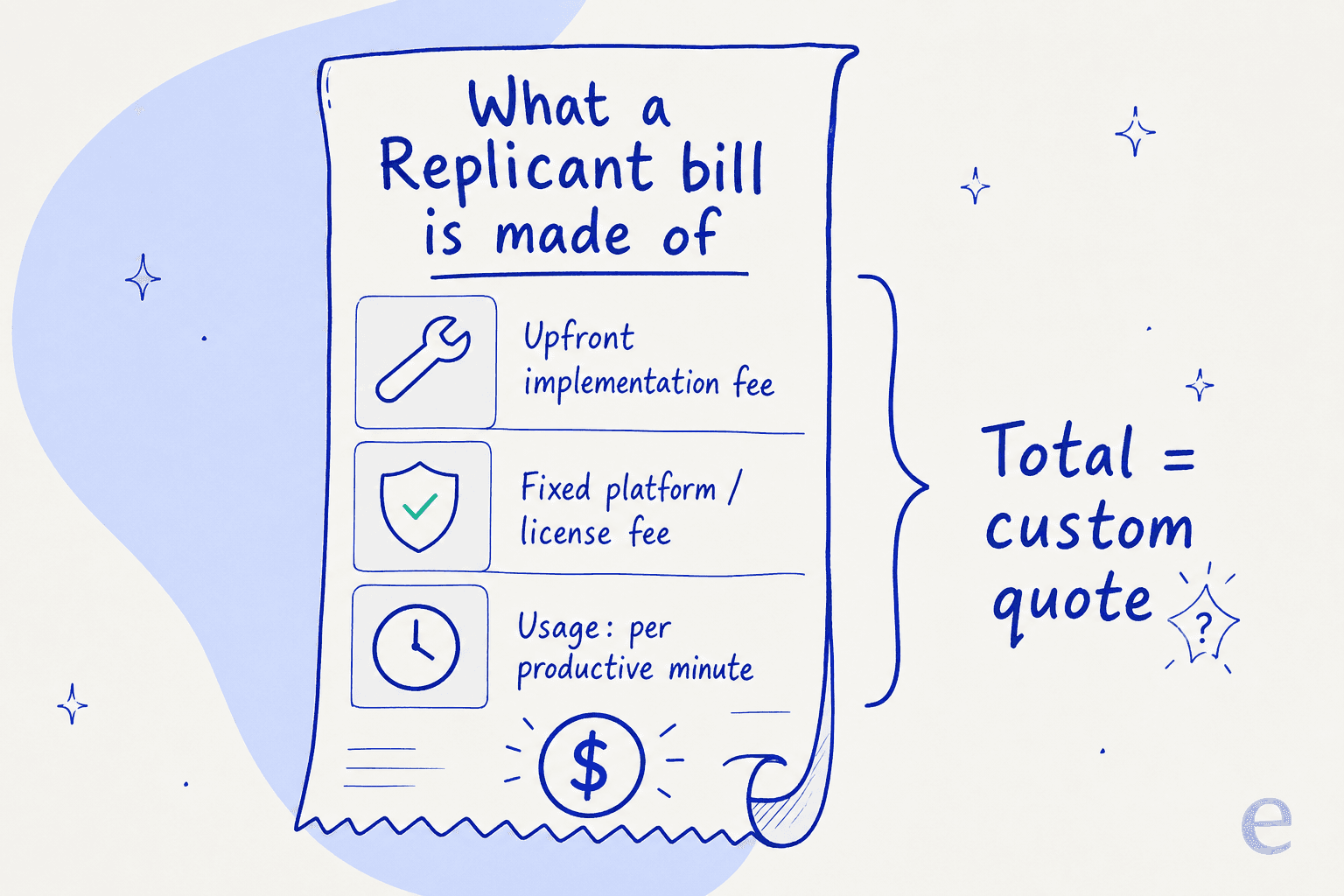
Independent write-ups and review-site summaries are consistent about what sits inside that quote. A Replicant contract is best understood as three separate line items stacked on top of each other, and understanding them is the whole game.
What you're actually paying for
The implementation fee
Replicant is a services-led platform, and the rollout is a real project. The company positions its delivery model, "Replicare," as embedded conversational-AI experts who build alongside your team, with a claimed 65 NPS across 200+ deployments. That hands-on delivery is one of the most-praised parts of the product, but it is also work that gets scoped, priced, and billed up front: discovery, solution design, integrations into your telephony and CRM stack, and training the AI on your conversation data.
The marketing promise is a testable agent in about an hour and production in roughly two weeks. Independent reviews tell a more grounded story, with most real deployments landing closer to six weeks. That gap matters for cost, because a longer services engagement is a larger implementation line item.
The platform fee
On top of implementation sits a fixed recurring platform or license fee. This is the "you have access to Replicant" charge, and it is a flat cost that shows up whether you route ten thousand calls in a month or a hundred thousand. It is the predictable part of the bill, which is exactly why the usage layer on top of it is the part that catches people out.
The usage charge
The third line item is usage, and reviewers describe it as tied to productive minutes, resolved calls, or overall call volume. This is where the "pay-as-you-go" framing on the pricing page actually lives. It is also the layer that makes the total hard to forecast, because it scales with something you don't fully control: how long your customers stay on the line.
The billable unit is the part that bites
Here is the distinction I would push any buyer to nail down before signing anything: what, exactly, is the meter counting?
Replicant's usage is billed by the productive minute. A voice conversation that takes four minutes to resolve costs roughly twice what a two-minute one does, even if both ended in the same successful outcome. Your bill therefore tracks call duration, which is a function of how chatty your customers are, how complex the intent is, and how many times someone asks the agent to repeat itself. None of those are things you can tidy up in a spreadsheet ahead of renewal.
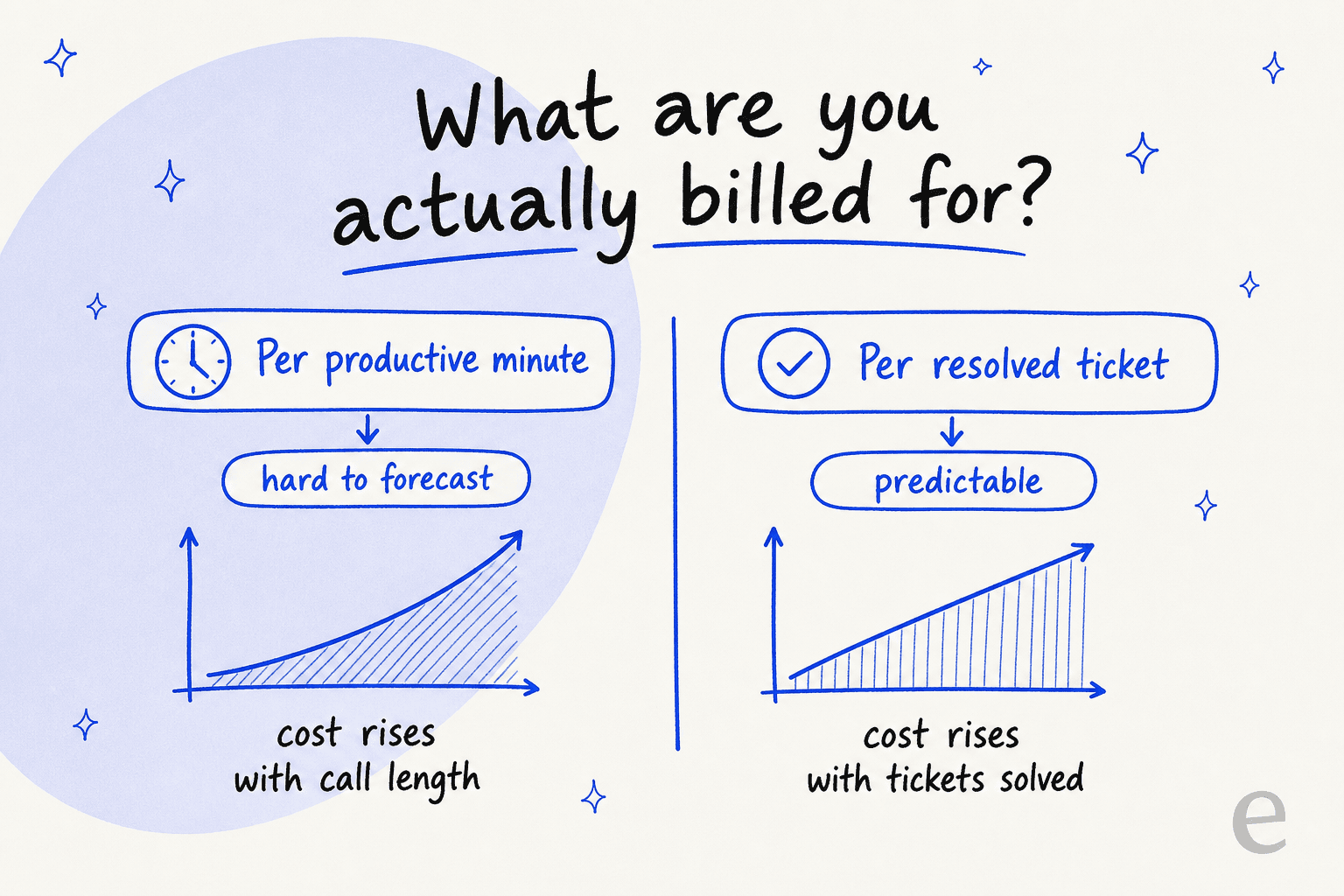
Contrast that with a per-resolved-unit model, where the meter counts outcomes rather than time. A per-ticket price rises when you resolve more tickets, which is the one variable you actually want cost to track. This is the difference that turns "we think it'll be around X" into "it will be X," and it is the single biggest reason a chat-and-ticket team should think twice about a per-minute voice platform.
Reviewers put the frustration plainly. In the community summaries, the recurring complaint isn't quality, it's predictability: the fixed-plus-variable structure is described as expensive and hard to model, with some buyers wishing the pricing scaled more cleanly with actual utilization.
What Replicant is genuinely good for
Let me be fair, because Replicant earns its reputation. It automates voice, chat, and SMS end to end, claims to resolve up to 80% of customer service conversations, and pairs LLMs with deterministic, code-based guardrails so business rules sit outside the model. Reviewers consistently praise how human the voice sounds and how expert the delivery team is. On G2 it holds a 4.7 out of 5 across 45 reviews, and on Capterra a 4.9 across 21. This is a real, proven product with 1B+ agent minutes automated, not vaporware.
If you match the profile it is built for, the price can absolutely pencil out. That profile is specific: a large enterprise, high inbound phone volume, an IT team to own the integration, and a tolerance for a services-led rollout. AAA, for one, is cited as hitting a 98% success rate and 25 FTE-equivalent saved on Replicant. At that scale, a six-figure platform that removes twenty-five agents' worth of repetitive calls is easy math.
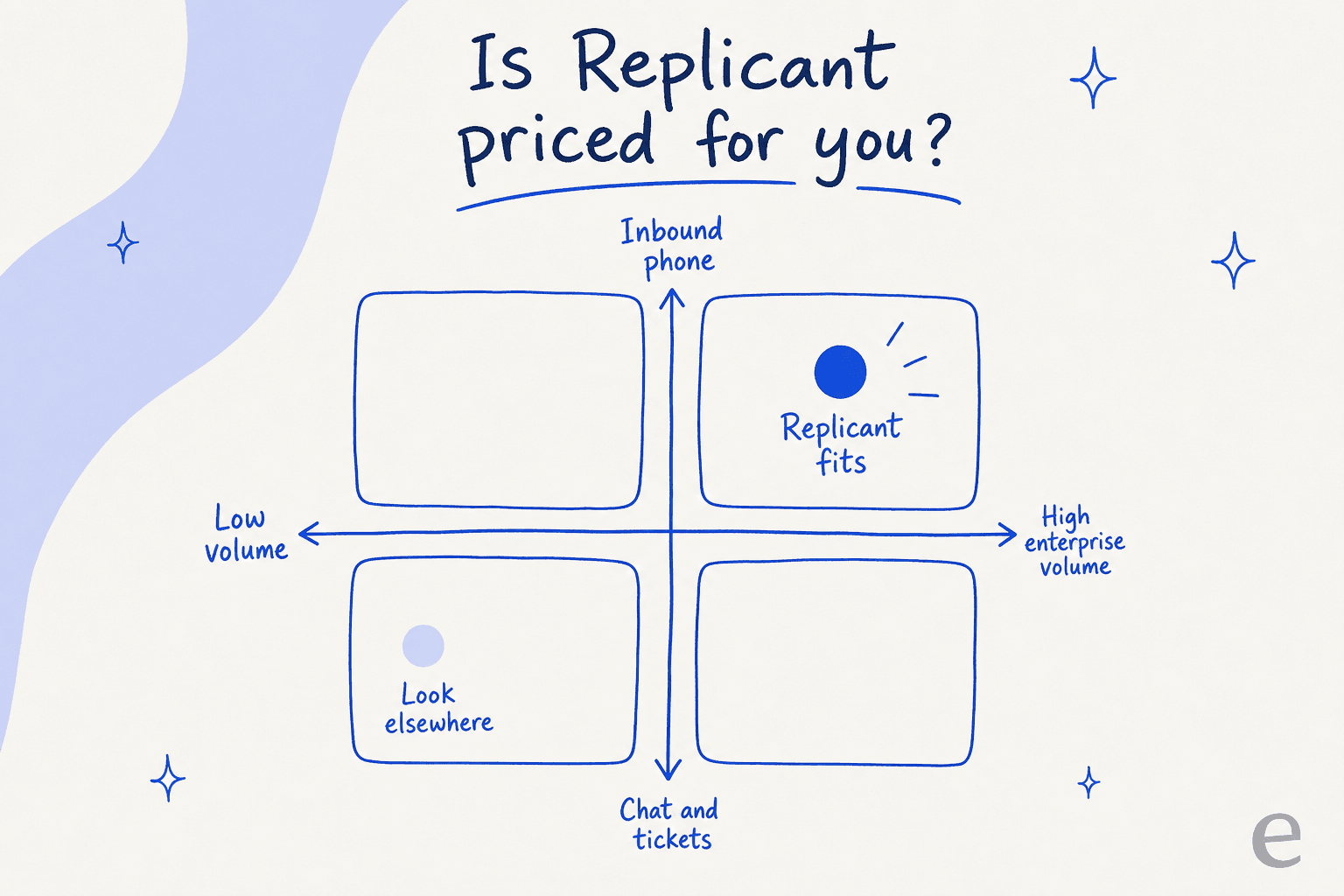
The trouble is that most teams shopping for AI support don't match that profile. If your volume is chat, email, and tickets, or you are a mid-market team without a dedicated implementation crew, you are being quoted for a phone-first platform whose most expensive strengths you will barely touch.
The three things buyers flag before they leave
Across the reviews, the reasons people start looking elsewhere cluster into three, and none of them are about quality.
First, the opaque pricing itself. You cannot estimate cost without a sales cycle, an ROI analysis, and a custom quote, which is a hard sell for any team that wants to try before they commit.
Second, the rollout is heavy, and control sits with the vendor. Meaningful changes route back through Replicant's team rather than something you self-serve. A Capterra reviewer put the tradeoff bluntly:
"Changes are in the hands of the Replicant team only."

For an enterprise that wants a managed partner, that is a feature. For a team that wants to tweak a workflow on a Tuesday afternoon, it is a bottleneck you are paying for.
Third, the reporting is thinner than the price suggests. Reviewers note the out-of-box dashboards aren't customizable much beyond date filtering, which stings on a platform positioned at the top of the market.
A worked example
Because there is no public rate, the point of a worked example isn't a precise number, it is the shape of your commitment.
A large call center automating a high-volume inbound phone line is Replicant's home turf. You will negotiate an implementation fee, a fixed annual platform fee, and per-minute usage that scales with call time. Model this as a six-figure annual commitment before you resolve a single call, justified by an ROI analysis that projects FTE savings. If the volume and the phone-first fit are real, this is a defensible spend.
Now run the same exercise for a 20-agent SaaS team whose volume is 80% email and chat. You are still on the hook for the implementation project and the fixed platform fee, but you are using the voice engine, the most expensive part, on a sliver of your traffic. The cost floor barely moves, but the value you extract collapses. That mismatch, not the raw price, is what sends chat-and-ticket teams looking for a different model entirely.
Try eesel for chat and ticket automation
If your volume lives in the helpdesk rather than on the phone, the honest recommendation is to stop pricing voice platforms and price a tool built for tickets. eesel AI is what I would put in front of that 20-agent SaaS team: it plugs straight into Zendesk, Freshdesk, Gorgias, Intercom and the rest, trains on your past tickets and help center, and starts drafting and resolving tickets without a migration or an IT project.

The pricing is the whole contrast with Replicant. There is no implementation fee, no platform fee, and no per-seat charge, just one fixed monthly price from $299/month for 500 credits, with 1 credit per ticket or chat however long it runs. You get 100 free credits to run it against your real tickets before you pay anything, so you can see the resolution rate on your own queue instead of taking an ROI slide on faith. For the buyer I mentioned who wanted their rate locked in writing, a single transparent monthly number was worth more than any demo.
Replicant is the right call if you are a large enterprise with a phone problem. For most teams whose customers reach them by chat, email, and ticket, a tool that goes live in minutes and bills per resolution is the better-value path, and it is the one you can model before you sign.