Gorgias AI Agent vs eesel AI: an honest comparison for 2026

Kurnia Kharisma

Katelin Teen
Last edited October 14, 2026
Why I am comparing these two at all
I have spent the last three-plus years putting AI agents on live support queues, and the Gorgias-versus-a-layered-agent decision comes up on almost every ecommerce call. It is worth being honest about where the tension actually is, because it is not "which AI is smarter." Both write good replies now. The tension is the shape of the pricing and how tied you are to one helpdesk.
One moment stuck with me. A Gorgias trial user ran twelve test chats with an AI agent, watched it perform well on every one, then opened the billing page and immediately filed to cancel.
"PLEASE CANCEL MY subscription."
a Gorgias trial user whose agent passed twelve tests, then saw the billing page (eesel sales call, March 2026)
The product worked. The pricing model was the thing that scared them off. That is the real subject of this comparison, so let me lay both tools out plainly and then get into the money.
What Gorgias AI Agent is
Gorgias is an ecommerce-first helpdesk that unifies email, chat, SMS, WhatsApp, Instagram, Facebook, and TikTok into one inbox, with an AI Agent built into the same platform. It is Shopify-invested and claims to power support for 40% of Shopify brands, so the whole product is designed around one store platform doing the heavy lifting.
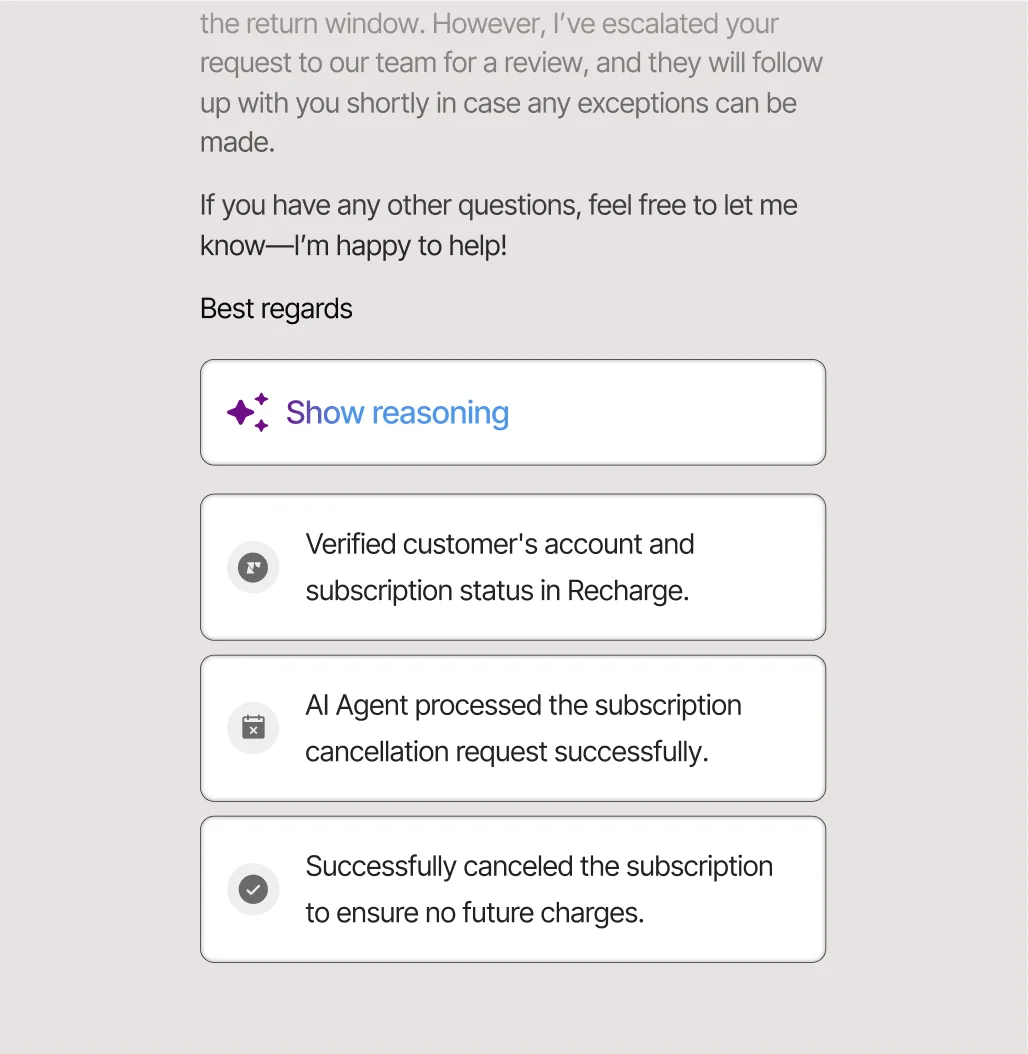
The AI Agent is genuinely capable. It does not just retrieve help-center articles, it takes Actions: it can look up an order, cancel a subscription, apply a discount, or process a return, all from inside the ticket. The screenshot below is Gorgias AI Agent walking through its own reasoning on a cancellation, verifying the customer in Recharge and then actually cancelling the subscription.
Because it lives inside the helpdesk, the AI Agent shares context with your human agents and your existing Gorgias Rules and Macros. For a Shopify brand that wants one tool for the inbox and the automation, that tight coupling is the whole pitch, and it is a good one.
The honest caveat, from a paying customer rather than from me:
"The AI Agent follows the same pattern, offering full functionality only for Shopify and requiring an awkward email-per-store setup that doesn't fit every business."

That is a five-star reviewer, and it is the cleanest statement of the ceiling: Gorgias AI Agent is a Shopify feature first. If you are on BigCommerce, Magento, or something more custom, the AI's depth drops off, and some of those store integrations are gated to higher plans anyway.
What eesel AI is
eesel AI comes at it from the other direction. Instead of being a helpdesk, it is an AI support teammate that plugs into the helpdesk you already run. The eesel AI Gorgias integration joins your Gorgias account over OAuth, reads your tickets, macros, and Shopify order data, and starts drafting or sending on-brand replies inside your existing inbox. No separate widget, no second inbox.
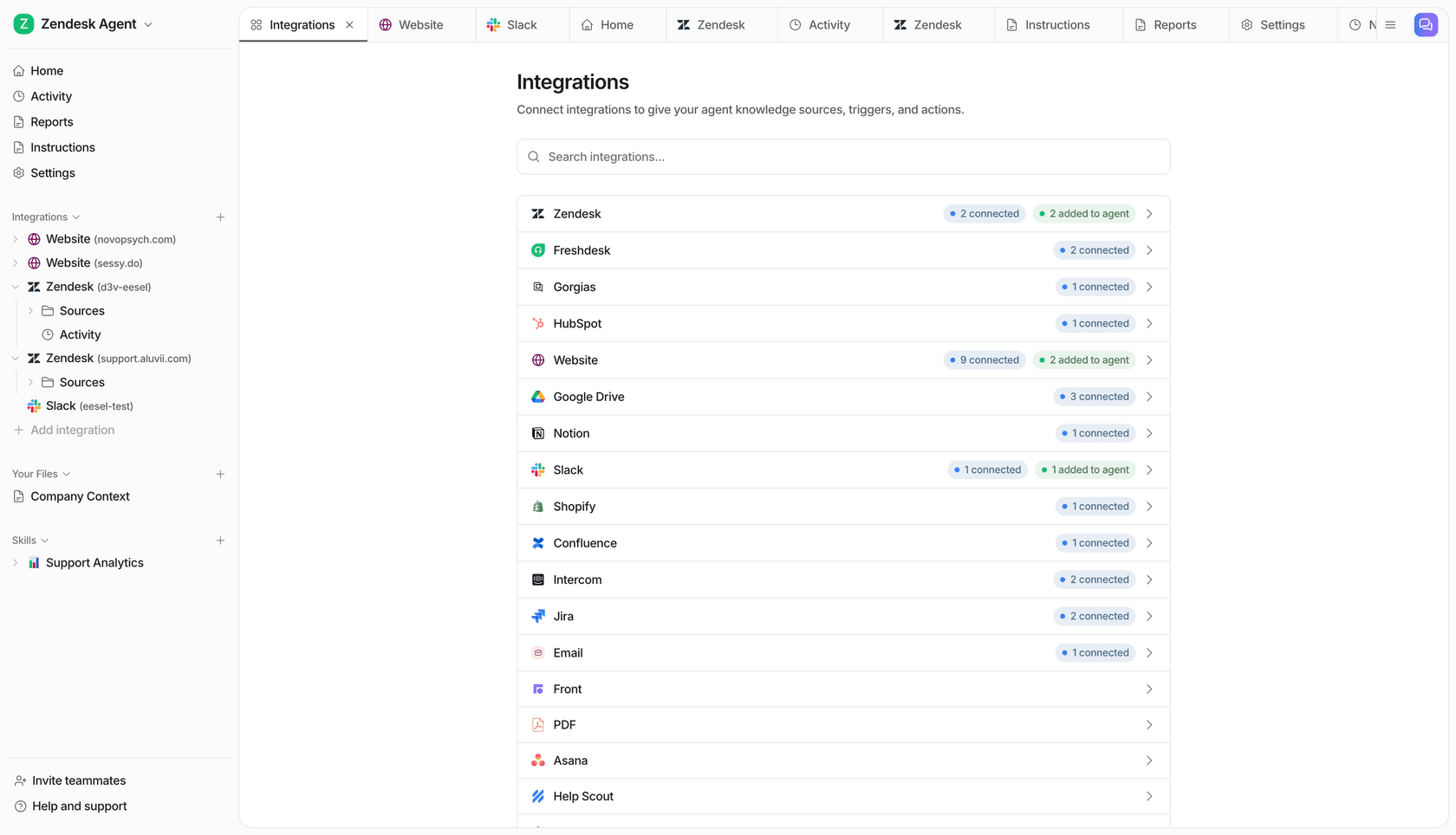
The distinction that matters most is that eesel is not tied to Gorgias. It plugs into Zendesk, Freshdesk, Help Scout, and shared inboxes the same way. So the same AI teammate can cover a Gorgias store and a Zendesk B2B queue at once, and if you ever migrate helpdesks, the agent comes with you.
On the ecommerce side it does the action-based work you would expect: eesel pulls live Shopify data into replies (order status, tracking, fulfilment) and can create returns, refund orders, and cancel orders. So "where is my order" and "cancel my order" both get real, current answers rather than a canned macro.
Pricing: two meters versus one
This is where most of the decision actually lives, so let me be precise about both.
How Gorgias bills
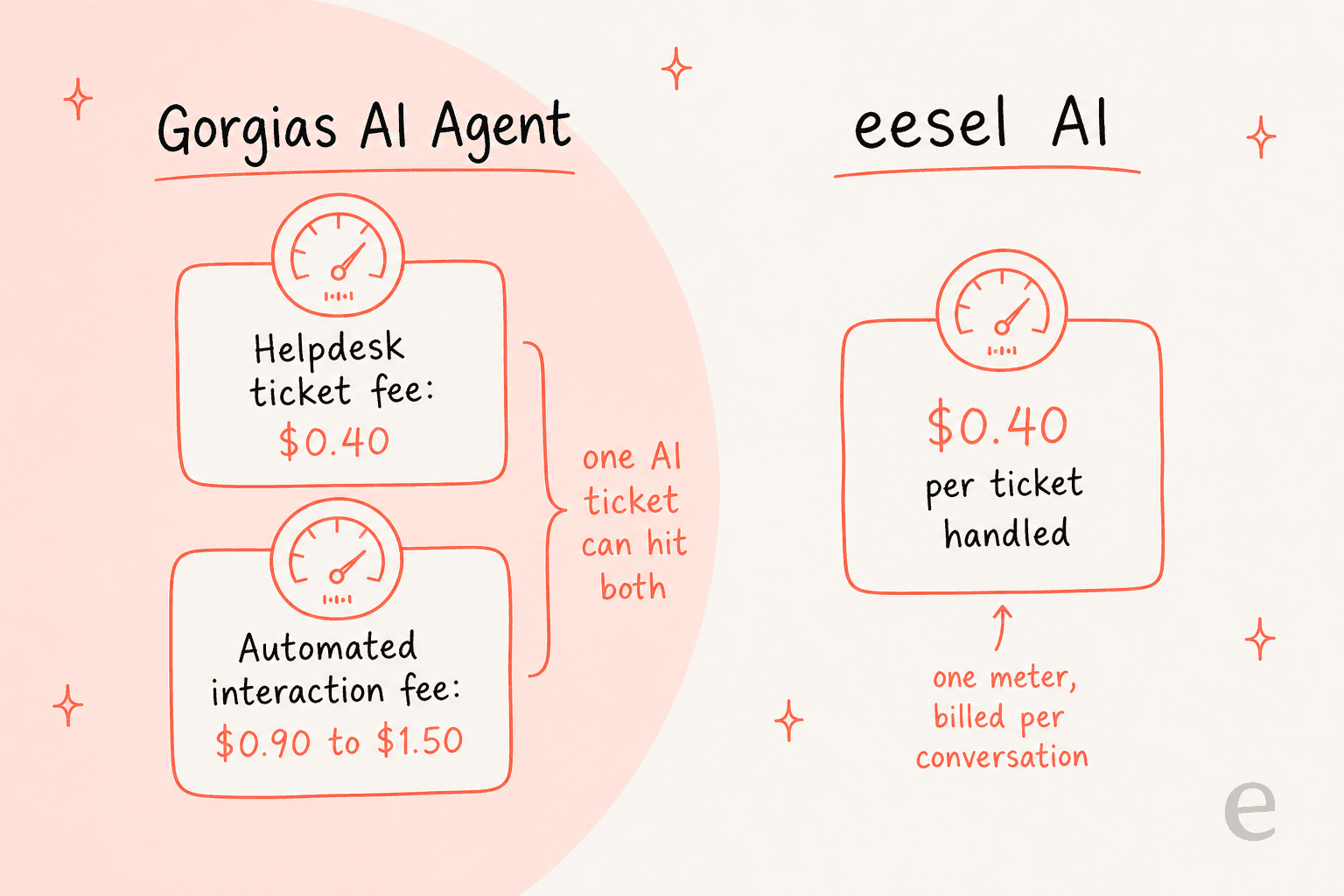
Gorgias sells two metered products on one invoice: Helpdesk (billed per billable ticket) and AI Agent (billed per automated interaction). Every plan card bundles an AI Agent allowance into the headline price.
| Plan | Bundled price (annual) | Tickets included | Automated interactions included | Price per automated interaction |
|---|---|---|---|---|
| Starter | $40/mo (monthly only) | 50 | 30 | $1.00 |
| Basic | $77/mo | 300 | 30 | $0.90 |
| Pro | $471/mo | 2,000 | 190 | $0.90 |
| Advanced | $1,227/mo | 5,000 | 530 | $0.85 |
Source: the live Gorgias pricing page. Ticket overage runs $0.40 on Starter and Basic, $0.36 on Pro and Advanced.
Two things trip people up. First, the per-interaction rate changes by plan: $1.00 on Starter, $0.90 on Basic and Pro, and $0.85 on Advanced, with the pricing page FAQ quoting $0.90 on annual plans and $1.00 on monthly. Second, and this is the part worth internalising, one fully-automated ticket can trip both meters: per the billing docs, if the AI Agent resolves a conversation without handing to a human, you pay the ticket fee and the automation fee. If it hands over, you pay only the ticket fee.
How eesel bills
eesel has one meter: 1 credit per ticket or helpdesk conversation handled, "not per reply." One ticket is one credit no matter how many messages go back and forth. You pick a fixed monthly plan sized to your volume, with no platform fee and no per-seat fee, and you start with 100 free credits and no credit card.
| Tickets handled / month | eesel monthly cost |
|---|---|
| 100 | Free (100 credits) |
| 500 | $299 |
| 1,000 | $499 |
| 2,500 | $999 |
| 5,000 | $1,899 |
Source: the eesel pricing page. One nuance to keep honest: eesel counts credits per handled ticket regardless of outcome, so it is per ticket, not strictly per successful resolution. The upside is there are no "resolution rate" games, and partial rollout is priced the same way, so if you route only 200 of 1,000 tickets to the AI you use 200 credits and fit the 500-credit plan at $299/month.
The part per-resolution pricing hides
There is a structural quirk in per-interaction and per-resolution models that is easy to miss until the invoice lands. A cost analysis I put together for a roughly 1,000-ticket-per-month ecommerce brand made it concrete: on a per-resolution model at 80% resolution, 1,000 tickets cost about $792 a month, and a Black Friday spike to 4,000 tickets at the same 80% ran about $3,168. A fixed monthly plan sized to volume keeps November's bill predictable, but it does not punish you harder for a better resolution rate the way a per-resolution meter does.
Worth asking any per-resolution vendor: does your "resolution" count auto-closing spam? For that same brand, 22% of the inbox was spam, and a model that bills for every auto-close quietly charges for junk. This is the exact anxiety behind that "please cancel" story earlier, and it is why the fixed monthly price tends to feel calmer in a seasonal ecommerce business.
Here is a quick calculator so you can plug in your own numbers rather than take my worked example on faith.
Capabilities, head to head
On raw AI ability the two are closer than the pricing makes them look. Both take real ecommerce actions, both handle multichannel, both speak many languages. The differences are about coverage and control.
| Dimension | Gorgias AI Agent | eesel AI |
|---|---|---|
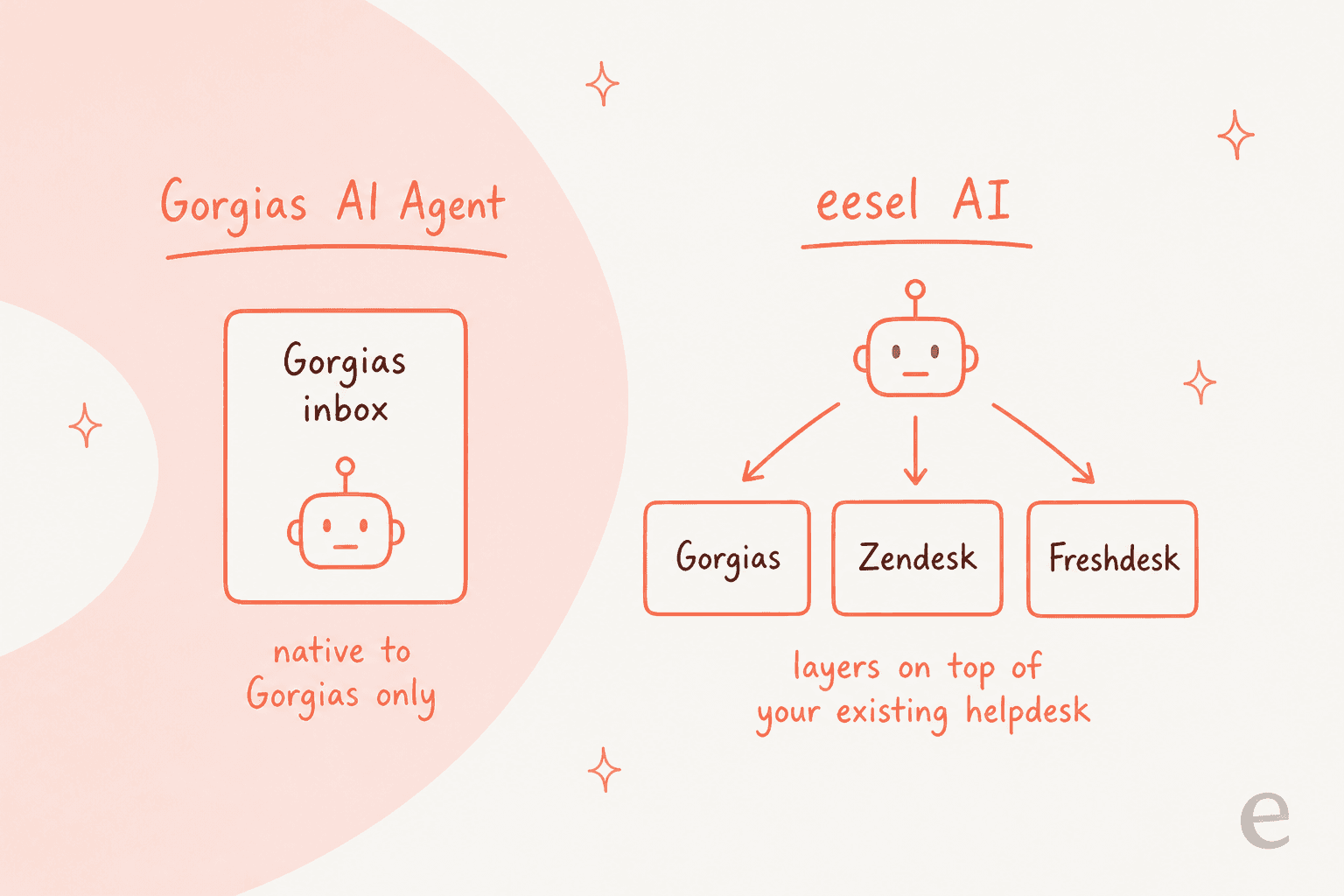
| Sits where | Native inside the Gorgias inbox | Layers on Gorgias, Zendesk, Freshdesk, Help Scout |
| Billing unit | Ticket fee + automated-interaction fee | 1 credit per ticket handled, from $299/mo |
| Shopify actions | Deep, native (cancel, refund, discount) | Live Shopify data + create return, refund, cancel |
| Non-Shopify stores | Full depth Shopify-only | Same behaviour across helpdesks |
| Test before go-live | Rules and previews | Simulation on your past tickets |
| Selling / upsell | AI Shopping Assistant | Support-focused teammate |
| Free to start | 7-day trial, no free tier | 100 free credits, no card |
Where Gorgias clearly leads is the AI Shopping Assistant, the sales-side agent that turns browsers into buyers. That is a genuine Gorgias strength and eesel does not try to match it, because eesel's teammate is a support teammate, not a storefront salesperson.
On answer quality, both have the same honest failure mode any AI support tool has. A paying five-star Gorgias reviewer put it fairly:
"While we still have quite a few snags with the AI agent who does give the wrong answers sometimes, it is still faster and more efficient than Zendesk."

That is exactly why the "test before you ship" gap matters, which is the next section.
Setup and going live
Both connect quickly. Gorgias AI Agent is on by default in the platform once configured, though tuning the rules and handover triggers is real work, per reviewers who called the rules builder something that "can get complicated fast."
eesel's setup is no-code and the integration page quotes under 30 minutes to connect Gorgias, closer to an hour if you are wiring in Shopify too. The piece I would not skip is simulation: eesel can run the agent over your past Gorgias tickets, compare its answers to what your team actually sent, and score accuracy before a single customer sees it.
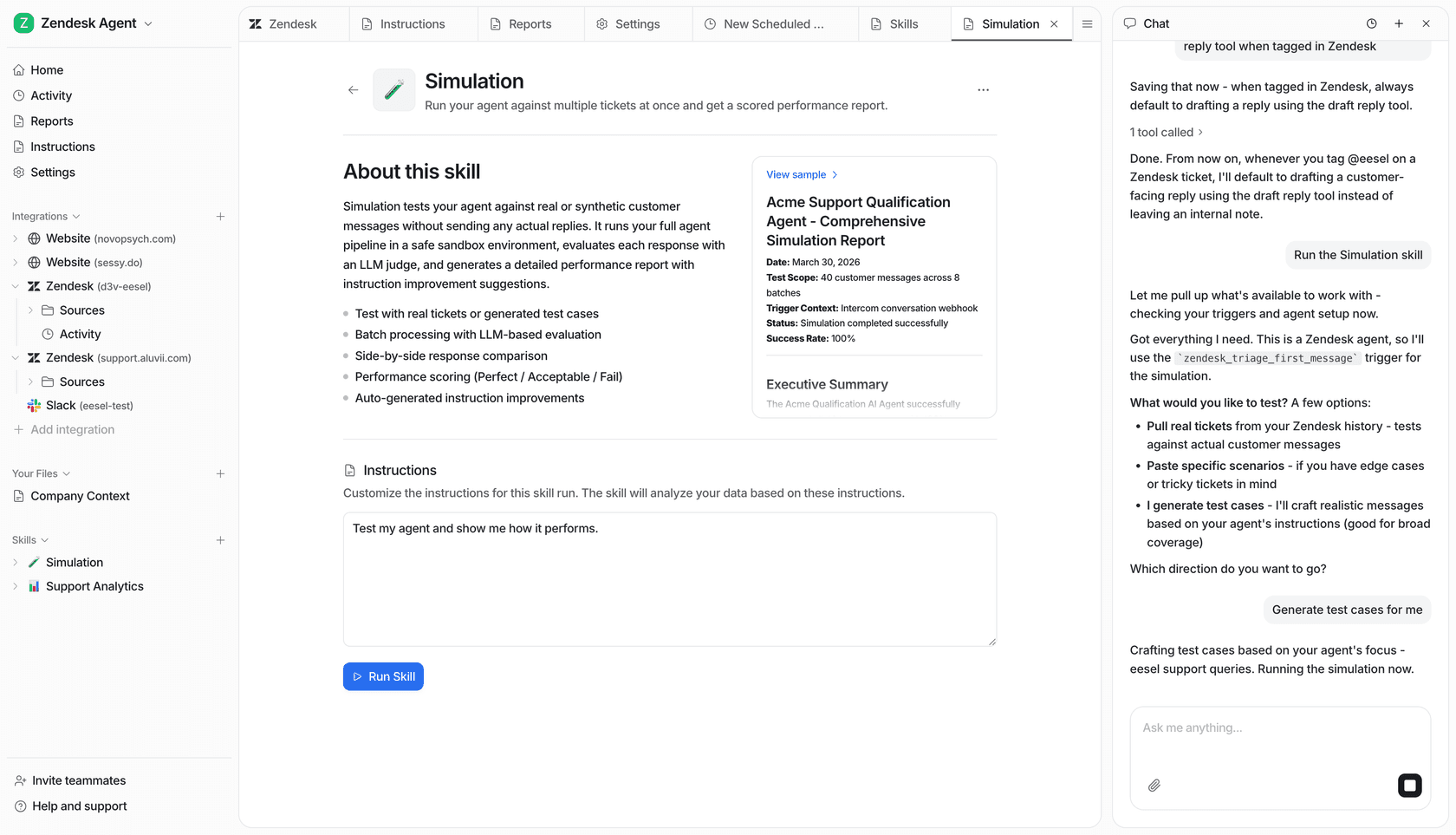
We built simulation because we have watched confident-sounding bots give wrong answers on live queues, and the only way to trust an agent is to see how it would have handled tickets you already know the right answer to. You can run that simulation during the free trial, before any spend, which is a very different feeling from flipping automation on and reading the invoice afterwards.
One accurate limitation to flag on eesel: PII redaction is configurable today on the Zendesk path, and support for Gorgias is listed as coming, not shipped. If automatic redaction inside Gorgias is a hard requirement for you right now, factor that in.
Who each one is for
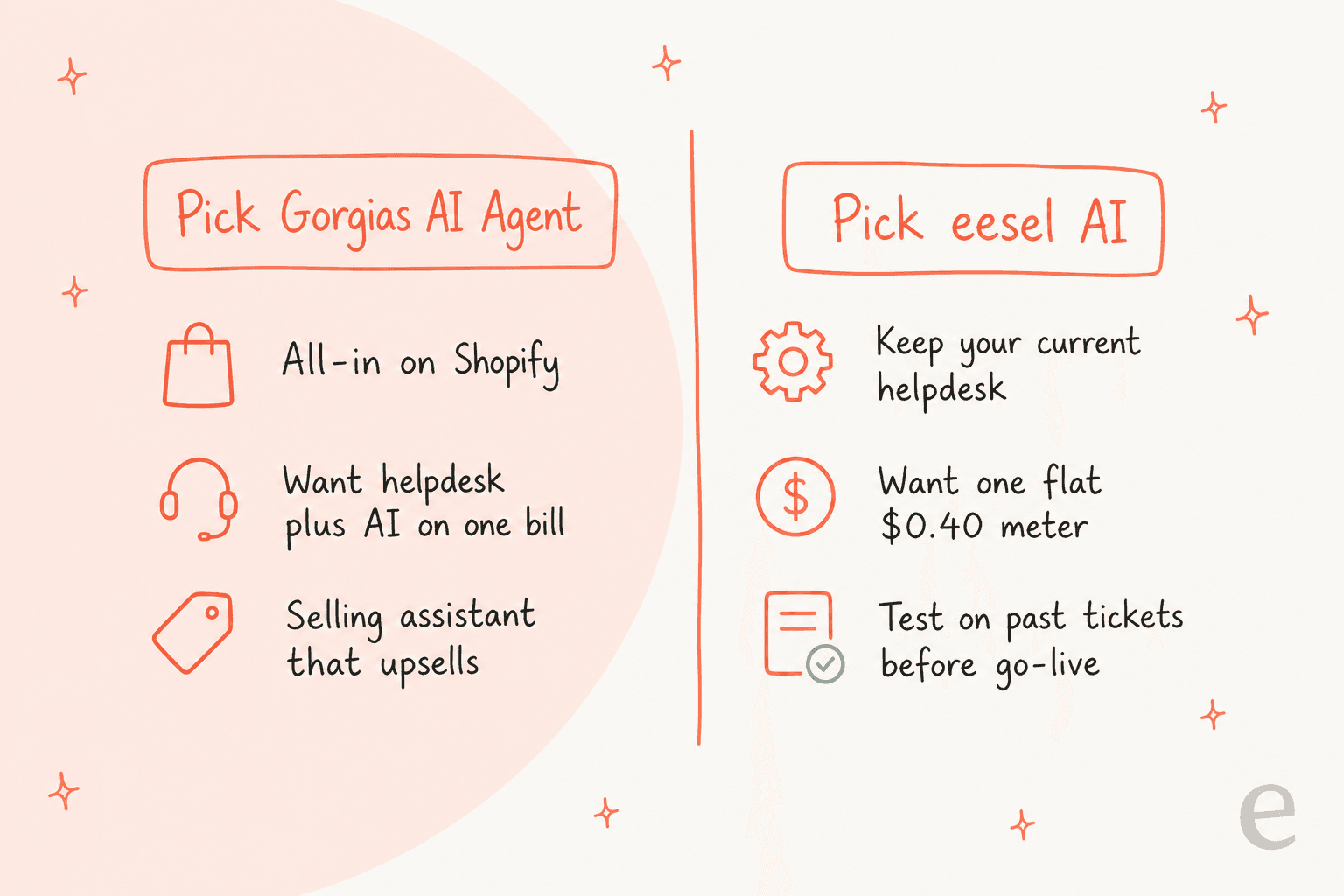
Pick Gorgias AI Agent if you are a Shopify-native brand that wants the helpdesk and the AI in one platform on one bill, you value the Shopping Assistant's upsell angle, and you are comfortable with a two-meter model that scales with volume. Gorgias is genuinely good at what it is built for, and the community backs that up: one G2 reviewer reported automating about 50% of interactions.
Pick eesel AI if you want to keep your current helpdesk (Gorgias included) rather than commit to one platform, you want a predictable fixed monthly price that will not punish a great resolution rate or a seasonal spike, and you want to simulate on your own tickets before going live. It is also the better answer if you run more than one helpdesk, because the same teammate covers all of them.
The two are not even mutually exclusive. Plenty of Gorgias stores keep Gorgias as the inbox and run eesel as the AI Agent inside it, precisely to get the fixed price and the pre-launch simulation without leaving the helpdesk they like.
Try eesel AI for Gorgias
If the pricing model is what is giving you pause, eesel AI for Gorgias is worth a look. It joins your Gorgias queue in under 30 minutes, learns from your past tickets, macros, and Shopify data, and runs on one fixed monthly price from $299 for 500 credits (1 credit per ticket handled) with no platform fee and no per-seat pricing. One DTC pet-food brand on Gorgias, Years, reported eesel resolving 73% of tier-1 requests in the first month, set up during a seven-day trial.
Best part: you can run a simulation on your own Gorgias tickets with the 100 free credits and no credit card, so you see exactly how it would perform before you decide anything. That is the test the "please cancel" trial user never got to run on the pricing side. Try eesel and start with the simulation.