Kodif AI vs Gorgias AI: built-in agent or a layer on top in 2026

Rama Adi

Katelin Teen
Last edited October 9, 2026

Why the meter matters as much as the agent
I'm an engineer on eesel's product, and a lot of what I've shipped is the plumbing that lets an AI agent read and reply inside helpdesks like Gorgias. So I know what each layer is actually touching under the marketing copy. But the lesson which stuck with me the most, it came from billing and not from code.
In March, a team on Gorgias trialing eesel ran 12 test chats. The agent handled all of them well. Then they opened the billing page and, within minutes, sent this:
"PLEASE CANCEL MY subscription."
a Gorgias trial user whose agent had just passed 12 test chats (eesel sales call, March 2026)
That was eesel's own billing page, so I'm not pointing fingers. The lesson holds for every tool in this post: the AI had already won, and the meter lost the deal. Kodif and Gorgias meter in a very different way, so I'll spend as much time on the bill like on the bot.
Kodif AI vs Gorgias AI Agent at a glance
Here's the whole comparison in one table, checked against each vendor's own pages on October 9, 2026.
| Kodif | Gorgias AI Agent | |
|---|---|---|
| What it is | AI agent layer on top of your helpdesk | AI agent built into the Gorgias helpdesk |
| Helpdesks | Zendesk, Gorgias, Kustomer, Gladly, Freshdesk, Richpanel, re:amaze, Genesys, Dixa and more | Gorgias only |
| Store platforms | Shopify plus 100+ ecommerce connectors | Shopify only for AI Agent |
| Billing unit | Each conversation worked, sold as a yearly volume | Ticket fee + fee per automated interaction |
| AI rate | $1 (Starter) to $0.75 (Enterprise) | $1.00 (Starter) to $0.85 (Advanced) |
| Entry price | About $24,000/yr, plus your helpdesk | $40/mo Starter, $77/mo Basic (annual) |
| Free trial | No, sales call only | Yes, no credit card |
| Channels | Chat on Starter, more channels on Growth and Enterprise | Email, chat, SMS, Instagram and Facebook DMs |
| Subscription retention | Separate Retention agent, 19% save rate claimed | Pause, skip, cancel via Recharge, Skio, Loop |
| Testing | Replay in a sandbox against your history | Playground, one test conversation at a time |
| Who builds it | Mostly Kodif's team | Mostly you, with help from Gaia |
| Security listed | SOC 2 Type II, HIPAA, ISO 27001, GDPR, CCPA | SOC 2 Type II, HIPAA, GDPR, CCPA |
| G2 | 4.8/5 from 31 reviews | About 4.6/5 from 560+ reviews (whole product) |
The two rows I'd read first are "billing unit" and "who builds it." Almost every other difference is following from those two. If you're still deciding on the helpdesk itself, my Gorgias review and Gorgias plans comparison are better starting points than this post.
What is Kodif AI?
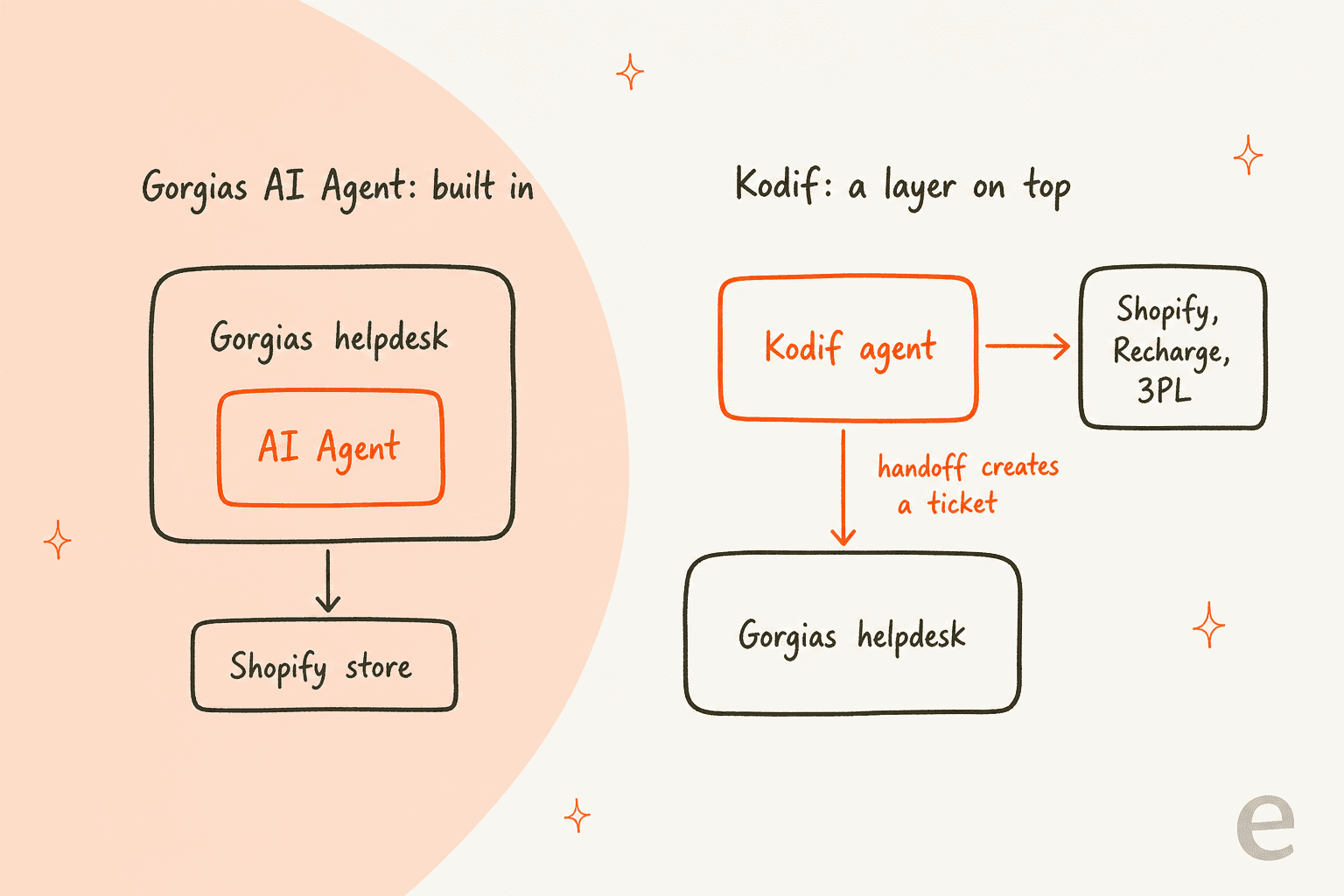
Kodif sells itself as "the AI agent built for ecommerce CX," and its pitch is action over ticket deflection. It isn't a helpdesk, it connects into the one you already have and works the conversations there.
The product is one agent split into three jobs. The Resolution agent handles refunds, returns, order status, shipping and order edits. The Retention agent runs subscription cancel-saves and writes the result back to billing. The Revenue agent answers presale questions and adds to cart. My Kodif AI review covers each one in more depth.
How Kodif runs on top of Gorgias
This is the part where the comparison gets more concrete. Four of Kodif's published case studies run on Gorgias: Starco Brands, Ivy City, Clearly Filtered and Neuro. Read together, they show the usual setup. Kodif starts on chat, resolves what it can, and when a case needs a human it creates a Gorgias ticket and routes it to the right queue. Neuro's case study describes a "Create Ticket policy" that "routes to the correct agent queue in Gorgias based on issue type." Starco's lists Gorgias ticket tagging, status updates and agent unassignment when a case closes without escalation.
The reported numbers on Gorgias brands are strong. Neuro handles about 24,000 tickets a year and reports 81% chat containment. Ivy City reports 78.8% chat containment and 65% on email (Ivy City case study). Those are Kodif's own figures, and containment is not same thing as fully resolved, but they are specific at least.
What is Gorgias AI Agent?
Gorgias AI Agent, now branded AI Agent 3.0, is the agent built into the Gorgias helpdesk. The pricing page sums up the bet: "Helpdesk + AI Agent. One platform. One inbox. One bill."
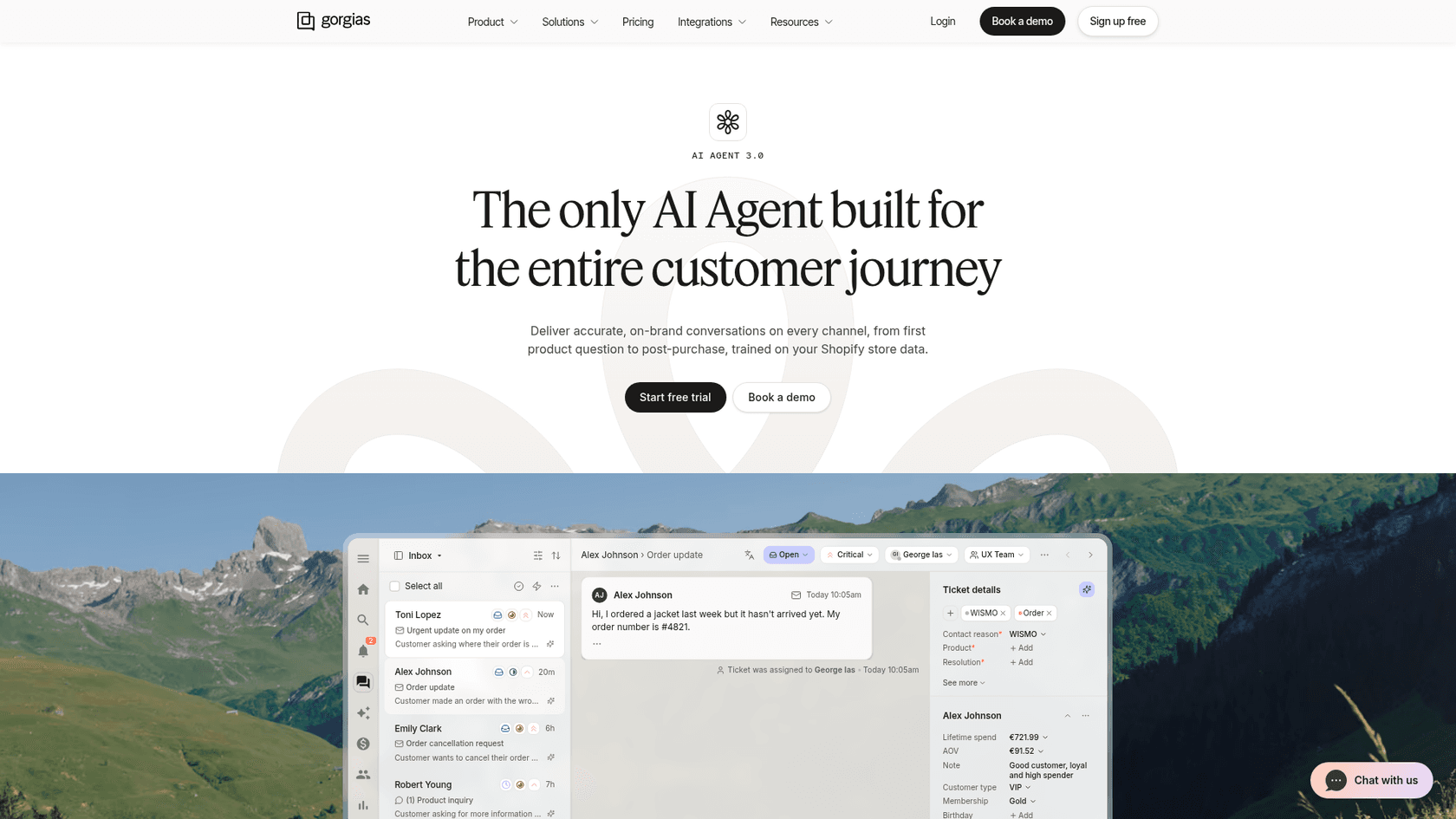
The same agent plays two roles: support (returns, tracking, cancellations, missing items) and a shopping assistant for presale chats. It replies in 80+ languages on email, chat, SMS and social DMs. Gorgias claims "17,000+ brands" and "60% tickets auto-resolved" on the AI Agent page. A little further down, the same page breaks automation out by industry, and the numbers are more modest: 53% for fashion, 51% for beauty, 48% for home goods. I would plan around those ones.
There's also Gaia, a setup assistant you talk to in plain language. Gorgias says it audits your knowledge for gaps and duplicates and can configure workflows for you, and the page says Gaia learns from "help center, catalog, policies, past conversations." My Gorgias AI guide walks through the full feature set.
Kodif vs Gorgias AI: features compared
Both agents cover the core ecommerce tickets: order tracking, returns, refund requests, cancellations and address changes. The differences sits in five places.
Where the agent lives
Gorgias AI Agent only exists inside Gorgias. That's its main strength: no second vendor and no sync, also one inbox with one report. It also means AI Agent needs a Shopify store. The chat setup doc says it's "not supported on stores that use BigCommerce, Magento or WooCommerce," even though the helpdesk itself connects to BigCommerce and Magento.
Kodif sits outside of the helpdesk, which is cutting both ways. You can move helpdesks without retraining the agent, and Kodif reaches systems Gorgias's agent doesn't, like NetSuite at Starco. But the handoff now crosses two products. One Kodif reviewer on G2 put the friction on the Gorgias side:
"The main challenge isn't with Kodif itself, but with the limited native integration capabilities on the Gorgias side. Certain data handoffs and rule triggers still require custom configuration, which can add setup complexity."

Knowledge and setup
Gorgias gives you the controls yourself. You write guidance (up to 100 per store, 30,000 characters each), connect your help center, sync public web pages one at a time, and upload documents. Tone of voice comes in four presets, and the Custom option is a field capped at 1,500 characters (tone of voice docs). The AI Agent explained FAQ is clear that the agent does not answer from your macros.
Kodif works the other way round. You describe policies in a plain English and Kodif's team builds the tools around them, with knowledge drawn from your FAQs, help center, website, docs and sheets. The trade-off shows up in the reviews, which I cover below, it's less work for you at the start and then more dependence on Kodif later.
Actions on orders and subscriptions
Gorgias AI Agent ships six Shopify actions: cancel order, edit shipping address, remove item, replace item, reship for free and add an order note (Shopify actions doc). It adds Recharge, Skio, Loop, ShipStation and ShipBob actions, and an advanced editor for custom HTTP calls. The documented limits are worth to read before you rely on them: cancellations change Shopify only and don't pass to your 3PL, and replace-item handles one item at a time. My Gorgias AI Agent actions post has the full list.
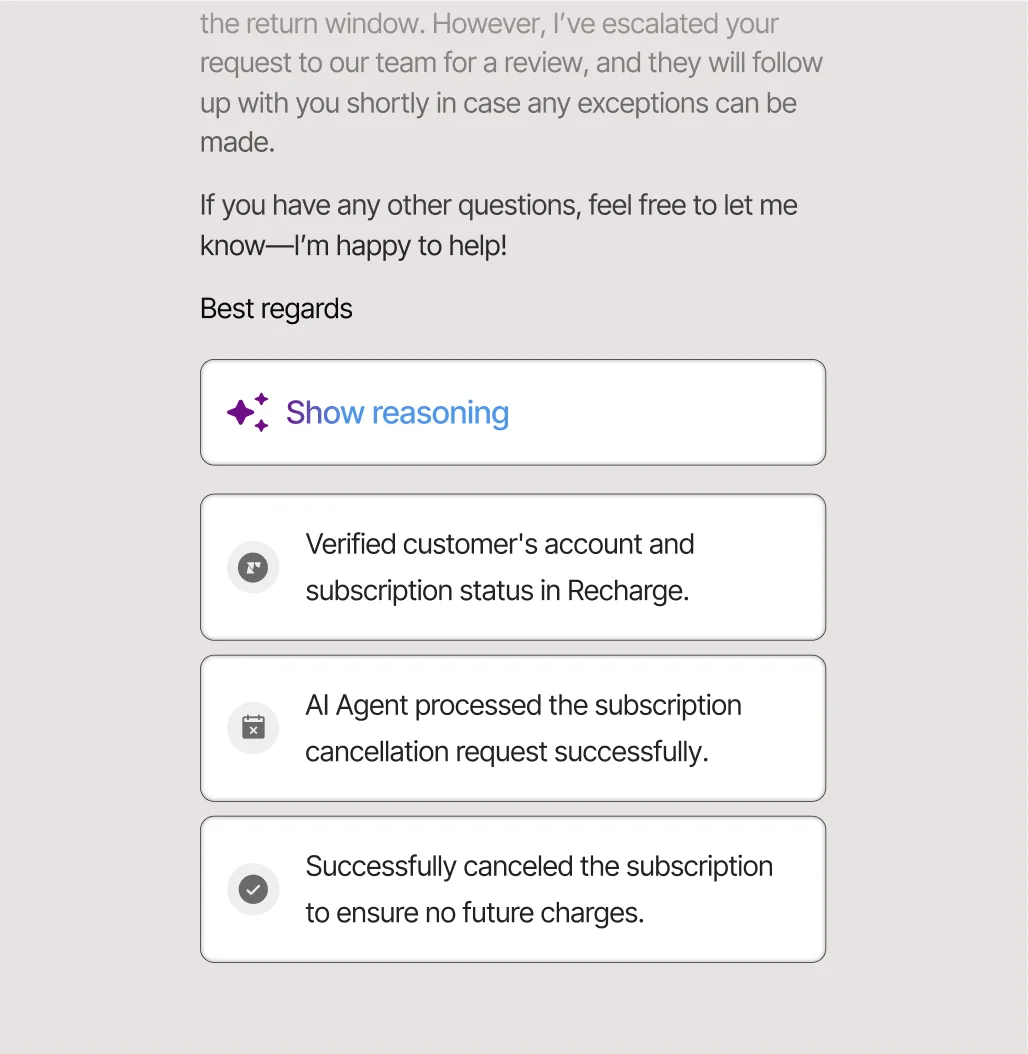
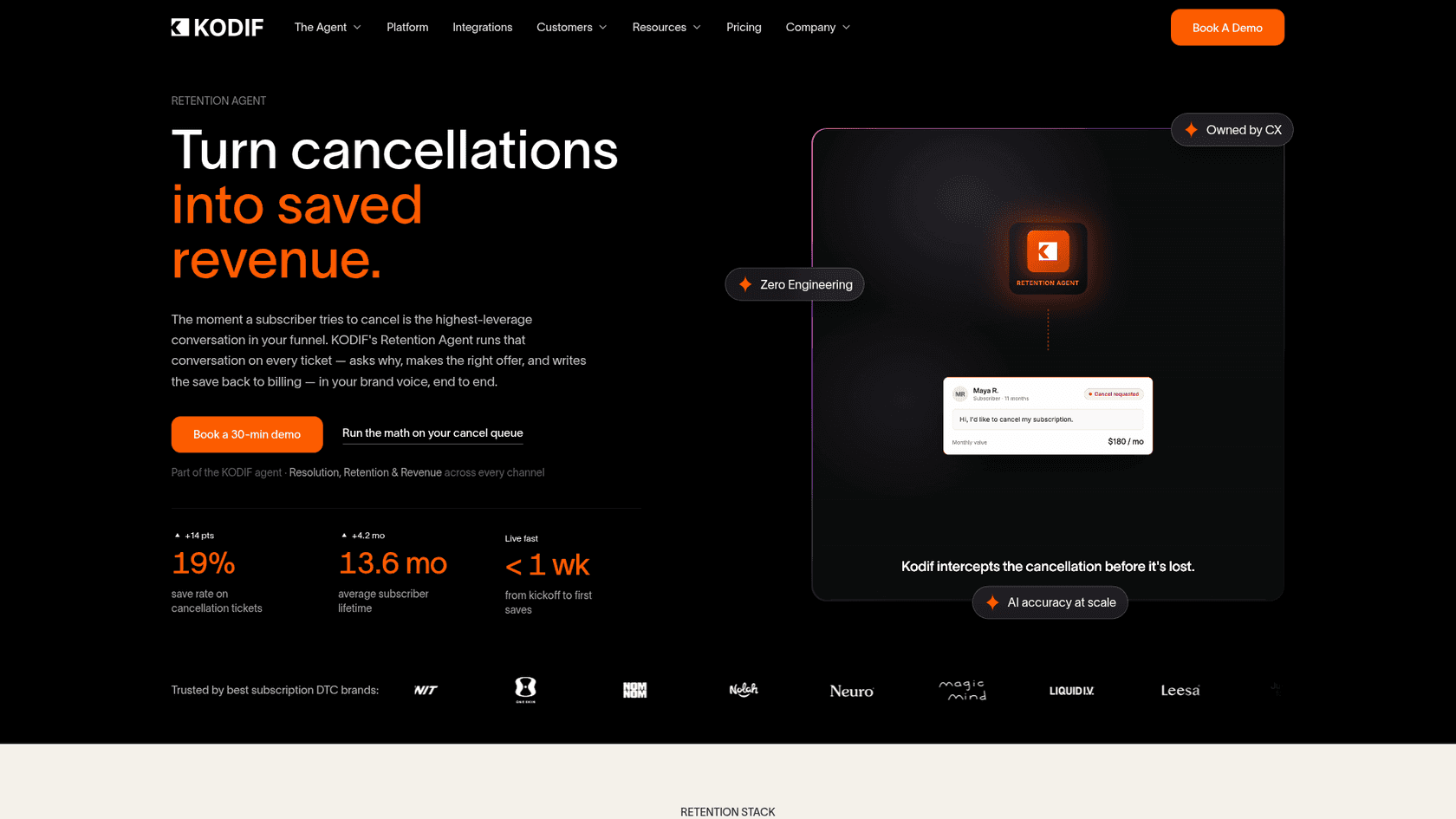
Kodif goes deeper on subscriptions. Its Retention agent is sold on its own numbers: a "19% save rate on cancellation tickets" and "< 1 wk from kickoff to first saves" (Kodif Retention agent). It reads your last 90 days of cancellation history to set up offers. If cancellations are a top intent for you, my guides to AI for cancellation retention and the best AI for subscription businesses go further.
Testing before go-live
Gorgias tests in a Playground: you pick a channel and a target (new customer, existing customer or an existing ticket) and see how the agent replies. Tests are free and don't send anything. But it's one conversation at a time, and the test conversations doc describes no bulk replay across a sample of past tickets.
Kodif says its policies are "tested against your real history" in a sandbox before launch (Resolution agent), with a QA loop that writes a regression test after each fix. Replaying a few hundred real past tickets is the step I would never skip, with any vendor. It's the cheapest way to catch AI hallucinations before a customer does.
Channels and handoff
Gorgias AI Agent runs on email, chat, SMS and social DMs on every plan, though brand voice and actions start at Basic. You can also control the chat handover and write handover topics in plain language. One update worth noting: the new AI Agent page says "You set the confidence threshold," where older Gorgias docs described a fixed threshold you couldn't tune.
Kodif's Starter plan is chat only. Email or SMS needs Growth, whose rate is set on a sales call. Since email is a large share of most Gorgias queues, worth checking which channels your volume actually come from before you price Kodif. Neither tool runs an AI voice agent; Gorgias sells Voice as a helpdesk add-on for your human team.
Kodif vs Gorgias AI pricing
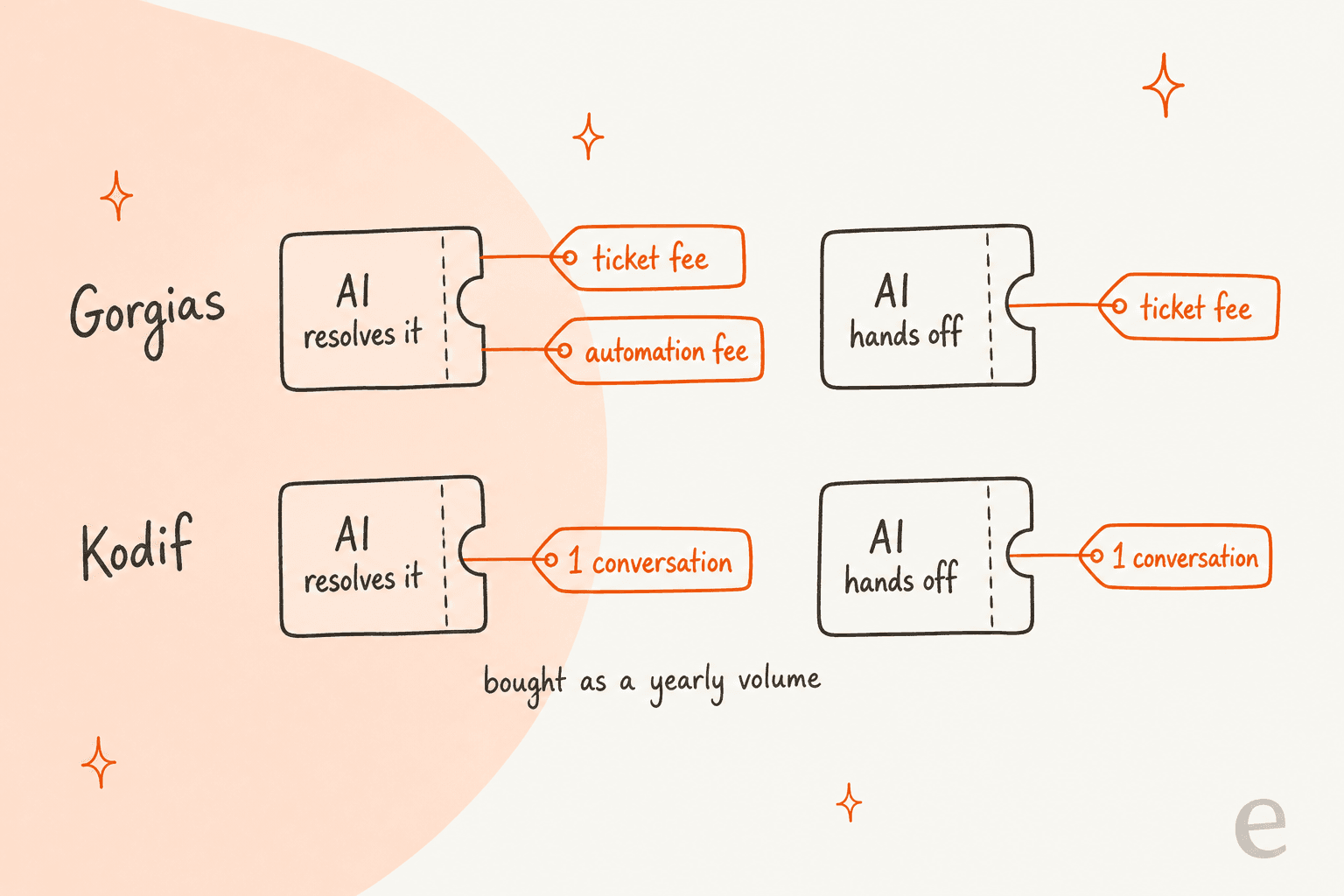
This is where the two differ the most, because they don't only charge different amounts, they charge for different events too.
How Kodif bills
Kodif sells a flat yearly volume. Starter covers 24,000 conversations a year at $1, Growth covers 75,000 at a rate it doesn't publish, and Enterprise covers 160,000 at $0.75 (Kodif pricing). A conversation is "one customer ticket the agent works, start to finish," so a chat Kodif starts and then hands to a human still counts. There are no seat or setup fees, onboarding is included, and overage is billed "at your plan's per-conversation rate."
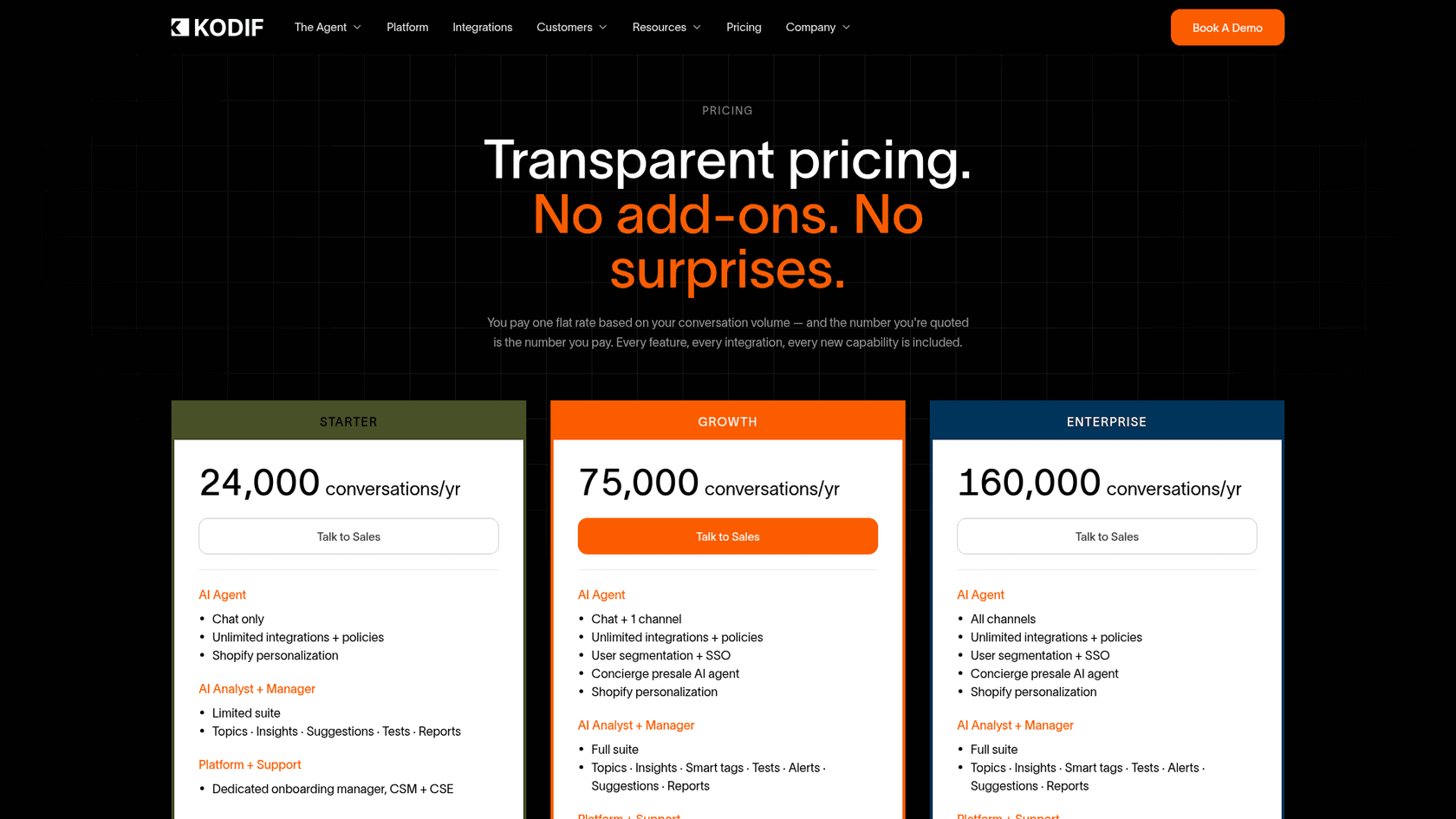
What the pricing page leaves out for a Gorgias team: you still pay for Gorgias. Kodif replaces the AI Agent add-on, not the helpdesk. My Kodif pricing breakdown covers the floor in more detail.
How Gorgias AI Agent bills
Gorgias bundles AI Agent into each plan. Here are the October 2026 prices with AI Agent turned on, billed annually (Gorgias pricing):
| Plan | Price | Tickets/mo | Automated interactions | Per automated interaction |
|---|---|---|---|---|
| Starter | $40/mo (monthly only) | 50 | 30 | $1.00 |
| Basic | $77/mo | 300 | 30 | $0.90 |
| Pro | $471/mo | 2,000 | 190 | $0.90 |
| Advanced | $1,227/mo | 5,000 | 530 | $0.85 |
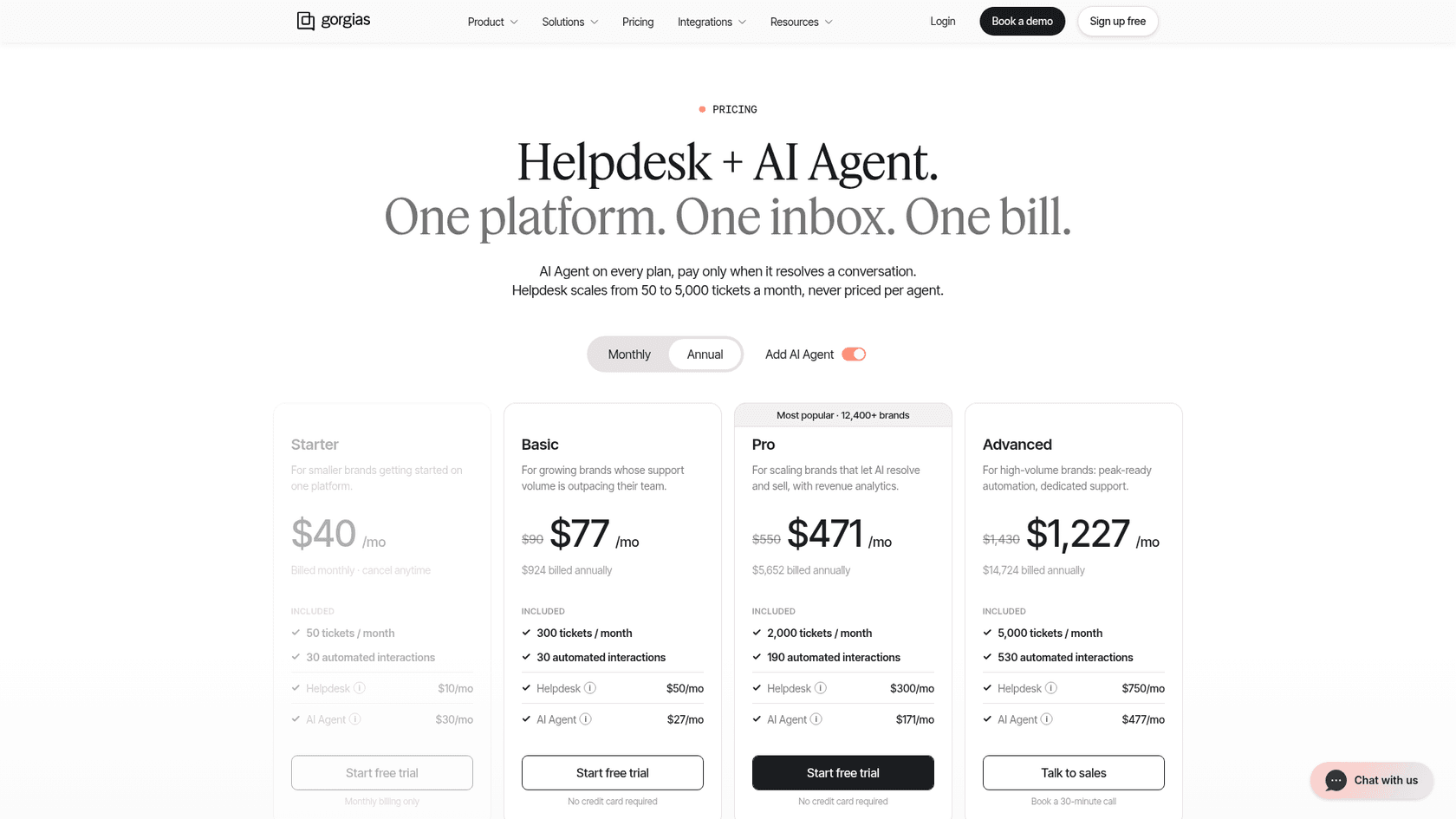
Two rules from the billing doc change the math. First, when AI Agent resolves a ticket with no handover, you pay both a ticket fee and an automation fee on that one ticket. A handover costs the ticket fee only. Second, a conversation counts as automated if no human gets involved "within 72 hours."
One detail to ask about on a call: in August 2026 the plan cards listed $1.50 per automated interaction "past your limit." The October page lists only the per-interaction rate. If extra interactions still bill at $1.50, the numbers below shift a lot, so I've put a toggle for it in the calculator. My Gorgias AI Agent pricing guide tracks these changes.
What each one costs at 2,000 tickets a month
To compare like with like, I priced the whole stack that each team would be running: Gorgias with AI Agent on its own, Kodif Starter plus a Gorgias Pro helpdesk ($300/mo annual, no AI), and eesel plus the same Gorgias helpdesk.
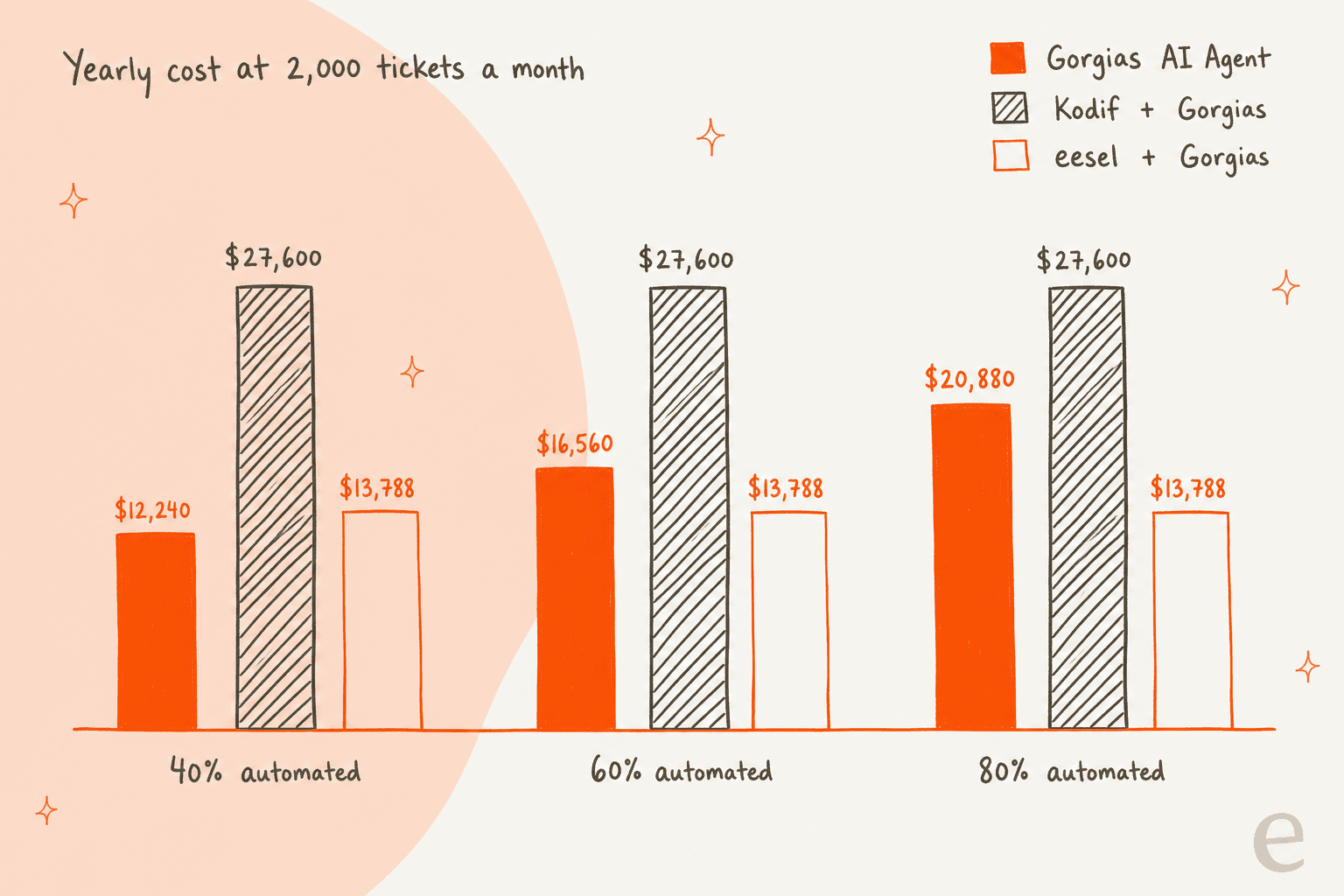
At the $0.90 rate, Gorgias AI Agent stays cheaper than Kodif-plus-Gorgias at every automation rate for a 2,000-ticket brand. Even at 100% automation it lands near $25,200. If extra interactions bill at $1.50, Gorgias passes Kodif-plus-Gorgias at roughly 70% automation. That's the honest version of "it depends". Plug in your own numbers:
Two things the numbers leave out, to be fair to both. Kodif's rate includes a dedicated onboarding manager, CSM and support engineer, and Kodif builds most of the agent for you. If Kodif runs its own chat widget, chats it closes may never become billable Gorgias tickets, which could let you sit on a smaller Gorgias plan. Ask both vendors how a Kodif-closed chat shows up in Gorgias before you sign. For more per-ticket math, see my cost per resolution breakdown.
What reviewers say about each one
Both products get good marks overall. The complaints differ though, and they line up with how each product is designed.
Kodif: you often wait on Kodif to change Kodif
The recurring Kodif theme is that the last mile goes through Kodif's engineers. G2's averages put time to implement at 2 months, against "9 days from contract to fully resolving tickets" on the Kodif homepage.
"Due to the complexity of automations, we do need a KODIF engineer to finish the policies, however they are very responsive and quick."
The same reviewer gives Kodif 5 stars and says it let the team handle peak volume without doubling support hours. So it's a dependency you plan for, it's not a reason to rule Kodif out. If you change return rules every flash sale, ask how fast a policy change ships and who makes it.
Gorgias AI Agent: cost at volume and the Shopify fence
Gorgias reviewers like how close AI Agent sits to the Shopify data. The complaints are about cost when volume grows and about the edges of what it can reach. On cost, one Shopify merchant laid out their estimate:
"I want to start using Gorgias AI Agent to automate tickets and also add voice support inside Gorgias, but the cost is insane. Right now I'm estimating roughly: $500+/month for ~400 AI Agent ticket resolutions [...] That feels like a ton for what we're getting, especially when combined with our existing plan."

On reach, another merchant found the agent couldn't talk to some of their third-party tools:
"i discovered quickly that the Gorgias AI would not work for us because it can't communicate with some of the third party platforms we use"
That second complaint is exactly the opening which Kodif sells into: a layer with 100+ ecommerce connectors that can reach the systems the built-in agent doesn't. My guides to AI escalation and containment vs escalation quality cover what to measure in your first month with either one.
Which one should you pick?
Here's how I'd decide if I were running a Gorgias queue.
| If you... | Pick | Why |
|---|---|---|
| Want one vendor, one inbox and one bill | Gorgias AI Agent | Built in, no sync, free trial |
| Care most about list price | Gorgias AI Agent | Cheaper than Kodif plus a Gorgias helpdesk at every volume I modeled, up to 5,000 tickets a month |
| Run a subscription brand where cancellations are a top intent | Kodif | Dedicated Retention agent with a published 19% save rate |
| Need the agent to reach NetSuite, a 3PL or a custom OMS | Kodif | Builds custom tools on top of 100+ connectors |
| Sell on BigCommerce, Magento or WooCommerce | Kodif | Gorgias AI Agent needs Shopify |
| Want someone else to build and maintain the agent | Kodif | Onboarding manager, CSM and support engineer included |
| Want to change the agent yourself, same day | Gorgias AI Agent, or see below | Gorgias gives you the controls; Kodif's team holds many of them |
| Might leave Gorgias for another helpdesk later | Kodif | The agent moves with you |
If you're still weighing other tools, my Kodif AI alternatives list and best Gorgias alternatives go wider. Gorgias AI vs Siena AI and Kodif AI vs Siena AI cover the closest managed rival to both.
eesel for Gorgias teams weighing Kodif
If you like the idea of a layer on top of Gorgias but you want to own it yourself, eesel works like a new hire who joins your Gorgias queue and has already read your past tickets and macros. That's the knowledge Gorgias AI Agent doesn't answer from. It drafts or sends replies, tags and routes, checks Shopify orders, and every action (refund, cancel, address change) can run on its own or wait for your approval.
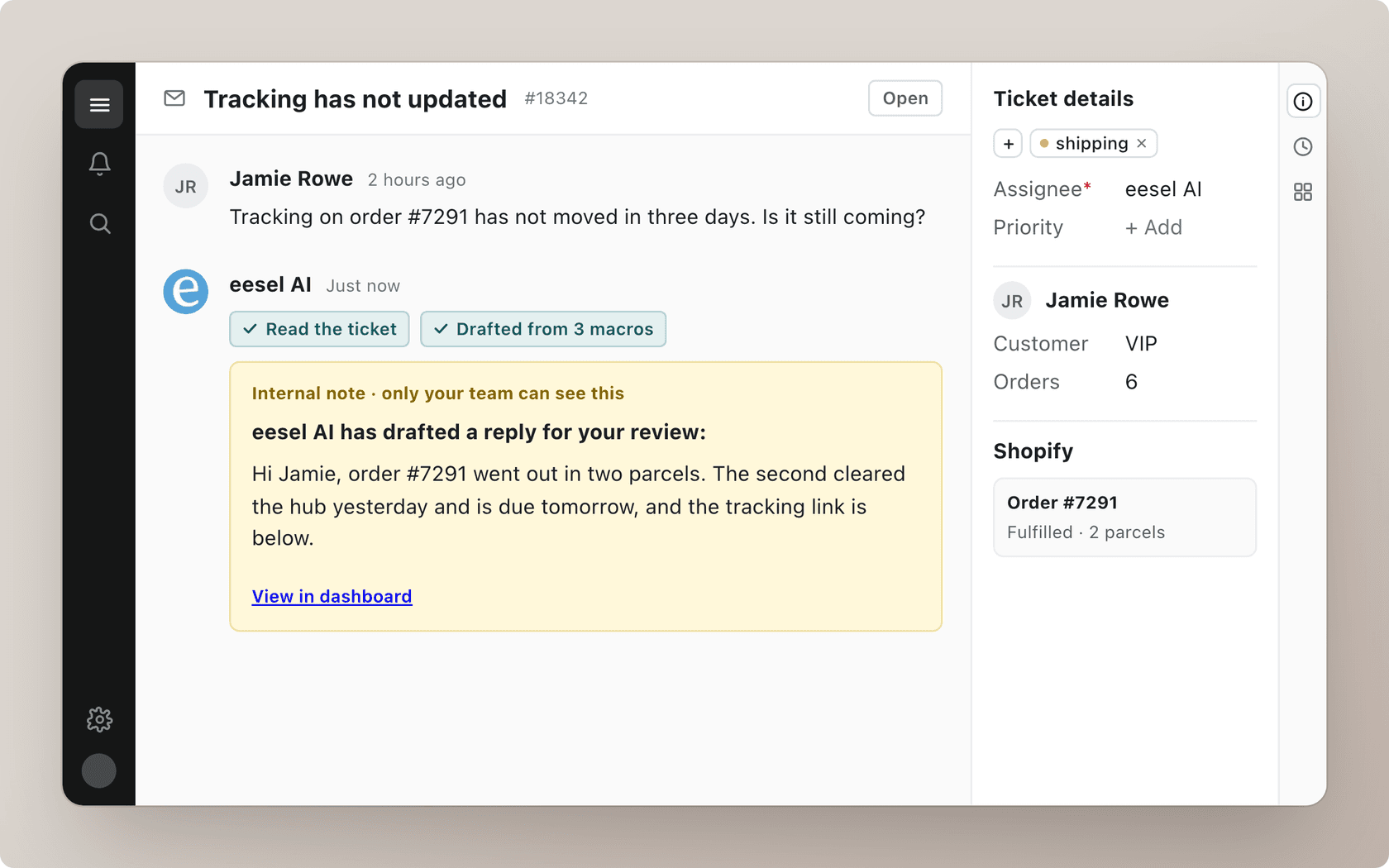
Before it touches a live customer, you run it against a batch of your real past Gorgias tickets and read how it scored, instead of testing one Playground chat at a time. For the "wait on the vendor" problem Kodif reviewers raise, the eesel CLI lets your own engineer, or a coding agent like Claude Code, edit the agent's rules (eesel instructions), clear held actions (eesel approvals) and audit what it did (eesel activity) from a terminal, with no ticket to anyone.
To be fair about where it doesn't fit: eesel has no prebuilt cancel-save agent like Kodif's Retention agent, and it isn't a helpdesk, so you still pay for Gorgias. On the bill, it's one meter: one credit per ticket handled, not a ticket fee plus an automation fee. Pricing is public, from $299 a month for 500 tickets, with 100 free credits to start. Try eesel on last week's Gorgias tickets and see what it would have sent.
Frequently Asked Questions
What is the difference between Kodif AI and Gorgias AI Agent?
Can I use Kodif with Gorgias?
Is Kodif AI cheaper than Gorgias AI Agent?
How much does Gorgias AI Agent cost in 2026?
How much does Kodif AI cost?
Does Gorgias AI Agent work without Shopify?
Which is better for subscription brands, Kodif or Gorgias AI?
Is there an alternative to Kodif and Gorgias AI Agent on Gorgias?



Article by
Rama Adi
Rama is a software engineer at eesel AI with two years of experience writing about B2B SaaS, AI tools, and customer support technology. Based in Bali, Indonesia, he brings a developer's perspective to product comparisons — cutting through marketing copy to what the integrations and APIs actually do.