8 Kodif AI alternatives in 2026 (with real first-year costs)

Rama Adi

Katelin Teen
Last edited October 8, 2026
Why people look for Kodif alternatives
I build integrations at eesel, so a big part of my week goes into the same ecommerce stacks Kodif plugs into, things like Gorgias, Zendesk, Shopify and Recharge. On sales calls the pattern keeps showing up in pretty much the same shape. One DTC supplements brand doing about 7,000 Gorgias tickets a month put the bar like this:
"I need an AI who is only handling the tickets that it's confident to handle and all the other ones, leave them alone."
Ops lead at a DTC supplements brand on Gorgias + Shopify, ~7,000 tickets/month (eesel sales call)
For a lot of brands, Kodif clears that bar. Kodif sells one ecommerce agent split into jobs. There's a Resolution agent for refunds, returns and order edits and a Retention agent for subscription cancel-saves, then a Revenue agent on top that takes presale questions. It runs on top of your helpdesk (Zendesk, Gorgias, Kustomer, Gladly, Freshdesk and others) rather than replacing it.
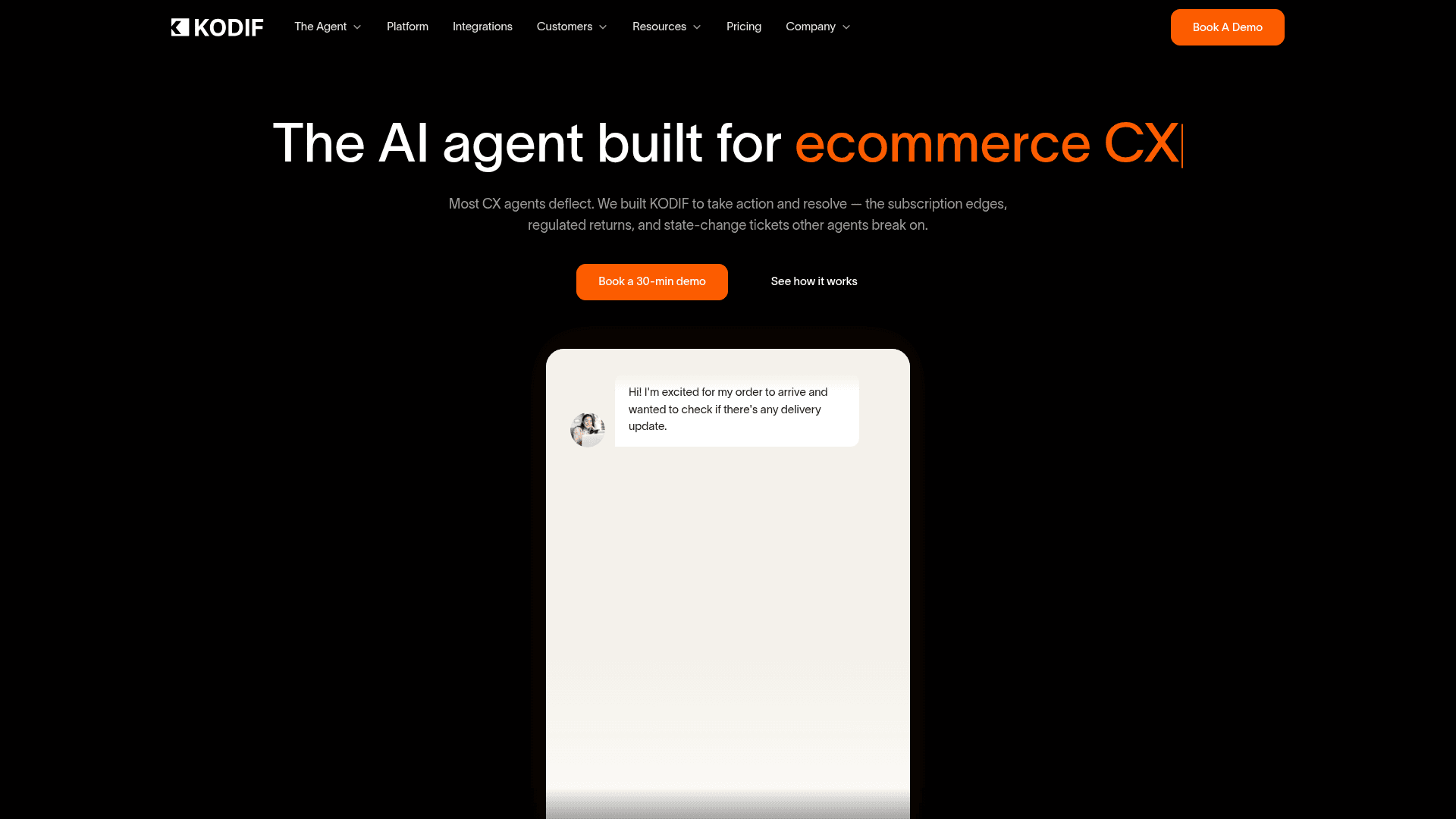
What it shows on its own site is real, and specific too. Helix Sleep reports 71.8% containment across 31,821 conversations from January to May 2026 (Helix case study). Liquid I.V.'s team says on the Kodif homepage that they hit 70% containment in the first two weeks and held it for a year. Kodif's G2 page has zero reviews below four stars.
So why are people searching for alternatives at all? If you read the "dislikes" part of those same G2 reviews, a few complaints come back again and again.
You often need Kodif to change Kodif
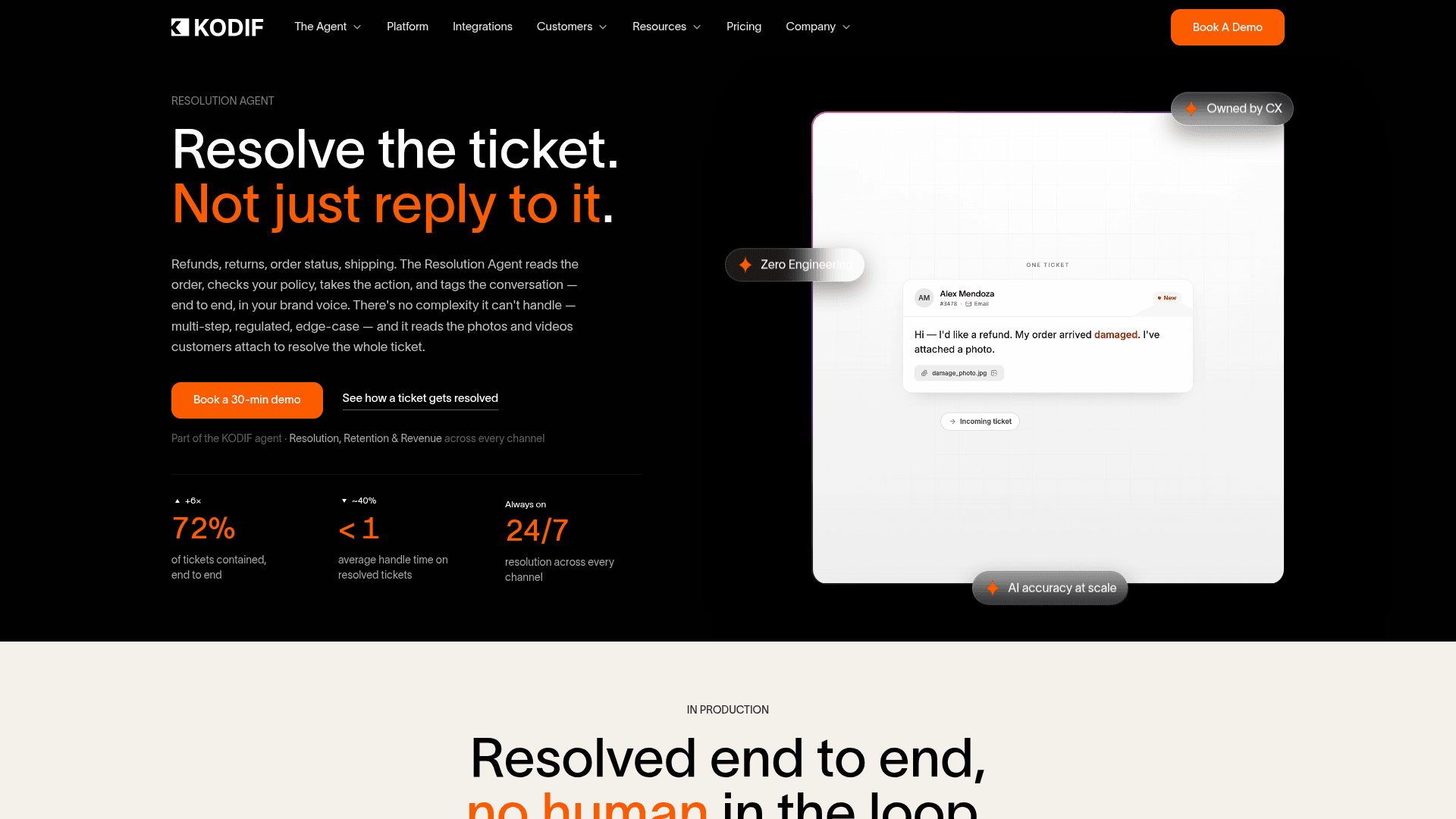
The Kodif platform page says "zero engineering," and yes, policy editing is in plain English. Several reviewers still mention that the last mile goes through Kodif's team, though.
"Due to the complexity of automations, we do need a KODIF engineer to finish the policies, however they are very responsive and quick."
Lauryn D., G2, Director of Customer Experience

"It should also enable the Developers functions for the companies to be able to add / modify tools designed inside Kodif, due to which we always have to as the Kodif Team to update a tool created by them."
Saad M., G2, Customer Retention Team Lead
When the vendor is responsive this is fine, and reviewers do say Kodif is. Where it starts to hurt is a flash sale, when your return policy changes on a Thursday afternoon and you are waiting on someone else. G2's own user averages put Kodif's time to implement at 2 months, which is longer than the "9 days from contract to fully resolving tickets" claim on the Kodif homepage.
Pricing is published as rates, not totals
Kodif's pricing page is more open than most in this category, to be fair. You pay a flat annual rate based on conversation volume, no seat fees and also no setup fee. Starter covers 24,000 conversations a year at $1 each, Enterprise covers 160,000 at $0.75, and the Growth rate isn't stated.
| Kodif plan | Annual volume | Per-conversation rate | Implied annual floor | Channels |
|---|---|---|---|---|
| Starter | 24,000 | $1.00 | about $24,000 | Chat only |
| Growth | 75,000 | Not published | Not published | Chat + 1 channel |
| Enterprise | 160,000 | $0.75 | about $120,000 | All channels |
The implied floor is my own math (volume times rate), it's not a number Kodif prints anywhere. There are two more things worth knowing here. A "conversation" means any ticket the agent works from start to finish, so you are billed for it whether the AI resolves it or not. Starter is also chat only, so email automation needs Growth at a rate you'll only learn on a call.
What it learns from, and what it doesn't
Kodif learns from your FAQs and help center, your website and docs, and on top of that the policies you write. Past ticket history gets used for replay testing, but it isn't listed as a knowledge source. Its docs and help center sit behind a login, and there's no voice channel anywhere on the site.
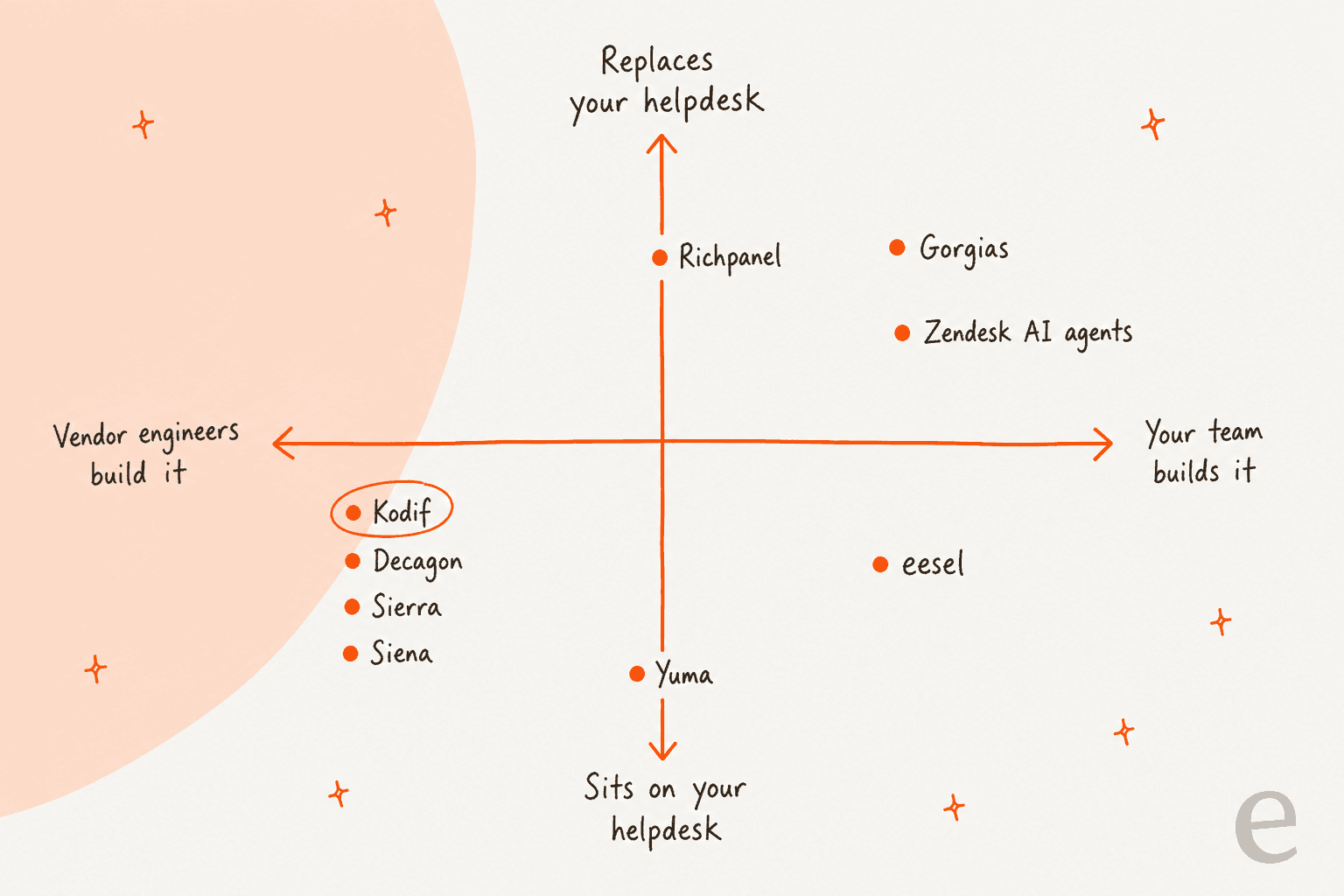
None of this makes Kodif a bad pick, it just means you are buying a managed build. The alternatives below are split along that line, first who builds the agent and then whether it lives on your helpdesk or replaces it.
Kodif AI alternatives at a glance
This is how the eight stack up on the points that usually decide a shortlist, with Kodif kept in the first row as the baseline.
| Tool | Best for | Your helpdesk or replaces it | Billing unit | Entry price | Free trial | Shopify | Voice | Security listed | Who builds it |
|---|---|---|---|---|---|---|---|---|---|
| Kodif (baseline) | Managed ecommerce agent | Sits on 10 helpdesks | Per conversation worked, annual | ~$24,000/yr | No | Yes | No | SOC 2 Type II, HIPAA, ISO 27001 | Mostly Kodif |
| eesel | Teams who want to edit it themselves | Sits on Gorgias, Zendesk, Freshdesk and more | Per ticket or chat worked (credit) | $299/mo | Yes, 100 credits | Yes | No | SOC 2 Type II underway, HIPAA on Enterprise | You |
| Yuma | Subscription DTC brands | Sits on 10 helpdesks | Per full resolution | $14,400/yr | First 30 days free | Yes | Via Twilio | SOC 2 Type II, GDPR, CCPA | Shared |
| Siena | Consumer brands wanting a CX "OS" | Sits on Zendesk, Gorgias, Kustomer, Gladly, Dixa | $750/mo + per automated ticket | ~$9,000/yr + usage | No | Yes | Not listed | SOC 2, HIPAA, GDPR, CPRA | Mostly Siena |
| Gorgias AI Agent | Shopify brands wanting one tool | Is the helpdesk | Per automated interaction + per ticket | $40/mo | Yes, no card | Yes | Add-on from $25/mo | SOC 2 Type II, HIPAA | You |
| Richpanel | Brands ready to switch helpdesks | Is the helpdesk | Per seat + per AI conversation | $69/seat/mo + $2,000 setup | Yes | Yes | Via Aircall, Dialpad, JustCall | SOC 2 Type II, HIPAA, CASA | Shared |
| Zendesk AI agents | Teams already on Zendesk | Is the helpdesk | Per verified resolution past allowance | $19/seat/mo | 14 days | Via custom actions | Early access | SOC 2 Type II, ISO 27001, FedRAMP | You |
| Decagon | Enterprise chat and voice | Sits on Zendesk, Salesforce | Per conversation or per resolution | Quote only | No | Via MCP or API | Yes (Voice 3) | SOC 2 Type II, ISO 27001, PCI DSS, HIPAA | Mostly Decagon |
| Sierra | Fortune 500 consumer brands | Not published | Per outcome | Quote only | No | Not named | Yes | SOC 2, FedRAMP High, ISO 42001, PCI | Mostly Sierra |
What 2,000 tickets a month actually costs
Sticker prices in this category don't use the same units, so comparing them directly doesn't work well. I ran one scenario through every public rate card instead: 2,000 tickets a month, with AI fully resolving 60% of them (1,200 a month), and that 60% is roughly what Kodif's own reviewers report. All figures are first-year at list price.
| Tool | How the bill is built | First-year cost |
|---|---|---|
| Kodif | 24,000 conversations x $1 (Starter is chat only) | about $24,000 |
| Siena | $750/mo platform + 14,400 automated tickets x $0.90 | about $21,960 + undisclosed implementation |
| Yuma | 14,400 resolutions is past Starter's 12,000, so Growth or a custom bundle | $14,400 to $40,000 |
| Gorgias AI Agent | Pro with AI Agent at $471/mo (2,000 tickets, 190 automations) + 1,010 extra automations x $0.90 | about $16,560, helpdesk included |
| Richpanel | 5 Pro seats x $69 + 2,000 AI conversations x $0.20 + $2,000 setup | about $10,940, helpdesk included |
| eesel | 2,000 credits plan at $849/mo | about $10,188 ($8,490 paid annually) |
| Zendesk AI agents | Seats + included verified resolutions, then $1.50 to $2.00 each | Depends on seat count |
| Decagon, Sierra | Quote only | Not published |
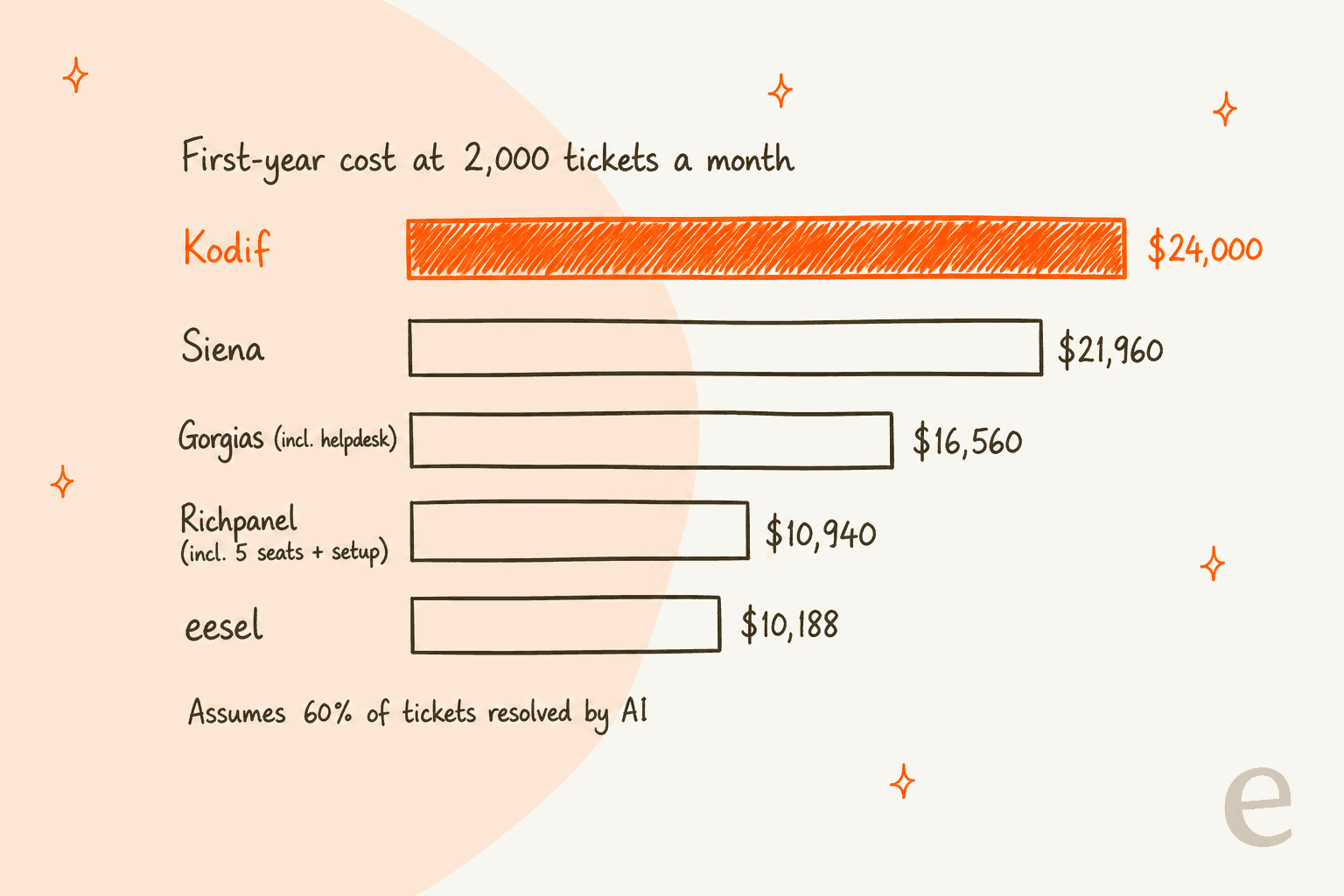
Two caveats, to be fair about it. Kodif's $24,000 includes a dedicated onboarding manager, CSM and support engineer, and that hands-on team is the part reviewers praise the most. The per-ticket figures also leave out your helpdesk bill for the tools that sit on top of one (Kodif, eesel, Yuma, Siena). If you want to model your own volume, my AI customer service cost guide and the cost per resolution breakdown walk through it.
How I picked these alternatives
I only kept tools a Kodif buyer would realistically put on a shortlist, meaning AI agents that handle ecommerce tickets (order status, returns, refunds, subscriptions) and either plug into Gorgias, Zendesk or Kustomer or replace them. Every price and limit below comes from the vendor's own pricing page, docs or trust center, checked on October 8, 2026. General chatbot builders that can't take actions on orders, I left out.
Each tool gets the same layout: what it is, then pros and cons, then pricing and my take at the end.
1. eesel
Best for: ecommerce teams on Gorgias, Zendesk or Freshdesk who want to build, test and change the agent themselves.
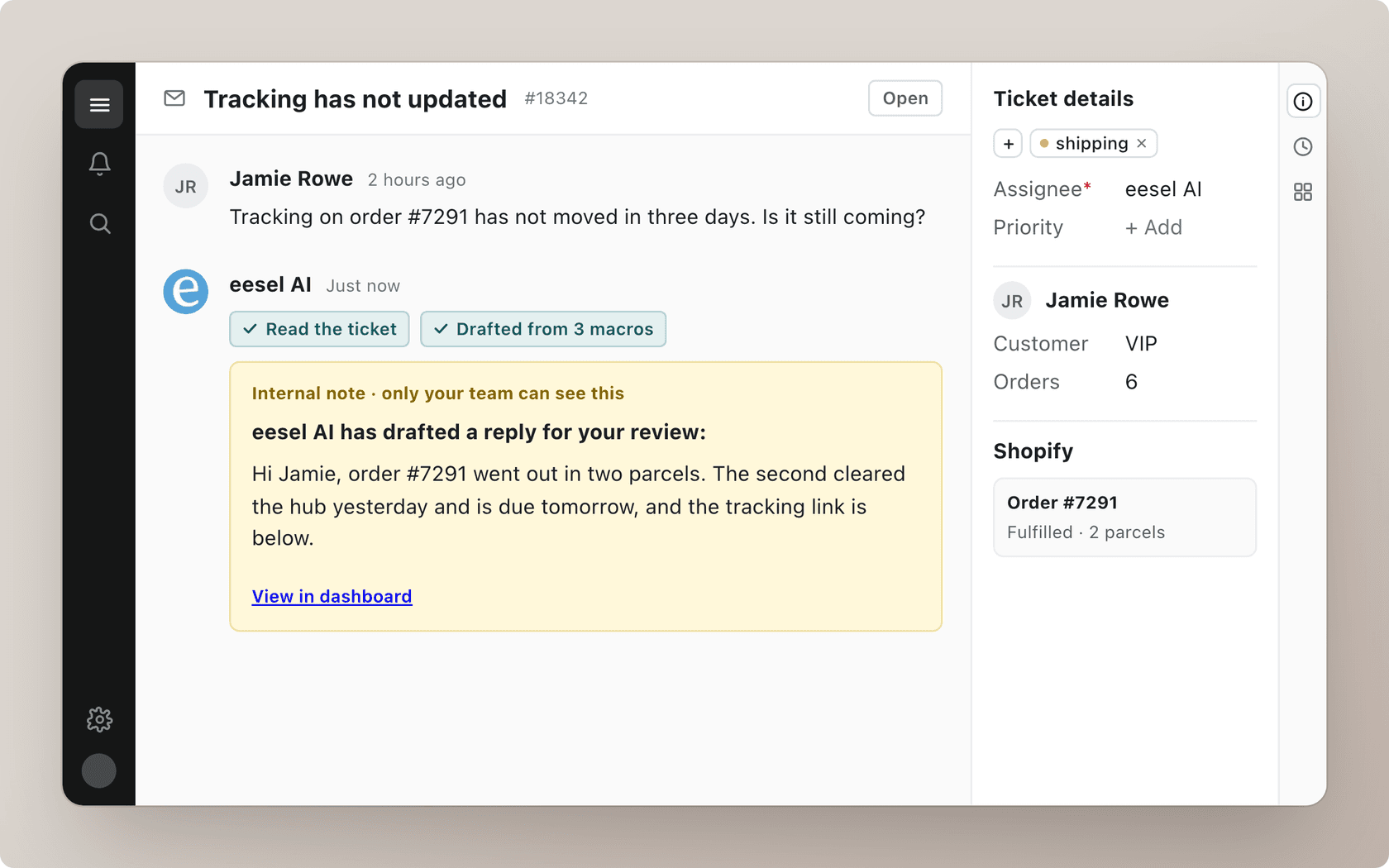
Full disclosure first: this is where I work, so weigh my take with that in mind. eesel is an AI teammate that joins your existing helpdesk the way a new hire would. On Gorgias it works inside your tickets, email and chat alike, where it drafts or sends replies and leaves internal notes. It also tags, assigns and closes tickets, and it checks the customer's Shopify orders.
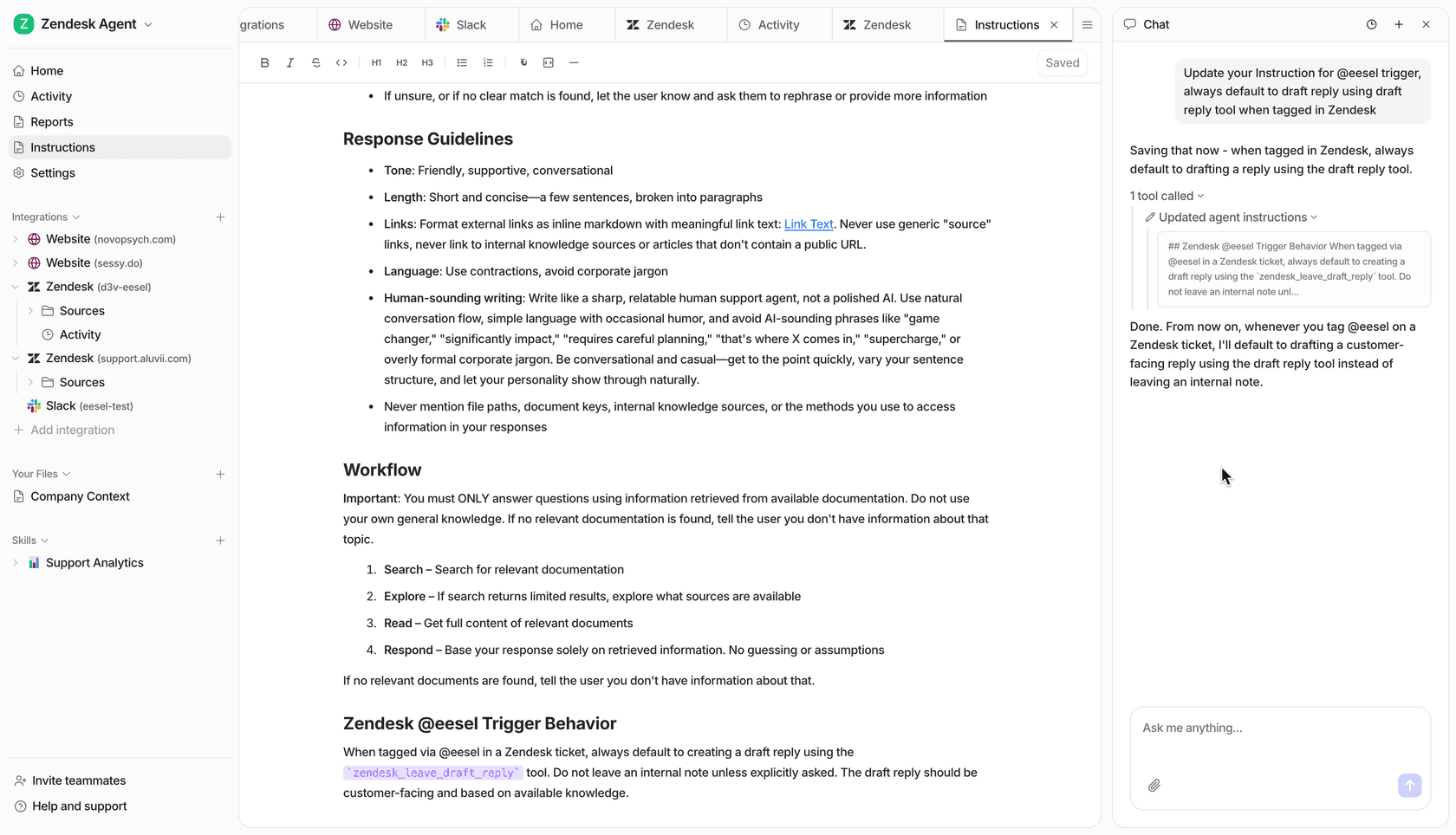
The difference from Kodif comes down to who holds the pen. Before it touches a new ticket, eesel reads your help center, your macros and your past tickets, so it already knows how your team answers. Instructions are written in plain English. Every action (refund, cancel, address change) can run on its own or wait for your approval, or you can just leave it off. So when something changes on a Thursday afternoon, you are the one editing the instruction.
This is also the spot where the developer-access gap from Kodif's reviews gets closed. The eesel CLI runs the same agent from a terminal: eesel integrations connect gorgias to connect, eesel instructions to read or edit its standing rules, eesel approvals to approve held actions, and eesel activity to see what it did. Because every command prints JSON, a coding agent like Claude Code or Cursor is able to make the changes for you, and it stays under the same approval rules as the dashboard.
Before you go live, the simulation skill runs your agent against real past tickets and scores each answer, then it suggests changes to the instructions. In one real-traffic trial on a German jewelry brand's Zendesk + Shopify inbox (about 1,000 tickets a month, eight languages), eesel hit 93% triage accuracy and 100% spam detection.
Pros
- Learns from past tickets and macros, not just help center articles.
- You edit instructions and actions yourself, in the dashboard, Slack or the terminal.
- Shopify connection looks up orders and tracking, starts returns and fixes addresses.
- Month to month, public pricing, free trial with 100 credits.
Cons
- It isn't ecommerce-only, so there's no prebuilt subscription cancel-save flow like Kodif's Retention agent; you build that one yourself with instructions and the Recharge or Stripe connection.
- No voice channel.
- SOC 2 Type II is still underway; HIPAA with a BAA is Enterprise only.
- Kustomer and Gladly aren't on the helpdesk list.
Pricing
| Plan | Price | Credits |
|---|---|---|
| Free | $0 | 100 credits trial, every feature |
| Teammate | from $299/mo | 500 credits (2,000 = $849, 5,000 = $1,749) |
| Enterprise | Custom | SSO, data residency, HIPAA with BAA |
Each ticket or chat the agent works on counts as one credit, no matter how long it runs (eesel pricing). There are no seat fees, and if you prepay annually you get two months free.
My take: If the Kodif friction you felt was mostly waiting on someone else to change your agent, pick eesel. Skip it when you want a vendor team running the whole build, or when you need voice today.
2. Yuma AI
Best for: subscription-heavy DTC brands that want a managed ecommerce agent with published prices.
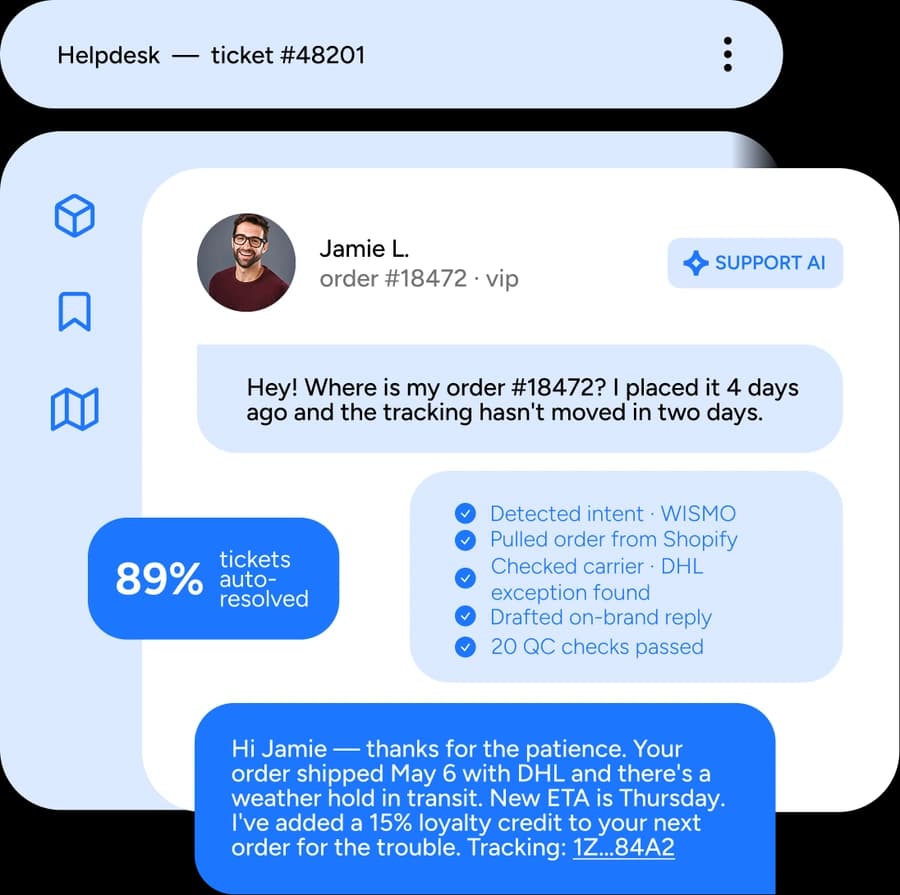
Yuma is the closest like-for-like swap for Kodif. It's built only for ecommerce and installs on top of your helpdesk, where it handles support tickets and presale chat, plus social DMs. The helpdesk list is wider than the one Kodif has: Gorgias, Zendesk, Kustomer, Salesforce Service Cloud, Front, Gladly, Re:amaze, Zoho Desk, Sprinklr and HubSpot.
The bigger news is that Yuma publishes its prices now, and what it bills is only full resolutions: "If a human touches the ticket, it doesn't count against your plan" (Yuma pricing). That meter is quite different from Kodif's, where every conversation the agent works gets billed.
Pros
- Pays only for tickets the AI closes with no human involved.
- Deep subscription stack: Recharge, Skio, Loop, Stay AI, Seal.
- "First 30 days on us," with no implementation fee.
- EvryJewels reports 89% automation and cost per ticket down from
$5.50to$2(case study).
Cons
- Every plan is a 12-month commitment, and once an annual bundle is used up it pauses instead of billing overage.
- Customer data may be used to improve Yuma's models unless you opt out (Yuma security).
- Sales AI and Social AI cost extra.
Pricing
| Plan | Annual price | Resolutions per year | Effective rate |
|---|---|---|---|
| Starter | $14,400 | 12,000 | ~$1.20 |
| Growth | $40,000 | ~48,000 | ~$0.83 |
| Scale | $90,000 | ~120,000 | ~$0.75 |
My take: Yuma is the one to pick if you liked Kodif's managed model but only want to pay for real resolutions. When your volume falls between Starter and Growth, ask them for a custom bundle, since Yuma says it builds those around your forecast. More in my Yuma AI pricing guide.
3. Siena AI
Best for: consumer brands that want one AI layer across support, shopping, social and QA.
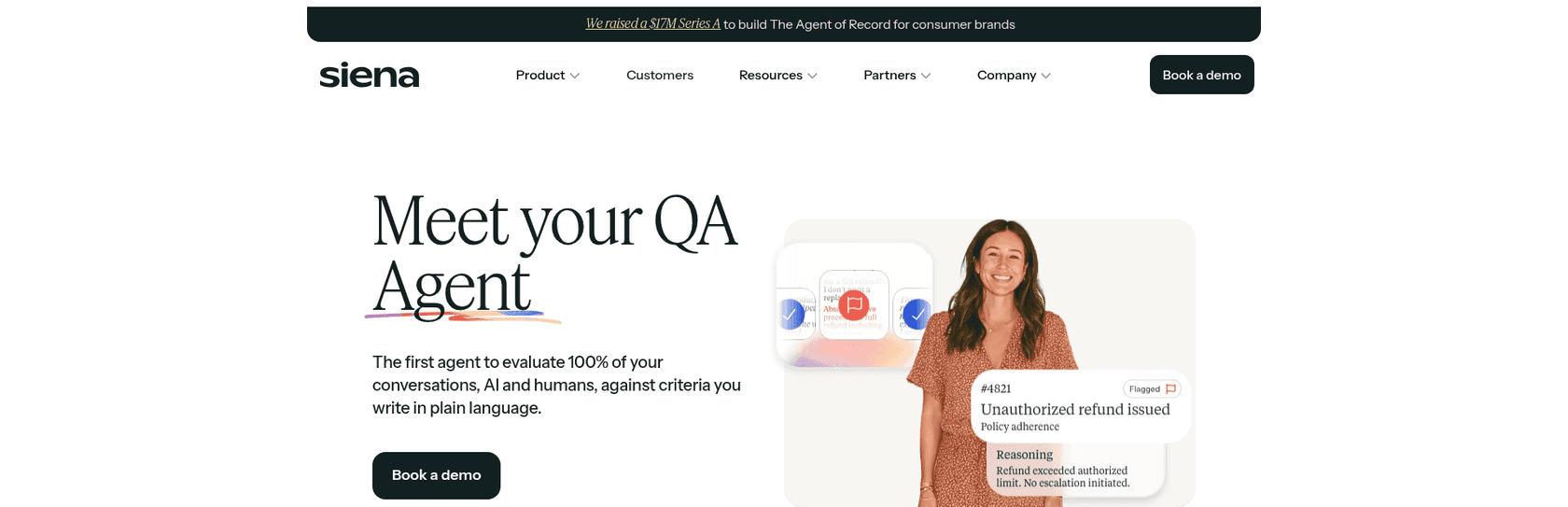
Siena calls itself "The AI CX operating system for consumer brands." Like Kodif, it sits on your helpdesk (Zendesk, Gorgias, Kustomer, Gladly, Dixa). The product line has grown quite a bit. Next to the customer service agent there are now shopping and social agents, a QA agent that scores every conversation against criteria you write, and Ask Siena, which answers questions about your own support data.
On the integrations side it leans hard into ecommerce operations: Shopify, Recharge, Skio, Ordergroove, AfterShip, ShipBob, Loop Returns and Stripe (Siena integrations).
Pros
- QA agent reviews AI and human conversations against your own rules.
- Strong subscription and shipping connectors.
- Spanx reports Siena handles 50% of conversations at 90%+ CSAT (Siena homepage).
- Trust center lists SOC 2, HIPAA, GDPR and CPRA.
Cons
- No self-serve signup or trial; every price goes through a form.
- "Automated ticket" isn't defined on the pricing page.
- No Salesforce Service Cloud listing.
Pricing
| Component | Price | Unit |
|---|---|---|
| Platform fee | $750/mo | Flat |
| Automation pack | $0.90 | Per automated ticket |
| Support and implementation | Not disclosed | Onboarding + Slack support |
My take: Siena fits a brand that wants more than ticket deflection, QA and shopping most of all. The $750 platform fee puts a floor of about $9,000 a year in place before a single ticket, which means it pays off mainly at volume. See Siena AI pricing for detail, or the Siena vs Yuma head to head.
4. Gorgias AI Agent
Best for: Shopify brands that want the helpdesk and the AI on one bill.
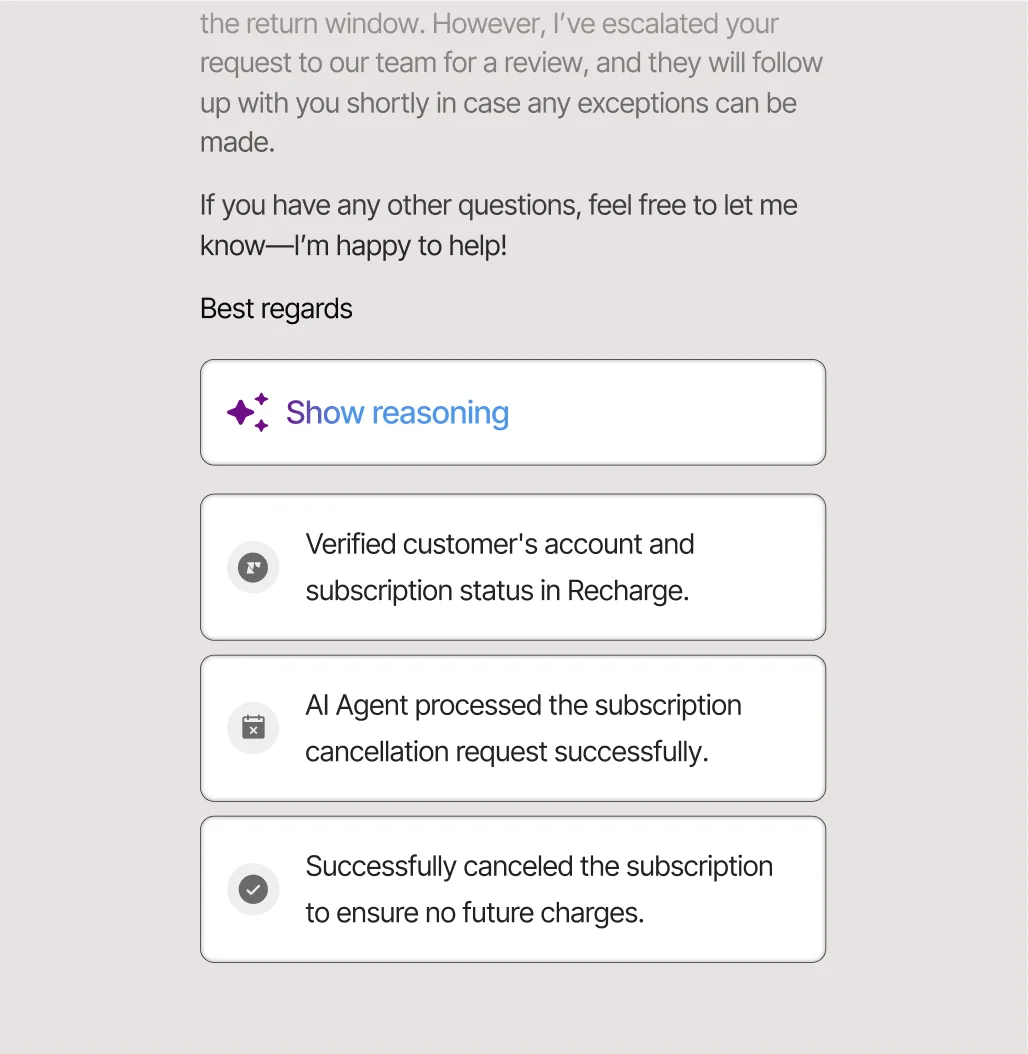
A lot of Kodif customers already run Gorgias underneath it, which makes Gorgias AI Agent the obvious "do we even need a separate layer?" question. It's built right into the helpdesk and can process actions like subscription cancellations. Gorgias also ships Gaia now, an in-product assistant that audits AI Agent skills and flags knowledge gaps.
The trade-off sits in the meter. Gorgias bills you for helpdesk tickets and on top of that a separate fee per automated interaction, and when the AI resolves a ticket with no handover you pay both (Gorgias billing doc).
"I want to start using Gorgias AI Agent to automate tickets and also add voice support inside Gorgias, but the cost is insane. Right now I'm estimating roughly: $500+/month for ~400 AI Agent ticket resolutions [...] That feels like a ton for what we're getting, especially when combined with our existing plan."

Pros
- No extra vendor if you're already on Gorgias.
- Free trial with no card on Starter, Basic and Pro.
- Orthofeet passed 50% automation after aiming for 30% in 30 days (Orthofeet story).
- SOC 2 Type II and HIPAA.
Cons
- Only works inside Gorgias; Zendesk or Kustomer teams would have to migrate.
- Resolved tickets carry both a ticket fee and an automation fee.
- Brand voice and actions aren't on Starter.
Pricing
| Plan (with AI Agent) | Monthly / annual | Tickets per month | Automations included | Extra automation |
|---|---|---|---|---|
| Starter | $40 | 50 | 30 | $1.00 |
| Basic | $90 / $77 | 300 | 30 | $0.90 |
| Pro | $550 / $471 | 2,000 | 190 | $0.90 |
| Advanced | $1,430 / $1,227 | 5,000 | 530 | $0.85 |
My take: On Gorgias with tickets that are mostly order status and returns? Start here before you buy a separate layer. Once the meter gets heavy, my Gorgias AI Agent pricing breakdown and the eesel vs Gorgias AI comparison show where a layer on top gets cheaper.
5. Richpanel
Best for: brands ready to leave Gorgias or Zendesk for an AI-first helpdesk.
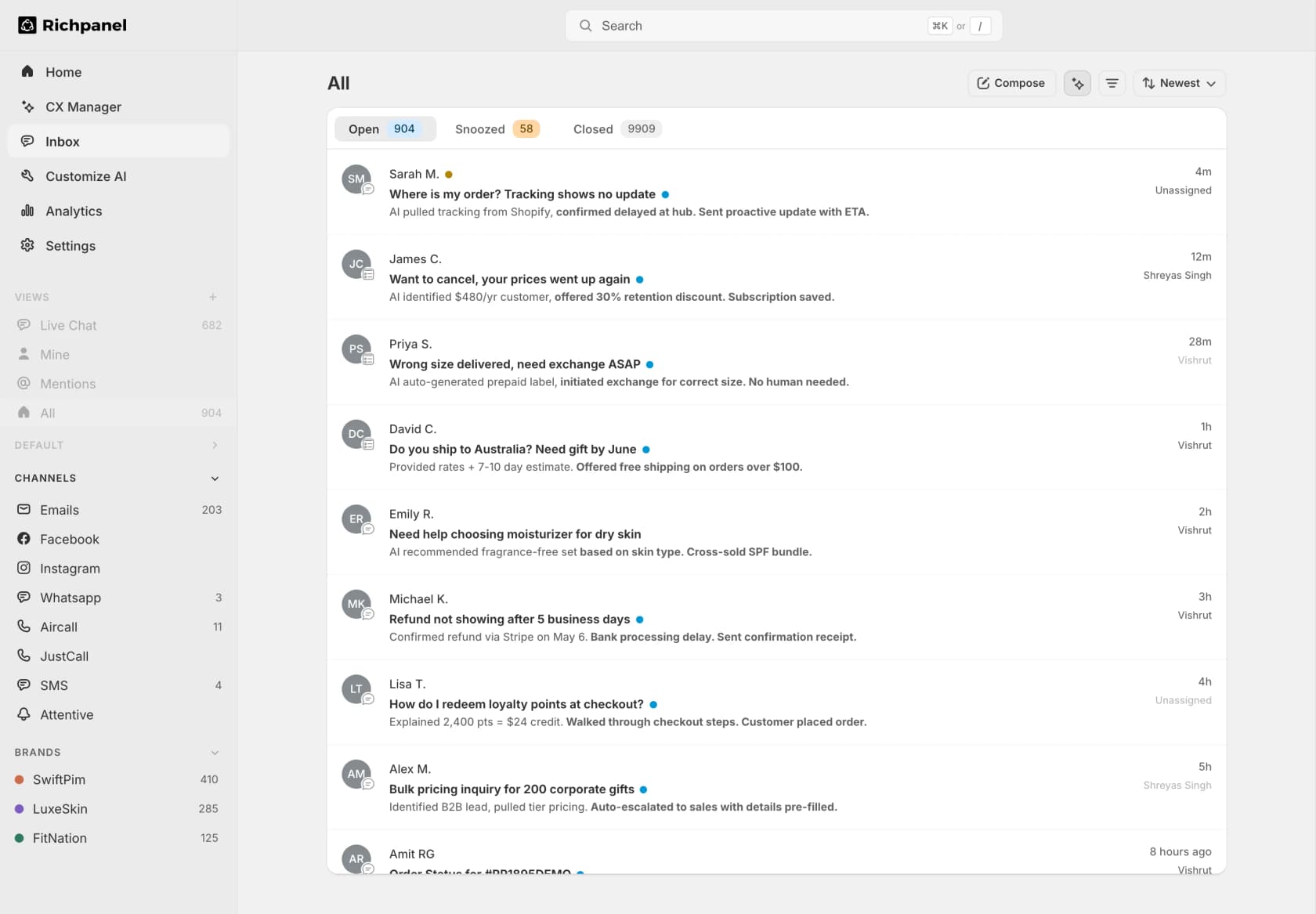
Richpanel pitches itself as "The helpdesk where AI closes 50% of tickets," built for teams that "outgrew Zendesk or Gorgias and the AI bolted onto it." It replaces your helpdesk entirely, putting email, chat, SMS, WhatsApp, social and phone into one inbox.
A lot of what Kodif reviewers asked for shows up in its AI controls. You get written SOPs and per-tool permissions (refunds can require approval), simulation on past tickets, and also a second QA AI that checks replies before they go out (Richpanel AI safety).
Pros
- Ridge reports cost per ticket down 70% and CSAT up from 88% to 96% (Ridge story).
- Migration from Gorgias or Zendesk done for you in about 14 days.
- Says it covers up to 100% of your remaining helpdesk contract when you switch.
- SOC 2 Type II, HIPAA audit (December 2025) and CASA.
Cons
- You have to move your whole helpdesk to use the AI.
- Yearly contracts only.
- The "every dollar back" guarantee covers subscription fees for the first 30 days only and excludes the setup fee (guarantee terms).
Pricing
| Item | Price |
|---|---|
| Pro seat | $69 per agent/month (annual) |
| Pro Max seat | $99 per agent/month (annual) |
| Customer Service AI | $0.20 per AI-handled conversation, $200/mo minimum |
| AI agents setup | $2,000 one-time |
My take: Per AI conversation Richpanel is cheap, and you get the helpdesk with it. Still, it only makes sense if leaving your helpdesk was already on your mind. More in Richpanel pricing and Richpanel alternatives.
6. Zendesk AI agents
Best for: brands already on Zendesk that want native AI without a second vendor.
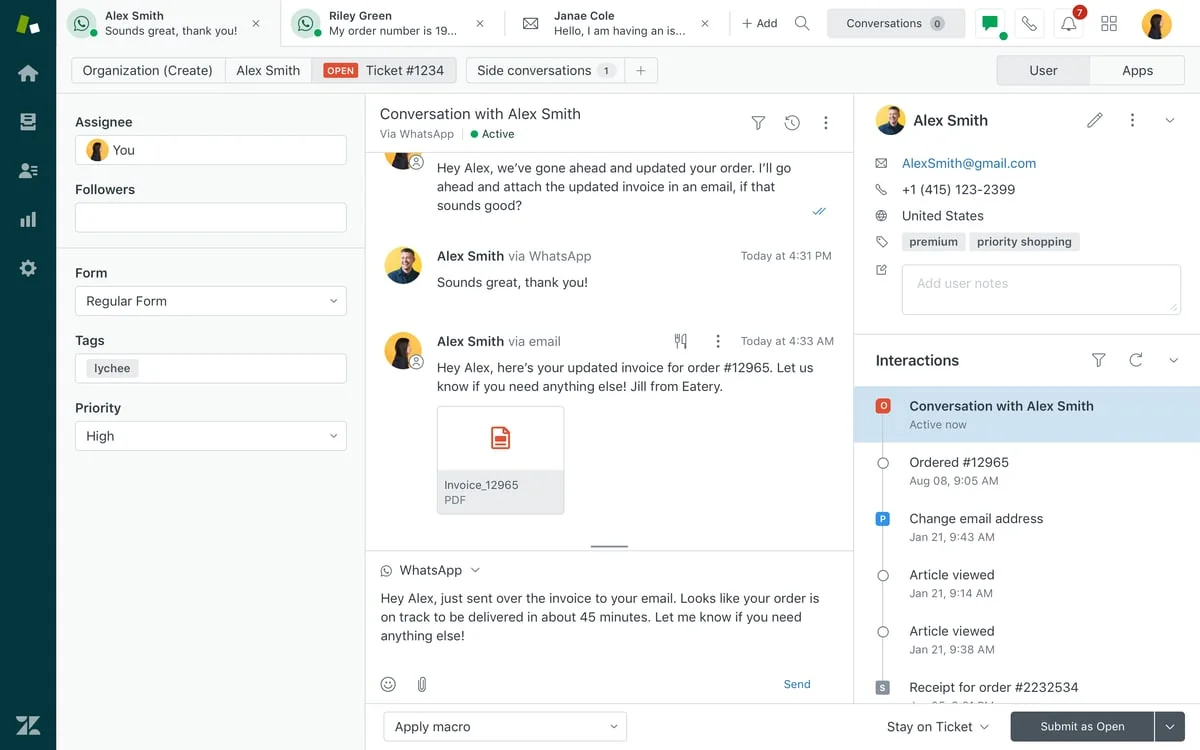
Several Kodif customers (Who Gives A Crap, OneSkin) run on Zendesk. Zendesk AI agents come included in every Suite and Support plan, with billing based on automated resolutions. Since May 18, 2026, only "Verified" resolutions count against your allowance, meaning the ones that pass an AI check confirming the request was actually resolved. Assisted escalations and contained conversations don't cost anything (Zendesk resolution tiers).
Pros
- No new vendor, no migration if you're on Zendesk.
- Only verified resolutions are billed.
- 80+ languages, plus a 14-day free trial.
- Deep compliance list: SOC 2 Type II, ISO 27001 family, FedRAMP.
Cons
- No prebuilt Shopify action; order lookups go through custom actions.
- Voice is still early access and needs Zendesk Voice.
- Existing accounts stay on the older per-agent allowance until they move over.
Pricing
| Plan | Annual, per agent | Monthly, per agent |
|---|---|---|
| Support Team | $19 | $25 |
| Suite Team | $55 | $69 |
| Suite Professional | $115 | $149 |
| Enterprise | Talk to sales | Talk to sales |
Past the included allowance, resolutions cost $1.50 committed or $2.00 pay-as-you-go. Copilot is a $50 per agent add-on.
My take: If you're on Zendesk and most of your tickets are simple, it's worth a trial. When ecommerce actions matter, though, test the missing Shopify action first, since that's the gap. My Zendesk AI pricing guide and eesel vs Zendesk AI cover the math.
7. Decagon
Best for: large consumer brands that need chat and voice on one enterprise agent.
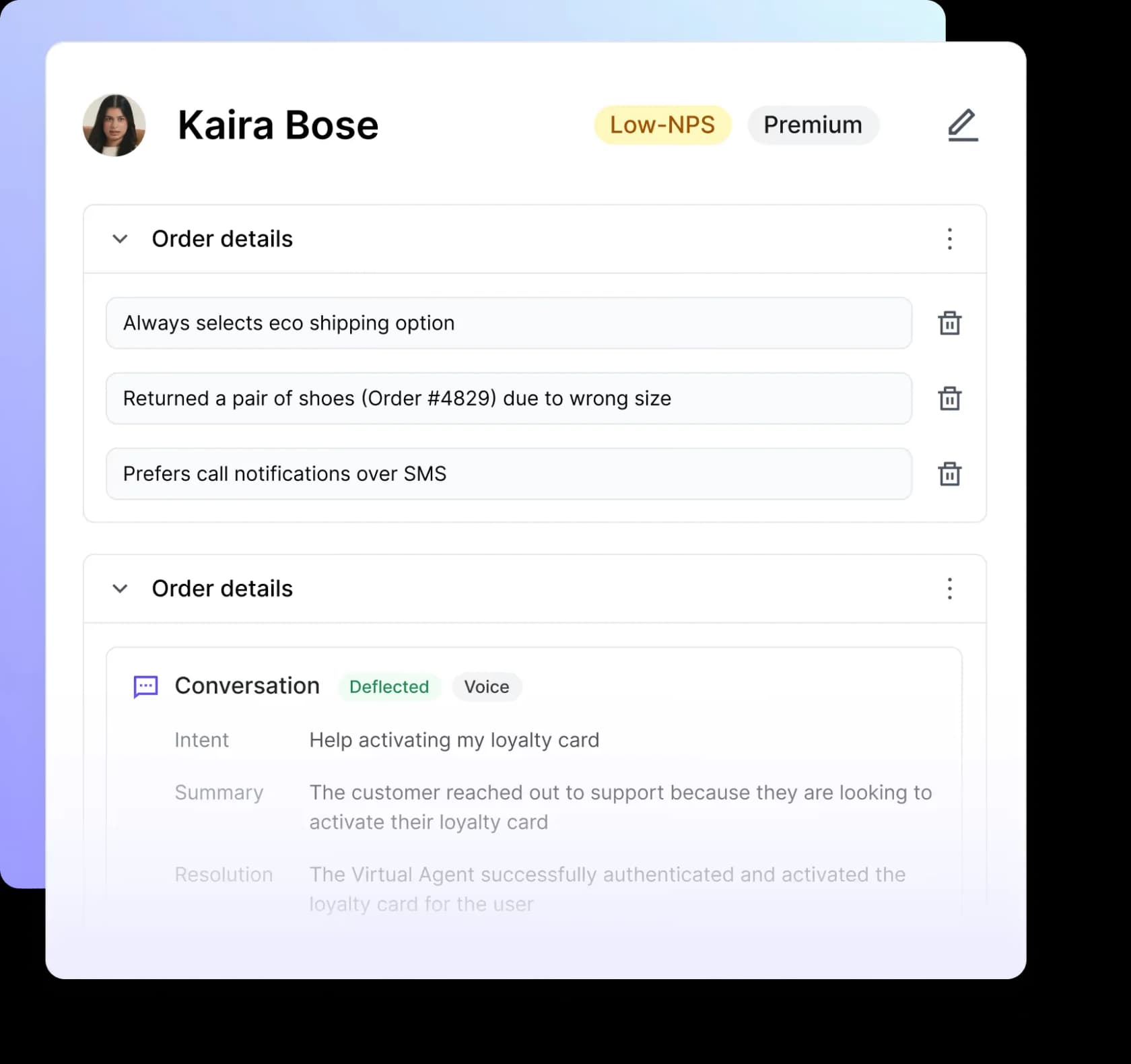
If Kodif's lack of a phone channel is the reason you're looking, Decagon is the most voice-forward option on this list. Agents get built from Agent Operating Procedures written in natural language, and on October 1, 2026 the company launched Voice 3, which pairs a new duplex architecture with its own Chord voice model.
Chime reports 70% chat and voice resolution and a 60% cut in support costs, with voice above one million calls a month (Chime case study).
Pros
- Voice is first-class, with caller authentication for sensitive flows.
- Choose per-conversation or per-resolution billing.
- SOC 2 Type II, ISO 27001, PCI DSS 4.0.1, HIPAA.
Cons
- Shopify and Gorgias aren't named connectors; you reach them through MCP or custom API tools.
- Quote only, and the pricing page is a 404.
- Built for enterprise volumes, not a 2,000-ticket store.
Pricing
| Model | What you pay for |
|---|---|
| Per conversation | A fixed rate for every incoming conversation |
| Per resolution | A higher rate per resolved conversation, escalations free |
No dollar figures are published (Decagon on pricing).
My take: Compared with Kodif, Decagon is a step up in scale and price rather than a sideways move. Put it on the shortlist if voice is non-negotiable for you. See Decagon pricing and Decagon for ecommerce.
8. Sierra
Best for: Fortune 500 consumer brands that want outcome-based pricing and a partner-led build.
Sierra, founded by Bret Taylor and Clay Bavor, deploys one agent across chat, SMS, WhatsApp, email, voice and ChatGPT. The build is partner-led like Kodif's, and each customer gets "an expert agent development team." Where it differs is billing, which goes per outcome, for example a resolved conversation or a saved cancellation, or an upsell (Sierra on outcome pricing).
BARK (BarkBox) says the agent handled roughly a quarter of conversations in its first year at 98% CSAT (BARK story).
Pros
- Pay for outcomes, with no charge for most unresolved conversations.
- Voice payments by card and bank transfer over the phone.
- The longest compliance list here, including FedRAMP High and ISO 42001.
Cons
- No public integrations catalog; Shopify, Zendesk and Gorgias aren't named.
- Quote only, and Sierra itself calls outcome pricing complex to contract.
- Sized for very large brands.
Pricing
| Model | What you pay for |
|---|---|
| Outcome-based | Resolved conversations, saved cancellations, upsells |
| Consumption | Per conversation, for routing or greeter flows |
My take: Sierra makes sense for a household-name brand that wants someone else owning the build end to end. A mid-market Kodif customer will usually find it's more contract than they need. See Sierra AI pricing or Decagon vs Sierra.
Which Kodif alternative should you pick?
The better starting point is the reason you're leaving, not the feature list. This is the shortcut I would use myself.
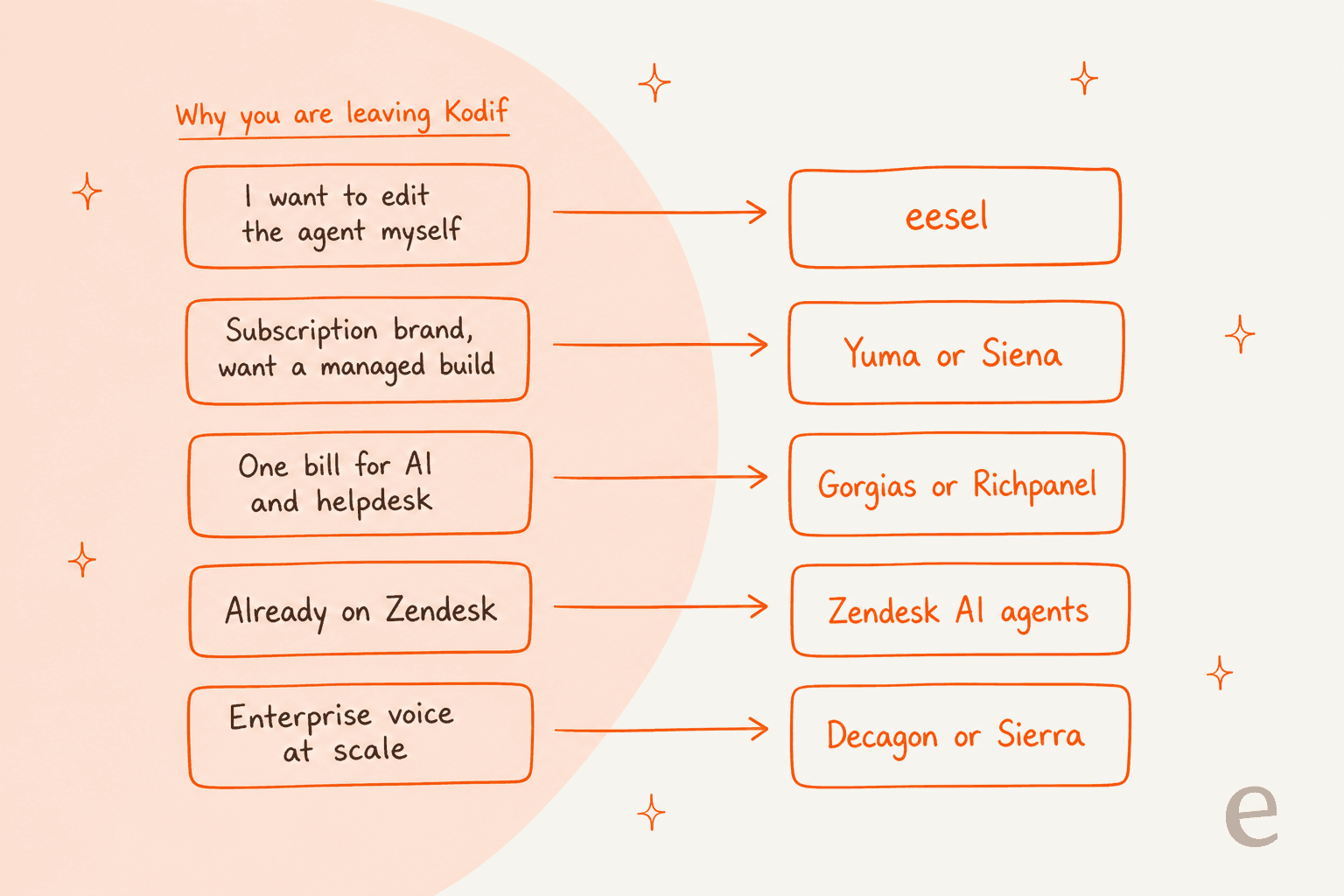
- You want to change the agent without filing a request: eesel. You own the instructions, the actions and the approvals.
- You liked the managed model but want different pricing: Yuma if you want to pay only for full resolutions, Siena if you want QA and shopping agents in the same layer.
- You'd rather have one tool and one bill: Gorgias AI Agent if you're staying on Gorgias, Richpanel if you're ready to switch helpdesks.
- You're on Zendesk and tickets are simple: Zendesk AI agents first.
- You need voice at enterprise scale: Decagon or Sierra.
Whichever one you pick, test it on your own history before it ever talks to customers. Ask each vendor to replay a few hundred of last month's tickets, the refunds and address changes but also the weird subscription edge cases, and to show you every answer it would have sent. Track the containment rate and escalation quality, not just deflection. And if returns are a big slice of your volume, my guides on automating returns and the best AI for Shopify support go deeper.
Try eesel on your own tickets
If the reason you're reading this is that you want your team, not a vendor's engineer, to own the agent, eesel is built for exactly that. It plugs into Gorgias or Zendesk in a few minutes and reads your macros and past tickets, and it checks Shopify orders as well. You can run it against last month's tickets before it sends a single reply. Then when a policy changes, your team edits the instruction itself instead of filing a request.
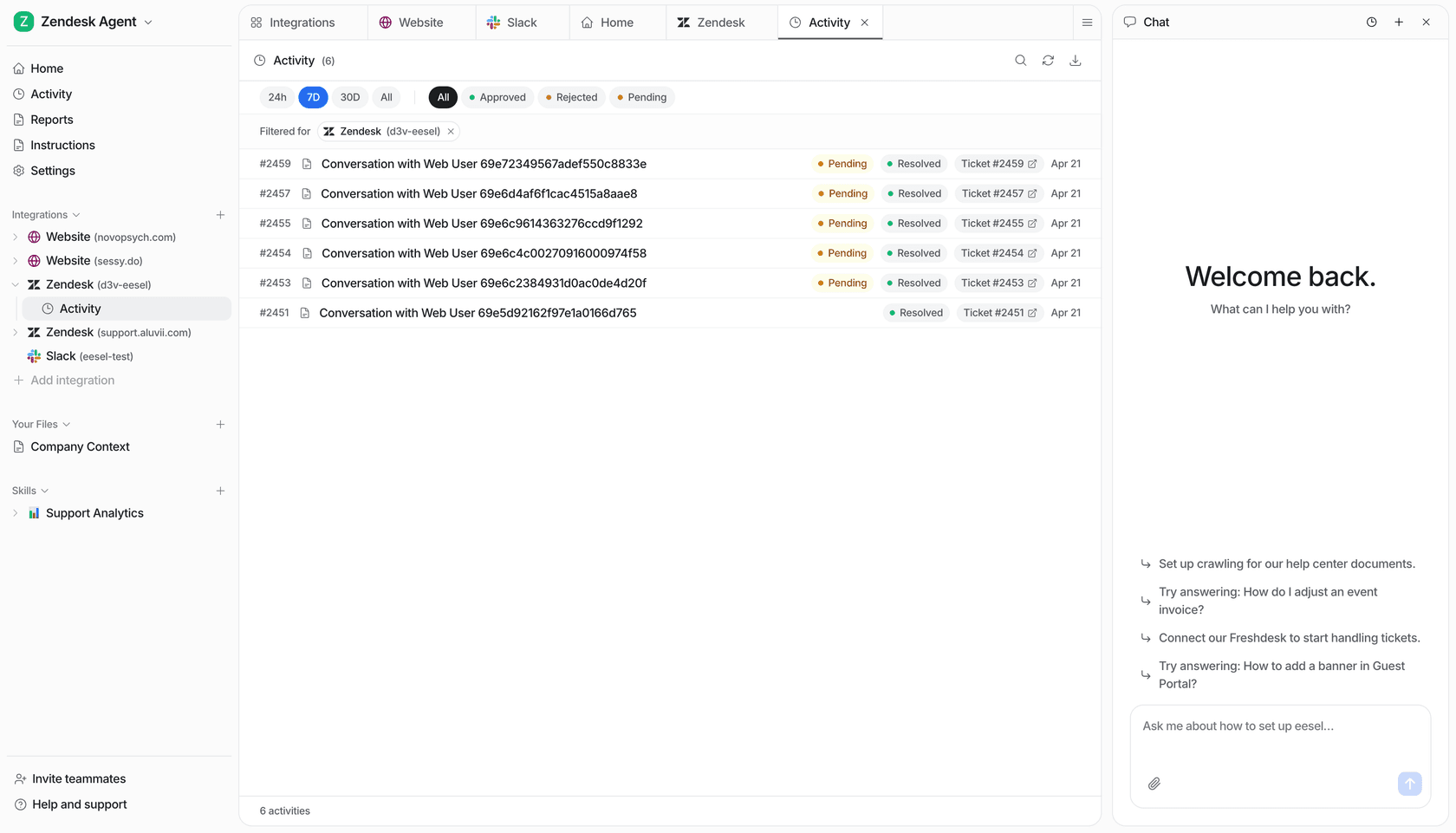
The free trial gives you 100 credits with every feature, no card. Try eesel and see what it does with your own queue.
Frequently Asked Questions
How much does Kodif cost?
Is there a Kodif alternative with self-serve pricing?
Which Kodif alternative works with Gorgias?
Which Kodif alternative works with Zendesk?
Can a Kodif alternative handle subscription cancellations?
Why do teams look for Kodif AI alternatives?
Is Kodif better than Siena or Yuma for ecommerce?



Article by
Rama Adi
Rama is a software engineer at eesel AI with two years of experience writing about B2B SaaS, AI tools, and customer support technology. Based in Bali, Indonesia, he brings a developer's perspective to product comparisons — cutting through marketing copy to what the integrations and APIs actually do.