Ecommerce customer support is at a turning point. With rising ticket volumes, shrinking margins, and customers who expect instant responses, online retailers need more than traditional helpdesk tools. They need AI that can actually resolve issues, not just deflect them.
Decagon has emerged as one of the most visible players in this space. Founded in 2023, the company has raised over $480 million in funding and landed enterprise customers like Duolingo, ClassPass, and Notion. But is it the right fit for your ecommerce business?
Let's break down what Decagon offers, how it works for online retailers, and what you should know before making a decision.
What is Decagon AI?
Decagon is an enterprise AI platform that builds conversational AI agents for customer support. The company positions itself as an "AI concierge" rather than a chatbot, emphasizing proactive, personalized interactions over scripted responses.
The platform was founded in 2023 by Jesse Zhang and Ashwin Sreenivas, both with backgrounds in AI and enterprise software. In just two years, Decagon has raised significant funding, including a $131 million Series C led by Andreessen Horowitz and Accel that valued the company at $1.5 billion. More recently, the company raised an additional $250 million at a $4.5 billion valuation.
Decagon's core technology is built on foundation models from OpenAI, Anthropic, and Cohere, hosted on Microsoft Azure for enterprise-grade reliability. The platform handles support across chat, email, voice, and SMS channels from a single unified system.
What sets Decagon apart is its Agent Operating Procedures (AOPs). These are natural language instructions that compile into structured logic, allowing non-technical teams to build and iterate on AI workflows without waiting for engineering resources.
How Decagon works for ecommerce brands
For ecommerce specifically, Decagon offers solutions tailored to retail use cases. The platform can handle the repetitive, high-volume inquiries that dominate online retail support: order status, returns, refunds, subscription management, and product questions.
Here's what that looks like in practice:
Account and billing support. Decagon can automate subscription changes, billing inquiries, and payment issues. For brands with recurring revenue models, this deflects a significant portion of tickets that'd otherwise require human intervention.
Order management. The platform integrates with order management systems to provide real-time tracking, handle modification requests, and resolve shipping issues. Customers get instant answers about where their package is without waiting for an agent.
Returns and refunds. Decagon can process return requests, check eligibility against policy rules, and initiate refunds. This is particularly valuable during post-holiday periods when return volumes spike.
Product recommendations. The AI can suggest products based on customer history and preferences, turning support interactions into sales opportunities. Learn more about Decagon's retail capabilities.
The results speak for themselves. Duolingo achieved an 80% deflection rate after implementing Decagon for their English Test support. ClassPass reported a 95% cost reduction and expanded support from 16 hours a day to 24/7 coverage. Curology saw a 65% reduction in support costs.
Key features for online retailers
Decagon's feature set is designed for enterprise-scale operations. Here's what matters most for ecommerce:
Omnichannel support
Decagon handles conversations across chat, email, voice, and SMS within a single platform. A customer can start a conversation on your website, follow up via email, and receive a proactive voice call if needed, all with full context preserved. The voice capability, powered by a partnership with ElevenLabs, produces natural-sounding conversations rather than robotic responses.
User memory
The platform maintains conversational context across sessions. If a customer mentions a product preference or sizing issue in one conversation, Decagon remembers it in the next. This complements your existing CRM data rather than replacing it.
Proactive agents
Decagon's newest capability enables outbound voice calls. The AI can initiate contact with customers at strategic moments: appointment reminders, payment issues that need resolution, or follow-ups on abandoned carts. This moves support from purely reactive to anticipatory.
Testing and optimization
Before deploying changes, teams can run simulated conversations to validate AI behavior. The platform supports A/B testing of different agent versions, allowing you to measure impact on metrics like CSAT and deflection rate before rolling out changes broadly.
Integration ecosystem
Decagon connects with major ecommerce and support platforms including Salesforce, Zendesk, Intercom, and Shopify. The platform also supports custom API integrations for proprietary systems.
Decagon pricing explained
Here's where things get complicated. Decagon does not publish any pricing on its website. The pricing page returns a 404 error, and specific costs are only available through direct sales conversations.
According to third-party analysis, Decagon reportedly offers two usage-based models:
| Pricing Model | Structure | Best For |
|---|---|---|
| Per-conversation | Flat rate per AI-handled interaction | Teams wanting predictable forecasting |
| Per-resolution | Higher rate, charged only on full resolution | Performance-focused teams |
The lack of transparency makes budgeting difficult, especially for growing ecommerce brands with fluctuating support volumes. Without published rates or usage thresholds, you can't estimate costs during seasonal spikes or promotional periods without engaging sales.
For comparison, many alternatives in the market offer transparent, public pricing with clear feature breakdowns by tier.
Decagon vs. eesel AI: Choosing the right fit
Decagon is built for enterprise scale, but that focus creates trade-offs that matter for ecommerce brands. Here's how it compares to eesel AI:
| Factor | Decagon | eesel AI |
|---|---|---|
| Setup time | Weeks to months | Minutes |
| Pricing transparency | Contact sales only | Public from $299/month |
| Best fit | Large enterprises | SMB to mid-market |
| Deployment model | Implementation-heavy | Plug-and-play |
| Progressive rollout | Limited | Built-in guidance to autonomy |
The fundamental difference is philosophical. Decagon approaches AI support as a technical implementation project. You configure workflows, integrate systems, and optimize over time.
We approach it differently. With eesel AI, you're not configuring a tool. You're hiring an AI teammate. Like any new hire, eesel learns your business, starts with guidance, and levels up to work autonomously as it proves itself.
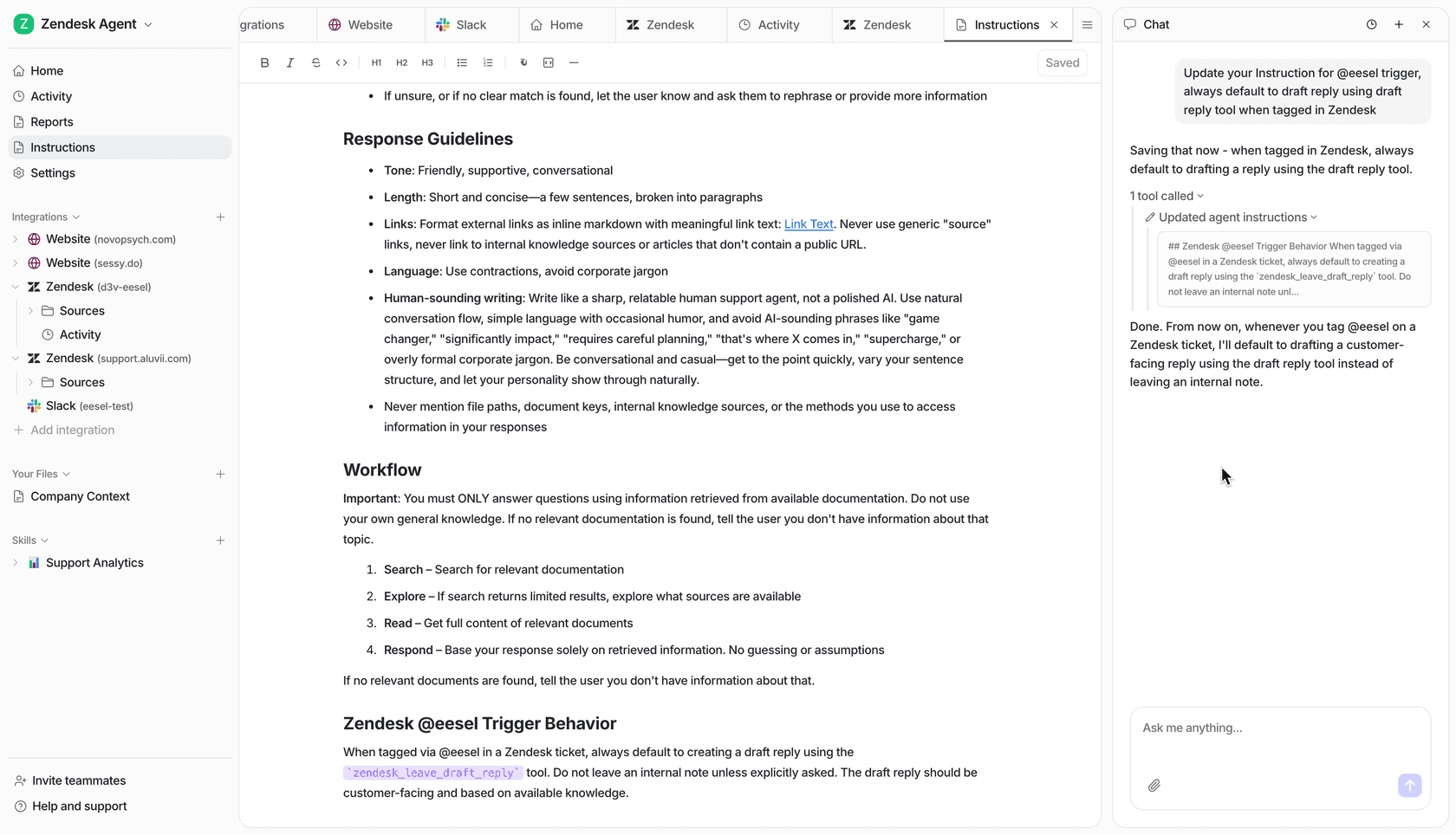
Here's what that means in practice:
Setup takes minutes, not weeks. Connect eesel to your help desk and it immediately learns from your past tickets, help center articles, and macros. No manual training, no documentation uploads, no configuration wizards. See how eesel AI works.
Start with oversight. Have eesel draft replies for review before sending. Limit it to specific ticket types or business hours. This lets you verify quality before expanding scope.
Level up based on performance. As eesel proves itself, expand its role: from drafting to sending directly, from simple FAQs to complex issues, from business hours to 24/7 coverage. You control the pace.
Define behavior in plain English. Instead of complex configuration, tell eesel what to do: "If the refund request is over 30 days, politely decline and offer store credit." No code, no decision trees.
Is Decagon right for your ecommerce business?
Decagon makes sense if you're a large enterprise with dedicated implementation resources, complex custom workflows, and a support team large enough to justify a multi-week deployment. The platform's proactive voice capabilities and enterprise-grade testing frameworks add value at scale.
Consider alternatives if:
- You need transparent pricing to budget effectively
- You want to see results this quarter, not next year
- Your team doesn't have engineering resources for implementation
- You prefer to test AI quality before going customer-facing
- You want to start small and expand based on actual performance
The reality is that most ecommerce brands, even successful ones, don't need enterprise-grade complexity on day one. They need AI that works quickly, improves over time, and doesn't require a dedicated project team to maintain.
Getting started with AI customer support for ecommerce
If you're evaluating AI support solutions, here's a practical framework:
-
Audit your current tickets. What percentage are repetitive inquiries that could be automated? Order status, returns, and password resets are usually the lowest-hanging fruit.
-
Check your integration requirements. Make a list of the systems your AI needs to connect with: help desk, ecommerce platform, order management, CRM.
-
Run simulations before going live. The best way to evaluate AI quality is to test it on your actual past tickets. This shows you exactly how it would've performed.
-
Start with guidance, then expand. Begin with AI drafting replies for review. Once you're confident in quality, expand to direct responses and broader scope.
-
Measure what matters. Track resolution rates, customer satisfaction, and time saved. The goal isn't just deflection but actual issue resolution.
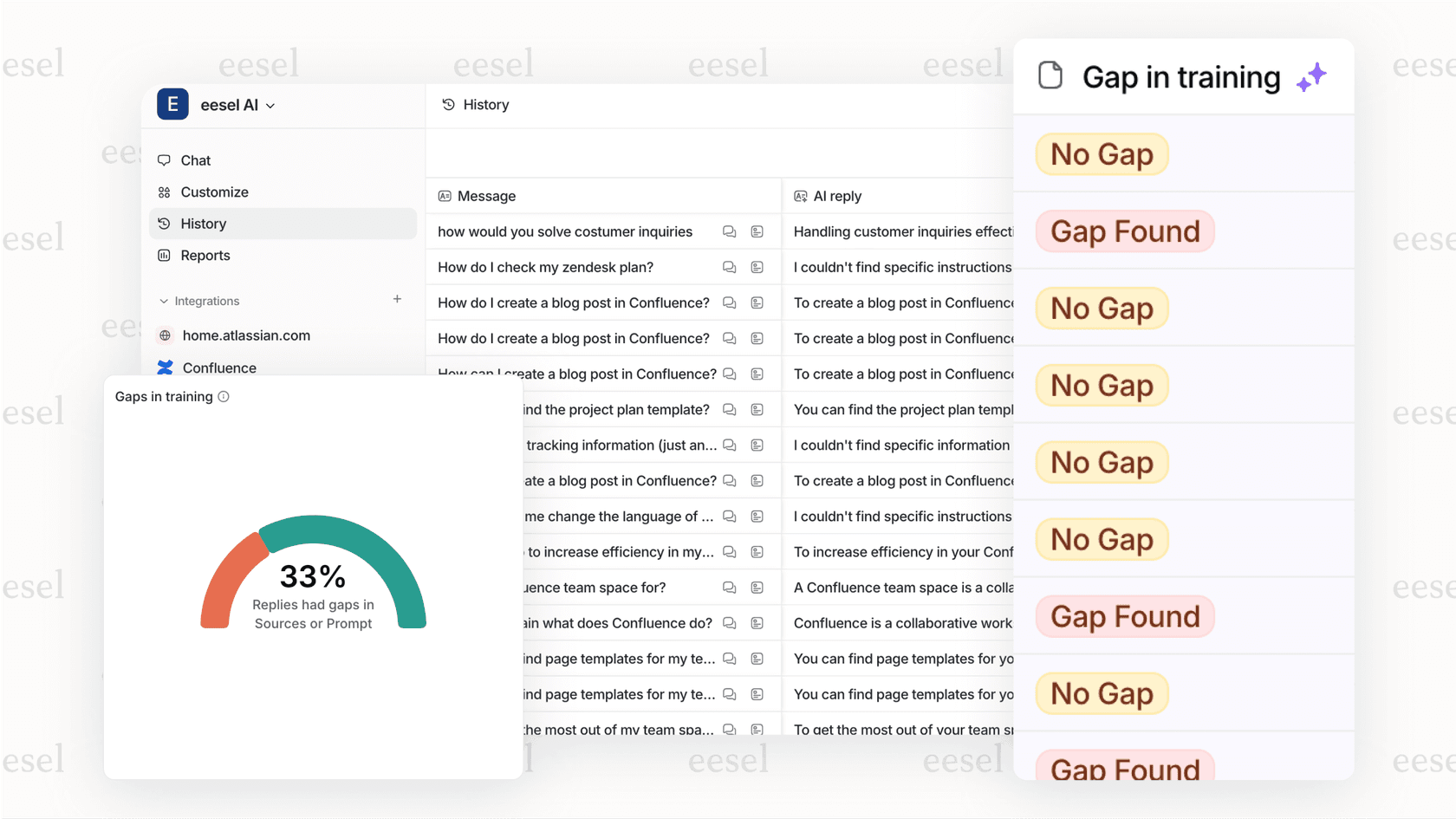
For ecommerce brands looking for an AI teammate that learns fast, deploys quickly, and grows with your business, eesel AI offers a different path. One that treats AI as a team member you hire and develop, not a tool you configure and maintain.