
If you run an ecommerce business, you know the content treadmill never stops. It’s not just about writing product descriptions and category pages. You need a steady stream of engaging blog posts that attract customers, answer their questions, and convince them to buy. That's a ton of work.
AI can help you produce more content, but not all AI writers are made for the specific demands of ecommerce. A generic tool can write text, but a specialized AI ecommerce blog writer understands your products, brand voice, and what it takes to rank in search results. It knows the difference between filler content and content that actually drives sales.
This guide will walk you through what to look for in an AI writer and compare the top tools for your online store. We’ll also show you how the eesel AI blog writer is designed for this exact job. It’s the same tool we used to grow our own blog from 700 to 750,000 daily impressions in just three months.
What is an AI ecommerce blog writer?
They are built to create the kinds of content an ecommerce business needs to get more traffic and sales:
- SEO-optimized blog posts: "How-to" guides, product comparisons, and trend articles that answer customer questions and bring in organic traffic.
- Product descriptions: Unique and persuasive descriptions that highlight benefits and convert shoppers, even if you have thousands of products.
- Category pages: Informative copy that makes it easier for users to navigate your site and helps your main pages rank for broader keywords.
- Marketing emails: Promotional content, newsletters, and abandoned cart emails to keep your customers coming back.
The main point isn't just to churn out words. It's to generate content that ranks on Google and convinces people to buy, turning your blog into a real growth engine for your business.
Key features of a great AI ecommerce blog writer
On-brand and context-aware content
The best tools learn your brand’s voice, style, and product catalog. They don't just work off generic prompts; they incorporate your key features and benefits correctly. This means the AI understands what makes your products special and can write about them like an expert.
Look for tools that can use your website URL or brand guidelines for context. This makes sure the content sounds like it came from your team and features your products naturally. For instance, an ecommerce-focused AI should be able to pull real-time pricing for a comparison post or tech specs for a review without you having to manually input every detail.
Built-in SEO and AEO optimization
A good AI content writer tool doesn't just write text; it structures it for search engines. This includes using target keywords in headings (H2, H3), generating meta descriptions, and creating a logical outline that Google can easily understand.
It should also be optimized for AEO (Answer Engine Optimization). This is a newer idea that’s becoming very important. It means the content is structured to show up directly in AI-powered search results, like Google's AI Overviews. Getting featured there can send a lot of traffic your way, and the right AI writer gets your content ready for that.
Automatic asset and media generation
Modern ecommerce content needs more than just text to keep people engaged. A top-tier AI ecommerce blog writer should automatically generate or embed relevant media to save you time and make your posts more interesting.
This can include AI-generated images, product comparison tables, infographics, and relevant YouTube videos. Think about how much time you spend looking for stock photos, creating charts, or finding the right tutorial video. A tool that does this for you automatically can save hours of work on every post, letting you publish more content, more quickly.
The best AI ecommerce blog writer tools compared
Here’s a look at the top AI ecommerce blog writer tools, evaluated based on the key features we just covered.
1. eesel AI
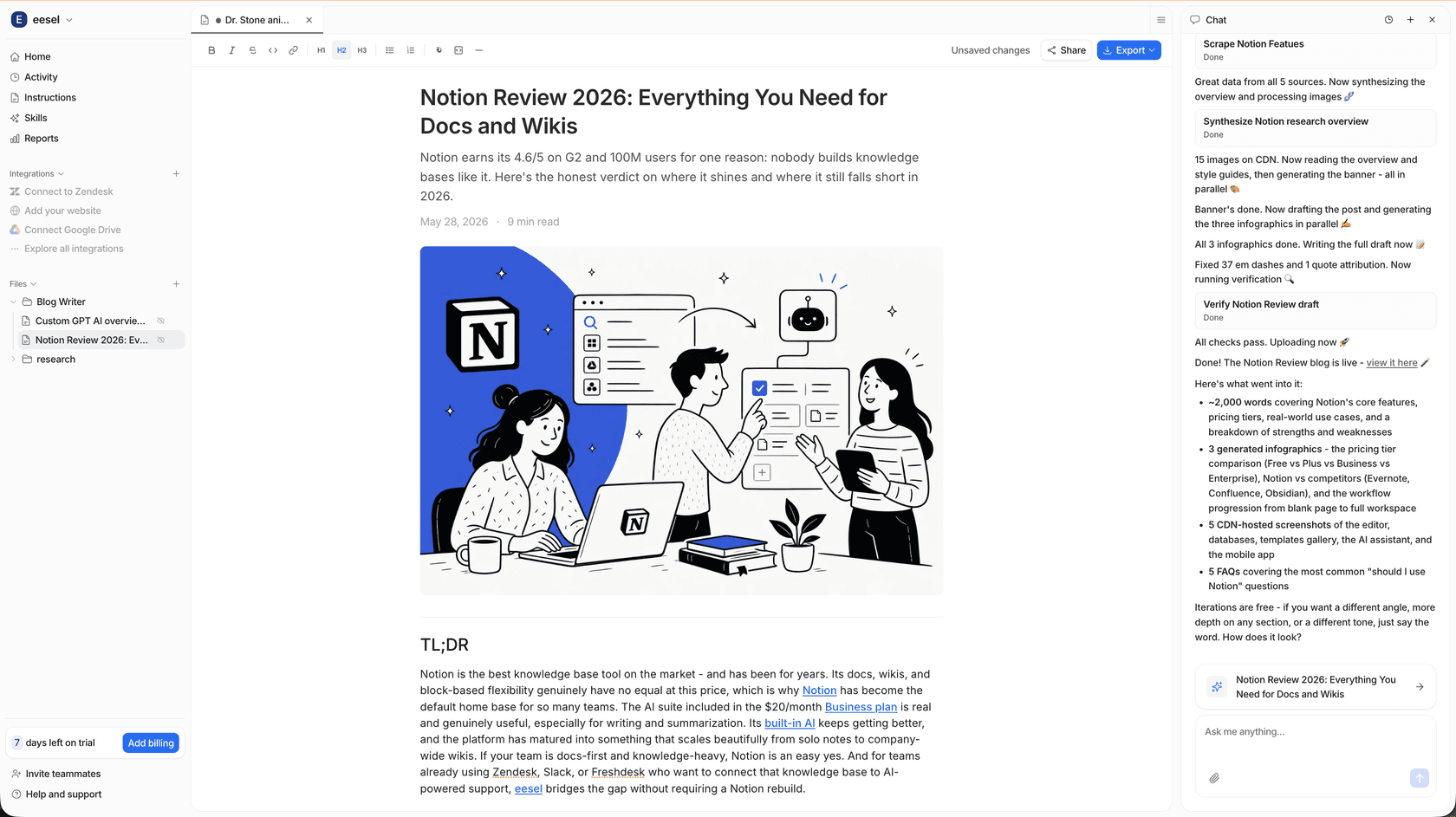
The eesel AI blog writer is for businesses that want a complete, ready-to-publish article from a single keyword. It’s built to manage the whole content process, from research and writing to creating assets and optimizing for search.
- Pros:
- Context-aware research: It automatically finds the specific data needed for ecommerce content, like pricing for comparison posts or technical details for product reviews.
- Complete asset generation: It does more than write text. It produces a full blog post with AI-generated images, relevant YouTube video embeds, and even real Reddit quotes for social proof.
- Optimized for modern search: The content is structured for both traditional SEO and AEO, helping it rank in Google and get cited by AI answer engines.
- Human-like tone: The output is refined to sound natural and engaging, avoiding a generic or robotic feel.
- Limitations: It’s a specialized blogging tool, so it doesn’t have dozens of templates for smaller marketing tasks like writing social media one-liners or ad copy. It’s focused on one thing: creating complete blog posts.
- Pricing: You can try it for free. Paid plans include a package of 50 blog generations for $99.
2. Jasper
Jasper is a well-known AI platform with a wide range of templates for different marketing needs. This makes it a versatile option for teams that need more than just blog content and want one tool for many different jobs.
Based on Sprout Score comparisons, Jasper scored higher (8.2) for brand voice and long-form consistency, especially in team use.

- Pros:
- Extensive template library: Jasper has templates for lots of content types, including specific ones for Amazon product descriptions and other short-form ecommerce copy.
- Brand voice training: You can teach Jasper your brand's tone and style to keep your content consistent across channels.
- Limitations: The output usually needs human editing to match search intent and your brand voice. It's a collection of different tools, not a one-click solution, and it doesn't automatically create or embed media like YouTube videos or social quotes.
- Pricing: The Pro plan starts at $59 per month.
3. Writesonic
Writesonic markets itself as a platform for improving visibility in both traditional and AI search, with a strong focus on SEO and what it calls Generative Engine Optimization (GEO).
Writesonic sat in the middle (7.8), solid for ecommerce and quick drafts but needed a lot of manual editing in B2B use.
- Pros:
- Strong SEO focus: The platform has tools for keyword research and competitor analysis to help you create content that’s designed to rank from the get-go.
- Multilingual support: It supports over 30 languages, making it a solid choice for ecommerce stores that sell globally.
- Limitations: The cheaper plans have monthly article limits. For example, the Lite plan has article limits. The main focus is on text and SEO data, not on automatically generating a complete, media-rich blog post with visuals.
- Pricing: The Lite plan starts at $39 per month.
4. Copymatic
Copymatic is an affordable AI tool that helps users generate a variety of copy quickly, including long-form blog posts from a short description. It's a good starting point for those on a tight budget.
- Pros:
- Affordable and simple: It's one of the more budget-friendly options out there for generating unlimited words.
- Variety of tools: Copymatic offers over 50 tools for different copy needs, from product descriptions to landing pages and blog content.
- Limitations: The content it generates is just a starting point and needs a lot of editing for tone, accuracy, and flow. The SEO features aren't as advanced as more specialized tools, and it doesn't automatically generate or include any visual assets.
- Pricing: The Pro plan starts at $19 per month.
Limitations of using an AI ecommerce blog writer (and how to fix them)
While an AI ecommerce blog writer is a great assistant, it has its limits. Knowing what they are helps you use the tool better. Here’s how to handle the common issues.
I'm finding AI to be a great tool - but not so great of a writer, especially for my blog posts. It generates ideas, builds outlines, and things like that - but it's still not quite trustworthy and does stupid things like making up links when it needs external links - it thinks something 'should' be there.. so it creates 'it.' Lol.
- Lack of genuine expertise: AI can research topics in seconds, but it can't fake personal experience or deep product knowledge. It hasn't actually used your product.
- Solution: Always have a human expert review and edit the content. This is your chance to add unique insights, customer stories, or personal anecdotes that make the article trustworthy and stand out.
- Potential for inaccuracies: AI can sometimes generate incorrect information or "hallucinate" facts, figures, or product details.
- Solution: Fact-check everything, especially technical specs, pricing, and stats. Use the AI to speed up the drafting process, not as the final word on what's true.
- Generic brand voice: Without the right instructions, AI-generated content can sound bland and just like your competitors.
- Solution: Use tools that let you customize the brand voice. More importantly, spend a few minutes during the final edit to inject your brand's unique personality into the copy. That final human touch makes all the difference.
To see how this works in practice, check out this step-by-step guide on creating AI-powered blog posts specifically for Shopify stores. It shows how you can quickly generate content that gets your products in front of more customers.
Using an AI ecommerce blog writer as your growth engine
An AI ecommerce blog writer is a fantastic tool for creating more content, but it works best when guided by human strategy and expertise. It’s not about replacing writers; it’s about making them faster and more efficient.
I don't think AI can fully take over marketing things, at least they can't do it now. But as an assistant, they are great.
The right AI blog writing tool does the heavy lifting of research, drafting, and optimization. This frees you up to focus on strategy and add the unique insights that build a loyal customer base. Instead of starting with a blank page, you can start with a nearly finished article, complete with visuals and an SEO-friendly structure, just waiting for your final touch.
Ready to turn your content creation into a traffic-driving machine? Try the eesel AI blog writer for free and generate your first publish-ready article in minutes.



