


How we picked
We weighted four things, in order:
- Long-form output quality at default settings. Anyone can produce a passable 500-word draft. We cared about what each tool ships when you ask for a 2,000-word SEO listicle without hand-holding it through every section.
- Research and grounding. Does the tool actually read top-ranking pages, real reviews, or your own knowledge base, or does it confabulate? SERP-driven and RAG-backed tools sit higher.
- Voice and editorial control. Brand voice, tone matching, style guides, glossary enforcement. AI drafts that don't sound like your other posts get thrown away.
- Where it sits in the workflow. Is this a writing surface, a research surface, or an end-to-end agent? Tools that try to be one of those clearly beat tools that are vaguely all three.
We deliberately skipped general-purpose chat tools like ChatGPT and Claude. They can write blogs, but they aren't blog writing tools: there's no SERP integration, no brand voice store, no publish pipeline. If you want that take, see our Claude vs ChatGPT for blogging breakdown.
At a glance: how the nine compare
| Tool | Best for | Entry price | Standout | Watch out for |
|---|---|---|---|---|
| eesel | End-to-end research → draft → publish | $4 per blog (no seat fee) | Autonomous Blog Writer agent that lives inside your existing apps | New category, fewer head-to-head reviews than the writers below |
| Jasper | Marketing teams that need on-brand long-form | $59/seat/mo (Pro, annual) | Brand IQ + Marketing Agents library | Output flagged as "generic" by SMB reviewers; Style Guide is Business-only |
| Koala Writer | Solo SEO operators chasing volume | $9/mo (Essentials) | One-click WordPress publish + 3,500-word default | Word counts double-charged on the best models |
| Frase | SERP-driven content briefs | $49/mo (Starter, annual ≈$39) | SERP analysis in 30 seconds + GEO scoring | Optimisation depth is below Surfer for the same money |
| Anyword | Performance-tested marketing copy | $49/mo (Starter, annual $39) | Predictive Performance Scoring (82% vs GPT-4o's 52%) | Long-form is a side product; price climbs fast |
| Writesonic | AI search visibility, not just writing | $79/mo (Starter) | 2 billion+ AI conversation dataset | Pivoted away from "AI writer", quota of 15 articles/mo on entry |
| Copy.ai | Codified GTM content workflows | $24/mo (Chat) → $1,000/mo (Growth) | Workflows + Tables + Agents | $29 → $1,000/mo cliff between self-serve and team plans |
| Writer.com | Regulated enterprise content | Contact sales | Palmyra LLMs + Knowledge Graph + SAML/SCIM | No public pricing; agents must be "approved" |
| Rytr | Solo budget writers | Free → $7.50/mo (Unlimited, annual) | Generous free forever tier, 40+ templates | Custom tones gated, character caps cited as #1 complaint |
A quick mental map for where each one actually plays:
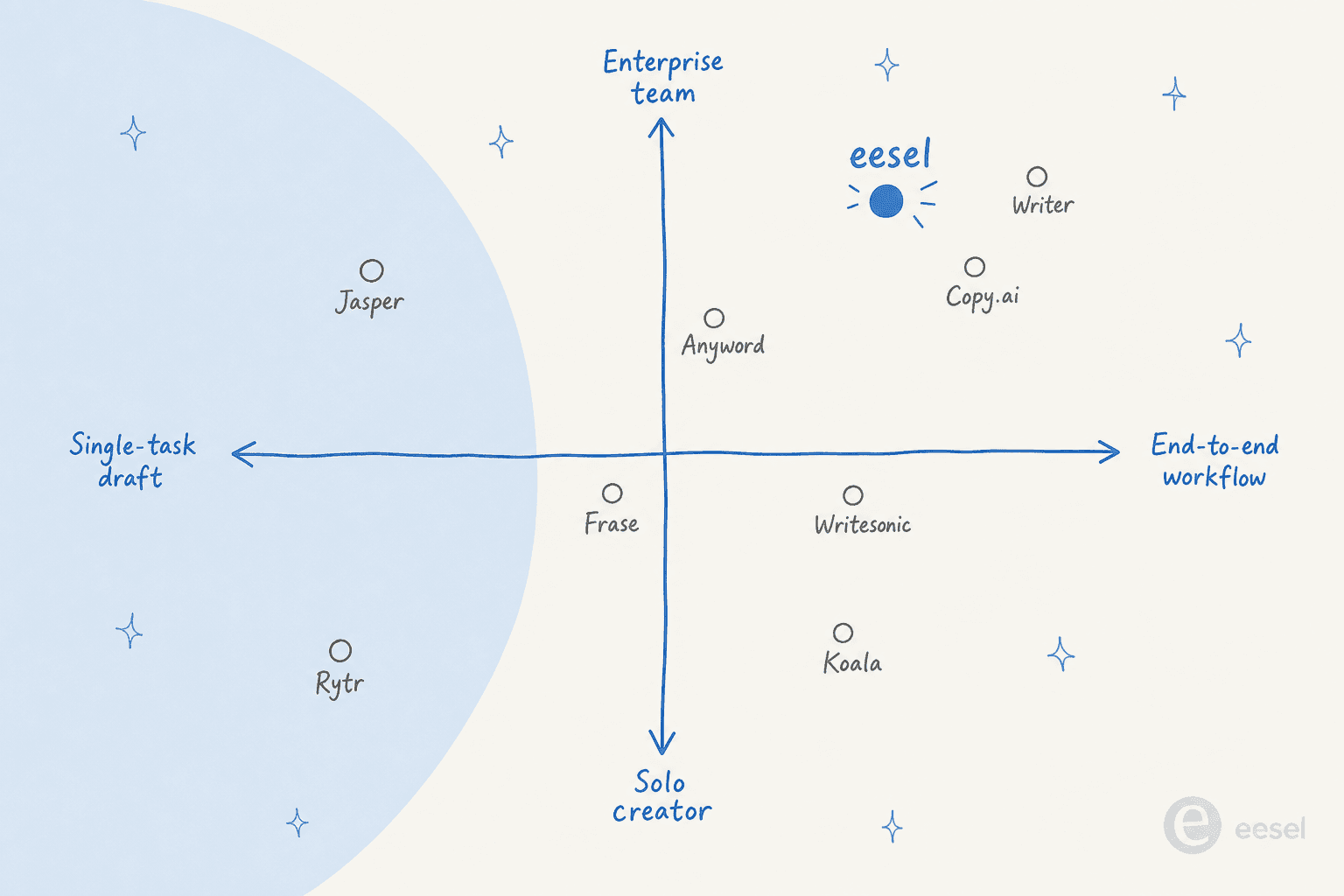
The vertical axis is who the tool is built for: a solo creator on a free tier vs. an enterprise marketing org with SAML. The horizontal axis is how much of the workflow the tool owns: a single drafting surface vs. an end-to-end research-to-publish agent. Most of the tools you'll see ranked elsewhere cluster bottom-left and middle-bottom; the genuinely agentic options are sparse, which is part of why we lead with eesel.
How a modern AI blog writer actually works
Before we go through the nine, the five-step shape is worth seeing once. Every serious tool below is some subset of this pipeline; the differences are mostly which steps it owns and how well:
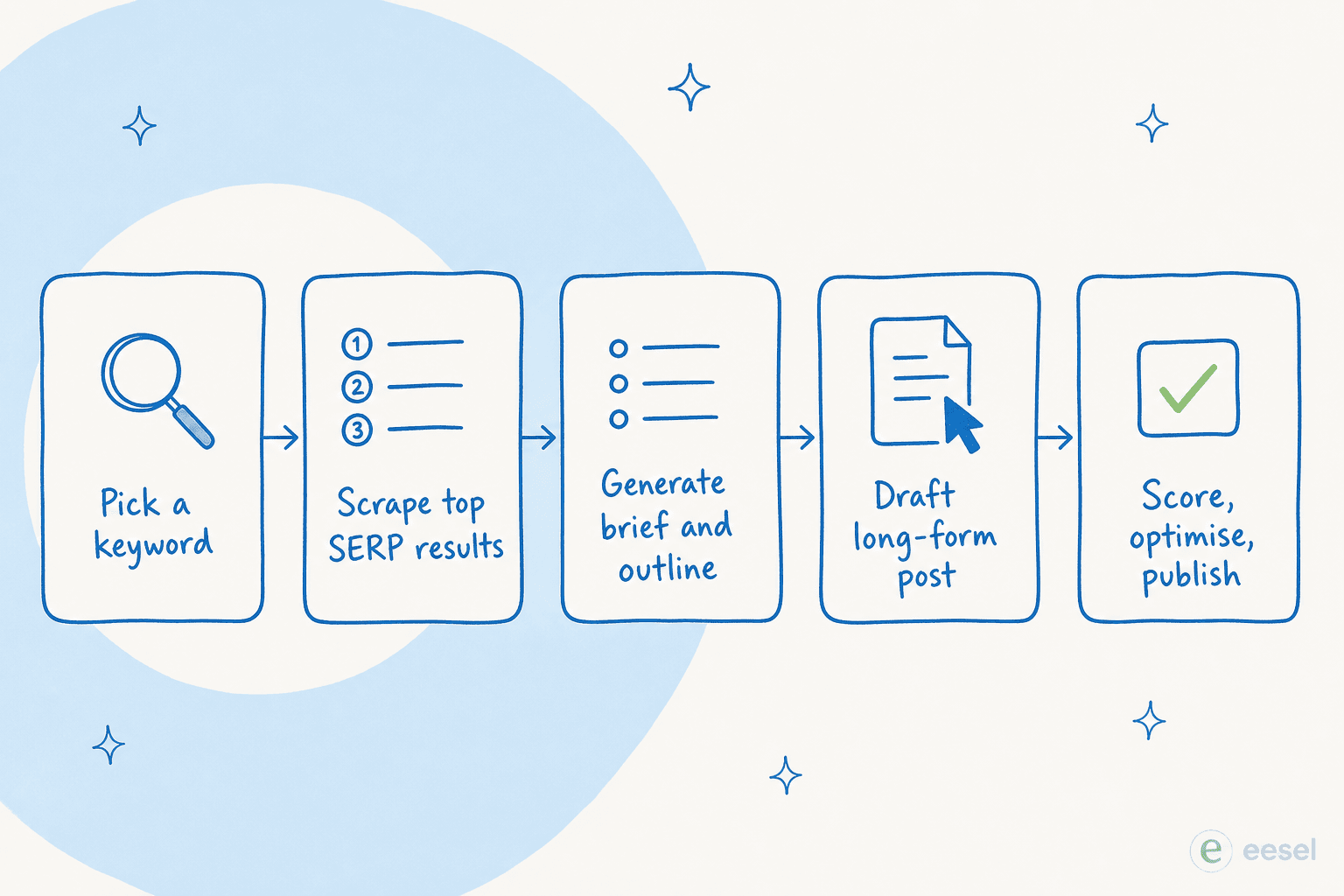
The boring truth is that the writing step is the least interesting part. The leverage is in the steps either side: real SERP and brand-voice research at the front, real on-page optimisation and one-click publishing at the back. Tools that only nail the middle step (the "AI writes 2,000 words from a prompt" demo) are easy to outgrow once you've got a working content engine. Worth keeping in mind as you read.
1. eesel, best for end-to-end research → draft → publish
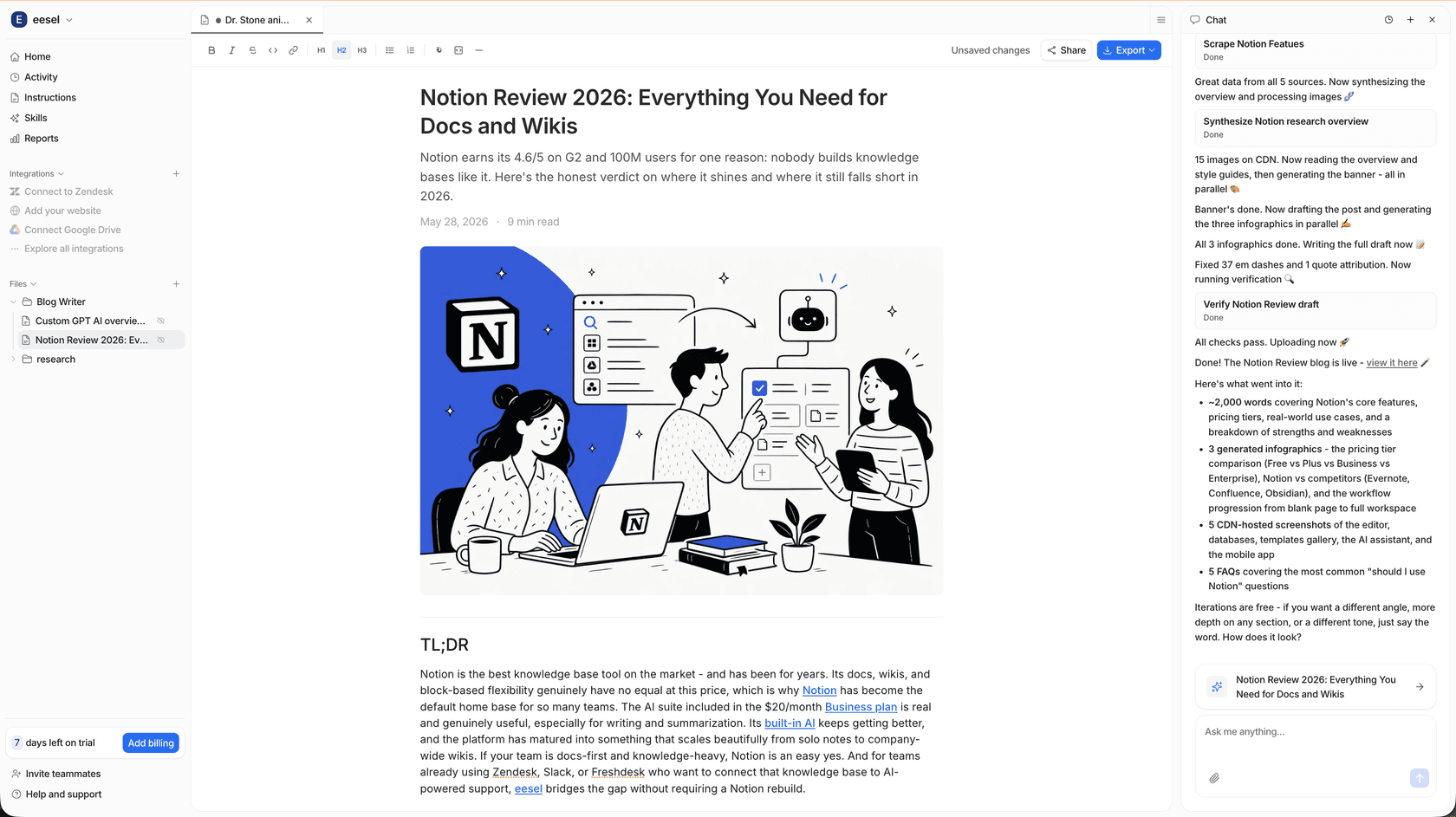
Best for: marketing and content teams that want the whole blog production loop, research, outline, draft, edit, publish, handled by one autonomous agent that lives inside the tools they already use.
eesel sells a platform of AI teammates that act as independent workers across helpdesks, Slack, email, Shopify, and 100+ other apps. One of those teammates is a Blog Writer agent, explicitly listed alongside the helpdesk and e-commerce agents in eesel's own product overview, with the job of "researches, drafts, and publishes long-form content." It's not a chat surface you prompt; it's an agent you brief like a new hire and then let work. That's the genuine wedge against everything else on this list.
The way the pricing meter is set up is part of the pitch. Instead of charging per seat (the dominant model for Jasper, Anyword, Frase, and Writer), eesel charges $4.00 per blog post, while its support agent runs on a fixed monthly plan from $299/month for 500 credits (1 credit per ticket or chat). The free plan includes 100 free credits, no credit card required. For a content team running anywhere from a handful to a few dozen posts a month, that's an unusually clean unit of cost.
What it does well
- Research lives where you do. eesel can read from existing helpdesk knowledge, internal Slack threads, Google Docs, and any of eesel's 100+ integrations as grounding context for a draft. The agent's research isn't a black box; it's pulling from sources you actually trust.
- Autonomous, not a copilot. The Blog Writer agent doesn't wait at every step. You brief it, and it returns a full draft (research, outline, body, citations), closer to delegating to a contractor than typing into an editor.
- No new interface to learn. The same agent platform that's drafting your blog can also be answering tickets or summarising Slack: your content team and your support team are using the same operating layer.
- Publishes where your blog lives. WordPress, Webflow, Ghost, HubSpot, and a webhooks layer for everything else.
What to watch for
- Newer category, less head-to-head review noise. You won't find 1,200 G2 reviews of an "eesel Blog Writer" the way you will for Jasper or Rytr. If you want a body of public review evidence before you buy, that's a real tradeoff.
- Per-task pricing rewards bursty usage. If you're publishing five posts a month, the $4-per-blog meter is brilliant; if you're publishing 500 a month, you're probably better off on Koala's volume plans, even at the quality tradeoff.
Pricing
| Plan | Cost |
|---|---|
| Free plan | 100 free credits, no card |
| Blog post | $4.00 each |
| Support (Teammate), 500 credits | $299/mo |
| Support (Teammate), 1,000 credits | $499/mo |
| Support (Teammate), 2,500 credits | $999/mo |
| Pay a year upfront | Two months free |
1 credit covers one ticket or chat, however long. No seat fees and no platform fee, and agents pause at your limit unless you turn on capped overage. Full breakdown on the eesel pricing page.
Our take: eesel's Blog Writer is the pick when you've stopped thinking of an AI writer as a tool and started thinking of it as a hire. The $4-per-post price and the agent-not-editor framing are unusually well-suited to teams that want to delegate blog production instead of operate it.
2. Jasper, best for marketing teams that need on-brand long-form
Best for: marketing teams at mid-market and enterprise companies that need consistent brand voice across long-form content and care more about governance than per-seat price.
Jasper is the AI platform purpose-built for marketing teams. The 2026 product surface is built around three layers: purpose-built marketing agents (SEO, campaigns, optimisation), content pipelines for scaled execution (Canvas long-form editor, Grid, AI Studio), and Jasper IQ, a context layer that stores brand voice, style guides, audience profiles, and multi-modal knowledge so every output stays on-brand. The headline social proof is real: 4.7/5 across 1,270 G2 reviews (G2 Jasper reviews), and enterprise references like Anthropologie ("60% of SEO now automated with Jasper") and Adidas ("7,500 product descriptions written by Jasper in 24 hours", see the Jasper × Adidas webinar).
What it does well
- Brand voice is a first-class object. Jasper's Brand Voice lets you store tone, vocabulary, and style; on the Business tier you also get Style Guide and Visual Guidelines for granular control over how every asset reads and looks.
- Marketing-specific agents (SEO, optimisation, campaigns) live alongside the writer, instead of trying to do every category at once.
- Real enterprise customer wall. Wayfair, Boeing, L'Oréal, Mars, Accenture, Anthropologie. SOC 2 certified, 30+ languages.
What to watch for
- "Generic / repetitive output" is the dominant negative in G2 reviews. One r/SaaS thread puts it bluntly: "quick drafts are okay, but structure and tone for blogs often felt off."
- The good stuff is Business-tier only. Style Guide, Visual Guidelines, API, SSO, Jasper Studio: all gated behind a custom-priced Business contract. Pro is single-seat at $59–$69/seat/month.
- Billing friction with the Pause Plan. A 1.5/5 G2 review by Kyle B. (Feb 2026) flagged that pausing the subscription immediately cut off remaining prepaid access, worth knowing if you bill annually.
Pricing
| Plan | Monthly | Yearly (~20% off) | Seats |
|---|---|---|---|
| Pro | $69/seat | $59/seat | 1 |
| Business | Custom | Custom | Multiple |
Full breakdown on Jasper's pricing page. For our long-form comparison, see Jasper AI vs Copy.ai and the Jasper AI alternatives roundup.
Our take: Jasper still earns its slot for marketing teams that buy the Business tier and use Brand IQ properly. For freelancers and small teams paying $59/seat for Pro alone, the value math is harder, Claude or even ChatGPT with a brand prompt often gets close enough at a fraction of the cost.
3. Koala Writer, best for solo SEO operators chasing volume
Best for: solo creators, affiliate site operators, and small agencies who want long-form SEO blog posts with one-click WordPress publishing and don't need a team-collaboration layer.
Koala AI's pitch on the homepage is "AI Articles That Actually Rank", its whole positioning is that output is built to win SERPs, not just read well. The platform bundles five products under one subscription: KoalaWriter (the flagship one-click SEO blog generator), KoalaChat (a chat product tuned for SEOs), KoalaImages, KoalaLinks (automated internal linking, with Koala claiming 10+ million internal links created to date), and KoalaMagnets (embeddable custom GPTs).
The recent Brand DNA + KoalaWriter v2 update (April 2026, described by Koala as "the biggest update in Koala AI's history", see the announcement post) is the current state of the product. Treat anything dated before April 2026 as the previous generation.
What it does well
- One-click to WordPress. This is the killer feature cited repeatedly across r/SEO and r/learnmachinelearning, the time-saver that flipped users off plain ChatGPT.
- Long-form by default. Community reviewers cite 3,500+ word articles as the standard wedge against raw ChatGPT.
- Real-time SERP analysis. Koala's SERP optimisation analyses top-ranking content live, surfaces entities and semantic keywords.
- Volume-friendly pricing. Plans scale from $9/mo (Essentials, 15K words) up to $2,000/mo (Scale III, 10M words), see koala.sh/pricing.
What to watch for
- The word-quota math has a footnote. Word counts are billed at the GPT-5 Mini rate; using the recommended Claude 4.5 Sonnet or GPT-5.2 doubles the word cost. So a $49 Professional plan is effectively 50,000 high-quality words per month, not 100,000.
- Trustpilot reality check. Koala's on-site testimonial wall is uniformly 5-star, but the public Trustpilot aggregate sits at 3.5/5 across 21 reviews. That gap is the most quotable contradiction in the dataset.
- Common stack is KoalaWriter + NeuronWriter. Multiple Reddit threads recommend pairing Koala for drafting with NeuronWriter for optimisation, Koala alone isn't usually the whole answer for serious SEO.
Pricing
| Plan | Monthly | KoalaWriter words | KoalaChat msgs |
|---|---|---|---|
| Essentials | $9 | 15,000 | 250 |
| Professional ★ | $49 | 100,000 | 1,000 |
| Boost | $99 | 250,000 | 2,500 |
| Growth | $179 | 500,000 | 5,000 |
| Scale I–III | $750 / $1,250 / $2,000 | 2.5M / 5M / 10M | 15k / 20k / 25k |
5,000-word free trial, 15-day refund window if you've used under 15,000 words. See the full breakdown on koala.sh/pricing.
Our take: Koala Writer is the best raw-output engine on this list. If you publish more than four or five SEO posts a week, the value math is hard to beat, just budget for a second-pass optimisation tool, because the AI output still wants a human or NeuronWriter on top.
4. Frase, best for SERP-driven content briefs
Best for: content marketers and SEO agencies who treat the brief, not the draft, as the most important artefact, and want one tool that goes SERP → outline → optimisation score.
Frase is an agentic SEO + GEO platform. The product's mental model is straightforward: scrape the top 10 SERP results for a target keyword in ~30 seconds, surface content gaps competitors miss, roll those into an outline, and then draft a full article with real-time SEO + GEO scoring. The whole flow is SERP-driven, Frase isn't a freeform AI writer, it's a SERP-mirroring brief generator with a writer attached, and that's the durable mental model.
GEO (Generative Engine Optimization) is now first-class on every plan: every brief is structured for AI citation readiness across ChatGPT, Perplexity, Claude, Gemini, and the platform tracks share-of-voice, appearance rate, and momentum across those engines via AI Tracking.
What it does well
- 30-second SERP analysis is the headline number from Frase's homepage and lines up with what reviewers report.
- Brief + outline quality is the standout strength across Frase G2 reviews (4.8 stars, 301 reviews).
- GEO + AI Search Tracking on every plan, including Starter: Frase's pivot to AI search is more thorough than most.
- 37+ AI writing tools in one platform, 100+ languages, see the Frase AI Writing Tools hub.
What to watch for
- "Cheaper Surfer SEO" is the recurring positioning in SERP comparison threads. Frase wins on price and content creation; Surfer SEO wins on optimisation depth.
- Pricing discrepancy between marketing pages: the AI Writing Tools page advertises "$38/month" while the actual pricing page starts at $49/mo Starter monthly, verify the annual billing math before committing.
- Most reviewers run Frase + Surfer, not Frase alone. Single-tool sufficiency claims overstate it.
Pricing
| Plan | Price | Seats | Articles/mo | Domains | AI platforms tracked |
|---|---|---|---|---|---|
| Starter | $49/mo | 1 | 10 | 1 | 2 |
| Professional | $129/mo | 3 | 40 | 5 | 3 |
| Scale | $299/mo | 5 | 100 | 10 | 5 |
| Enterprise | Custom | Custom | Custom | Custom | 8 |
Every plan includes the full AI Agent, SEO + GEO optimisation, AI visibility tracking, and SERP research, plans differ in volume, not capabilities. Kevin Indig (Director of SEO at Shopify) is quoted on Frase's pricing page with "Our organic traffic is up 3x since we started".
Our take: Frase earns its slot if you treat the content brief as the deliverable. If you want both the brief and a publish-ready draft from the same tool, you'll edit harder than you would with Jasper or Koala, but the SERP-derived structure is genuinely useful, and the GEO tracking is overdue at this price point.
5. Anyword, best for performance-tested marketing copy
Best for: performance marketers who want every line of copy scored against a real A/B-tested dataset before it ships, and don't mind that long-form is the side product.
Anyword's wedge is Predictive Performance Scoring: a numeric prediction of how a piece of copy will perform against a target audience, business goal, and channel before you publish it. The accuracy claim, verbatim from the homepage:
"Anyword's AI delivers industry-leading performance prediction, accurately determining which of two content variations will perform better based on audience, business goal, and channel, with 82% accuracy. In comparison, generic AI models like GPT-4o achieve only 52%." (anyword.com)
A second framing on the same page hedges to 70% vs. 52%, so the range to cite is 70–82% depending on the comparison. Either way, that's the moat, and it's why a lot of G2 reviewers (4.8 stars, 1,226+ verified) chose it over Jasper or Copy.ai.
What it does well
- Predictive Performance Scoring is the most-cited buying reason in reviews, users echo the marketing claim, not just the vendor.
- Blog Wizard is the long-form module: AI blog drafts with SEO score, plagiarism checker, brand-voice alignment, and a research panel.
- Enterprise-grade trust posture: SOC 2, ISO 27001, GDPR, HIPAA, private LLM option on Enterprise.
- Performance API + Performance-RAG (anyword.com/api) lets developers bolt predictions onto ChatGPT, Notion, Gemini, custom agents, useful if you're building your own stack.
What to watch for
- Cost is the dominant pushback for solo / freelance users; Starter at $49/mo monthly feels high vs. Copy.ai's $24 Chat tier or Writesonic.
- Niche / sensitive-topic handling is a stated weakness for content outside mainstream marketing.
- Long-form is a side product. The Blog Wizard is real, but Anyword's centre of gravity is short-form ads, landing pages, and email copy.
- API access and SSO are Enterprise-only, a common mid-market friction point.
Pricing
| Plan | Monthly | Yearly (per mo) | Seats | Predictions/mo |
|---|---|---|---|---|
| Starter | $49 | $39 | 1 | 50 |
| Data-Driven | $99 | $79 | 3 | 100 |
| Business | Custom | Custom | 3+ | 250 |
| Enterprise | Custom | Custom | Custom | 500+ |
7-day free trial on Starter and Data-Driven. No free forever plan. See the full breakdown on Anyword's pricing page and our Jasper AI vs Anyword comparison.
Our take: Anyword is a buy if your job description includes the word conversion. For pure long-form blog production it's overpowered and overpriced, you're paying for performance prediction you won't really use on a top-of-funnel SEO post. For ads, landing pages, and emails, it earns the premium.
6. Writesonic, best when AI search visibility matters as much as the article
Best for: mid-market and agency teams who care about whether their content is getting cited in ChatGPT, Perplexity, Claude, and Gemini, not just whether it ranks on Google.
Writesonic is no longer pitched as an AI writer. The 2026 homepage frames it as an AI Search Growth Engine, a unified platform to track brand visibility across 10 AI search surfaces (ChatGPT, Perplexity, Claude, Gemini, Grok, DeepSeek, Microsoft Copilot, Meta AI, Google AI Mode, Google AI Overviews) plus traditional Google. The historical "AI Article Writer" is still in the product, it lives inside as a metered article quota (15 / 25 / 50 / custom per plan), but it's not the front-door product any more.
The numbers Writesonic leads with are large: 2 billion+ real AI conversations in their AI Search Dataset across 10 platforms and 50+ markets, 10,000+ marketing teams as customers, G2 4.8 / 2,031 reviews, Trustpilot 6,000 reviews. Headline customer story from the homepage: Maestra closed multiple six-figure deals from AI leads in 60 days; largest $350K+ ACV. The line that justifies the off-page outreach is "85% of AI citations come from sites you don't own", also from the Writesonic homepage.
What it does well
- AI Visibility Tracker monitors brand mentions, citations, and sentiment across up to 10 AI platforms, see writesonic.com/ai-visibility-tracker.
- Action Center surfaces 5–10 prioritised weekly fixes, off-page, on-page, technical, ranked by impact.
- Compliance: SOC 2 Type II, GDPR, HIPAA, SSO/SAML, Microsoft Azure hosting.
- NP Digital (Neil Patel's agency) reportedly switched from "a $1B-valued competitor" to Writesonic, a banner claim on the Writesonic homepage.
What to watch for
- It's not really a blog writer any more. The dedicated
/ai-article-writer-5and/seo-writerpages 404 as of 2026-06-09. If you came here for an AI writer, you're now buying an AI search visibility platform with a writer attached. - Quotas are stingy at the entry tier. Starter at $79/mo gets you 15 articles/month and ChatGPT-only tracking.
- Most of the cool stuff is Enterprise-only. Perplexity, Claude, Grok, DeepSeek, Meta AI tracking. Full Action Center. SSO. Looker Studio + GA4. Agentic Workflows beyond a 10-run trial.
- Reviewers describe drafting as needing heavy editing, "you're always gonna be heavily editing" is the long-running r/SEO thread quote.
Pricing
| Plan | Price | AI platforms | Articles/mo | Users |
|---|---|---|---|---|
| Starter | $79/mo | ChatGPT only | 15 | 1 |
| Basic | $199/mo | ChatGPT + Gemini + Google AIO | 25 | 2 |
| Growth ★ | $399/mo | ChatGPT + Gemini + Google AIO | 50 | 3 |
| Enterprise | Custom | All 10 platforms | Custom | Custom |
7-day free trial, no credit card. Full breakdown on Writesonic's pricing page. For head-to-heads, see Claude vs Writesonic and Jasper vs Writesonic.
Our take: Buy Writesonic if you've already decided that AI search visibility is a metric you care about, and you want the dashboard plus an article writer in one place. Buy it as a blog writing tool alone and you'll feel the quotas before the quality.
7. Copy.ai, best for codified GTM content workflows
Best for: sales-and-marketing ops teams who want to codify repeatable GTM processes, content, outreach, deal coaching, and run them at scale, not just draft a blog post.
Copy.ai is mid-rebrand from "AI writing assistant" to "The First AI-Native GTM Platform." The pitch is to replace fragmented AI copilots and point solutions with a single platform that codifies sales, marketing, and operations workflows. The new framing centres on Workflows + Tables + Agents + Brand Voice as the building blocks of a GTM operating layer; the legacy "AI writer" framing has been largely retired from the homepage. Copy.ai claims 17 million users on its homepage, up from the "10M users" milestone you'll find in older Reddit threads.
The most quotable user signal from the most recent thread on r/AskMarketing (about two weeks before our review) is "they seem to remember brand voice and tone." Brand Voice and Infobase are real and well-loved.
What it does well
- Beats the blank page. Every positive G2 testimonial returns to this; First Draft Wizard is the named feature.
- Brand-voice control is the named differentiator in reviews, Brand Voice is wired into every workflow.
- Workflows are the genuine wedge: see /platform/what-are-workflows and Copy.ai's own Illusion of Progress thesis post for the strategic argument.
- Enterprise-secure: SOC 2, GDPR, SSO. LLM-agnostic across OpenAI, Anthropic, Gemini, Perplexity.
What to watch for
- The Chat → Growth pricing gap. Self-serve Chat is $29/mo monthly (or $24/mo annual). The next tier, Growth, is $1,000/mo annual. There's no middle. Mid-market buyers stall here.
- Reliability + pricing are the stated detractors. Third-party reviews summarised by The Marketing Agency describe the negative pole as "hate the reliability issues. Small business owners think it's expensive."
- The product surface is in transition. The
/products/*URL space (e.g./products/workflows,/products/brand-voice) currently 404s; canonical pages are under/platform/*. Worth knowing if you're linking out to docs.
Pricing
| Tier | Seats | Workflow Credits/mo | Public price (annual) |
|---|---|---|---|
| Chat (self-serve) | 5 | none (Chat only) | $24/mo |
| Growth | 75 | 20K | $1,000/mo |
| Expansion | 150 | 45K | $2,000/mo |
| Scale | 200 | 75K | $3,000/mo |
| Enterprise | custom | custom | not published |
The meter is Workflow credits, not words. See copy.ai/pricing and our Jasper AI vs Copy.ai head-to-head.
Our take: Copy.ai is no longer the right pick if you only want an AI blog writer, the Chat tier still does that, but you're not buying the platform any more. If you're building a sales-and-marketing automation layer and want content as one workflow among many (outreach, ABM, prospecting), the higher-tier Workflows engine is genuinely differentiated.
8. Writer.com, best for regulated enterprise content
Best for: large enterprises in regulated industries, financial services, healthcare, insurance, government, that need governance, audit logs, and a model layer the security team will actually approve.
Writer.com is a full-stack enterprise generative AI platform, headquartered in San Francisco, founded in 2020, 201–500 employees per Gartner's company record. It's not a writing assistant in the consumer sense; it sells an end-to-end platform for building, governing, and operating AI agents that autonomously execute multi-step work across enterprise data and tools.
Writer's positioning, from the homepage: "WRITER is where the world's leading enterprises orchestrate AI-powered work. Our vision is to expand human capacity through superintelligence." The marquee logos are Vodafone, Vanguard, Salesforce, KPMG, Qualcomm, American Eagle, Uber, Dropbox, e.l.f. Cosmetics, SCAN Health Plan, Accenture, HubSpot, Hilton, Ally. There are no SMB logos.
What it does well
- Palmyra LLMs: Writer's own in-house model family, marketed as "frontier AI, purpose-built for regulated enterprises."
- Knowledge Graph: Writer's proprietary RAG layer over customer data. 1 GB single graph on Starter, 50 GB single graph on Enterprise (with unlimited graphs).
- Governance stack: audit logs, RBAC, SAML SSO, SCIM, BAA for HIPAA, third-party guardrail integration. All Enterprise-only.
- Brand voice enforcement is the most-praised feature across G2, Gartner, and TrustRadius, the wedge against ChatGPT/Grammarly/Copilot in reviewer language.
What to watch for
- No published dollar pricing. Every primary CTA is "Request a demo." The 14-day Starter free trial is real, but per-seat pricing is gated.
- Performance on large documents is the most-repeated complaint in reviews, multi-minute query times against Knowledge Graphs come up across multiple sources, including Gartner reviews.
- Phased rollouts feel restrictive. Gartner reviewers note an "agents must be approved" workflow that limits experimentation.
- Polarised accuracy. Some named reviewers report near-zero hallucinations over a year; others (a 1-star Gartner review) say "Cannot be trained like it says it can be."
Pricing
| Plan | Price | Users | Voice profiles | Knowledge Graph |
|---|---|---|---|---|
| Starter | Self-serve (14-day free trial) | up to 5 | 1 | 1 GB single graph |
| Enterprise | Contact sales | unlimited | departmental | 50 GB single graph, unlimited graphs |
Expect five- to six-figure ACV territory based on Writer's competitive set (Glean, Cohere for Business, Microsoft 365 Copilot Enterprise). Full plan comparison on writer.com/plans.
Our take: Writer is the answer when "can the security team sign off" is the binding constraint. For everyone else, it's a heavy commitment with a sales conversation attached, too much platform for a content team that mostly wants a long-form drafting surface.
9. Rytr, best for solo budget writers
Best for: solo content creators, freelance copywriters, and small-business marketers who want a freemium AI writing assistant they can actually use without a credit card.
Rytr is the budget-friendly, freemium AI writer aimed at solo operators. Three things define the pitch: a free-forever tier (10,000 characters/month, no credit card, Chrome extension, custom use cases), 40+ content templates across long-form, marketing, creative, and editing, and tone matching that mirrors a writing sample you feed it.
Rytr's own counter on the homepage: 8,000,000+ users, 25 million+ hours and $500M+ saved in content writing. G2 gives it 4.7/5 from 819 verified reviews (G2 Rytr reviews), 85% 5-star.
What it does well
- "Budget-friendly" is the dominant buy-in. The free tier and $7.50/mo Unlimited tier are the reason people pick Rytr over Jasper or Copy.ai.
- 40+ templates cover most short-form use cases out of the box.
- Generous free forever tier, no credit card required.
What to watch for
- Character / credit caps are the #1 complaint, even 5-star G2 reviewers list "usage cap could be more generous" as their downside.
- Tone-of-voice paywall. Free users want at least one custom tone unlocked; Unlimited gets 1, Premium gets up to 5.
- Output reads as "generic" without human editing. Reviewers who use Rytr to augment (autocomplete, expand) report better results than those generating end-to-end.
- No team / workspace tier, no SOC 2 / ISO 27001 / GDPR claims on the public marketing pages, /features is a 404 and the blog-section use-case page is "under construction", the marketing-site maintenance is visibly lagging.
- ChatGPT pressure. Reddit threads increasingly ask whether ChatGPT replaces this category outright, a real positioning headwind on the premium tier.
Pricing
| Tier | Price (yearly) | Headline limit | Tone match | Languages |
|---|---|---|---|---|
| Free | $0/m | 10K characters/month | None | 1 |
| Unlimited | $7.50/m | Unlimited characters | 1 custom tone | 1 |
| Premium | $24.16/m | Unlimited + 3x input limit | Up to 5 custom tones | 35+ |
Yearly billing is advertised as "get 2 months free" (~16.6% off); monthly billing toggles higher (G2's pricing summary lists the monthly-billing ceiling as $29/m). See Rytr's pricing page and our Claude vs Rytr comparison.
Our take: Rytr is the right pick if you're publishing a few posts a month, you're paying out of your own pocket, and you're already comfortable doing the heavier editing pass yourself. For anything team-shaped, shared brand voice, multiple seats, real governance, it's not on the shortlist.
How to actually pick
Here's the entry-tier price chart that often does most of the decision for solo buyers:
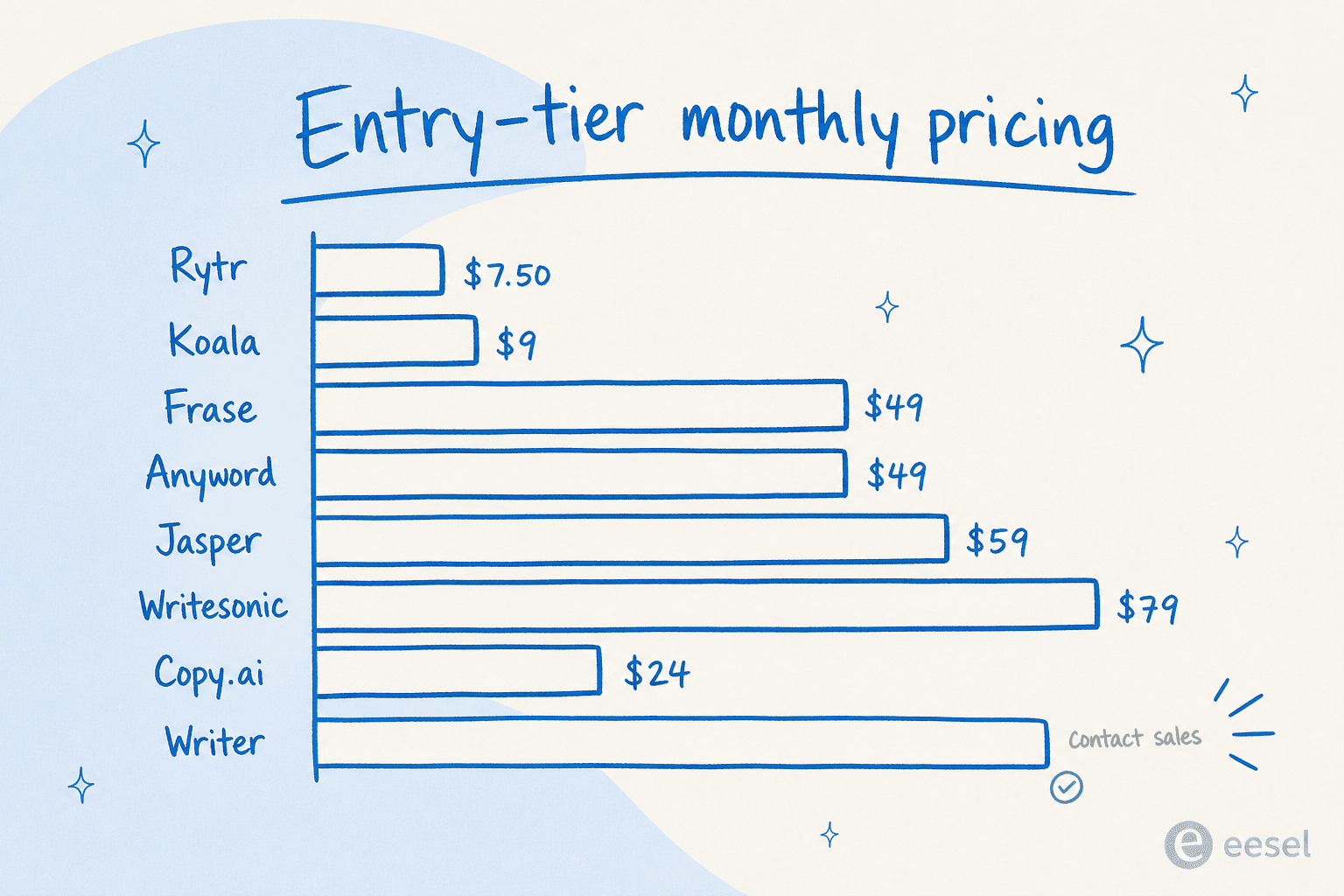
But price alone is a bad way to pick an AI blog writing tool. The shortcut we'd actually use:
- You want one tool to handle everything from research to publishing → eesel. The Blog Writer agent is the only option here that's explicitly designed as an autonomous teammate, not an editor surface.
- You're a marketing team buying for brand consistency → Jasper Business (with Style Guide and Visual Guidelines, not Pro). For a comparison shortlist, see our Jasper AI alternatives post.
- You're chasing SEO volume on a budget → Koala Writer + a separate optimisation tool like NeuronWriter or Surfer.
- You treat the brief as the deliverable → Frase, and accept you'll edit harder than with Jasper.
- You're optimising for AI search citations, not just Google rank → Writesonic (or watch Frase's GEO tracking closely).
- You're a performance marketer who lives in conversion data → Anyword.
- You're at a regulated enterprise → Writer.com, and budget for the sales cycle.
- You're a solo creator on a tight budget → Rytr Free, with the upgrade to Unlimited when you outgrow the character cap.
- You're a sales-and-marketing-ops team codifying GTM motions → Copy.ai Growth or above; below Growth, the writer alone isn't worth the trip.
And the meta-rule that catches most buyers out: the writing step is the least interesting part. If a tool only shines in the middle of the pipeline (the "AI drafts 2,000 words" demo) and falls down on research or publishing, you'll outgrow it the moment your content workflow gets serious.
Try eesel for end-to-end blog production
If you've read this far and you're nodding along with the "I just want the whole loop handled" point, that's exactly where eesel lands. The Blog Writer agent is one of three agent roles on the eesel platform (alongside the Helpdesk Agent and the E-commerce Agent), and it's built to research, draft, and publish long-form content end-to-end: pulling from your existing knowledge sources, drafting in your brand voice, and pushing to WordPress, Webflow, Ghost, or HubSpot when it's done.
The billing model matches the pitch: $4 per blog post, no seat fees, no platform fee. The free plan ships with 100 free credits, no card required, enough to actually compare the output against whichever tool from this list you're currently using.
If you want a deeper read on the workflow before you sign up, see our guide to an AI blog writer with brand voice training and the AI blog writer workflow breakdown.