It feels like AI writing tools went from a niche technology to an essential part of the modern content stack almost overnight. They promise to speed up everything from brainstorming ideas to drafting entire articles. But with hundreds of options available, all claiming to be the best, choosing the right one can be challenging. Many tools can produce generic text, so finding one that aligns with your quality standards is key.
To cut through the noise, I spent weeks trying out dozens of the most popular AI writers. This guide breaks down the top 6 options, pointing out their strengths, weaknesses, and who they're really for, so you can find the right fit for your work.
Understanding the best AI-powered writing tools
What are these AI writing tools, really? At their simplest, they're applications designed to help you generate, tweak, and optimize text. Under the hood, most of them run on large language models (LLMs) like OpenAI's GPT or Google's Gemini. These models have been trained on a massive amount of text from the internet, books, and articles, which lets them predict and create human-like sentences based on your requests.
Effective tools are more than just a simple interface for an LLM. They often include specialized features and workflows to solve specific problems. For example, some tools are focused on SEO blog posts, others are masters of short-form ad copy, and a few are even built for writing fiction. They add value with things like templates, brand voice settings, research functions, and integrations that can make content creation faster than using a general tool like ChatGPT.
How we chose the best AI-powered writing tools for this list
I wanted this list to be useful, so I focused on how these tools performed in real-world scenarios, not just what their marketing pages promised. I judged every tool on the same set of criteria that I think matters most to writers and marketers.
-
Quality of Output: Does the text sound like a human wrote it, or does it need a ton of editing to fix awkward phrases and repetitive sentences?
-
Ease of Use: Is the interface easy to figure out? Can a new user jump in and get good results without a huge learning curve or needing a degree in prompt engineering?
-
Feature Set & Use Case: Does the tool have features that are perfect for a specific job, like SEO, ad copy, or long-form articles? I looked for tools that do one thing exceptionally well.
-
Customization & Control: How much can you influence the final text? I gave extra points to tools that let you set a brand voice, feed it specific information, and guide the AI to create content that sounds like you.
-
Value for Money: Is the price fair for what you get? I looked at free plans, trials, and whether the cost was worth the benefits compared to everything else out there.
A quick comparison of the best AI-powered writing tools in 2026
| Tool | Best For | Starting Price | Free Plan/Trial |
|---|---|---|---|
| eesel AI blog writer | Generating publish-ready SEO blog posts | $99 for 50 blogs | Yes, free to try |
| Jasper | Enterprise teams & AI content automation | $69/month per seat | 7-day free trial |
| Writesonic | AI search visibility & SEO content | $49/month | Free trial available |
| Copy.ai | Go-to-market teams & sales automation | $29/month | Yes, free plan available |
| Rytr | Affordable short-form content generation | $9/month | Yes, free plan available |
| Sudowrite | Creative and fiction writing | $19/month | Yes, free trial available |
The 6 best AI-powered writing tools in 2026
After putting a bunch of tools through their paces, here are the ones that actually deliver, each with its own specialty.
1. eesel AI blog writer
The eesel AI blog writer is designed to generate a complete blog post from a single keyword, including media elements and SEO optimization. The tool aims to reduce manual formatting by delivering an article that includes headings, images, tables, relevant YouTube videos, and Reddit quotes for social proof. This tool contributed to our blog's significant impression growth over a three-month period.
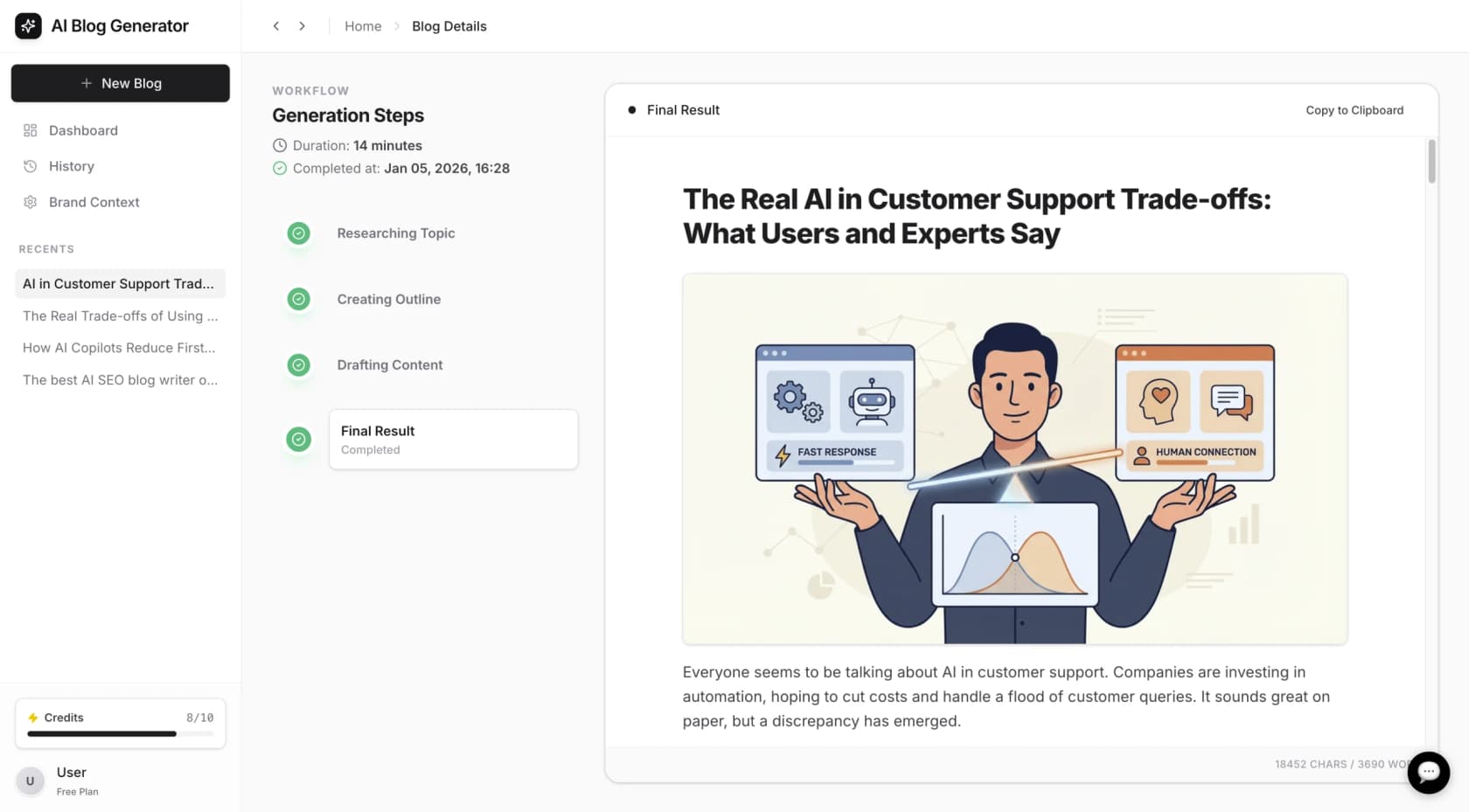
The tool features smart research capabilities and focuses on optimizing for both search engines (SEO) and AI answer engines (AEO). You provide a topic and your website, and it analyzes your brand context to add natural product mentions. The final product is designed to align with your team's voice and rank in search results.
eesel AI's functionality extends beyond text generation by automatically creating assets like infographics and charts and incorporating social proof. This makes it a comprehensive tool for teams looking to scale high-quality content production.
Pros and Cons: A key benefit is its ability to generate a complete, formatted blog post with assets included, which can significantly reduce editing time. It is also designed for both SEO and AEO. A consideration is its specialization in blog content, so it may not be suitable for users who primarily need short-form copy for social media or ads.
Pricing: You can try it for free. Paid plans start at $99 for 50 blog credits.
Who it's for: Content marketers, SEO specialists, and businesses that want to scale their organic traffic with high-quality, long-form articles.
2. Jasper
Jasper is a well-known name in the AI space, particularly for marketing teams that need to automate their content. It's a well-rounded platform for creating various materials, from blog posts and website copy to social media updates and ad campaigns. Its polished design and features reflect its experience in serving larger teams.
Jasper's "Jasper IQ" feature is especially useful for larger companies. It consolidates your brand voice, style guides, and a knowledge base to ensure the AI's output is consistently on-brand and factually correct. That level of control, plus enterprise-level security like SOC 2 compliance, makes it a solid choice for bigger organizations. It also has workflow tools like "Content Pipelines" and a no-code "Studio" for building custom AI apps.
While Jasper is powerful, it is also one of the pricier options. The platform is aimed at professional teams with a dedicated budget. For those who can afford it, Jasper provides a robust and reliable way to scale content production across an entire company.
Pros and Cons: Jasper’s main strengths are its deep enterprise features, tight brand controls, and numerous integrations. The biggest downside is the price, which is higher than many competitors and might be a stretch for individuals or small teams.
I like a mix of free Chat GpT and Jasper. Free Chat GPT is actually still better for brainstorming , Jasper doesn’t really always understand the same prompts, the same way. I could ask it to suggest an outline for an ebook blah blah blah and sometimes it takes a lot more correction than chat GPT.

Pricing: The Pro pricing starts at $69 per month per seat. A 7-day free trial is available.
Who it's for: Businesses and enterprise marketing teams that need a secure, all-in-one platform with comprehensive features and have the budget to match.
3. Writesonic
Writesonic has positioned itself as an AI search visibility platform that helps brands appear in both traditional search results and AI-powered answer engines. It has a set of tools to track a brand's performance in AI search on platforms like ChatGPT, Gemini, and Perplexity, and then provides assistance to improve visibility.
The platform is built around what it calls "Generative Engine Optimization" (GEO), which helps users find content gaps and opportunities. Beyond writing, Writesonic's "AI Article Writer" creates fact-checked, SEO-friendly content with internal links, and its "SEO AI Agent" can perform technical audits and suggest fixes. It’s a complete tool for marketers focused on the future of AI-driven search.
The user interface is feature-rich, giving users a high degree of control over the final article. It's a strong option for content marketers who need to create and optimize content for the new era of search.
Pros and Cons: The best part about Writesonic is its combined SEO and GEO toolkit, which makes creating search-ready content much simpler. On the flip side, the sheer number of features could be overwhelming for someone just looking for a simple writing assistant.
Writesonic has better British English support out of the box. For you specifically, found writesonic superior for social captions and blog writing, but jasper's better for seo work and keword integration
Pricing: A free trial is available. The Lite plan starts at $49 per month.
Who it's for: Content marketers and SEO pros who want an AI tool with built-in features for creating and optimizing content for both Google and AI search.
4. Copy.ai
Copy.ai began as a simple copywriting tool but has evolved into a full GTM AI Platform for automating sales and marketing tasks. It is particularly effective at handling inbound leads, running account-based marketing campaigns, and creating highly personalized sales emails at scale.
One of Copy.ai's standout features is "Workflows," which lets teams turn their go-to-market strategies into automated, multi-step processes. For instance, you could build a workflow that takes a new lead, researches their company, and drafts a personalized email sequence automatically. Its "Prospecting Cockpit" is also useful for helping sales teams find and understand prospects better, leading to more effective outreach.
While it is still effective for generating marketing copy, its primary focus is now on automating the complex work that drives revenue. For teams that produce a high volume of sales and marketing content, the unlimited word count on paid plans is a significant benefit.
Pros and Cons: The platform's ability to automate complex GTM workflows is a huge plus for sales and marketing teams. The downside is that it's not the best choice if you're looking for a dedicated tool for creative writing or in-depth articles.
ease-of-use and friendly interface, compared to other competitors; quality of content is also superior (yet, here is a trick: in a paid plan, it seems to be much better than in a free one).
Pricing: A free plan is available with a 2,000-word monthly limit. The Chat plan, with unlimited words and 5 user seats, starts at $29/month.
Who it's for: Sales and marketing teams that want to automate their entire go-to-market process, from finding leads to sending personalized messages.
5. Rytr
If you're on a tight budget or just beginning to explore AI writing, Rytr is a good option. It has a generous free plan and one of the most affordable paid plans available, making it highly accessible. The platform is simple and easy to use, with over 40 templates for different types of content, like blog outlines, emails, product descriptions, and ad copy.
Rytr lets you choose from over 20 different tones to achieve the right style, whether you need something formal and convincing or casual and funny. That flexibility, plus support for over 30 languages, makes it a surprisingly capable tool for its price. It even includes a built-in plagiarism checker to help ensure your content is original.
As an affordable option, Rytr's output may sometimes require more editing to achieve the same level of polish as more expensive tools. It is best suited for quick marketing tasks and overcoming writer's block rather than producing a finished long-form article.
Pros and Cons: Rytr's low price and a wide variety of templates make it a great value. The main drawback is that the quality of its longer articles may not be as consistent as pricier tools, and sometimes the different versions it suggests can be a bit repetitive.
I liked Rytr in pre-chatgpt era. Now I don't use it. And customer support sucks with its 'dark patterns' when it comes to your subscription annual fee. They got my annual subscription fee in advance and when were asked ro a refund THE NEXT day, they just like: 'we don't refund, it's a company's policy... blah-blah-blah-...' Given my previous pre-paid year I didn't use the service almot entirely. Meaning they got 2-year subscription fee almost for nothing...
Pricing: A free plan is available for 10,000 characters per month. The Saver plan starts at just $9/month.
Who it's for: Freelancers, solopreneurs, and anyone on a budget who needs a simple, all-around AI writer for general short-form content.
6. Sudowrite
While most AI writing tools are for marketers, Sudowrite is for fiction writers. It’s designed to be a creative partner that helps authors brainstorm plot ideas, flesh out characters, overcome writer's block, and write more descriptive prose. It's a fantastic tool for those open to receiving AI assistance with their creative work.
Sudowrite has unique features specifically for storytelling. The "Describe" function can add sensory details to a scene, while "Brainstorm" can generate character names or plot twists. Its "Story Bible" helps you keep all your lore and character details organized, and the "Canvas" feature lets you map out your plot visually. It doesn’t write the novel for you, but it can act as a co-pilot to help you through the process.
The platform has received praise for its ability to generate high-quality, literary-style writing, making it a favorite for novelists, screenwriters, and hobbyists who need a creative spark.
Pros and Cons: Sudowrite's specialized features for fiction and its high-quality writing are its biggest strengths. However, relying on it too much can lead to generic stories, and its credit-based pricing might not be ideal for writers who produce a high volume of words.
If you want an easy beginner tool for AI-assisted writing, you can check out Sudowrite but if you're going all in for NaNoWriMo an unlimited option would work way better.
Pricing: Plans start at $19/month (or $10/month when billed annually). A free trial is available.
Who it's for: Fiction authors, screenwriters, and creative writers who want an AI assistant for brainstorming, drafting, and polishing their stories.
To see some of these tools in action and get a better sense of how they compare, check out this video review that breaks down several top contenders in the AI writing space.
Getting the most out of the best AI-powered writing tools
No matter which tool you choose, the secret is to treat it like an assistant, not an autonomous employee. An AI can generate a first draft in seconds, but it lacks the critical thinking, personal experience, and unique voice that make content truly great. To get the best results, you need to keep a human in the loop.
First, give the AI as much context as you can. Use features like brand voice, knowledge bases, and detailed prompts to steer the output. The more specific you are, the better the result will be. Don't just provide a keyword; tell it who you're writing for, the desired tone, key points to include, and what to avoid.
Second, always check the facts. AI models have a tendency to "hallucinate", meaning they can invent facts, stats, and sources. Never publish AI-generated content without ensuring its accuracy.
Finally, use the AI text as a starting point. Your job is to edit, refine, and inject it with your own expertise and personality. Add personal stories, original thoughts, and a clear narrative. The best content comes from a partnership between human creativity and AI efficiency. The goal isn't to let the AI write for you, but to use it to write better and faster.
Choosing the right AI writing tool
The AI writing tool landscape is vast and constantly evolving. While tools like Jasper offer powerful automation for businesses and Sudowrite caters to creative writers, the right choice depends on your specific goals. Some tools focus purely on text generation, requiring additional time for editing, formatting, and sourcing assets. For those seeking a more streamlined workflow, an all-in-one solution can be beneficial.
The eesel AI blog writer is one such tool, built to turn a keyword into a complete, SEO-optimized article with images, videos, and social proof included. It’s designed to produce content that is ready for publishing, which can save significant time. If you're looking to scale your content strategy, you can try the eesel AI blog writer.
Frequently asked questions
What are the best AI-powered writing tools for beginners?
For beginners, Rytr is a fantastic starting point. It has a generous free plan, a simple interface, and plenty of templates to get you started without feeling overwhelmed. It's great for learning the ropes of AI-assisted writing for short-form content like emails and social media posts.
Can the best AI-powered writing tools replace human writers?
No, AI writing tools are not intended to replace human writers. They function best as powerful assistants. The best AI-powered writing tools can handle the heavy lifting of a first draft, research, and outlining, which saves a ton of time. But they can't replicate your unique voice, personal experiences, or critical thinking. The magic happens when a human editor takes that AI draft and polishes it into something truly special.
How do I choose from the best AI-powered writing tools for my specific needs?
The best way is to match the tool's specialty to your main goal. If you need to scale SEO articles, a tool like the eesel AI blog writer is ideal. If you're on a large marketing team needing brand consistency, look at Jasper. For creative fiction, Sudowrite is your best bet. Always use the free trials to see which workflow feels most natural to you.
Are the best AI-powered writing tools able to create SEO-friendly content?
Yes, many of them are specifically designed for it. Tools like eesel AI and Writesonic are built with SEO in mind, helping you create content that includes relevant keywords, proper heading structures, and even internal links. However, you should always review the output to ensure it aligns with your broader SEO strategy.
What's the main difference between free and paid versions of the best AI-powered writing tools?
The main differences are usually word or character limits, access to advanced features, and output quality. Free plans are great for testing a tool or for very light use, but they often have strict monthly limits. Paid plans unlock unlimited or much higher generation caps, premium features like brand voice and plagiarism checkers, and often use more powerful AI models for higher-quality results.
Do the best AI-powered writing tools check for plagiarism?
Many of the top-tier tools, like Rytr and Jasper, include a built-in plagiarism checker. This is an important feature to ensure the content you generate is unique before you publish it. However, it's always a good practice to double-check with a dedicated plagiarism tool if originality is a major concern.