


Let's be real, writing blog posts that actually rank on Google can be a serious grind. You have to juggle keyword research, spy on what competitors are doing, sketch out an outline, write the thing, and then go on a scavenger hunt for visuals. It's a lot to handle.
So, naturally, a lot of us have looked to AI to make life easier. But there's a common challenge, isn't there? Many AI writers can produce generic content that requires significant editing to align with a specific brand voice. It kind of defeats the whole purpose.
This is what I do. I outline, have it do a first draft, edit it for a good period, and then add the 'me' to it.

So, how do you find an AI tool that acts more like a partner and less like a content factory? I’ve spent the last few months testing all the big names to find the ones that genuinely help create top-notch, SEO-friendly content. This list breaks down the 7 tools that will save you time and help you publish blog posts that both people and search engines will actually like in 2026.
What makes a great AI tool for SEO blog content?
Before we dive into the list, it helps to know what separates a genuinely useful AI writing partner from a simple text generator. The top tools do more than just put words together; they get the strategy behind content that actually ranks.
Beyond basic text generation
A great AI tool doesn't just write, it does the homework for you. It should be able to look at the top-ranking pages for your keyword and figure out what topics, questions, and related terms you need to cover. It’s all about creating content that answers what people are actually looking for, not just throwing spaghetti at the wall and hoping it sticks.
Understanding search intent and user engagement
These days, SEO is all about giving people what they want. The best AI tools can tell if someone is trying to learn something, compare a few products, or is ready to make a purchase. They then help you structure your post to meet that need, which keeps visitors on your page longer, sending a big thumbs-up to Google that your content is good stuff.
Creating publish-ready content with assets
Honestly, the biggest time-saver is an AI that hands you a nearly finished blog post. I'm talking about a tool that generates not just the words, but also a smart structure with headings, relevant images, tables, and even things like YouTube videos or quotes from social media. Some tools, for instance, are built for exactly this, turning a multi-day process into a few minutes by automatically including all those assets, as illustrated in the graphic below.
A quick comparison of top AI writing tools for SEO
Every tool on this list has its own thing it's good at. Some are all-in-one platforms that take you from a single keyword to a full article, while others are more like specialized assistants that are pros at research or optimization. Here’s a quick rundown of how they compare.
| Tool | Best For | Key Feature | Starting Price (Monthly) |
|---|---|---|---|
| eesel AI blog writer | Generating complete, publish-ready blog posts | Automatic asset & social media integration | $99 for 100 blogs (Early Bird plan) |
| Jasper | Versatile content creation with templates | Brand IQ (voice, style, visual guides) | $59 (billed annually) |
| Surfer | On-page SEO optimization | Real-time Content Score & AI Tracker | $79 (billed annually) |
| Copy.ai | Go-to-market (GTM) workflow automation | AI-powered workflows and agents | $24 (billed annually) |
| Writesonic | AI search visibility and up-to-date content | AI Article Writer 6.0 with web access | $39 (billed annually) |
| Frase | SEO research and content brief creation | AI-powered outlines & GEO optimization | $38 (billed annually) |
| ChatGPT | Brainstorming and collaborative first drafts | Custom GPTs and Canvas interface | $20 (Plus plan) |
The 7 best AI tools for writing SEO-rich blog content
After putting dozens of tools to the test, here are the top seven that really shine when it comes to creating blog content that's built to rank.
1. eesel AI blog writer
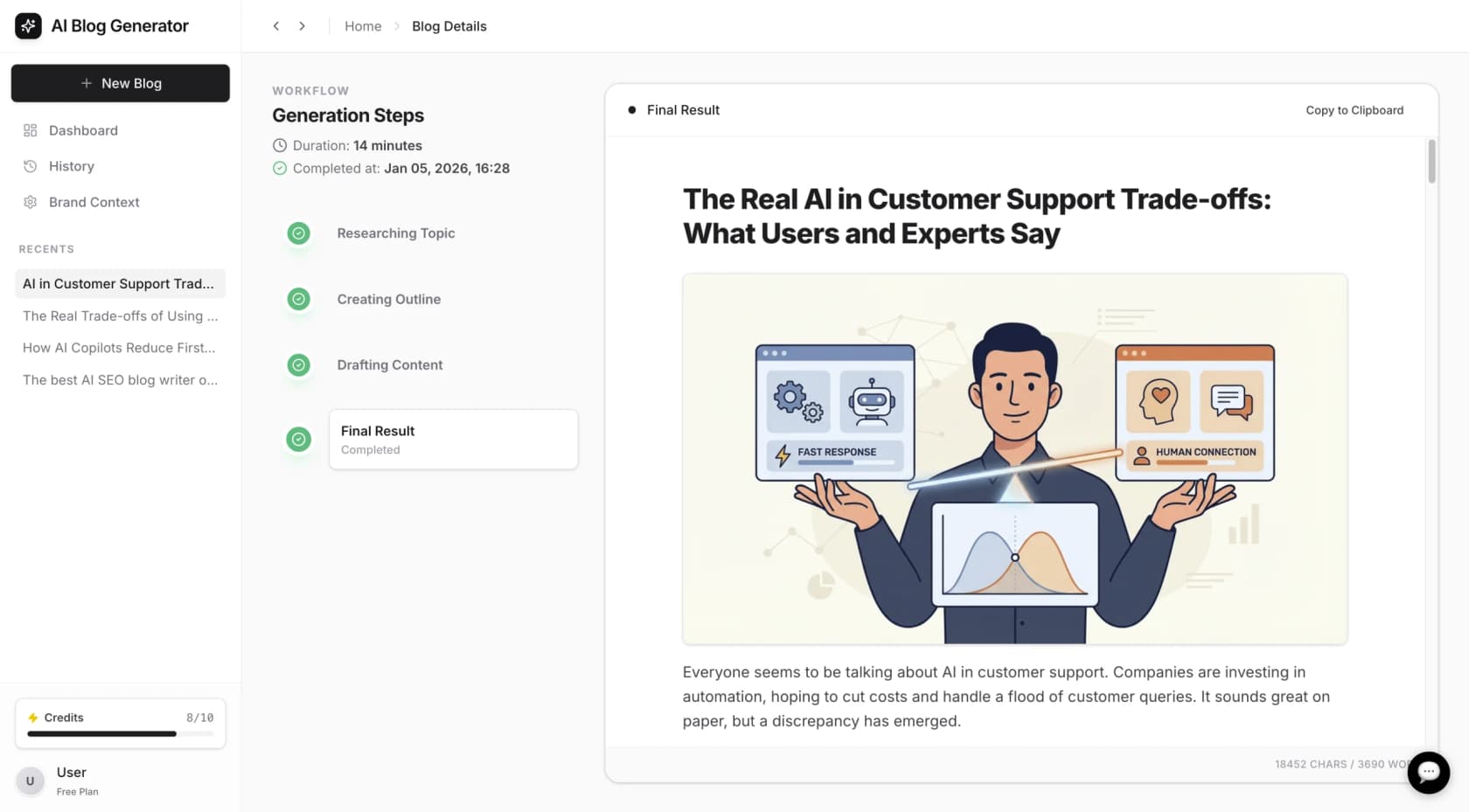
The eesel AI blog writer is designed to turn a keyword into a complete, SEO-optimized, and media-rich blog post. It generates a fully structured article that includes AI-generated images, relevant YouTube videos, and Reddit quotes to add social proof. The tool's research capabilities aim to differentiate between content types, such as product reviews and how-to guides, to source appropriate information. A key feature is its ability to automate the inclusion of assets and formatting. This tool is specialized for blog generation and is not designed as a general-purpose AI assistant.
-
Pricing: You can try it for free. The Early Bird plan offers 100 blogs for $99/month.
-
Best for: Content teams and marketers who want to scale up high-quality blog production without all the manual headaches.
2. Jasper
Jasper is a huge name in the AI writing space, with a library of over 100 templates for just about anything, from blog posts to social media ads. Its Brand IQ feature is fantastic for keeping your content consistent, as you can teach it your brand voice, style guide, and even visual preferences.
Jasper and Writesonic are solid for long-form structure, but I still run drafts through ChatGPT or Claude for depth and fact-checking. SurferSEO or NeuronWriter help align with search intent. Honestly, mixing one AI writer with a manual edit pass gives the best results.
The platform also has collaboration tools like the Canvas, which is handy for planning and creating content with a team. While Jasper is effective for creating copy and first drafts, users typically add their own assets like images and videos to finalize a blog post. It can be integrated with Surfer for SEO optimization, which requires a separate subscription.
-
Pricing: Starts at $59/month per seat for the Pro plan when billed annually.
-
Best for: Marketers who need a flexible AI tool for all kinds of content, not just blogging.
3. Surfer
Think of Surfer as less of an AI writer and more of an AI optimization coach. Its star player is the Content Editor, which gives you a real-time "Content Score" while you write. It scans the top-ranking pages for your keyword and gives you a checklist of terms to include, how long your article should be, and how to set up your headings. This data-first approach takes a lot of the guesswork out of on-page SEO.
They’ve also added new tools like the AI Humanizer to make AI text sound more natural and a Topical Map to help plan out content clusters. The big win here is its top-tier SEO guidance. Its primary function is SEO guidance, and it is often paired with another AI writer for content generation. API access is available on the Enterprise plan.
-
Pricing: Starts at $79/month for the Essential plan when billed annually.
-
Best for: SEO pros and content writers who want to be absolutely sure their content is perfectly optimized to rank.
4. Copy.ai
Copy.ai has pivoted to become a "GTM AI Platform" focused on automating sales and marketing workflows. It's particularly good at building and running processes with multiple steps, like turning a webinar into a blog post, handling new leads, or adapting sales materials for different countries. Its main strength is turning your company's playbooks into AI workflows you can run again and again.
When writing a full blog post, it provides a solid first draft. Users typically conduct further research and add assets to complete the article.
-
Pricing: A free plan is available. Paid plans start at $24/month for the Chat plan when billed annually.
-
Best for: Marketing and sales teams who are trying to automate a bunch of different tasks, not just blogging.
5. Writesonic
Writesonic's best feature is its AI Article Writer 6.0, which pulls from real-time web data to create content that's factually accurate and current. This is a huge advantage if you're writing about news or topics that change quickly. The platform also talks a lot about "AI Search Visibility" and Generative Engine Optimization (GEO), which is about getting your content cited in AI chat answers from bots like ChatGPT.
Its chatbot, Chatsonic, is also pretty cool because it mixes together top AI models like GPT-4o, Claude, and Gemini in one spot. While its ability to use current information is a key feature, the generated articles may require editing to align with a specific brand voice and structure.
-
Pricing: Starts at $39/month for the Lite plan when billed annually.
-
Best for: Bloggers who cover timely or data-heavy subjects and want to get ahead on optimizing for AI search.
6. Frase
Frase is a beast when it comes to the first part of the content process: research and outlining. It scans the top search results for your keyword and spits out a detailed content brief in just a few minutes. The platform is also built to optimize for both regular search (SEO) and AI search engines (GEO), helping you get your content mentioned by ChatGPT, Perplexity, and Claude.
Its "Content Opportunities" feature is also really useful, connecting to your Google Search Console to find pages that are slipping in the rankings and could use a refresh. Frase is excellent for building a strong, data-backed plan for your article. The AI-generated draft provides a solid starting point, and users typically refine the text and add their own visuals to finalize the post.
-
Pricing: Starts at $38/month for the Starter plan when billed annually.
-
Best for: Content strategists and SEOs who want to make their research faster and optimize for both Google and AI chat.
7. ChatGPT
ChatGPT is the Swiss Army knife of the AI world. It's amazing for brainstorming blog ideas, creating outlines, rephrasing sentences, and banging out a quick first draft. With its new Canvas feature, you can work with the AI in a live document, which feels a lot more natural for editing than the old back-and-forth chat window.
I haven’t launched my blog yet, but i’ve been drafting posts. I write the whole thing myself, upload it to chat gpt & it gives feedback on grammar, tone, etc. I haven’t used anything else that’s AI yet.
It's an incredibly powerful and flexible tool. For blog writing, it provides the text-based content. It does not conduct competitive research or source assets like images, so it functions as a writing assistant rather than an end-to-end blog creation tool.
-
Pricing: The Plus plan is $20/month. Business and Enterprise plans are also available.
-
Best for: Pretty much everyone. It’s a must-have tool for brainstorming, drafting, and editing, but you’ll want to pair it with other tools for optimization and asset creation.
For those looking to see these tools in action, this video provides a helpful comparison of how different AI writers perform when tasked with creating SEO content.
How to choose the right AI writing tool for SEO
With so many choices, picking the right one really depends on your goals and how you work. Here are a few things to think about.
Start with your primary goal
If your goal is to scale content production from zero to a high volume, a tool that automates the entire process from keyword to finished post may be suitable. If you are focused on optimizing existing content to rank higher, a specialized tool like Surfer would be a good fit. To automate various marketing tasks beyond writing, a platform like Copy.ai could be the right choice. Identify your primary pain point first.
Consider your existing workflow
Think about the biggest bottleneck in your current process. If you burn hours on research, a tool like Frase can give you that time back. If formatting and finding visuals is a significant bottleneck, a platform that automates asset integration can be beneficial. Pick a tool that fits into how you already work, not one that makes you change everything.
Remember to augment, not replace
No AI tool is going to completely replace a human writer's creativity, expertise, or unique perspective. The idea is to use these tools to take over the repetitive, boring parts of the job. That frees you up to focus on adding personal stories, unique opinions, and a final layer of polish, which is what makes content great.
Choosing the best AI tool for your needs
The right AI tool can accelerate content creation by helping you produce high-quality articles in less time. While general-purpose tools like ChatGPT and Jasper are useful for drafting, specialized platforms that manage the entire workflow can offer significant efficiency gains. Evaluating your specific needs will help you select the tool that best fits your goals, whether that's drafting, optimization, or end-to-end content generation.
Frequently asked questions
What is the best type of AI writing tool for beginners?
For beginners, an ideal tool is one that simplifies the entire content creation process. Look for a tool that can take a keyword and generate a fully formatted, publish-ready post with assets included. This approach removes much of the technical SEO and formatting guesswork. The eesel AI blog writer is an example of such a tool.
Can an AI writing tool replace a human writer?
Not completely. Even the top tools are designed to be assistants or co-pilots. They handle the heavy lifting of research, drafting, and asset gathering, which saves a ton of time. However, a human writer is still essential for adding unique insights, personal anecdotes, and a final strategic polish to make the content truly stand out.
How much do AI writing tools for SEO content typically cost?
Prices vary a lot. A simple tool like ChatGPT Plus is around $20/month, while more specialized platforms can range from $40 to over $100 per month. For example, eesel AI's Early Bird plan is $99/month for 100 blog posts, which is aimed at users who need to produce content at scale.
What features should I look for in an AI tool for writing SEO content?
Look for tools that go beyond just text generation. Key features include SERP analysis (analyzing top competitors), integration of media assets (images, videos), understanding of search intent, and the ability to create a well-structured article that's nearly publish-ready.
Is AI-generated content detectable by Google?
Google's stance is that it rewards high-quality content, regardless of how it's produced. As long as the content is original, helpful, and satisfies user intent, it doesn't matter if AI was used. The key is to use AI to create valuable content, not to generate low-quality spam.
How can I ensure the facts are accurate when using an AI writing tool?
That's a great question. Always choose a tool that has access to real-time web data, like Writesonic. This helps ensure the information is current. Even then, it's a good practice to fact-check any specific data, statistics, or claims before publishing, especially for topics in fast-changing industries.