Why subscription support is its own animal
I've spent the last three-plus years helping teams put AI agents on live support queues, and subscription brands are where the generic "answer questions from your help center" pitch falls apart fastest.
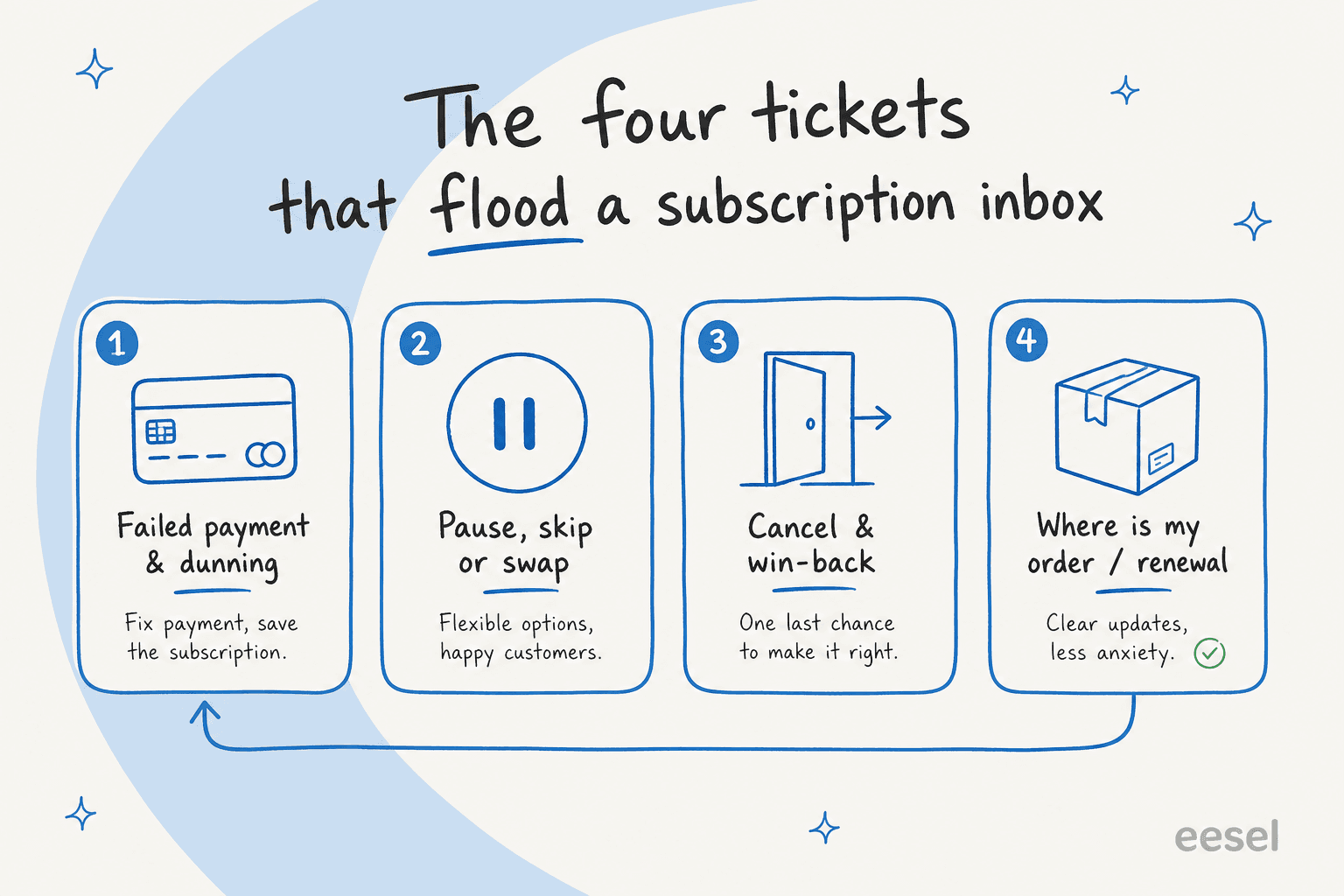
Here's the moment that made it click for me. A CX lead at a DTC supplements brand, running about 7,000 tickets a month on Gorgias, told me his team came in wanting a copilot and left realising they needed something autonomous, because more than half of his email volume was the same handful of recurring jobs: where's my order, change my subscription, basic product questions. None of those are answered by a knowledge-base article. They're answered by doing something to the customer's account.
That's the whole game with recurring revenue. A one-off store gets a wave of pre-sale questions; a subscription business gets the same person back month after month with billing and lifecycle requests. The volume is relentless and weirdly predictable.
So the bar for "good AI" here is higher than deflection. A subscription-grade agent has to:
- Read the live account, not just your docs. It needs to know this customer is on the annual plan, their card failed yesterday, and they've skipped twice.
- Take real actions safely: pause, skip, swap, reschedule a delivery, retry a payment, issue a prorated refund, run a save offer.
- Know when to back off. A wrong answer about a charge is a chargeback and a churn event, not a mildly annoyed customer.
That last point is the one I'd never compromise on, and it's exactly where most tools cut corners.
What I looked for
I judged each tool on the things that actually decide a subscription rollout, not the feature grid:
- Action depth - can the AI change a subscription and fix billing, or only answer FAQs and hand off?
- Billing/subscription integrations - does it connect cleanly to Shopify, Recharge, Stripe, or your billing platform?
- Accuracy controls - confidence routing, the ability to simulate against past tickets before going live.
- Fit with your stack - does it layer onto your current helpdesk, or demand a full migration?
- Honest cost at renewal-day scale - what you actually pay when volume spikes.
A quick word on method: this is hands-on with each product's setup, docs, and pricing plus what real operators say on G2 and Reddit, not a spec-sheet recital. Where a tool genuinely shines, I say so, even when it isn't my top pick.
The tools at a glance
| # | Tool | Best for | AI billing unit | AI cost | Starting seat price | Takes billing/sub actions | Layers on your helpdesk |
|---|---|---|---|---|---|---|---|
| 1 | eesel | AI on the helpdesk you already run | Per ticket handled | $0.40 | None (no seats) | Yes, via custom actions | Yes |
| 2 | Gorgias | Shopify subscription boxes | Per resolved conversation | $0.90 (annual) | $10/mo | Yes, native Shopify/Recharge | No (own helpdesk) |
| 3 | Gladly | High-LTV membership brands | Per AI resolution | $1.50 | ~$180/seat | Yes, via Action Guides | No (own platform) |
| 4 | Kustomer | High-volume B2C subscriptions | Per engaged conversation | ~$0.60 | ~$89/seat | Yes, via the CRM model | No (own platform) |
| 5 | Zendesk | Scaling/enterprise subscriptions | Per automated resolution | Usage, quoted | $19/agent/mo | Via apps/custom build | No (own platform) |
| 6 | Freshdesk | Early-stage budget pick | Per session | ~$0.49 | $0 for 6 months | Via marketplace apps | No (own platform) |
| 7 | Front | B2B/account-managed subscriptions | Per conversation | $0.05 (Autopilot) | $25/seat | Limited, via integrations | No (own inbox) |
| 8 | Help Scout | Small relationship-led teams | Per resolution | $0.75 | $25/user | Limited, via integrations | No (own inbox) |
How AI actually resolves a subscription ticket
Before the list, it's worth seeing what "resolving" a subscription ticket really looks like, because it's the dividing line between the tools that work here and the ones that just sound good in a demo.
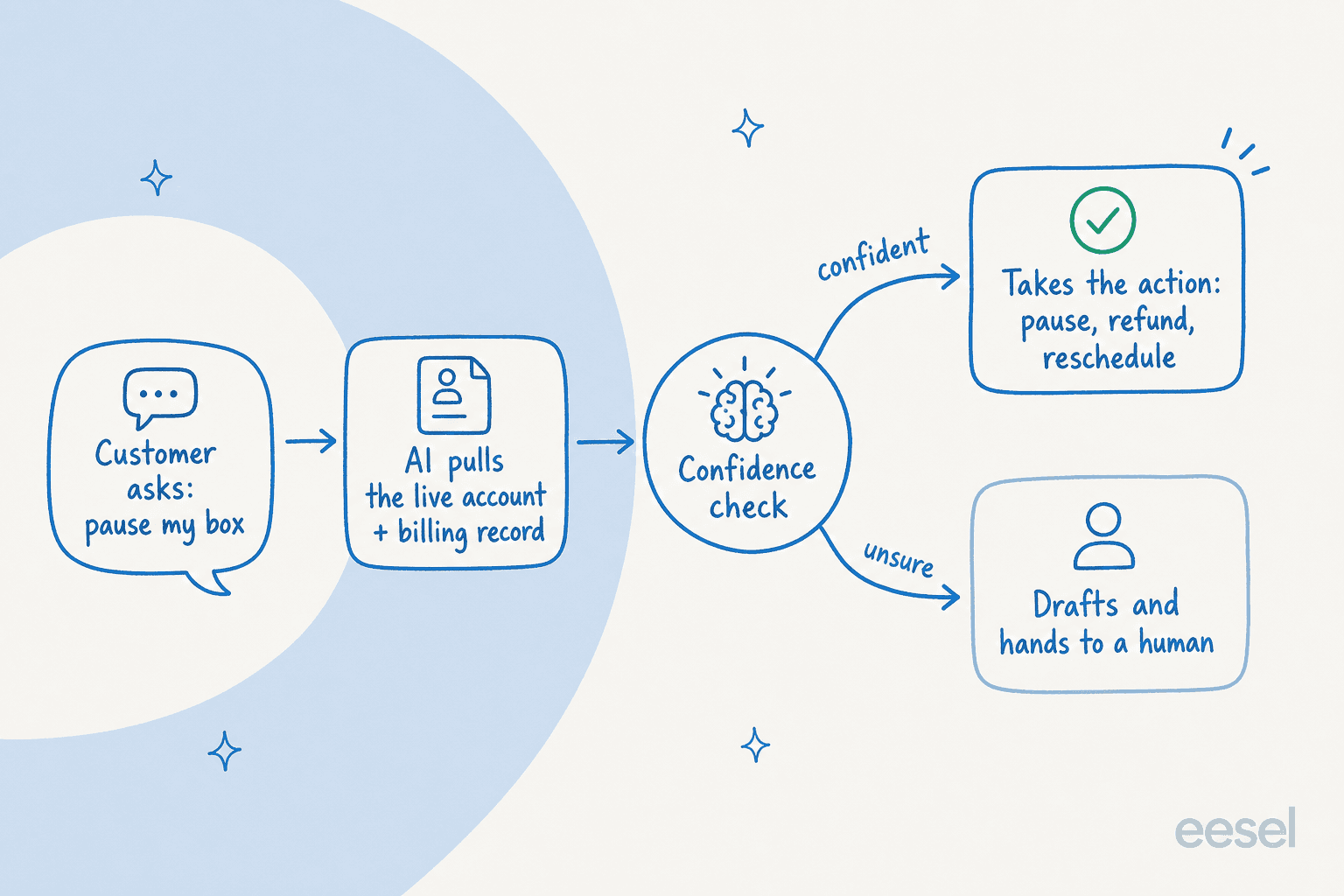
The customer says "pause my box this month." A deflection bot points them at a help article and hopes. A real agent pulls the live subscription record, confirms it's safe to act, pauses the next charge, and confirms back, all without a human touching it. When it isn't confident, it drafts a reply and routes to a person instead of guessing.
That confidence gate is non-negotiable for subscriptions. As one CX lead handling 7,000 tickets a month put it to me, an AI that confidently makes up an answer to a billing question is worse than one that does nothing, because nobody has time to audit thousands of replies after the fact. The agent should only handle what it's sure about and leave the rest alone. Keep that picture in mind as you read the list.
1. eesel

Best for: teams that already run a helpdesk and want AI that resolves subscription tickets on top of it, without a migration.
I'll declare the bias: I work on eesel. But the reason it leads this list for subscriptions is structural, not loyalty. eesel isn't another helpdesk you switch to. It's an AI layer that plugs into the one you already have and learns from your past tickets, help docs, and tooling on day one.
Features
eesel connects to Zendesk, Freshdesk, Gorgias, Front, Shopify, and 100+ other tools, then handles the recurring jobs a subscription brand drowns in: billing questions, plan changes, pause and cancel flows, and renewal queries. The piece that matters for subscriptions is custom actions, which let the agent reach into your systems to look up an order or change a subscription, not just retrieve a doc.
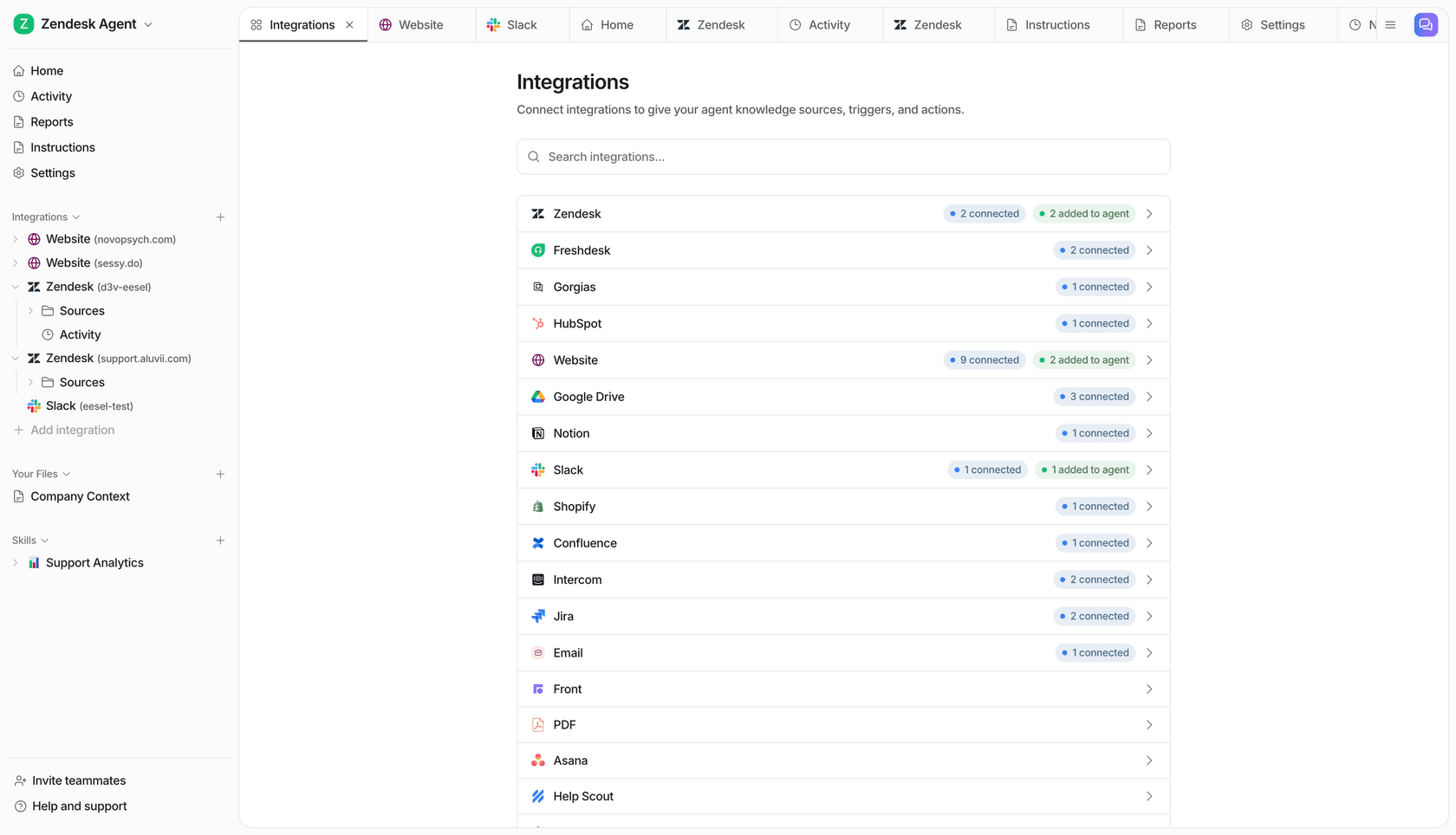
Two things make it safe to actually turn on. First, simulation mode replays thousands of your historical tickets so you can see exactly how the AI would have answered, by theme, before a single live customer hits it. Second, confidence-based routing means it only auto-resolves what it's sure about and quietly drafts the rest for a human. You grant autonomy gradually, ticket type by ticket type.

Pros
- Keeps your existing helpdesk and ticket history; setup is days, not a migration.
- Simulation and confidence routing make the accuracy story real, not a promise.
- Usage-based pricing fits the renewal-day spike pattern, since you pay per ticket handled rather than per seat.
- Handles 80+ languages, useful for subscription brands shipping internationally.
Cons
- It's an AI layer, not a full helpdesk, so if you don't have one yet you'll need both.
- SOC 2 is listed as in progress rather than certified, though EU data residency and signed DPAs are available.
- Deep custom actions need a quick setup conversation to wire into your billing system.
Pricing
eesel is usage-based: $0.40 per ticket handled, no per-seat fees, no platform minimum. The free trial gives you $50 of usage with no credit card. Commit to $300+/month annually and you pay 25% less, and there's a $1,000/month enterprise platform fee if you need SSO, HIPAA, and a dedicated SE. For a subscription brand, the no-seat model is the quiet advantage: your support headcount can stay flat while ticket volume swings with your billing cycle.
Verdict
Our take: if you already have a helpdesk and your problem is "the same billing and subscription tickets keep flooding in," eesel is the fastest path to actually resolving them, with the strongest guardrails of anything here. Skip it only if you have no helpdesk at all and want one product that's both.
2. Gorgias
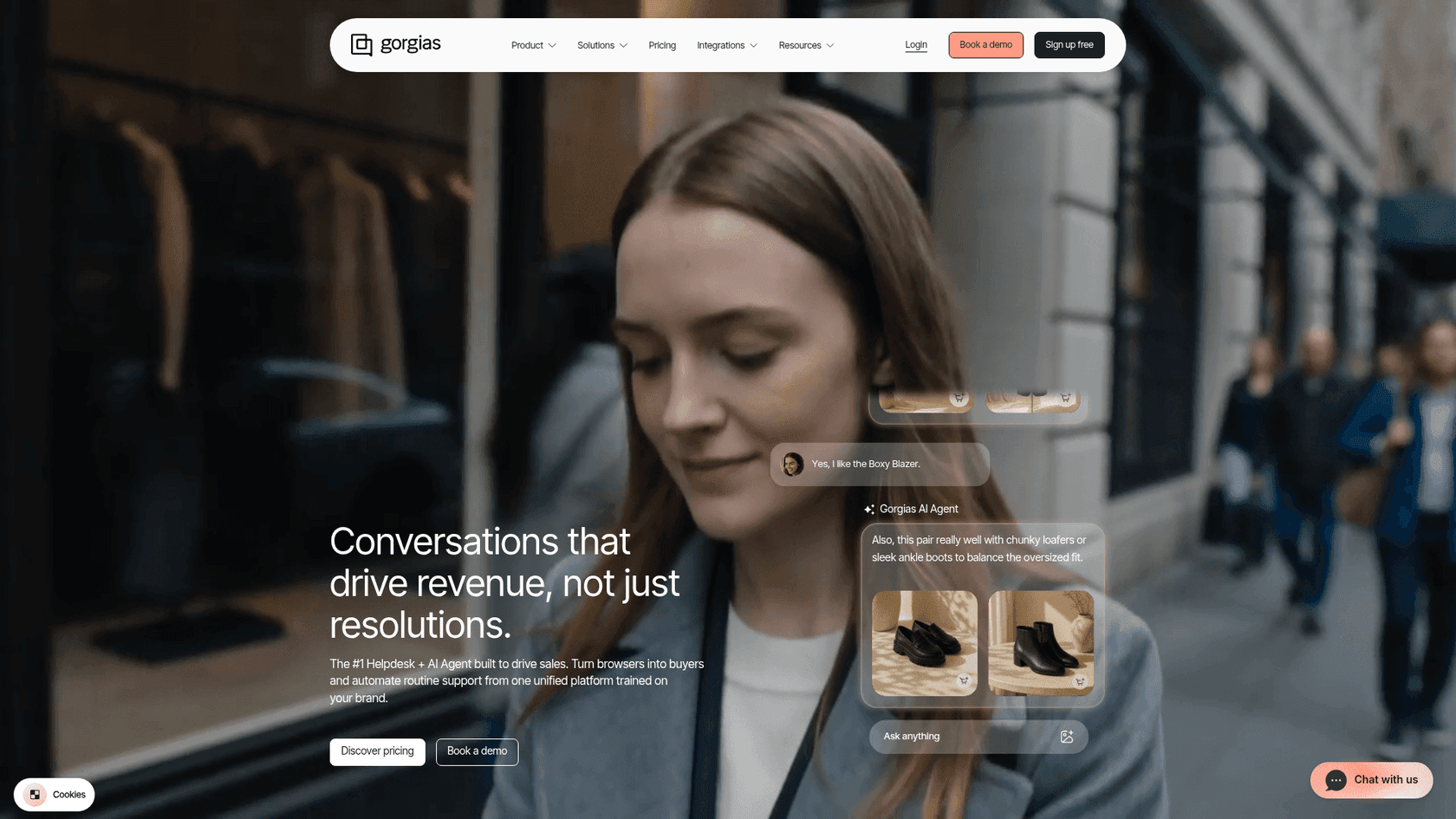
Best for: Shopify subscription boxes and DTC brands that run on Recharge.
Gorgias is built for ecommerce, and it shows. It claims to power 40% of Shopify brands and pulls orders, customers, and store data natively into the ticket view. For a subscription box on Shopify with Recharge, that native context is the headline feature.
Features
The AI Agent is pre-trained on a billion-plus ecommerce conversations and can edit orders and subscriptions, run returns and refunds, and generate dynamic discounts inside a conversation. It integrates with Recharge, Loop Returns, and Klaviyo, which is the exact stack most Shopify subscription brands already run.
Pros
- Genuinely native Shopify and Recharge actions; nothing else pulls store data in this cleanly.
- Strong automation during peak season; Orthofeet reportedly hit 50%+ automation. Practitioners describe the AI agents the same way:
"They are live right now, talking to customers, updating orders, and never taking a day off."
Vikas Solanki, on LinkedIn

- Revenue attribution baked in, so support gets credit for sales it drives.
Cons
- Pricing runs roughly 3x Zendesk for similar ticket volumes; the community rule of thumb is it pays off once 40%+ of tickets need direct Shopify actions.
- Every AI Agent interaction also counts as a billable helpdesk ticket, so you're billed twice on the same conversation.
- It's a full helpdesk, so adopting it means moving off whatever you run now.
Pricing
Ticket-based, not per-seat: Starter from $10/mo (50 tickets), Basic $50 (300), Pro $300 (2,000), Advanced $750 (5,000), then Enterprise. The AI Agent is a usage add-on at $0.90 per resolved conversation on annual plans, $1.00 monthly, and each resolution also burns a helpdesk ticket.
Verdict
Our take: if you're a Shopify subscription brand on Recharge, Gorgias is the most natural home and a real contender. Just go in clear-eyed about the double-billing and the per-resolution cost, and look at Gorgias alternatives if you'd rather keep a cheaper helpdesk and add AI on top.
3. Gladly
Best for: premium membership and high-LTV subscription brands that treat support as a relationship.
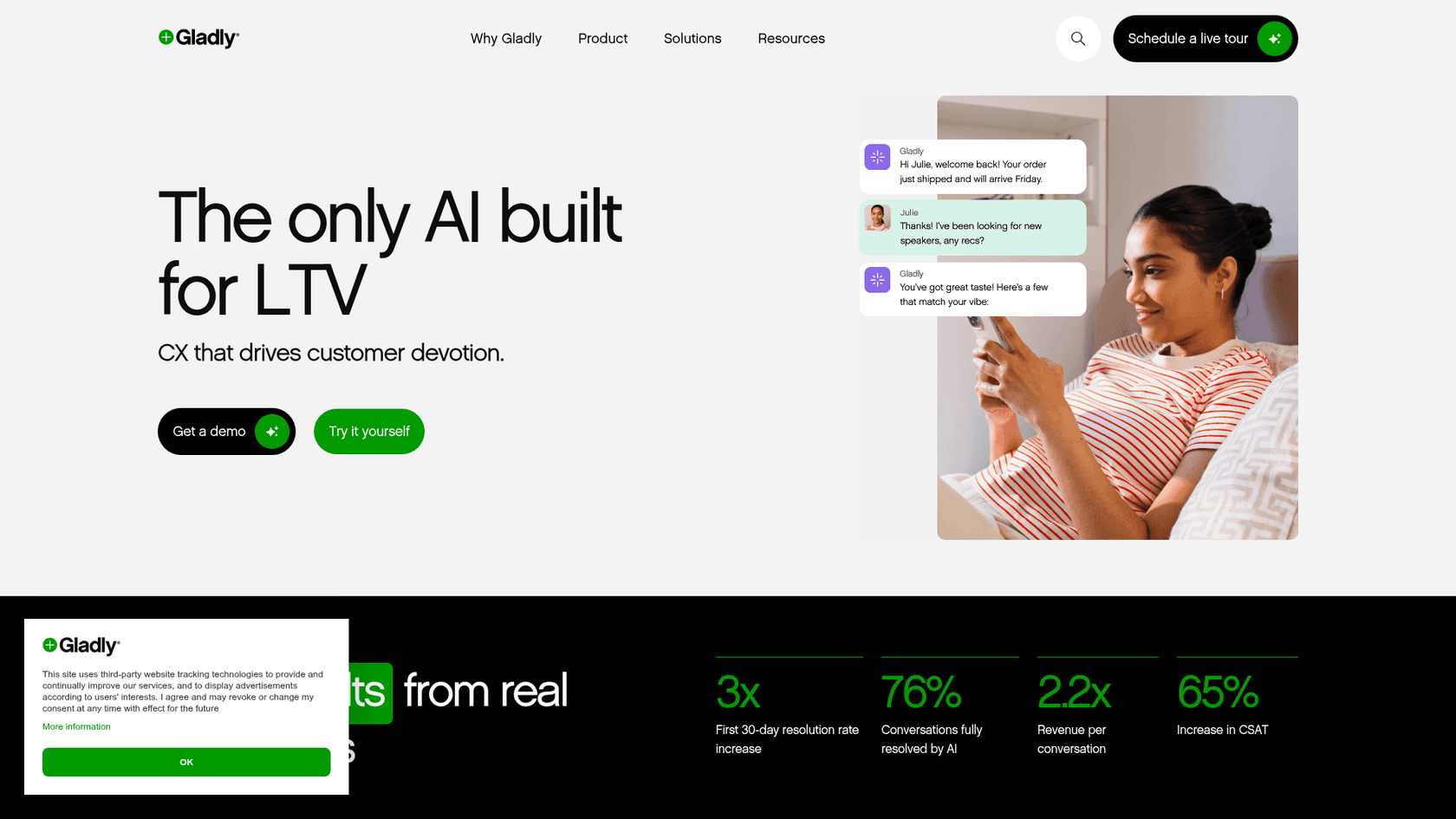
Gladly is built on a "people, not tickets" model: one lifelong conversation per customer instead of a stack of disconnected tickets. For a subscription business, that framing is genuinely apt, because you do have a lifelong relationship with each subscriber. Its pitch is "the only AI built for LTV."
Features
The Sidekick AI agent resolves end to end and takes real actions like cancel order, return, exchange, and price adjustment, across chat, voice, email, SMS, and social. Every conversation sits under a unified 360-degree customer profile, so subscribers never repeat themselves. Gladly claims 76% of conversations fully resolved by AI and a 3x resolution-rate jump in the first 30 days.
Pros
- The unified customer view is the most-praised thing in reviews, and it fits subscriptions perfectly.
- Real action-taking, not just answers, via Action Guides.
- Strong 4.7/5 on G2 across 1,100+ reviews.
Cons
- Expensive, and it's the most consistent complaint in the community.
- Reporting is fragmented; the top G2 gripe is manual Excel pulls for key metrics.
- It's a platform you migrate to, with seat minimums, not something you add to your stack.
Pricing
Gladly doesn't publish core platform pricing (it's demo-gated, with third-party sources citing ~$180-210/seat/mo annually). The self-serve Shopify plan does list usage rates: $1.50 per AI Resolution, $0.25 per AI Assist, and $120/mo per seat. That $1.50 is the highest per-resolution cost in this roundup.
Verdict
Our take: Gladly is a lovely fit for premium subscription brands that compete on white-glove service and have the budget for a platform rebuild. If you mostly want to automate billing and lifecycle tickets without the migration or the price, it's overkill; see Gladly alternatives.
4. Kustomer
Best for: high-volume B2C subscription operations that want AI running on a full customer data model.
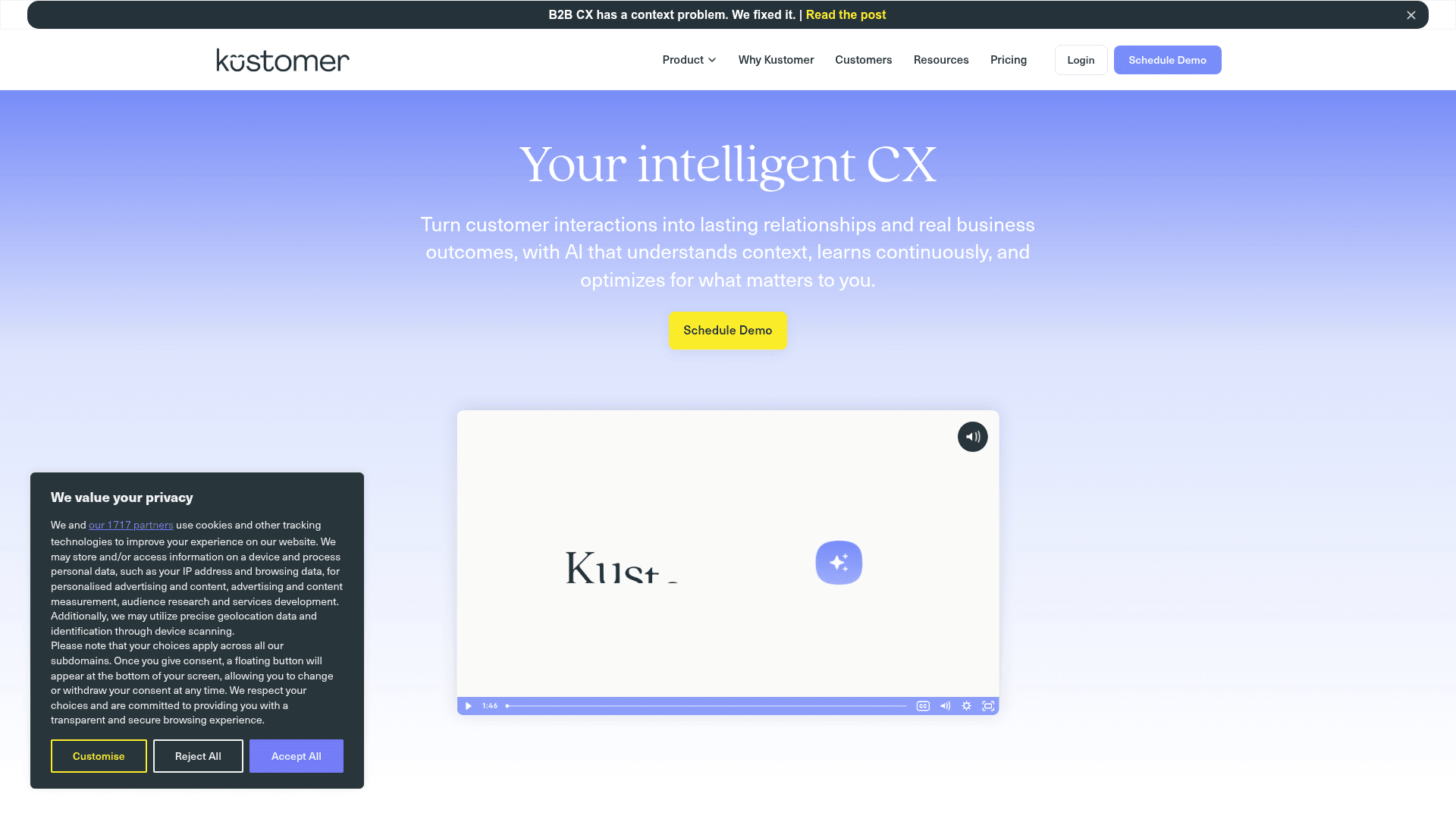
Kustomer is a CRM-style CX platform, not a ticket tool. Every interaction ties to a complete customer record (order history, loyalty tier, churn risk), which is the same instinct as Gladly and, again, a good fit for recurring relationships. Its pitch is "AI runs on context, not guesswork."
Features
The native AI suite is four products: Concierge (customer-facing autonomous AI), Envoy (agent copilot), Architect (no-code AI builder with Model Context Protocol support so agents act on live data), and Data Explorer (conversational analytics). Vuori reportedly runs 70% of chat conversations fully automated on it.
Pros
- The unified timeline and customer-centric model suit subscriptions well.
- Native MCP support means the AI can act on live Kustomer data, not just read it.
- Strong DTC and marketplace customer roster (Skims, Turo, Vuori).
Cons
- Quote-only pricing with an 8-seat minimum, annual-only.
- The voice channel is repeatedly flagged as buggy in reviews.
- Watch the marketing: the homepage advertises a "5.0 from 500+ G2 reviews," but the actual G2 aggregate is 4.4/5 from 555 reviews.
Pricing
No public figures; everything routes to sales. Competitor-teardown research puts it around $89/seat (Enterprise) or $139 (Ultimate), 8-seat minimum, with AI billed separately at roughly $0.60 per engaged conversation plus $40/user/mo for agent-assist AI. Treat those as directional.
Verdict
Our take: Kustomer is a serious option for a larger B2C subscription brand that wants its AI sitting on a rich customer data model and has the volume to justify a platform. Smaller teams will find the seat minimum and quote-only pricing heavy; Kustomer alternatives are worth a look.
5. Zendesk

Best for: scaling and enterprise subscription operations that want one big, mature platform.
Zendesk is the default enterprise helpdesk, and its AI agents (now Forethought-powered) resolve across channels and learn from every interaction. It's a safe, capable choice that scales, with a 1,800+ app marketplace to wire in billing and subscription tools.
Features
The "Resolution Platform" bundles AI agents, ticketing, omnichannel messaging, voice, QA, and workforce management. For subscriptions, the action-taking depends on building flows and connecting apps rather than a native billing model, but the raw capability is there. Zendesk claims up to 80% automation and 830M AI interactions processed.
Pros
- Mature, scales to enterprise, huge integration marketplace.
- AI agents resolve across channels and self-improve.
- Named a Leader in the 2025 Gartner Magic Quadrant for CRM Customer Engagement Center.
Cons
- The pricing is layered and easy to underestimate: a seat price, plus separate per-resolution AI billing, plus $50/agent/mo add-ons.
- Subscription/billing actions aren't native; you build them.
- Enterprise pricing is hidden behind sales.
Pricing
Seat-based, billed annually: Support Team $19/agent/mo (no AI), Suite Team $55 (AI agents first appear here), Suite Professional $115, then Enterprise (quoted). AI agents bill separately per automated resolution on top, and key add-ons (Copilot, WEM, Contact Center) are $50/agent/mo each.
Verdict
Our take: Zendesk is the right call if you're scaling and want one mature platform to standardise on. But you don't have to buy Zendesk's AI to get AI on Zendesk; layering eesel on top of Zendesk often resolves subscription tickets at a lower, more predictable cost than stacking its native add-ons.
6. Freshdesk
Best for: early-stage subscription startups that want a capable helpdesk for next to nothing.
Freshdesk is the budget-friendly, broadly capable option, and its free tier is the real hook for a bootstrapped subscription startup. Its Freddy AI Agent takes action with 50+ prebuilt agentic workflows and integrates with Shopify, Stripe, and PayPal through its marketplace.
Features
Ticketing, omnichannel, self-service, and Freddy AI (Agent, Copilot, Insights) in a unified Command Center. The marketplace connectors for Stripe and Shopify are how you wire in subscription and billing actions. Freshworks cites up to 80% resolutions with Freddy.
Pros
- A genuinely free tier ($0 for 1-2 agents for 6 months), then cheap paid plans.
- Action-taking AI via prebuilt workflows.
- Good usability reputation and a broad app marketplace.
Cons
- Subscription actions lean on marketplace apps rather than native depth.
- Freddy AI is consumption-priced and scales up at high volume.
- Deeper features sit behind the pricier tiers.
Pricing
Annual: Growth $19/agent/mo, Pro $55, Enterprise $89. The Freddy AI Email Agent includes 500 sessions, then $49 per 100 sessions (roughly $0.49 each). Plus the free 6-month on-ramp.
Verdict
Our take: for an early-stage subscription startup watching every dollar, Freshdesk's free tier is hard to argue with. As your renewal-day volume grows, the per-session AI cost climbs, which is the point to consider layering eesel on Freshdesk or weighing Freshdesk alternatives.
7. Front
Best for: B2B and account-managed subscriptions where support is relationship-led and collaborative.
Front is a collaborative shared inbox built for complex customer operations that span teams. It's a strong fit for B2B subscription and account-management work, where a renewal conversation might pull in success, billing, and support together.
Features
Shared inboxes, ticketing, omnichannel, and Front AI (Autopilot, Copilot, Smart QA, Smart CSAT). Front AI claims to resolve up to 70% of requests. The collaboration layer (internal comments, shared drafts) is the real differentiator, reported to deliver a 428% average ROI.
Pros
- Best-in-class collaboration for cross-team subscription accounts.
- Clean shared-inbox experience teams genuinely like.
- AI add-ons are modular, so you only pay for what you use.
Cons
- Less native billing/subscription action depth than the ecommerce-first tools.
- AI is mostly an add-on stack on lower tiers, which adds up.
- Starter is single-channel only.
Pricing
Annual: Starter $25/seat/mo (up to 10 seats), Professional $65, Enterprise $105. AI is add-on: Autopilot from $0.05/conversation, Copilot $20/seat/mo, Smart QA $20, Smart CSAT $10, all bundled into Enterprise.
Verdict
Our take: Front is the pick when your subscription support is really account management and collaboration matters more than raw ticket deflection. If you want it to resolve billing and lifecycle tickets autonomously, pair it with a dedicated agent like eesel on Front.
8. Help Scout
Best for: small, relationship-driven subscription teams that want a simple, human-feeling inbox.
Help Scout is the friendly, fast-to-learn shared inbox for small teams. Its AI Answers agent resolves around 73% of interactions from your knowledge base, and it's a lovely tool for a small subscription brand that values a human, email-like feel.
Features
Shared inbox, Docs knowledge base, the Beacon widget, live chat, and an AI layer (AI Answers for customers, Inbox Assistant for agents). Subscription and billing actions lean on integrations rather than native depth, so it's best when your AI job is mostly answering rather than acting.
Pros
- Genuinely easy; new agents are productive in under an hour.
- Clean knowledge base that feeds the AI.
- Free tier for up to 5 users to start.
Cons
- Limited advanced features and thin reporting at scale.
- AI Answers stacks $0.75/resolution on top of seats, a noted hidden scaling cost.
- The pricing history has burned trust. The 2025 per-seat to per-interaction switch triggered real churn:
"HelpScout changed back to user-based pricing. Guess too many people cancelled including me... Helpscout lost all trust with this flip-flopping on pricing."
u/manu_8487, r/SaaS, Nov 2025

Pricing
Per user/mo, annual: Free ($0, up to 5 users), Standard $25, Plus $45, Pro $75. AI Answers is a usage add-on at $0.75 per resolution, with a 3-month free trial.
Verdict
Our take: Help Scout is a great home for a small relationship-led subscription team that mostly needs to answer well. Once you need the AI to take billing and subscription actions at volume, you'll outgrow it, and adding eesel on Help Scout extends the action depth without leaving the inbox you like.
What an AI resolution actually costs
Here's the part I promised in the TL;DR. The seat price is the number everyone quotes; the per-resolution AI cost is the one that actually scales with your renewal-day spikes, and it varies almost 4x across these tools.
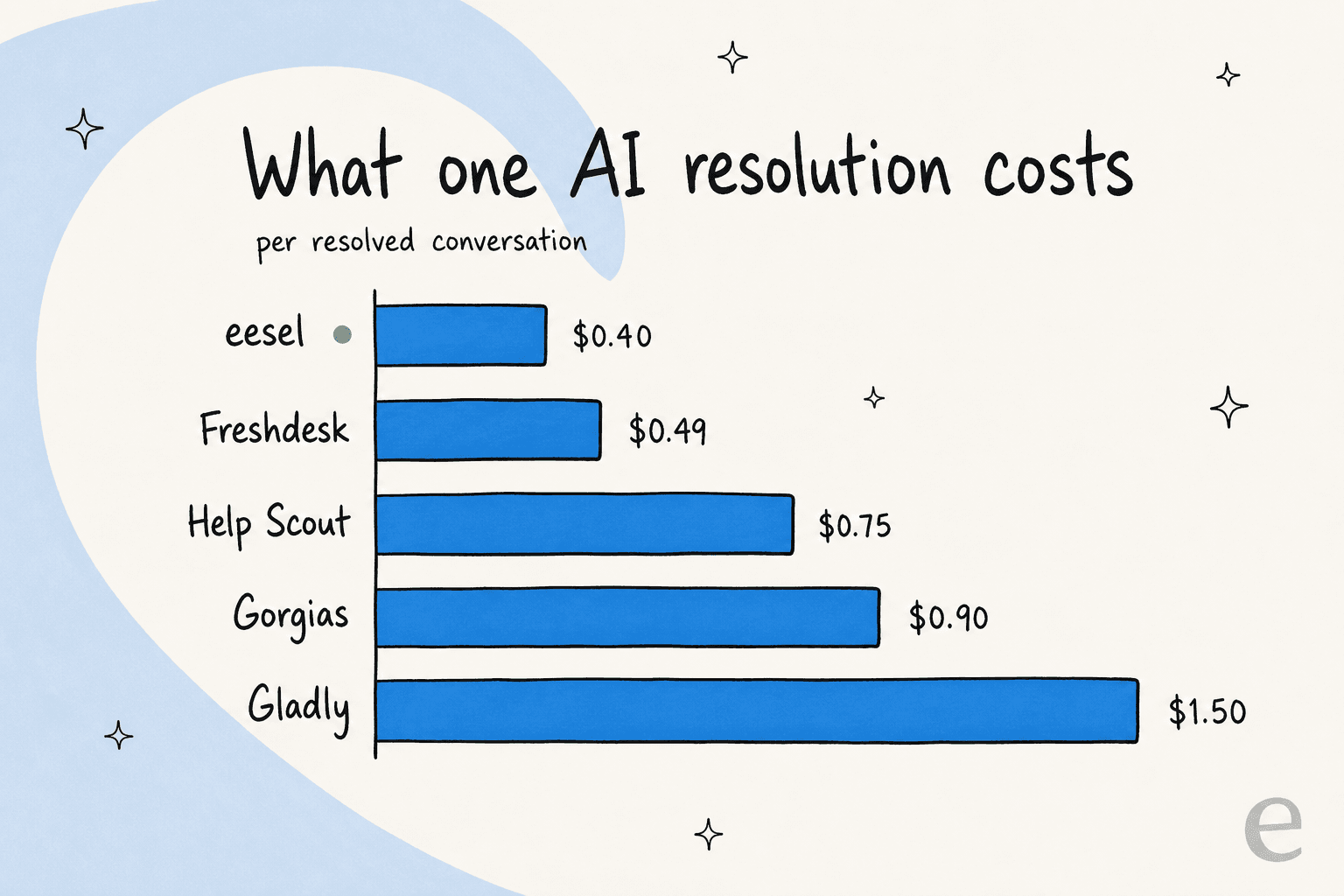
Run a quick worked example. Say your subscription brand gets a 5,000-conversation spike in renewal week and AI resolves 60% of it (3,000 conversations):
- At eesel's $0.40, that's $1,200.
- At Gorgias's $0.90 (plus the helpdesk ticket each resolution also burns), it's $2,700+.
- At Gladly's $1.50, it's $4,500, before seats.
Same work, wildly different bills. The per-resolution model rewards tools that resolve cleanly and punishes the ones that loop. This is also why I rate usage-based, no-seat pricing for subscription brands specifically: your support cost should flex with your billing cycle, not sit as a fixed seat count you over-provision for the spike and overpay for in the trough.
How to actually choose
Strip away the brand names and it comes down to two questions:
- Do you already have a helpdesk you're happy with? If yes, don't migrate. Add an AI layer like eesel on top and keep your history. If you have nothing yet, a full platform (Gorgias for Shopify, Freshdesk for budget, Gladly/Kustomer for premium B2C) makes sense.
- Does the AI need to take billing actions, or just answer? If it only needs to answer (you'll act manually), Help Scout or Front are fine. If it needs to pause, refund, swap, and cancel autonomously, you need real action depth and confidence routing, which is where eesel, Gorgias, and Gladly separate from the pack.
Whatever you pick, simulate it against your real tickets before you trust it with a live billing conversation. A subscription business runs on recurring trust, and one confidently wrong answer about a charge costs more than the whole tool.
Try eesel for subscription support
If your problem is the one I opened with - the same billing, pause, cancel, and renewal tickets flooding in every cycle - eesel is built to resolve exactly those, on the helpdesk you already run. It plugs into Shopify, Gorgias, Zendesk, and Freshdesk in minutes, learns from your past tickets, and lets you simulate the whole thing against your history before a customer ever sees it.
The differentiator for a subscription brand is the combination: real action-taking on your billing system, confidence routing so it only handles what it's sure about, and $0.40-per-ticket pricing with no seats, so your cost flexes with your renewal cycle instead of sitting fixed. It's free to try with $50 of usage and no credit card, so you can point it at your own tickets and see the resolution rate before you commit.
Frequently Asked Questions
What is the best AI for subscription businesses?
How much does AI customer service cost for a subscription business?
Can AI handle subscription billing and cancellation requests?
How do I stop an AI from giving wrong answers about a customer's plan?


Article by
Kurnia Kharisma Agung Samiadjie
Kurnia is a software engineer and writer at eesel AI with two years of SEO experience, writing about AI tools, helpdesk software, and customer support. He pairs a developer's understanding of how these products are built with search-driven research into what actually ranks and resonates with the people searching for them.