
"HIPAA-compliant AI" doesn't mean what the marketing says
Here is the thing to internalize first: HIPAA has no certification body. Nobody hands out a "HIPAA compliant" stamp the way a lab hands out an ISO 27001 cert. So when a tool's homepage says "HIPAA compliant," that claim is doing a lot of quiet work, and it usually means "you can configure this to be compliant," not "this is compliant the second you turn it on."
A healthcare IT practitioner put the distinction cleanly in a LinkedIn post:
"The marketing claim of 'HIPAA compliant' often means the AI tool can be configured to meet HIPAA requirements; not that it's compliant by [default]."
The gap between "can be configured" and "is compliant" is where breaches live. On r/healthIT, one thread described exactly the failure mode:
"A healthcare group near me just installed an AI chatbot, which claims to be HIPAA compliant. It gives out personal information without verifying identity."
That's a "HIPAA compliant" tool actively leaking PHI in production. The label was true in the narrow sense (the vendor would sign a BAA) and useless in the practical sense (nobody configured identity verification). The lesson for anyone shopping for a healthcare chatbot: the vendor's compliance posture is necessary but not sufficient. You still own the configuration.
When a support ticket becomes PHI
Most support teams underestimate how much of their queue is protected health information. It's not just lab results and diagnoses. HIPAA's Safe Harbor method lists 18 identifiers, and the moment one of them is tied to any health information, you're holding PHI. That includes names, every kind of date (birth, admission, appointment), phone numbers, email addresses, medical record numbers, and health plan or member IDs.
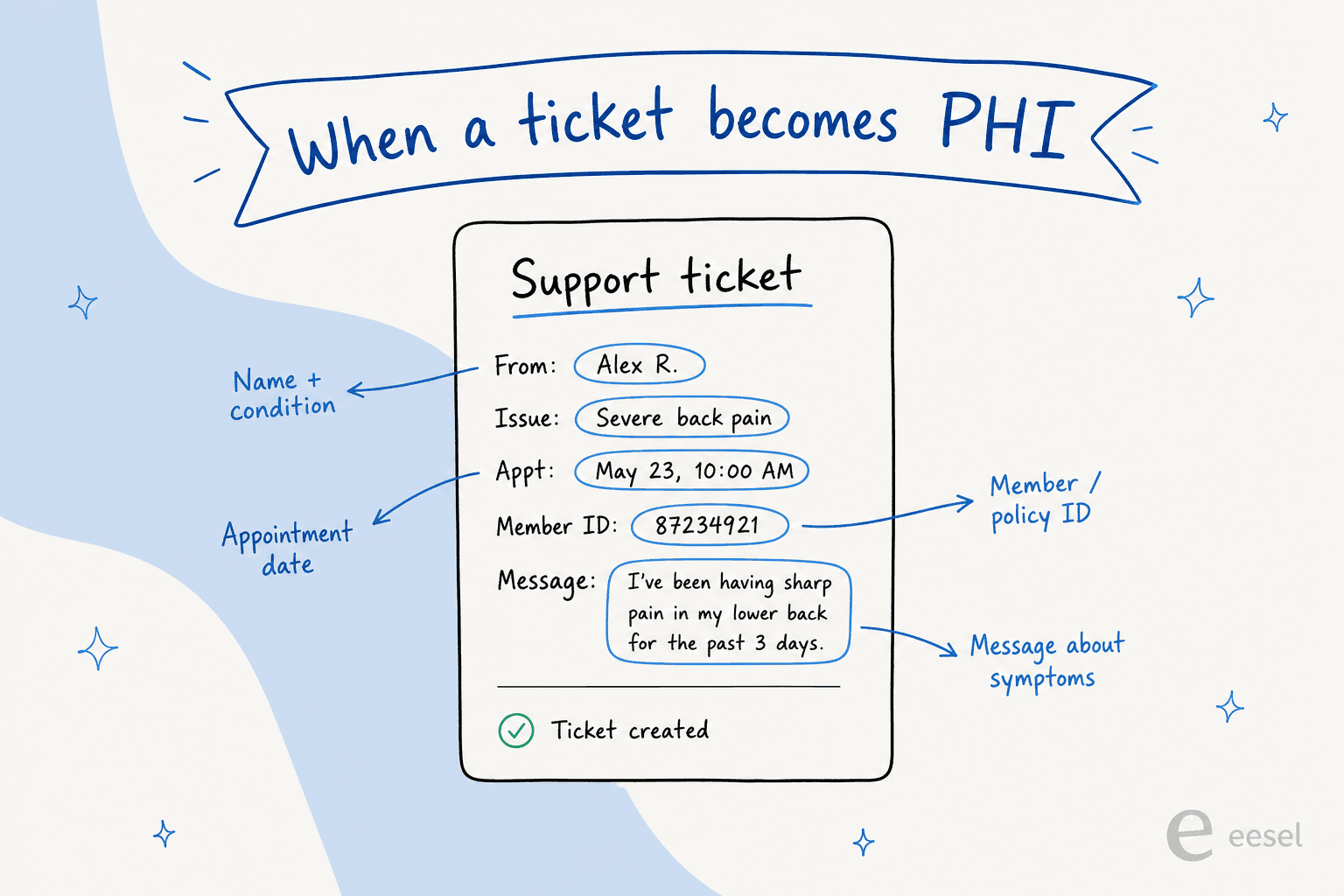
Look at an ordinary healthcare support ticket through that lens and almost every field lights up. "Alex R., appointment May 23, member ID 87234921, message: I've been having sharp pain in my lower back" is textbook PHI. This isn't hypothetical: in a 2025 HHS enforcement action, the OCR found a provider had impermissibly disclosed ePHI including patient names, dates of birth, and diagnoses, the exact fields a support ticket carries. It's a big reason healthcare helpdesk software gets held to a higher bar than most.
This is why the "just plug ChatGPT into our helpdesk" plan is so dangerous in healthcare. Every ticket you feed the model is a disclosure of PHI to a third party, and disclosures to a third party are precisely what HIPAA governs. We heard this concern verbatim from a Danish telematics buyer whose security review was a hard gate before any trial: their tickets contained card numbers and passwords, and the whole review hinged on whether that data stayed inside their environment. Healthcare buyers ask the same question, with higher stakes.
The stakes: what getting this wrong actually costs
The reason healthcare buyers are the strictest security reviewers you'll ever meet is that the downside is enormous and well-documented.
Healthcare has been the most expensive industry for data breaches for 14 consecutive years, averaging $7.42 million per incident in IBM's 2025 report, well above the $4.44 million all-industry average. Healthcare breaches also take the longest to spot and contain, at 279 days. And the tail risk is genuinely catastrophic: the Change Healthcare breach was confirmed by HHS to have impacted approximately 192.7 million individuals, which the department calls the largest breach in US healthcare history.
Enforcement isn't abstract either. The behavioral-health provider in that OCR action paid a $225,000 settlement and a two-year corrective action plan after a breach affecting 171,871 people, with the root cause cited as a failure to do a basic HIPAA risk analysis. When a support-tool decision could plausibly end up on the HHS public breach portal, you understand why the BAA conversation comes first, well before anyone talks about cost savings.
What HIPAA actually requires from an AI support vendor
Strip away the marketing and HIPAA's demands on a vendor are specific. If an AI tool processes PHI on your behalf, it is a "business associate," and HHS is unambiguous about what that means.
It must sign a BAA. HHS requires a covered entity to get written satisfactory assurances that a business associate will safeguard PHI, and "data analysis, processing or administration" (what a support AI does) is explicitly named as a business-associate function. No signed BAA, no lawful processing. Full stop.
It's directly on the hook. Since the HITECH Act, the Security Rule's safeguards apply to business associates the same way they apply to you, and associates are civilly and criminally liable for violations. Your vendor isn't just promising; it's legally exposed.
It has to implement the Security Rule safeguards. That's the administrative, physical, and technical trio: risk analysis, access management, encryption, audit controls, incident procedures, the works.
It should honor "minimum necessary." The Privacy Rule requires limiting PHI to the minimum necessary to do the job. For an AI, that's the argument for stripping identifiers before the model ever sees them.
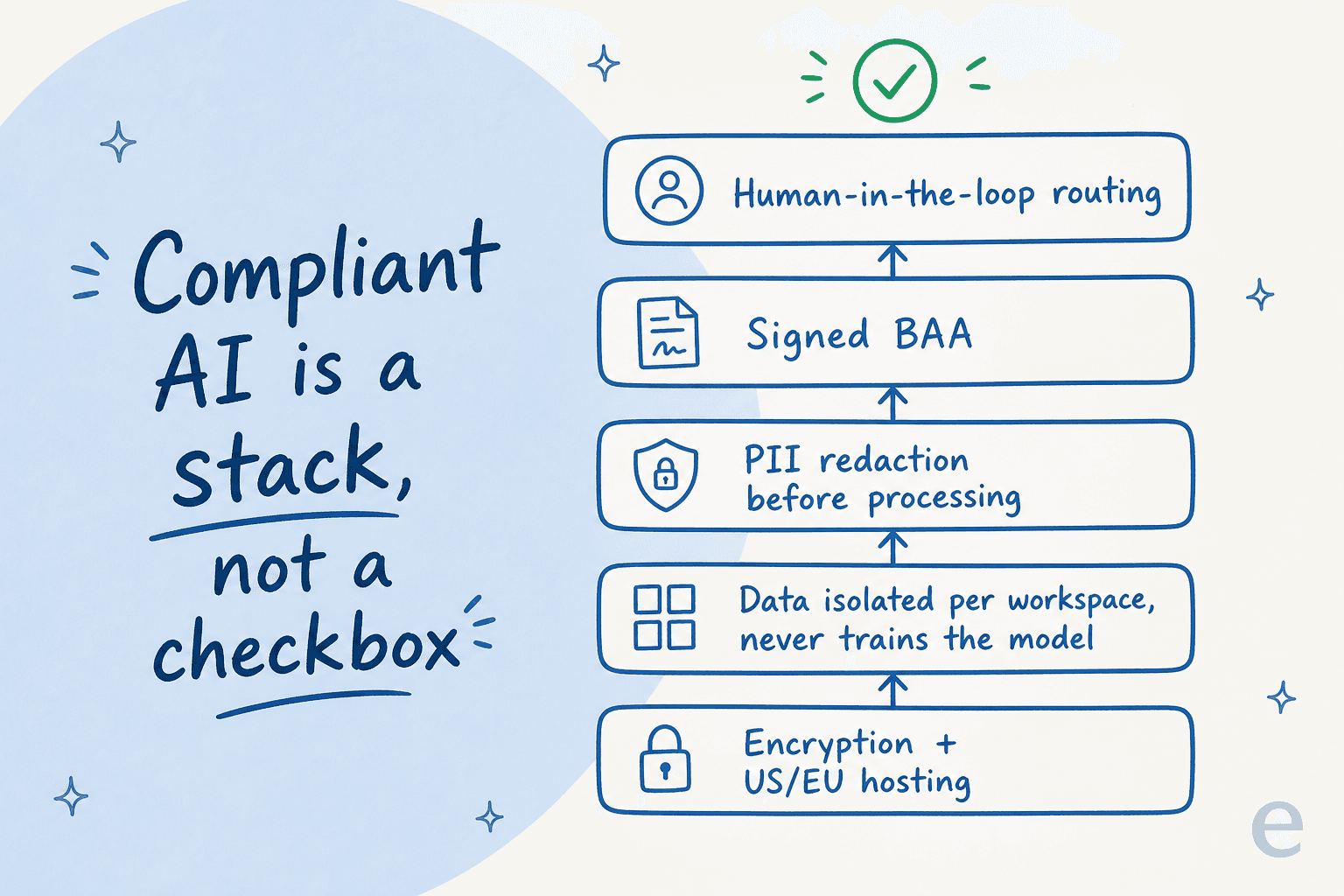
Put together, this is why compliant AI support is a stack of controls, not a single checkbox you tick.
Do the big AI models even sign a BAA?
This is the question that quietly kills a lot of DIY plans. Teams assume that because they're building on OpenAI or Anthropic, they're covered. The primary sources say: only on the right tier, and only for the right features.
- OpenAI will sign a BAA, but for the API Platform only, not the consumer ChatGPT product you probably tested with.
- Anthropic signs a BAA for its "HIPAA-ready" first-party API and Enterprise plans, and the exclusion list is sharp: the BAA does not cover the Console, Claude Free/Pro/Max/Team, or several API features. The Messages API is covered; Batch, Files, and Web Fetch are not.
- Google Cloud offers a HIPAA BAA covering a named set of products including Vertex AI, and requires you to avoid any product not explicitly on the covered list when working with PHI.
The pattern is consistent across all three: the consumer chat apps are never HIPAA-eligible, and even the API tiers only cover a specific subset of features. On r/legaltech, a practitioner summed up the correct mental model:
"Client data leaving your control doesn't mean you're not HIPAA compliant. OpenAI offers a BAA that forces you into non-retention API endpoints..."
That's the nuance most "is ChatGPT HIPAA compliant" hot takes miss. Data can leave your four walls and still be compliant, as long as there's a BAA and the retention terms are locked down. This is also the strongest argument for buying over building your own: stitching together the covered-feature subset of three different model providers, each with its own BAA and exclusion list, is a compliance project in itself. As one buyer told us when they chose a platform over a homegrown LLM app, they didn't want something they'd have to maintain forever.
How compliant AI support actually works under the hood
So what does a properly-built compliant setup look like in practice? The core move is to satisfy "minimum necessary" mechanically: strip the identifiers out before the model, your database, or your search index ever touches them.
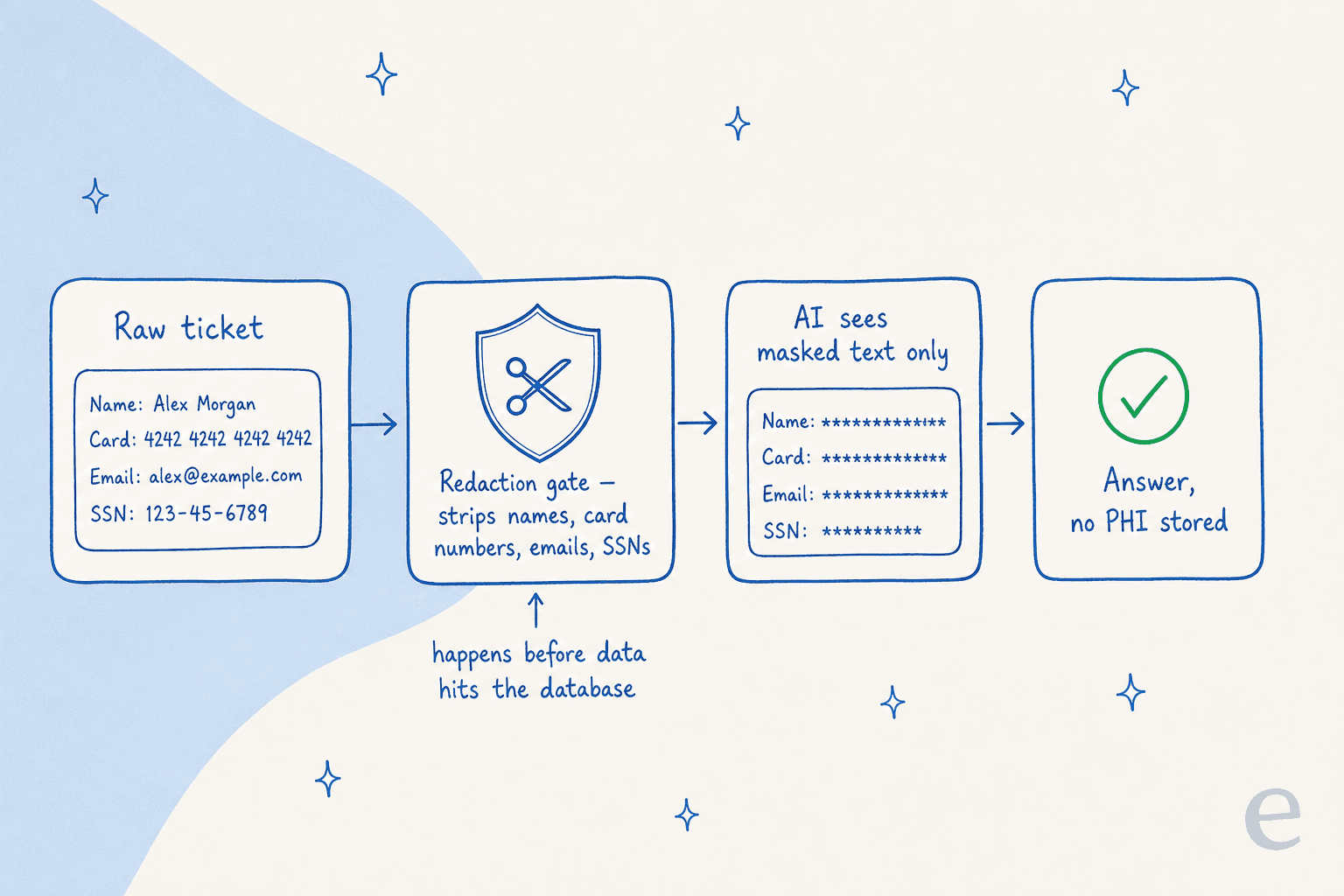
At eesel, PII redaction happens at ingestion. When you enable it, personal identifiers (credit cards, emails, phone numbers, SSNs, API keys, names, and more) get stripped from content before it's processed or sent to an AI provider, so the original data never reaches our database or search index. A colleague reassured that Danish telematics buyer with the same principle: the AI is really looking at question types and the shape of a good agent response, not at a customer's raw PII.
Three more layers matter just as much:
- No training on your data. Your content is never used for training, and it serves only your agents. The underlying model providers process it to generate a response and don't fold it into their general models either.
- Isolation per workspace. Each customer's data is fully siloed, with no cross-contamination between accounts, plus AES-256 encryption at rest and TLS in transit, hosted on AWS in the US with EU residency available on request.
- A real deletion window. Customer content is purged within 60 days of a request, in line with GDPR.
I'll be straight about where we are on the paperwork, because vendors that overstate this are exactly the problem: eesel signs a BAA and offers HIPAA support on our Enterprise plan, and our SOC 2 Type II certification is currently underway with continuous monitoring via Vanta, not yet complete. If a vendor claims a finished SOC 2 without a report to show under NDA, push back.
Keep a human in the loop, especially in healthcare
The single most important configuration choice isn't a security setting, it's how much you let the AI do on its own. Healthcare is the last place you want an over-confident bot auto-replying to everything.
The best framing I've heard for this came from a CX lead at a DTC supplements brand handling roughly 7,000 tickets a month, who told us the AI will never answer 100% of questions, so what they actually needed was "an AI who is only handling the tickets that it's confident to handle" and left the rest alone. That's exactly the pattern healthcare support needs.
With eesel, you scope precisely which ticket types the AI touches, set a confidence threshold, and route everything else to a person via ticket triage. PHI-heavy or high-risk cases can be excluded from automation entirely and sent straight to escalation, while the AI safely clears the tier-1 volume, password resets, "where's my appointment," billing questions, that clogs the queue.
You can even simulate the whole thing against your historical tickets before it goes live, so you see the resolution rate and the risk profile before a single real patient is affected. It's the difference between AI as a copilot and AI as an unsupervised liability.
What to check before you sign
If you're evaluating an AI customer service tool for a healthcare or otherwise regulated queue, this is the short list that actually matters:
| Question to ask | What a good answer looks like | Red flag |
|---|---|---|
| Will you sign a BAA? | Yes, in writing, before we send any PHI | "We're HIPAA compliant" with no BAA offered |
| Where does our data go, and does it train your model? | Named subprocessors; never used for training | Vague or "it's secure, don't worry" |
| Can you redact PII before the model sees it? | Yes, at ingestion, configurable | Redaction only after storage, or not at all |
| Is data isolated per customer? | Full per-workspace isolation | Shared indexes across tenants |
| Can we control which tickets the AI handles? | Confidence thresholds + ticket-type scoping | All-or-nothing automation |
| What's your breach notification window? | Documented, within 72 hours | No stated process |
Notice how few of these are about the AI's answer quality. In healthcare, the security review is the sale. The teams that get AI support live fastest are the ones that walk in with these six questions and a vendor that can answer all six on the first call.
Try eesel for healthcare support
If you're trying to get AI onto a support queue that touches PHI, eesel is built for exactly this kind of scrutiny. It connects to your existing helpdesk (like Zendesk or Freshdesk), trains on your own knowledge base and past tickets, and lets you deploy AI with PII redaction on, data isolated per workspace, no training on your content, and a BAA available on our Enterprise plan.

The part healthcare teams tend to like most: you can simulate the AI against thousands of your real historical tickets before it ever answers a live one, so you see the resolution rate, the confidence routing, and the risk profile up front, no guessing, no exposing patients to an untested bot. You control exactly which ticket types it handles and which get routed to a human. Book a demo and bring your toughest security question; those are the calls we like best.
Frequently Asked Questions
What makes an AI tool HIPAA-compliant?
When does a customer support ticket count as PHI?
How much does a healthcare data breach cost?
Can AI handle healthcare tickets without a human reviewing them?


Article by
Kira
Kira is a writer at eesel AI with a Computer Science background and over a year of hands-on experience evaluating AI-powered customer service tools. She focuses on breaking down how helpdesk platforms and AI agents actually work so that support teams can make better buying decisions.