

AI is becoming integrated into many aspects of life, including health and wellness. On January 7, 2026, OpenAI launched ChatGPT Health, a new feature designed to be a personal health journey companion.
This article will cover what the feature is, its capabilities, its privacy considerations, and why it is designed for personal use rather than for business applications.
What exactly is ChatGPT Health?
Think of ChatGPT Health as a private section within the main ChatGPT app, dedicated to your health and wellness conversations. According to OpenAI, the goal is to consolidate your scattered health information into one place to help you feel more in control.
It is important to understand that this tool is not a doctor. It will not provide diagnoses or prescribe medication. It is built to help users prepare for conversations with medical professionals, not to replace them.
Currently, it is being rolled out to a waitlist for users on the Free, Go, Plus, and Pro plans. It is available in some countries but, notably, not in the EEA, Switzerland, or the UK. To connect medical records, you must be in the U.S. and over 18.
A breakdown of ChatGPT Health features and capabilities
ChatGPT Health is set up to pull information from a few different places to create a single view of your health.
Connecting your data sources for ChatGPT Health
To get the most benefit, you can connect a few types of data to build your personal health profile.
- Medical Records: If you are in the U.S., you can link your electronic health records (EHR) from your doctors and hospitals. This works through a partnership with b.well, a secure health data network. It lets ChatGPT see things like lab results, visit summaries, clinical history, and diagnoses.
- Apple Health: You can also sync data from Apple Health, which covers your movement, sleep, and daily activity. You will need an iPhone with iOS for this to work.
- Third-Party Wellness Apps: OpenAI has started by partnering with a few popular wellness apps, including MyFitnessPal, Peloton, Weight Watchers, Function, AllTrails, and Instacart.
Here’s a quick look at what you can connect:
| App / Data Source | Primary Use Case | Platform/Region Notes |
|---|---|---|
| Medical Records | Ground conversations in clinical history, lab results, and visit summaries. | U.S. only; powered by b.well |
| Apple Health | Analyze activity, sleep, and movement patterns for wellness insights. | Requires an iPhone running iOS. |
| MyFitnessPal | Get personalized nutrition advice, macros, and recipes. | App integration required. |
| Peloton | Receive suggested workout classes or guided meditations. | App integration required. |
| Weight Watchers | Find personalized meal ideas and recipes. | App integration required. |
| Function | Analyze biomarkers and receive nutrition suggestions. | App integration required. |
What you can actually do with ChatGPT Health
Once your data is connected, you can start asking detailed questions. Based on OpenAI's examples, here are a few things you could do:
- Get a summary of your recent lab results to see what has changed before you talk with your doctor.
- Prepare for an appointment by asking things like, "What should I ask my doctor about my cholesterol trend?"
- Receive personalized diet and workout plans based on your data from MyFitnessPal or Peloton.
- Compare different health insurance plans based on your typical healthcare usage.
It also supports the usual ChatGPT features like uploading files or using your voice, but all those interactions stay inside the private Health space.
ChatGPT Health can help you understand health information and prepare questions for your care team. Choosing an in-network doctor also involves checking provider availability and quality. Tools like Garner Health use medical claims data to evaluate providers and patient outcomes, helping members find in-network physicians.
Privacy concerns and data security with ChatGPT Health
Connecting personal health information to an AI is a significant consideration, and for many, it raises privacy concerns.
Let's look at what OpenAI claims it is doing to protect your data and what the general reaction has been.This is straight out of Black Mirror
OpenAI's stated privacy measures
According to their Health Privacy Notice, OpenAI has put a few specific safeguards in place for this feature:
- A Separate Space: All your health chats, files, and memories are kept completely separate from your other ChatGPT conversations.
- No Training on Your Data: OpenAI says that your health conversations and connected data are not used to train their large AI models.
trust me, bro
 Reddit
 - Data Stays Put: Information you discuss in the Health space will not transfer to your general chats.
- Extra Security: The company claims it uses more protections like special encryption and data isolation for all health-related chats.
- You're in Control: You can disconnect your apps whenever you want. When you do, it cuts off access and can trigger data deletion from partners like b.well.
Public and expert reactions
Even with these promises, privacy experts remain wary. The Center for Democracy and Technology noted that health data is incredibly sensitive, and any protections have to be completely solid.
Many potential users are also worried about data being shared with or sold to third parties, like insurance companies, in the future. The fact that the feature is not available in the UK and Europe is also notable. Those areas have tough data protection laws like GDPR, which hints that the bar for handling this kind of data is set very high.
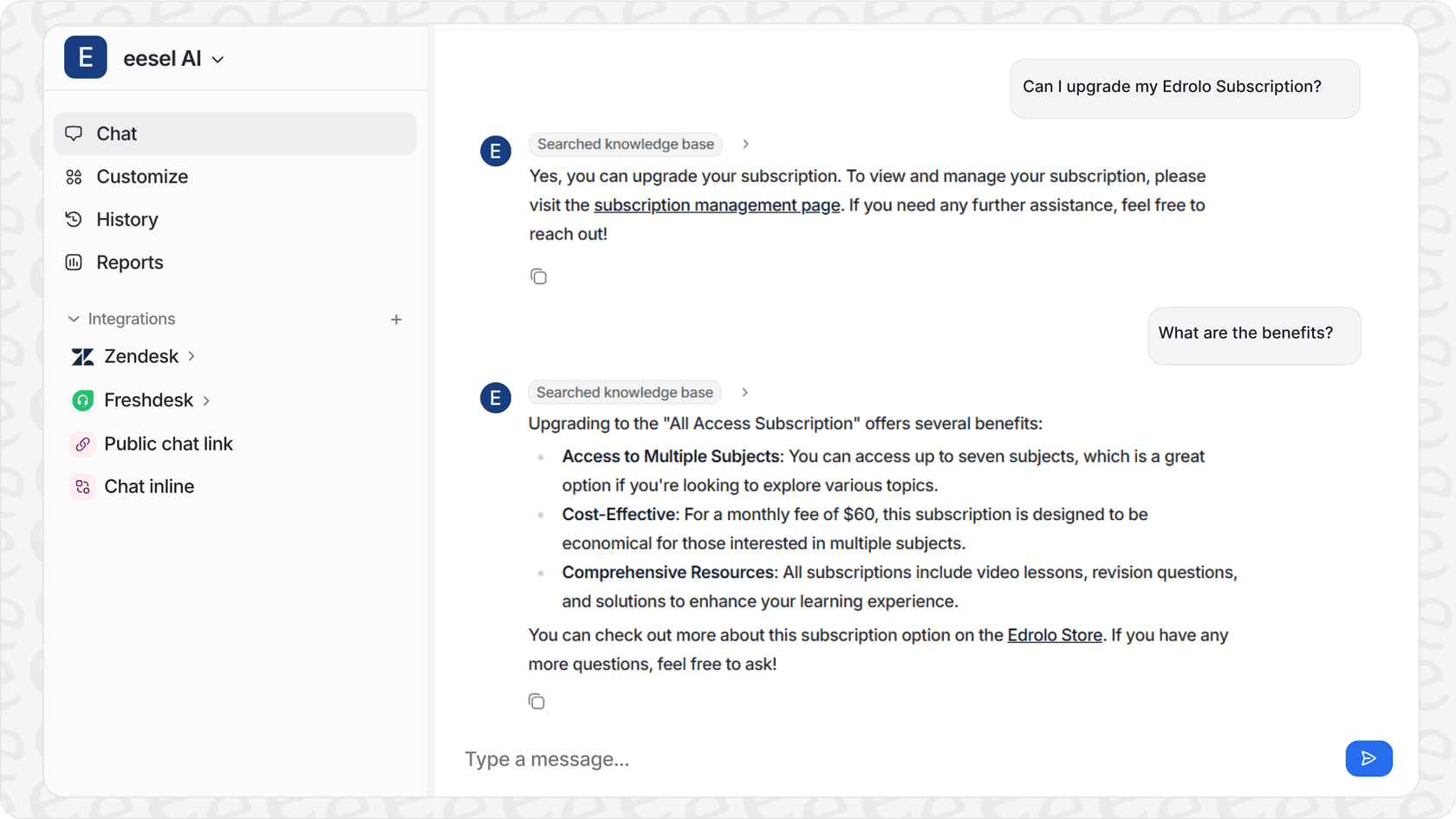
For businesses that handle sensitive information, such as customer data or employee records, using a consumer-focused tool may not meet their security and compliance needs. Enterprise-level platforms are built with business security in mind. For example, a solution like eesel AI offers contractual guarantees that company data is not used for training external models and includes features like EU data residency and SOC2 compliance to meet business requirements.
ChatGPT Health vs. OpenAI for Healthcare: What’s the difference?
Why ChatGPT Health is for individuals
The person who would get the most out of ChatGPT Health is someone who wants to be more involved in their own wellness. It is for somebody who wants to bring their scattered health info from different apps and patient websites into one place and use AI to get ready for doctor's appointments. It’s a personal health organizer, not a professional tool.
The limitations of ChatGPT Health for businesses
This is where the distinction becomes clear. The consumer version of ChatGPT Health is not designed for business use for several reasons:
- No Central Management: Everything is tied to an individual's account. There is no admin dashboard to manage users or oversee data.
- Consumer-Level Security: It is missing key business features like role-based access controls (RBAC), audit logs, or a Business Associate Agreement (BAA), which is necessary for HIPAA compliance in the U.S.
- Siloed Knowledge: It only knows about an individual's personal data and what it can find on the web. It has no knowledge of your company’s specific policies, procedures, or internal documents.
- No Business Integrations: It does not plug into professional tools like Zendesk, Jira, or Slack, where work is typically done.
OpenAI pricing for its ChatGPT Health products
The pricing for OpenAI's two health products is completely different, which again shows who they are built for.
- ChatGPT Health (Consumer): This feature is part of the existing ChatGPT plans (Free, Go, Plus, and Pro). You do not have to pay for a separate subscription.
- OpenAI for Healthcare (Business): This is the platform for healthcare organizations. It comes with support for HIPAA compliance, a BAA, and models designed for clinical work. The pricing is based on ChatGPT Enterprise, and companies need to get in touch with sales for a custom price.
The bottom line on ChatGPT Health
ChatGPT Health is a fascinating step forward in managing personal wellness with AI. For anyone who wants to be more proactive in understanding their health data, it offers useful ways to connect the dots between different apps and medical records.
But its focus on consumers, individual-first design, and lack of business-grade controls make it unsuitable for any professional use. When you need to control your data, integrate with your workflows, and get answers based on your organization’s knowledge, you need a tool that was built for teams from the ground up.
The launch of ChatGPT Health has sparked widespread discussion about the role of AI in personal healthcare. To get a sense of the public conversation, including the potential benefits and pitfalls, here is a segment from 'The View' where the co-hosts share their perspectives on using the new tool for medical questions.
AI solutions for business environments
While ChatGPT Health helps individuals organize their personal wellness data, businesses require a different type of AI that can act as a secure and knowledgeable resource for their teams.
Solutions like eesel AI are designed for this purpose. By training on a company's trusted documents, helpdesk tickets, and internal wikis, these tools can provide accurate answers to both customers and internal staff. They integrate with business tools like Zendesk, Jira, Slack, and Confluence to streamline information access.
Learn more about eesel AI.