


What is Kodif?
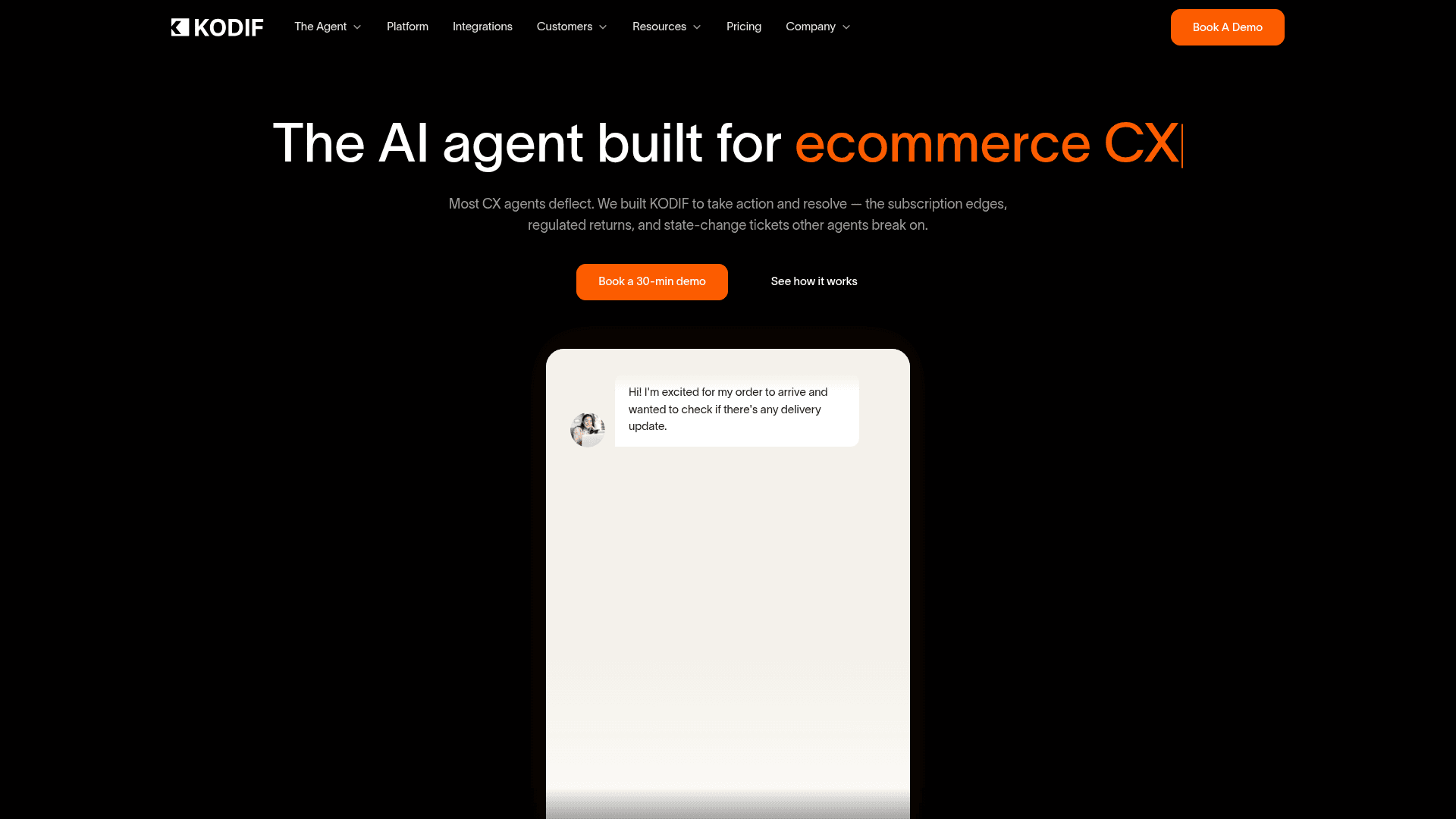
Kodif calls itself "The AI agent built for ecommerce". It's one agent sold as three jobs: a Resolution Agent for refunds, returns, order status and edits, a Retention Agent for subscription cancel-saves, and a Revenue Agent for presale product recommendations. It works across chat, email, SMS and social. It also sits on top of the helpdesk you already run, so you don't have to replace anything.
The company is small, and it stays focused on one market. Co-founder and CEO Chyngyz Dzhumanazarov previously founded a 3PL company, and co-founder and CTO Norm built the support automation platform at Uber that handled 150 million support requests a month, per the Kodif about page. The team page lists 17 people. Customer logos include Dollar Shave Club, Liquid I.V., Helix, Who Gives A Crap and JustFoodForDogs, and that list tells you pretty clearly who it's built for: subscription-heavy DTC brands on Shopify.
How I reviewed Kodif
I build integrations at eesel, so the first thing I check on any AI support agent is the boring part. Who writes the code when the agent needs to call Recharge or Loop, and who fixes it later when an API changes?
I don't have a Kodif login, and Kodif's docs and help center sit behind a sign-in, so what I had to work with for this review is the public material. I read every product, pricing, platform and integrations page on kodif.ai, all 16 case studies, and the 12 of Kodif's 31 G2 reviews that were readable in full. When a number comes from Kodif itself I say so, and when something is only my opinion I label it as mine.
There's one more bit of context worth mentioning. On a sales call this year, an ops lead at a DTC supplements brand doing about 7,000 Gorgias tickets a month told me their team couldn't keep up. They had come looking for a copilot and realized they needed an agent that would close at least half of email on its own: where-is-my-order, subscription changes, basic product questions. Their knowledge lived in an SOP tool, untranscribed Loom videos and a pile of outdated macros. That is pretty much the buyer Kodif is built for, so I kept that team in my head the whole way through.
What Kodif does well
Where Kodif is strong is in the hard parts of ecommerce support: actions that change something in another system, and conversations where a customer is about to leave. Below is what stood out to me.
It takes actions, not just replies
Plenty of AI agents can tell a customer where their order is. Far fewer of them can actually process the return. Kodif's Resolution Agent "reads the order, checks your policy, takes the action, and tags the conversation". On its page the example goes like this: a refund is applied in Shopify, a return label gets generated in Loop, then the ticket is tagged and closed, and no human touches it.
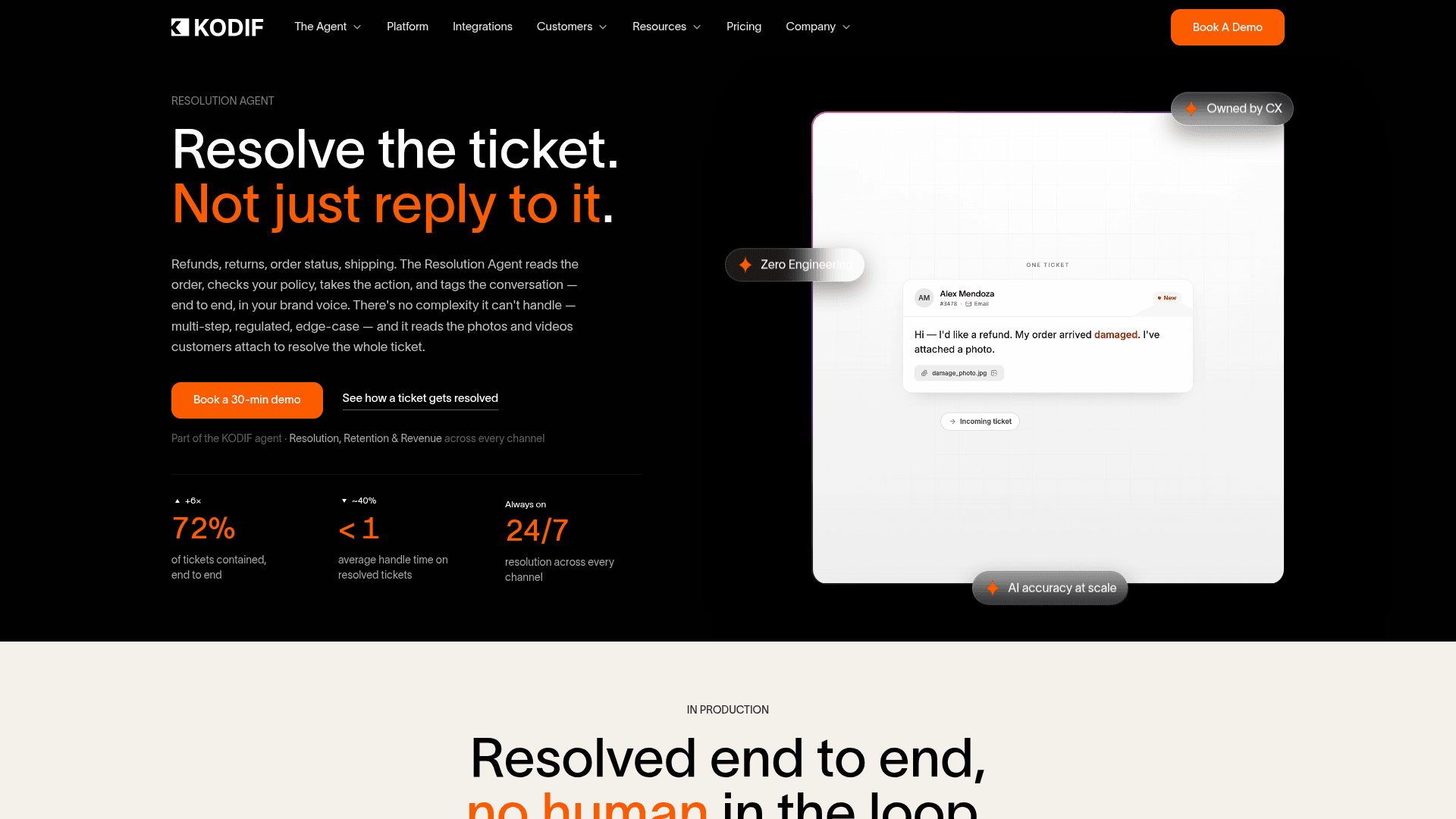
The integration list supports this too. The Kodif integrations page claims "100+" native ecommerce integrations and "2000+" shipping carriers, covering Shopify, Salesforce B2C Commerce, NetSuite, Recharge, Skio, Ordergroove, Loop, AfterShip, Redo and Stripe. Kodif can also read the photos and video that customers attach, so a "my item arrived broken" ticket can be checked before a refund goes out.
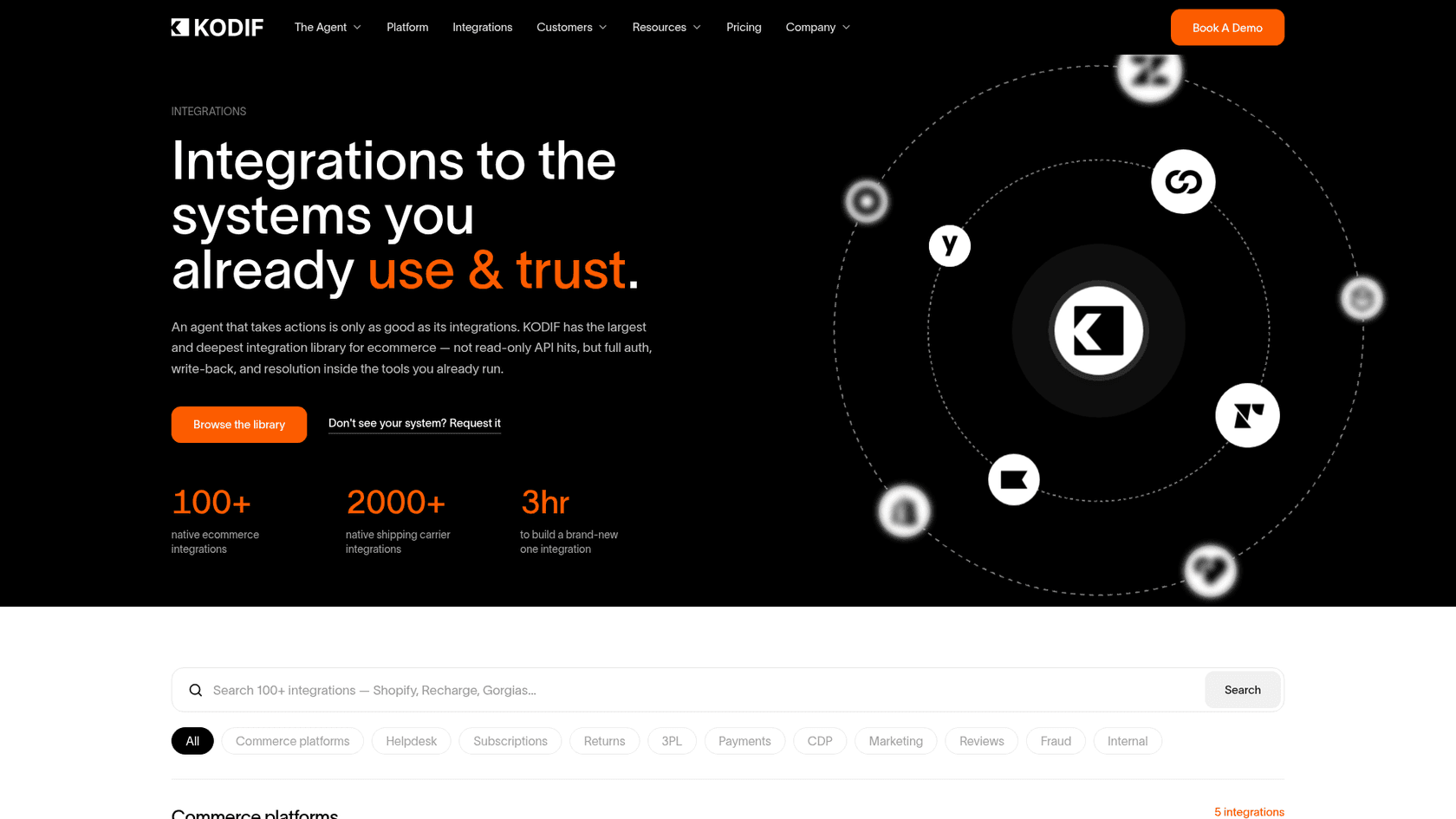
One number on that page is worth reading twice: "3hr" to build a brand-new integration. That is quick, but it's Kodif's engineers who do that building, and I come back to this point further down.
Cancel-saves are the standout
If you run subscriptions, the Retention Agent is the reason to look at Kodif. Before it cancels anything it asks the customer why, and then it picks an offer from your library based on tenure, order value, plan and reason: "Too expensive: 25% off · 3 months", "Going on vacation: Pause 7 days". The save then gets written back to Recharge, Skio or Stripe. You can also A/B test offers per segment without code.
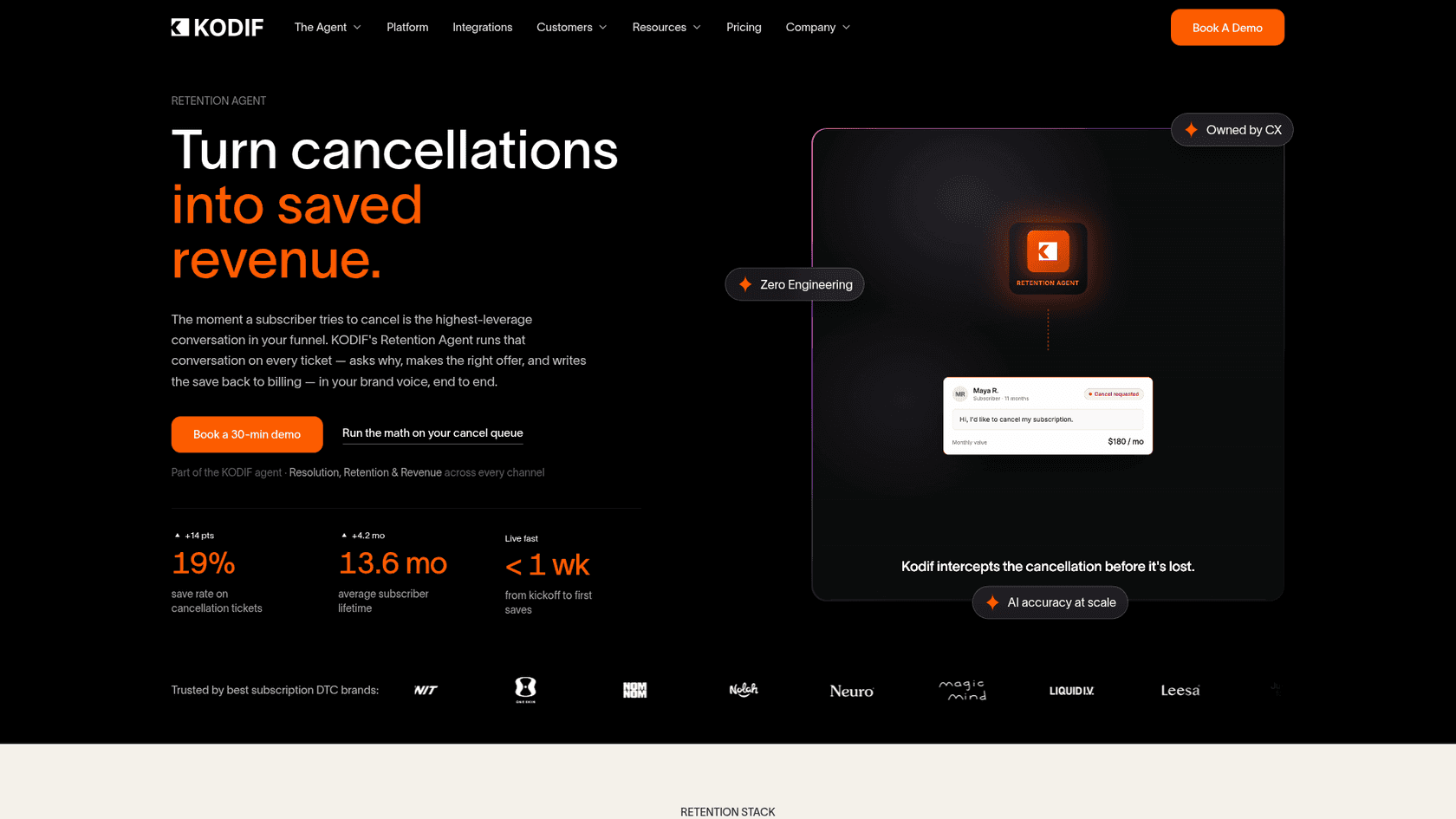
Kodif claims a 19% save rate on cancellation tickets and says "most subscription brands save under 5% of cancellations today". One named customer comes close to that: Get Joy reports 16% of cancellations saved. Not many support AIs treat cancellation retention as a separate job with its own offer logic. For a subscription brand, even a few points of saves can pay for the whole contract.
Testing before launch, plus a QA loop
I've watched support bots confidently make things up when the knowledge base came back empty, and I've seen paying customers run into exactly that. Because of it, I care more now about how an agent gets tested than about how it demos. On this part, Kodif does it properly. You can "run a new policy against your historical conversations" and see what the agent would have said side by side, and according to its platform page it tests the integrations as well as the conversations.
Once you're live, a five-step loop takes over: an issue is detected, Kodif drafts the fix, your CX team approves or rejects it, a regression test is written for that exact scenario, and it's locked in. I like that approve-the-diff step, because your team keeps the final say on what changes.
The results are real
Kodif's published case studies are more specific than most. Each one names the helpdesk and the date range, and also the denominator.
| Customer | Stack | Kodif-reported result | Period |
|---|---|---|---|
| Helix Sleep | Zendesk, Shopify | 71.8% containment, 64.9% fully resolved, across 31,821 eligible conversations | Jan to May 2026 |
| Ivy City | Gorgias, Redo, Shopify | 78.8% chat containment over 18,249 conversations | Jan to Jun 2026 |
| Who Gives A Crap | Zendesk | 66% chat and 63% email resolved end to end | Q1 2026 |
| Neuro | Gorgias, Shopify, Skio | 81% chat containment of 8,087 chats | One quarter |
| Get Joy | Zendesk, Shopify, Skio | 89% chat containment, 16% of cancellations saved | Not stated |
Notice Helix reports two numbers. Containment and full resolution aren't the same thing: 71.8% of conversations didn't escalate, but 64.9% closed with no human at all. Whatever vendor you talk to, ask which of the two they are quoting. My guide to measuring containment goes into why that gap matters.
The G2 reviewers say much the same thing. Ali A., a CX manager at a small business, wrote this:
"By automating intent recognition, subscription actions, and policy handling through Kodif, we've achieved 69% AI containment, cut phone volume by 70%, and reduced email tickets by more than half—all within six weeks."

Where Kodif falls short
None of Kodif's G2 reviews are below four stars, so the limits I found come from the "what I dislike" sections of reviews that are otherwise happy. Those sections mostly point in the same direction.
"Zero Engineering" still needs Kodif's engineers
Kodif's platform and retention pages carry a "Zero Engineering" badge and an "Owned by CX" badge. It is true that your team can write policies in plain English and set tone guidelines, and it can approve proposed fixes without code too. There's even AI Sam, "the agent that builds agents", which you configure by talking to it.
The moment a policy needs a new tool, though, the work moves over to Kodif's side. Three of the 12 readable reviews say this directly:
"Due to the complexity of automations, we do need a KODIF engineer to finish the policies, however they are very responsive and quick."
"Their engineering team often needs to create specific tools to make the policies work effectively. I wish the integrations were more direct so that I could handle them independently without needing additional engineering support."
A third reviewer, Saad M., asked for "Developers functions" so that their company could modify the tools Kodif built, because "we always have to as the Kodif Team to update a tool created by them."
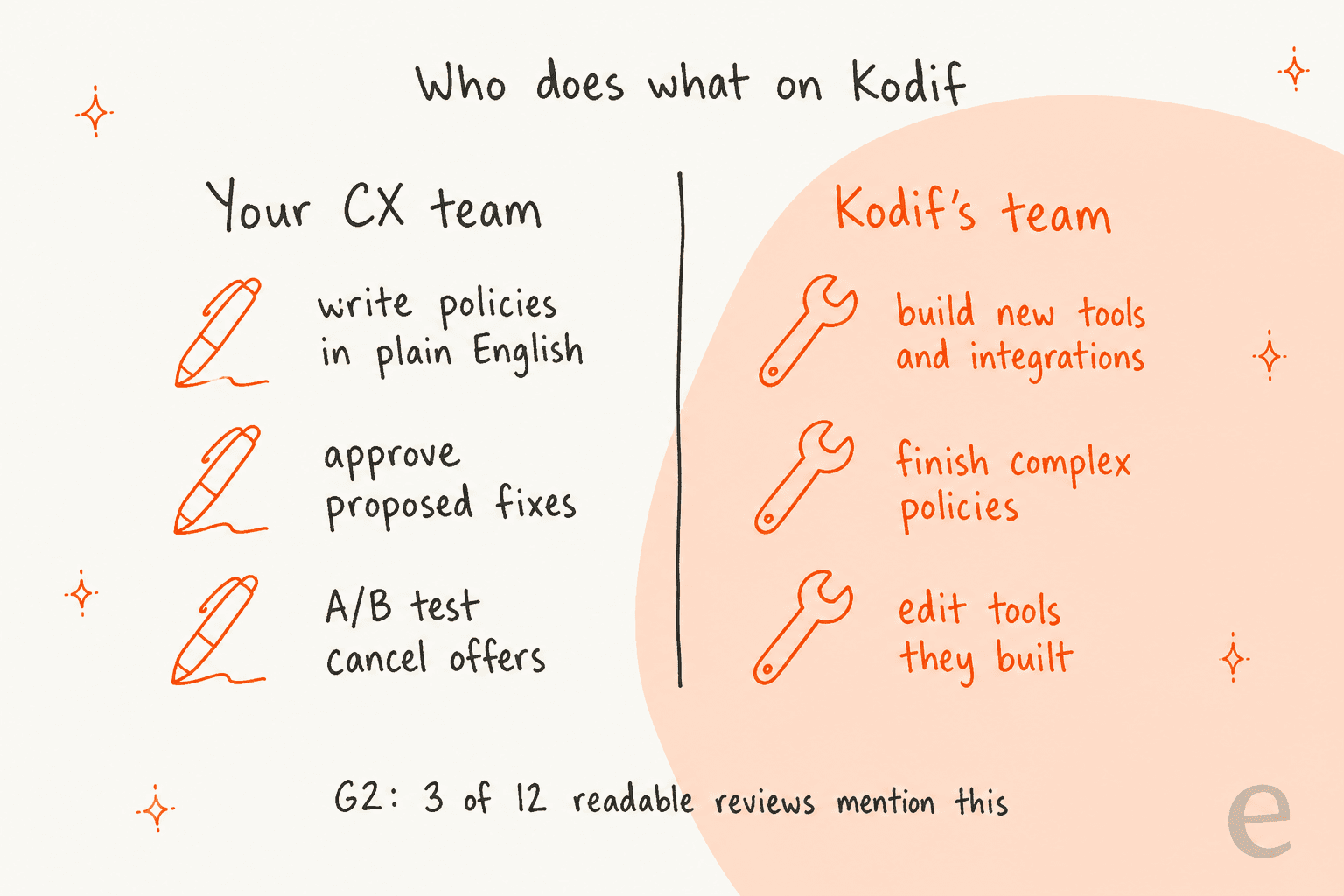
To be fair to Kodif, every reviewer who raised this point also praised how fast the team responds, and the pricing page includes a dedicated onboarding manager, a customer success manager and a customer success engineer on every tier at no extra cost. What you get is a managed service, and the price reflects that. The question is whether you want a vendor in the loop for every new action, because you'll have one.
Setup takes longer than the 9-day headline
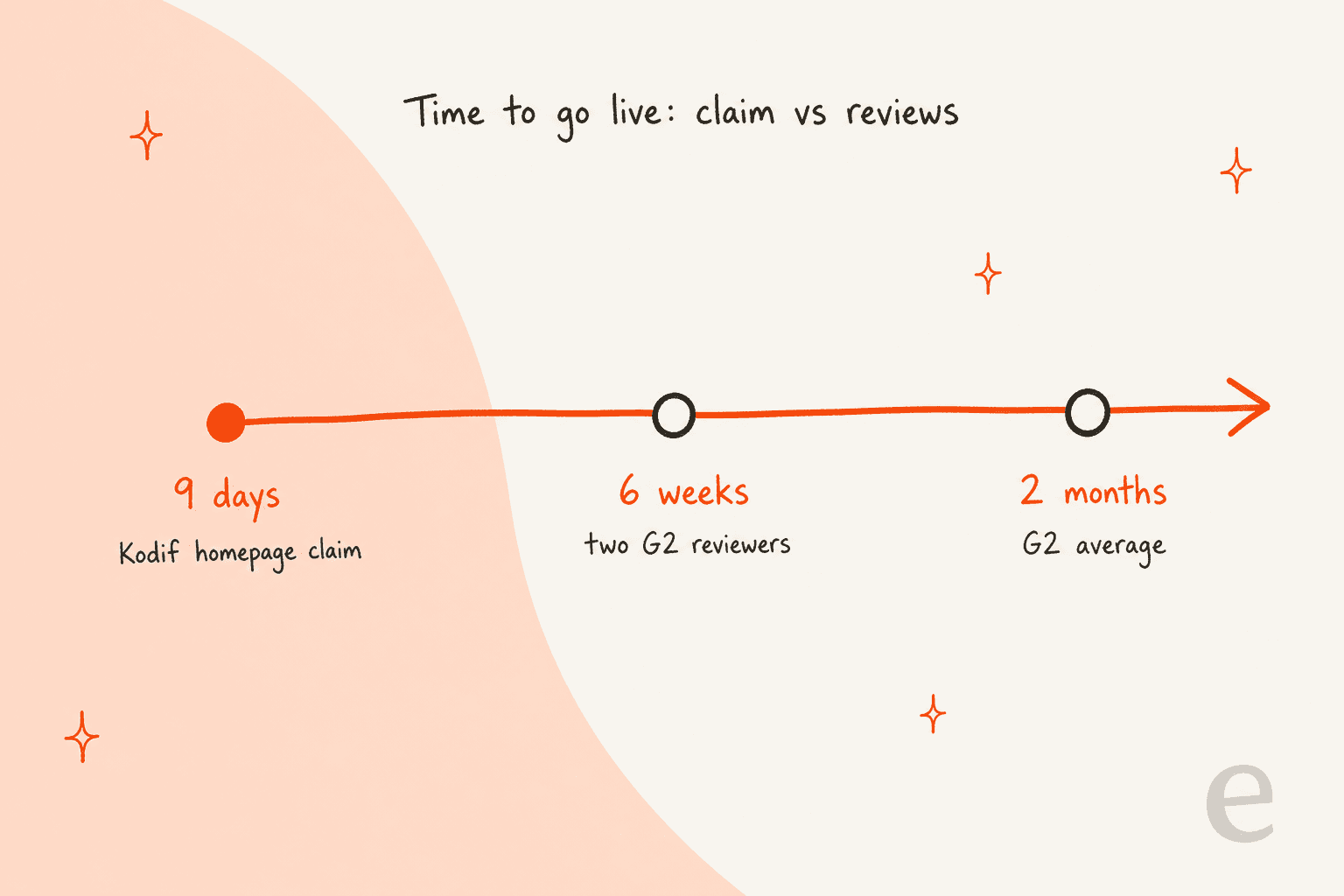
Kodif's homepage promises "9 days from contract to fully resolving tickets in production". Some customers do get close to it: Neuro went live 15 business days after signing, just before Black Friday. G2's averages, though, show a slower picture.
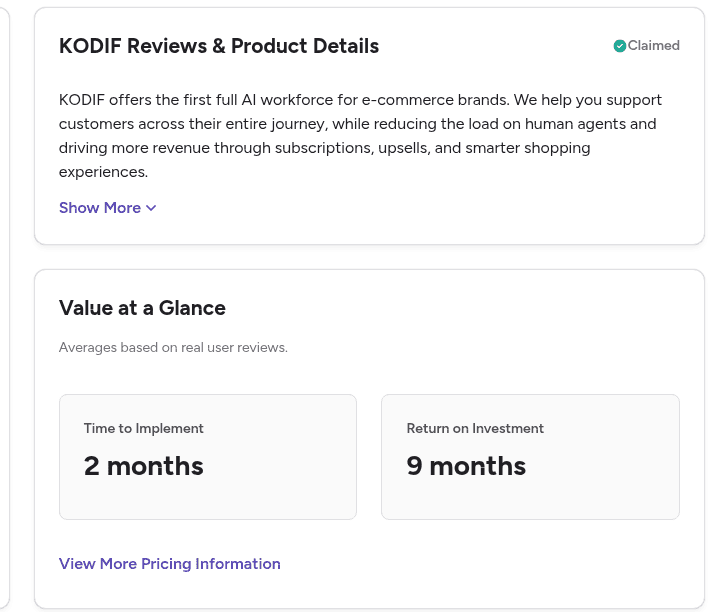
Reviewers average 2 months to implement and 9 months to return on investment, per Kodif's G2 page. Two reviewers describe going live in about 6 weeks. For an agent that touches refunds and billing, either of those timelines is fine. Just plan in weeks rather than days.
Starter is chat only, and email lags chat
The entry tier covers chat only. Email, SMS and social need Growth ("Chat + 1 channel") or Enterprise. This matters, since for a lot of DTC brands email is where most of the volume sits. Even on the higher tiers, Kodif's own stories show email running behind chat: Who Gives A Crap reports email as 31% fully automated, with "no policy automations on email today".
If your queue is mostly email, ask Kodif for a case study that is specific to email before you sign. Also check that the tier in your quote actually includes email.
Reporting and the chat widget are basic
Across the reviews, the feature people ask for most is better reporting. Domonique B., Head of CX at a mid-market brand, asked for "enhanced reporting capabilities for trend analysis and deeper insights into CSAT detractors" and called the CSAT survey tools "quite basic". Two reviewers also had comments about how the chat widget looks. Saad M. put it plainly: "The look is really basic."
Starter also gets a "Limited suite" of analytics; smart tags and alerts are Growth and up. None of this stops the agent from doing its work. Still, if you report to a VP on cost per ticket and CSAT trends, set aside some time for exports.
How much does Kodif cost?
Kodif publishes volumes and two per-conversation rates, but no plan totals and no checkout. Every tier sends you to a sales call.
| Tier | Included volume | Rate | Implied annual cost | Channels | Notable extras |
|---|---|---|---|---|---|
| Starter | 24,000 conversations/yr | $1.00 per conversation | About $24,000 | Chat only | Unlimited integrations and policies, onboarding manager, CSM and CSE |
| Growth | 75,000 conversations/yr | Not published | Not published | Chat + 1 channel | Smart tags, alerts, SSO, user segmentation, presale agent |
| Enterprise | 160,000 conversations/yr | $0.75 per conversation | About $120,000 | All channels | Executive oversight |
The implied annual cost is just volume times the stated rate, so it is my arithmetic and not a number Kodif publishes. There are no seat fees and no setup fee, and overage is billed at your plan's rate.
There are two details that move the real number. First, the unit: Kodif's pricing page bills every conversation the agent works, including ones it hands to a human, while its Resolution Agent page says "you pay for tickets the agent closes". Make sure you get the unit in writing. Second, the floor: at 1,000 conversations a month, you still pay for Starter's 24,000 a year, so your real cost is about $2 per conversation. My full Kodif pricing post works through both, and the cost per resolution guide shows how to compare it with outcome-based pricing from other vendors.
Who should use Kodif?
Kodif fits one particular kind of team, and two questions decide whether that's you: how many conversations you handle a month, and whether you're happy for Kodif's team to build and change the agent.
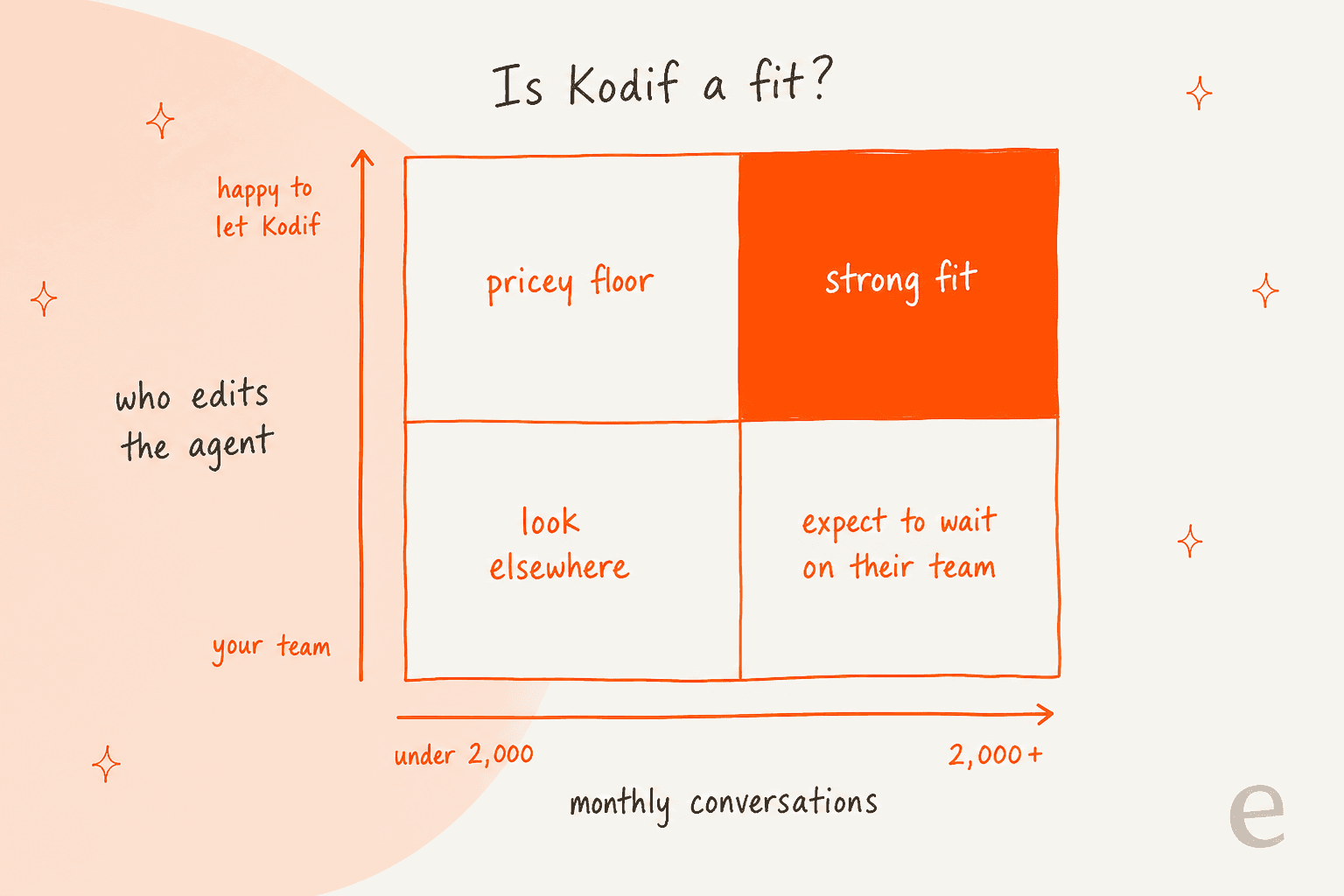
Pick Kodif if you're a subscription or DTC brand on Shopify, handling 2,000+ conversations a month, with returns, address edits and cancellations that need real actions in Recharge, Skio or Loop. You would rather have a vendor engineer build those tools than learn the APIs yourself. The ops lead from the supplements brand I mentioned, whose knowledge was scattered across SOPs and videos, would be well served by a team that reviews the SOPs and proposes starting policies for them.
Skip Kodif if you're under about 1,500 conversations a month, your queue is mostly email and you can't stretch to Growth, or your team wants to change the agent's behaviour the same afternoon a policy changes. It's also not the right pick if you're outside ecommerce: everything in the product is framed around orders, subscriptions and returns, and it lists no voice channel.
If you're comparing it head to head, I wrote up Kodif vs Siena with a look at where the costs cross over.
If cancel-saves are what you mainly care about, have a look at the wider set of subscription business tools. Gorgias users should also read my Gorgias AI Agent comparison and the Gorgias alternatives list.
My Kodif AI review verdict
| What I looked at | My rating | Why |
|---|---|---|
| Actions and integrations | 5/5 | Refunds, labels, address edits and subscription changes, across 100+ ecommerce tools |
| Subscription cancel-saves | 5/5 | Reason-based offers, A/B tests, written back to billing |
| Testing before launch | 4.5/5 | Replay on past conversations, integration tests, approve-the-diff QA loop |
| Self-serve editing | 2.5/5 | Plain-English policies yes; new tools and complex policies need Kodif's engineers |
| Pricing for small teams | 2/5 | About $24,000 a year floor, chat only at that tier, annual and sales-led |
| Reporting | 3.5/5 | Full decision traces, but reviewers want deeper trend and CSAT analysis |
Out of the ecommerce support automation tools I've looked at this year, Kodif is one of the most capable, and it earned its 4.8 on G2. Brett B., a support manager who'd tested other vendors, said most "seemed like 'smoke and mirrors', but not KODIF." I tend to believe him. Go in knowing, though, that you're partly hiring Kodif's team, not only its software, and that's what the annual contract pays for.
Try eesel if you'd rather own the build
If Kodif's managed model sounds slower than you'd like, eesel goes the other way. It's an AI helpdesk teammate that joins your existing Gorgias or Zendesk queue in minutes, learns from your past tickets and macros, and checks Shopify orders before it replies.
When a policy changes, your team edits its instructions in plain English and the change is live, with no ticket to a vendor engineer.
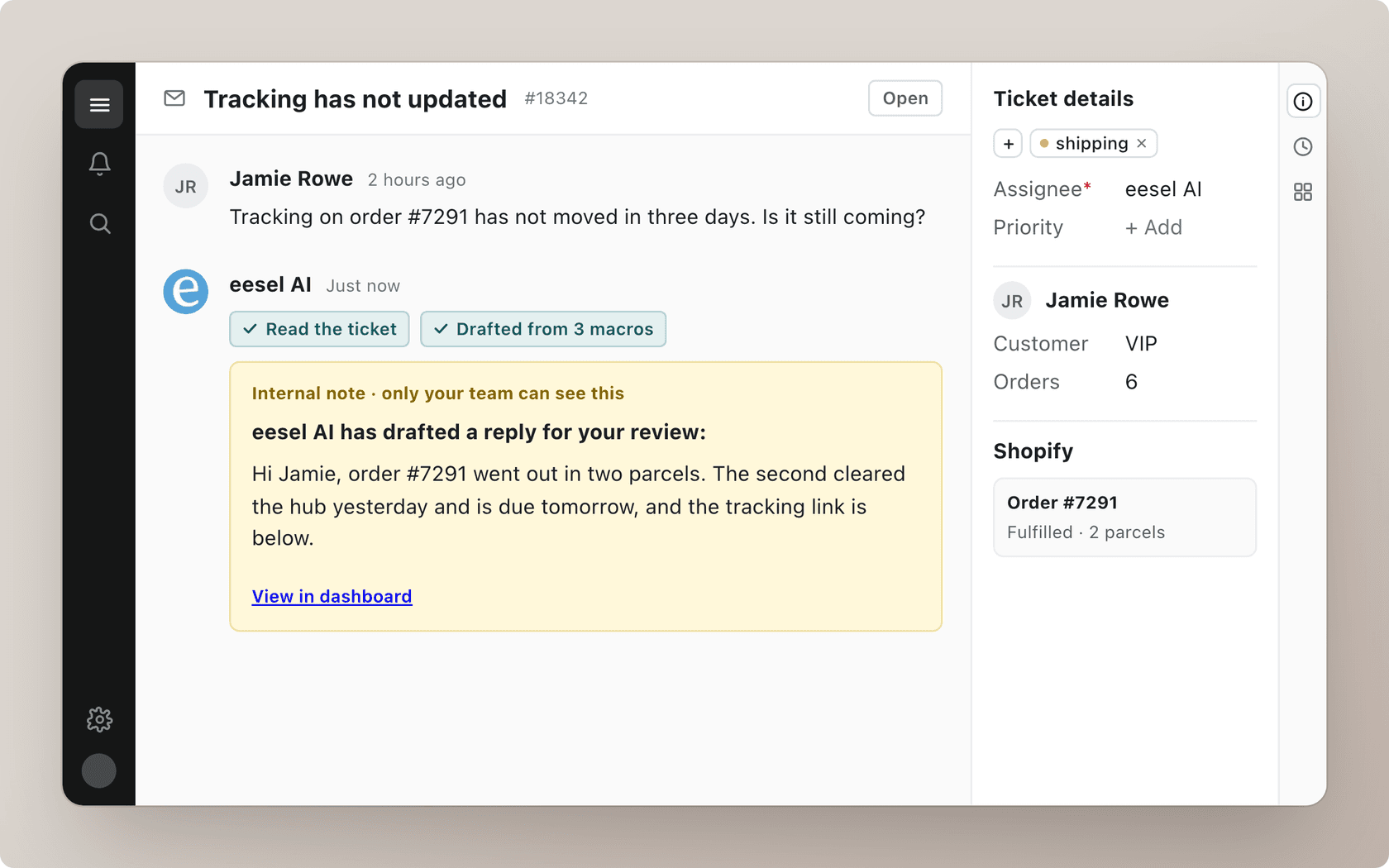
You can run it on hundreds of your past tickets before it ever talks to a customer, and eesel pricing starts with a free plan, then $299 a month for 500 tickets or chats, month to month. At 2,000 a month that's $849, against roughly $2,000 a month for Kodif's Starter. Out of the box it won't match Kodif's depth on subscription cancel-saves. For teams that want to move fast on their own, though, it's a much smaller first step. Try eesel on your own queue.
Frequently Asked Questions
Is Kodif AI any good?
What does Kodif AI do?
How much does Kodif AI cost?
Which helpdesks does Kodif AI work with?
How long does it take to set up Kodif?
Can I edit Kodif AI's policies myself?
Is Kodif better than Gorgias AI Agent?
Does Kodif AI have a free trial?



Article by
Rama Adi
Rama is a software engineer at eesel AI with two years of experience writing about B2B SaaS, AI tools, and customer support technology. Based in Bali, Indonesia, he brings a developer's perspective to product comparisons — cutting through marketing copy to what the integrations and APIs actually do.