


Dixa's conversation summaries live in Co-Pilot, a EUR 39 per agent per month add-on on top of seats from EUR 49 (Team) or EUR 139 (Professional), and Dixa describes them as an instant recap of long or escalated conversations. I would treat that as a reading aid and ask for a demo before you buy: Dixa's public pages never say how a summary is triggered, which languages it covers or where it shows up. Mim, Dixa's AI agent, passes the full conversation and context on handover, but Dixa doesn't call that a summary.
eesel has no native Dixa connector, so I can't offer a note inside Dixa. On Zendesk, Freshdesk, Gorgias, Front or Help Scout, the AI helpdesk teammate answers what it can and leaves an internal note when it escalates. With the eesel CLI, an AI coding agent can upload approved knowledge and test answers before anything goes live, though someone with helpdesk admin access still approves the connection.
What are Dixa AI conversation summaries?
They are short, model-written recaps of a conversation, so the agent picking it up doesn't read twenty messages first. In Dixa they belong to Co-Pilot, the assistant for human agents, and not to Mim, the agent that talks to customers. Dixa's Co-Pilot page lists Conversation Summaries next to Smart Drafts, Suggested Tags, Recommended Actions and translation, and describes them as an "instant recap of long or escalated conversations".
The page goes further on the handover case: agents get "a summary of what happened, what the customer needs, and what's been tried", and new agents can "get up to speed without reading the full thread". That makes summaries a handoff tool first. If you want the general idea, my guide to ticket summarization covers it, and Dixa AI agent covers the Mim side.
The feature isn't new. Dixa's August 2023 announcement named Smart Conversation Summaries, where agents "automatically get a concise overview of a customer's past interactions".
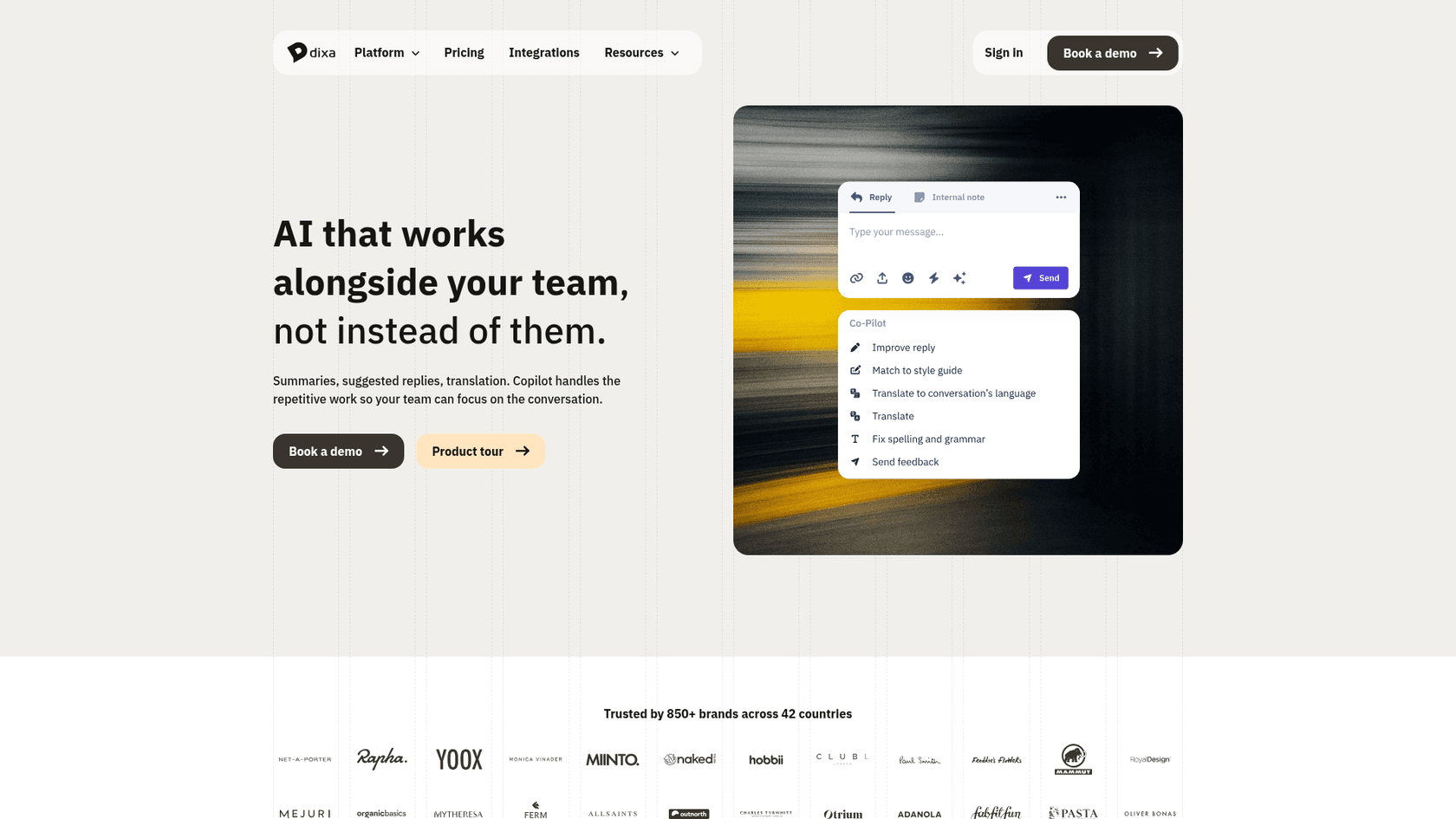
I looked closely at that screenshot. The menu in the mockup lists reply, tone, translation and spelling tools, and no Summarize entry. That is a marketing image, not documentation, so I wouldn't read it as proof the button is missing. It is a reason to ask Dixa to show you a summary live.
Where do summaries show up in a Dixa conversation?
Three places, and only one of them is clearly documented.
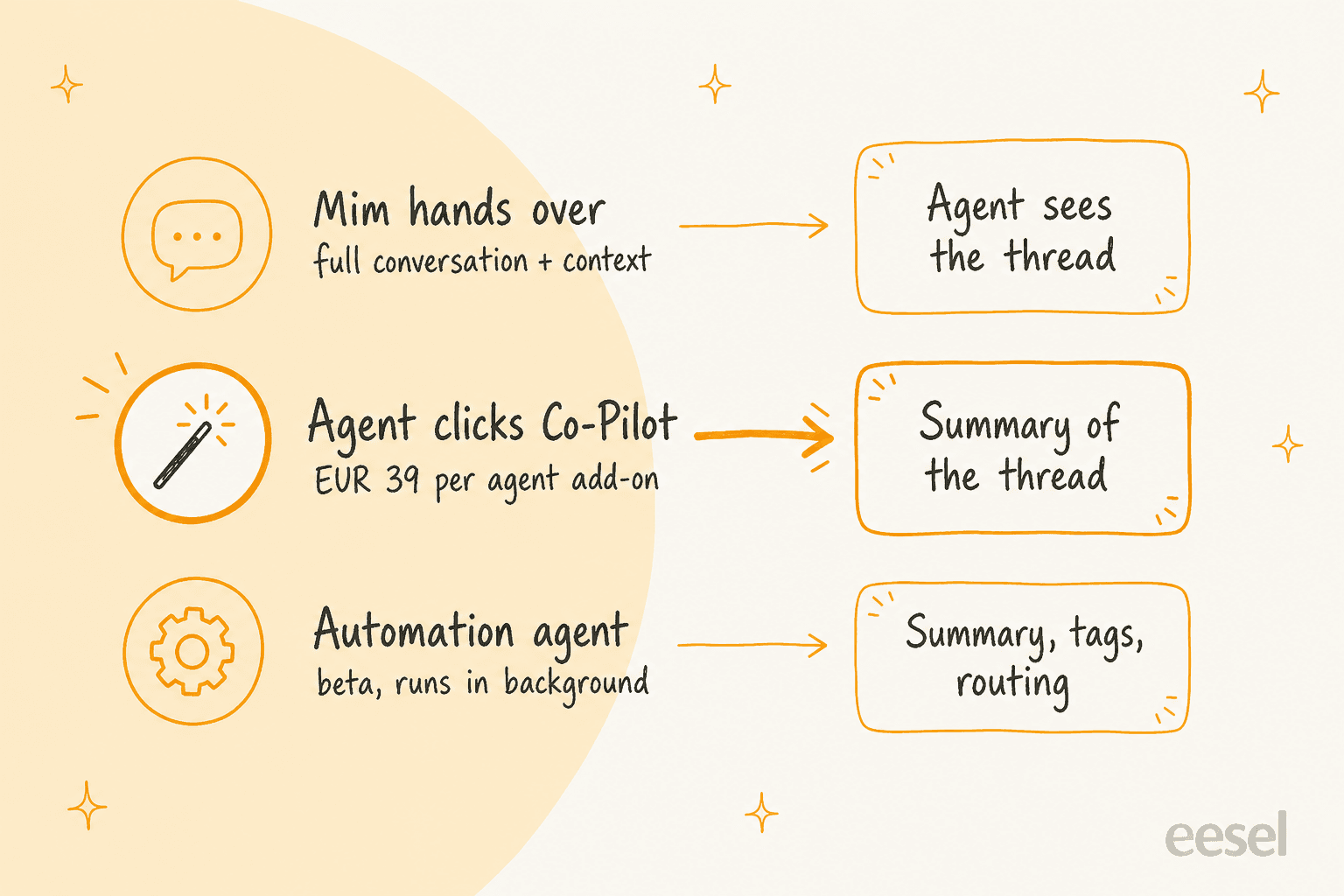
- Co-Pilot, for the agent. Dixa's Co-Pilot FAQ says it "summarises long conversation threads for agents picking up a transfer", all inside the agent's screen. The pricing page adds that Co-Pilot can "generate summaries, all directly from Team Hub".
- Mim's handover, for the next agent. Dixa says Mim hands over the full conversation, what it already tried, the order and customer details, and the reason it escalated, routed to the right queue with the handoff message in the customer's language. That is context, and Dixa doesn't describe it as a written summary.
- The automation agent, in the background. Dixa's Q2 2026 roadmap lists a beta agent that "enriches conversations" with summaries, tags, attributes and routing behind the scenes. Dixa's Q4 roadmap session is advertised as showing an automation agent that analyses every conversation Mim handles.
Dixa's Q3 2026 roadmap adds translated handover messages (generally available) and plans Contact Memories for Q4, a short briefing on each customer when a conversation opens. Planned items can change scope, so I wouldn't buy against them.
Which Dixa summary fits your job?
Pick the handover you care about most. The answer changes with who passes the conversation on.
Pick who passes the chat on to see which Dixa option covers it.
How much do Dixa AI summaries cost?
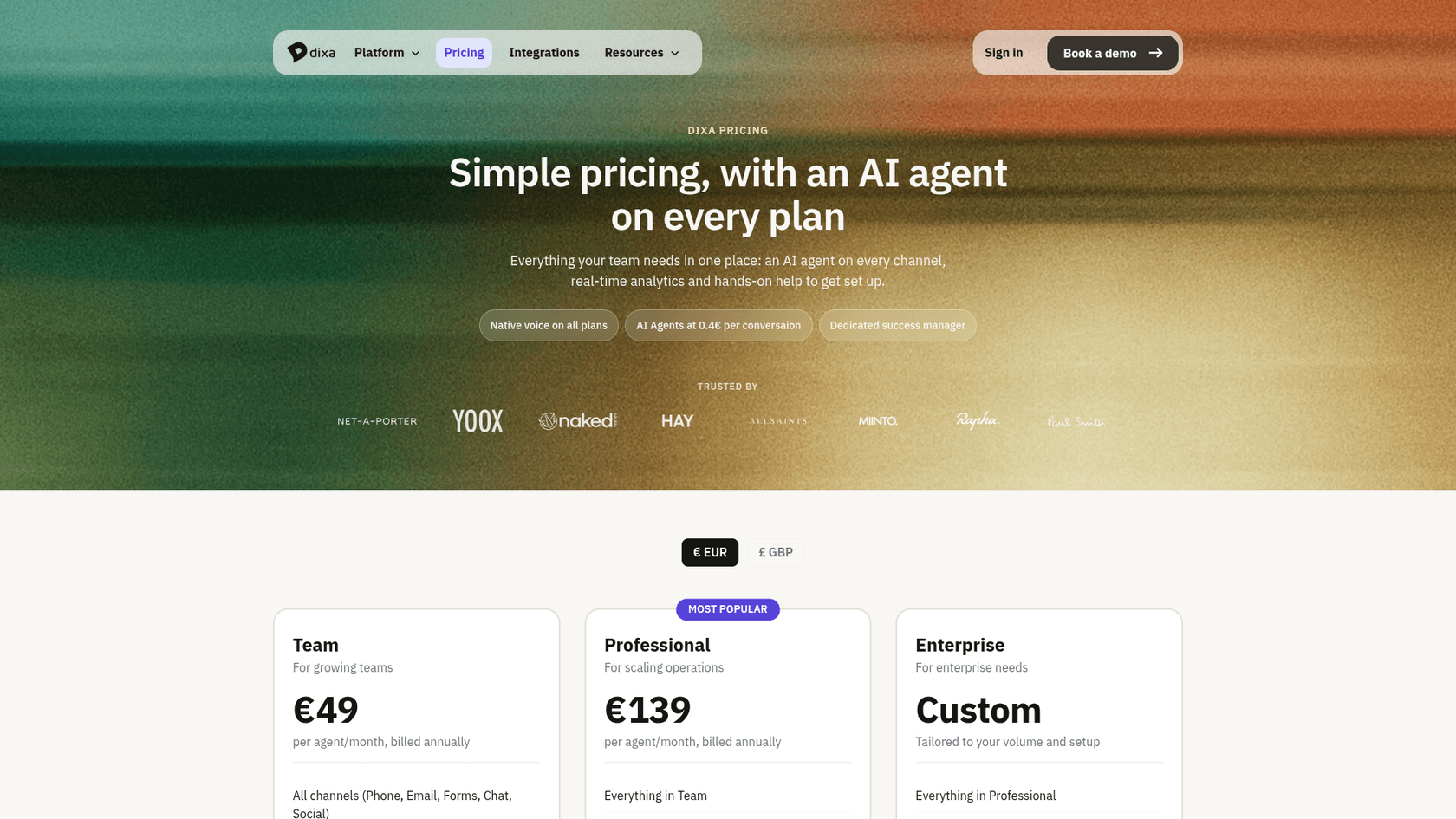
Dixa sells summaries inside Co-Pilot at EUR 39 per agent per month, and it never appears in a seat price. Dixa's pricing page lists three plans, billed annually, and Co-Pilot is available "as add-ons across Team, Professional, and Enterprise".
| Item | Price | Source line |
|---|---|---|
| Team seat | EUR 49 per agent per month, billed annually | Pricing page |
| Professional seat | EUR 139 per agent per month, billed annually | Pricing page |
| Enterprise seat | Custom | Pricing page |
| Co-Pilot add-on | EUR 39 per agent per month | Includes summaries |
| Voice Transcription add-on | EUR 0.012 per minute | Calls into searchable text |
| Mim AI agent | EUR 0.40 per conversation | Flat, no seat component |
A 10-agent team on Team with Co-Pilot pays (EUR 49 + EUR 39) x 10 = EUR 880 a month before Mim. On Professional it is (EUR 139 + EUR 39) x 10 = EUR 1,780. Older Dixa coverage, including some of mine, used Growth, Ultimate and Prime plan names, so check the live page. For the wider picture, my Dixa review and best AI for Dixa posts cover the rest.
What does Dixa not document about summaries?
Four things, and each decides whether the add-on earns its price.
- The trigger. I found no public Dixa help article describing a summary button, an automatic summary or a rule that creates one. Dixa's developer hub at docs.dixa.io documents the API, not Co-Pilot.
- Language. Dixa says Mim replies in the customer's language, but I found nothing on the language of a Co-Pilot summary.
- Placement. The Co-Pilot page says summaries appear in the agent's screen, and doesn't say whether one is saved to the conversation or discarded.
- Accuracy. Dixa publishes no accuracy figure. For comparison, Help Scout warns in its own docs that a summary can be misleading.
I found no review on G2, Capterra or Reddit that discusses Dixa's summaries specifically, so I have no user quote to offer. That absence is itself a signal: ask for a reference customer who uses them. If you also compare tools, the same questions apply to Gladly, Kustomer and Freshchat.
How do other helpdesks handle summaries?
Mostly with a button and a plan gate. Zendesk, Front and Gorgias each document their trigger, language and plan in a help article, and Salesforce and HubSpot do the same. Freshdesk saves a structured summary to the ticket. Dixa's difference is that it sells summaries inside a bundle with drafts and translation, which is fair value if agents use the rest of Co-Pilot. If summaries are the only reason you'd buy, price them against the alternatives in best Dixa alternatives and Reamaze vs Dixa.
Where does eesel fit if you use Dixa?
I'll be direct: eesel has no native Dixa connector, so it can't write a note inside Dixa today. What it does well is the thing a summary is really for, a conversation that reaches a person already understood. On Zendesk, Freshdesk, Gorgias, Front, Help Scout and HubSpot, the AI helpdesk teammate answers from your knowledge base and macros, and when a person should take over it leaves an internal note and stops.
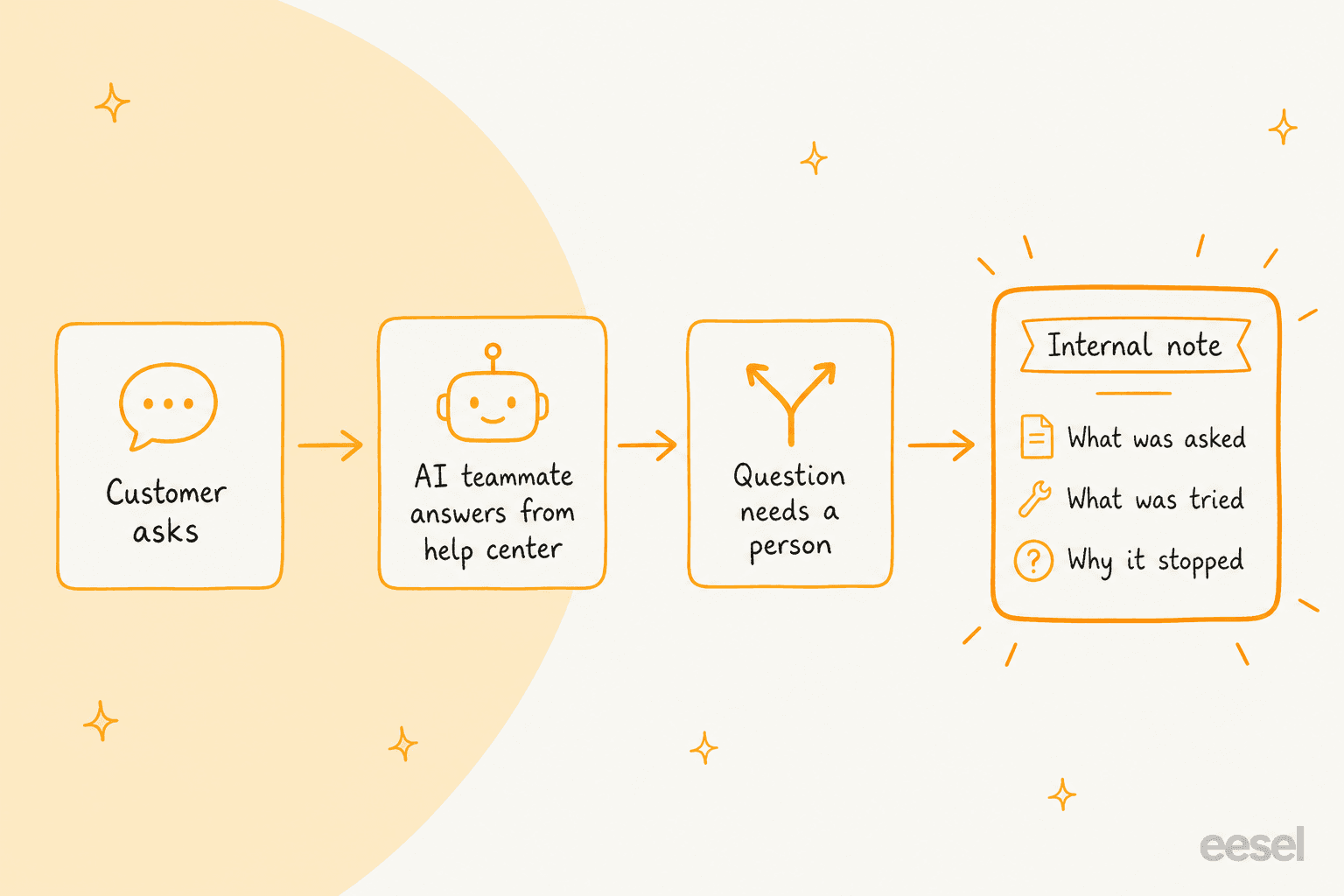
SamCart runs one eesel agent on Freshdesk tickets and another on its website chat. On tickets, the agent replies only while no person is assigned, and when a seller asks for a person or the question goes beyond the help center, the ticket is tagged for handoff and the agent stops. I'd want that behavior, plus a clear note, on any helpdesk. For the escalation steps around it, see my ticket escalation process guide.
If you are choosing between building on Dixa and moving, three practical checks help: test a handover against past conversations, set permissions before an agent acts, and keep a human in the loop for money and promises. For an ecommerce stack, my Shopify AI agent guide shows where the order data comes from. eesel starts at $299 a month for 500 credits.
What would I ask Dixa before buying Co-Pilot?
Five questions, in this order:
- Show me a summary on a real escalated conversation. Where does it appear?
- Is it a button, an automatic summary or a workflow action?
- What language is the summary written in when agent and customer differ?
- Can I buy Co-Pilot for only some agents?
- Does Mim's handover create a written note, or only pass the thread and context?
If the answers are clear, EUR 39 per agent is reasonable for a team that also uses drafts and translation. If they aren't, spend the same money on a human handoff process your agents will follow every time. For related reading, Dixa AI deflection covers what Mim resolves, and my AI conversation summarization guide covers review routines. Help Scout shows how a drafting feature differs from a summary.
Try eesel for your Dixa handoffs
If your team also runs Zendesk, Freshdesk, Gorgias, Front or Help Scout, or you are weighing a move off Dixa, the AI helpdesk teammate joins your existing queue, answers from your help center and leaves an internal note for your team when it stops. Try eesel on one escalated conversation first.