Cost per ticket
Cost per ticket is the average total cost a support team spends to handle one customer request, found by dividing total support costs by the number of tickets resolved.
What cost per ticket means
Cost per ticket is the average total cost a support team spends to handle one customer request, calculated by dividing total support costs over a period by the number of tickets resolved in that period. The total typically includes agent wages, helpdesk and tooling software, management overhead, training, and any automation spend. The result is a single number that captures the real economics of running support, not just the headline payroll line.
In customer support, cost per ticket is the metric that connects service quality to the budget. Two teams can resolve the same volume at very different costs depending on how long each ticket takes, how much is automated, and which channels they use. Because it is an average across everything, it is most useful when broken down: cost per ticket by channel, by topic, and by whether a human or an automated system handled the request.
Why cost per ticket matters
Cost per ticket turns support from a vague expense into something you can manage and forecast:
- It scales with volume. Multiplied by ticket volume, it tells you what support will cost as the business grows, which is the input for staffing and budgeting.
- It is driven by handle time. The labor share of each ticket rises and falls with average handle time, so anything that shortens handling lowers cost directly.
- It rewards self-service and automation. A ticket a customer never has to file, or one resolved without an agent, costs a fraction of a human-handled one, so deflection and automation move the average sharply.
- It exposes expensive channels. Phone and complex technical tickets usually cost far more per ticket than chat or simple email requests, which informs where to invest.
- It is the denominator of support ROI. Any efficiency project is judged by whether it moves cost per ticket without hurting satisfaction.
Not every ticket carries the same price tag, and the channel a customer uses is one of the biggest swings:
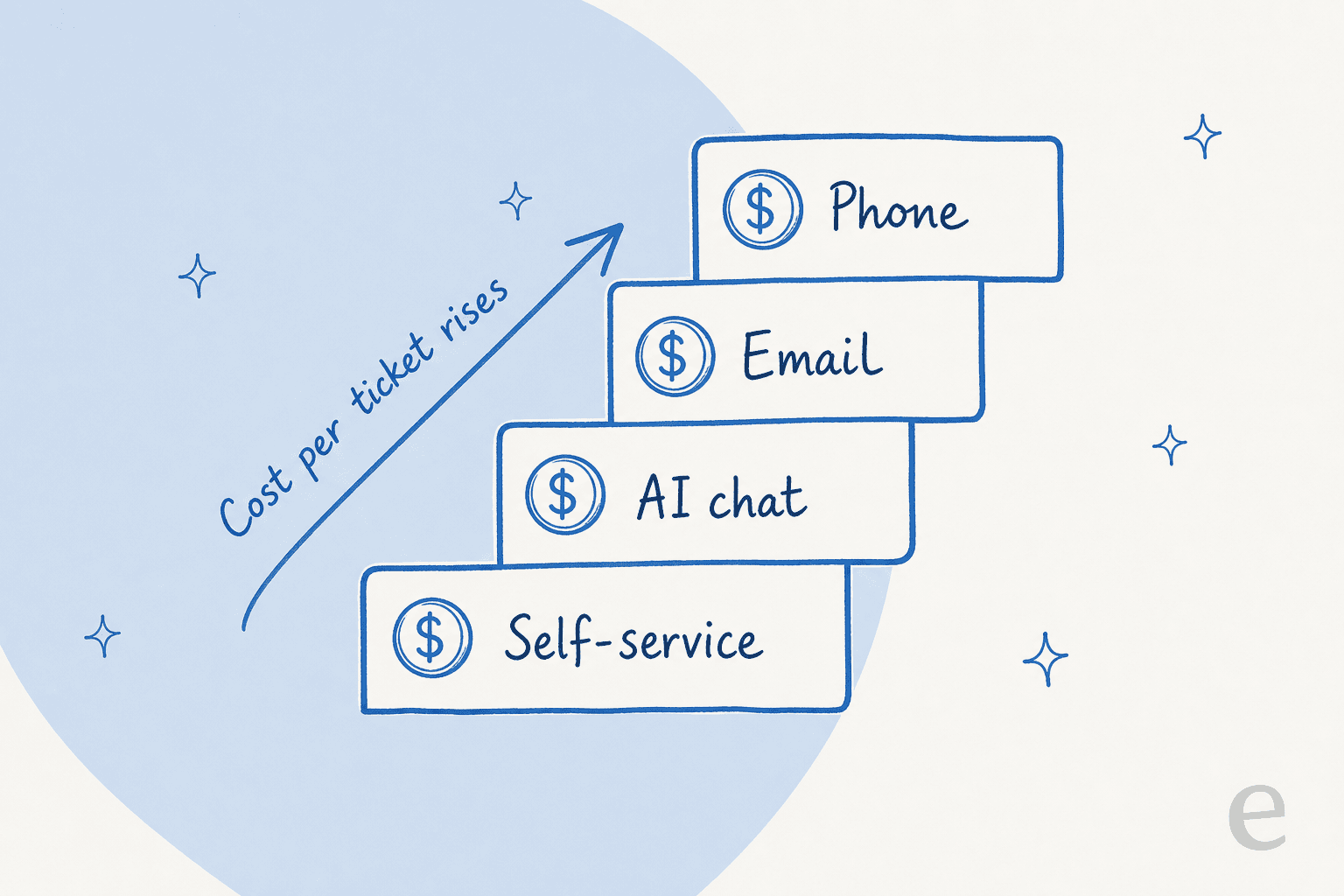
Each step up the ladder costs more to resolve: a self-service answer is the cheapest, AI chat sits just above it, and email and phone climb steeply because they tie up agent time. Shifting volume down the staircase is what actually moves the blended average.
How AI changes cost per ticket
Automation reshapes the math because it splits the queue into two very different cost profiles:
- Sort the volume. Repetitive, well-documented tickets go to automation; nuanced ones go to people.
- Resolve the cheap tier cheaply. Each automated resolution costs a small, predictable amount rather than a slice of an agent's salaried hour.
- Free people for the costly tier. Agents spend their (more expensive) time on the tickets that actually need judgment.
- Track the blended rate. The overall cost per ticket falls as the automated share of volume rises.
A support agent like eesel AI resolves the repetitive tickets it can answer from your help center and past tickets, at a predictable per-ticket cost, and escalates the rest. Because eesel charges per task rather than per seat, the cost of high-volume support stops scaling one-for-one with headcount, which is exactly the leak that traditional support staffing creates. That usage-based shape is a form of outcome-based pricing: you pay for tickets handled, not for seats sitting idle during a quiet hour.
Cost per ticket in practice
The number is only honest when the inputs are complete. Teams that count payroll but omit tooling, overhead, and training understate the figure and then make bad efficiency decisions on it. The most useful view is the blended cost trending over time alongside the automated-versus-human split, because that shows whether efficiency gains are real or just shifting cost into a column nobody is tracking. Lowering cost per ticket is the goal only as long as satisfaction holds, since the cheapest ticket of all is a wrong answer that reopens, and that one shows up twice in both the cost and the reopen numbers.
Plug in your own totals to see where your cost per ticket lands today, and what happens to the human-handled tier as automation takes a slice of the volume:
Type your support cost, ticket volume, and AI share to see your cost per ticket and what the AI-resolvable slice costs on humans versus usage-based pricing.
Want the full breakdown? See our guide to cost per resolution.
Lower your cost per ticket
eesel AI resolves repetitive tickets at a predictable per-ticket price, so the cost of high-volume support stops scaling with headcount.