Agentic AI
AI that acts with autonomy, planning its own steps, using tools, and adapting to results to reach a goal, rather than producing a single response to a single prompt.
What agentic AI means
Agentic AI describes AI systems that act with autonomy: they plan their own intermediate steps, use tools, and adapt to results in order to reach a goal, rather than producing a single response to a single prompt. The word "agentic" points to behavior, not a specific model. The system takes initiative and works toward an outcome instead of waiting to be told each step.
It is the broader idea behind a concrete AI agent: if an AI agent is the system, agentic AI is the property that system has, the capacity to plan, act, and self-correct. In customer support, that property is what separates a bot that suggests an article from a system that reads a ticket, checks the order, takes the action, and closes the loop.
What makes AI "agentic"
Most AI you interact with is reactive: prompt in, answer out. A system is agentic when it adds the behaviors that let it carry work on its own:
- Goal-seeking. It works toward an outcome ("resolve this refund request"), not just a reply.
- Planning. It breaks a goal into steps and sequences them, instead of following one fixed branch.
- Tool use. It calls APIs and systems to act on live data, rather than answering from memory alone.
- Adaptation. When a step fails or returns something unexpected, it changes course instead of stopping.
- Self-correction. It checks its own results and retries or escalates rather than confidently shipping a wrong answer.
One way to picture the difference is as a ladder of autonomy, where each rung adds a capability the rung below it lacks.
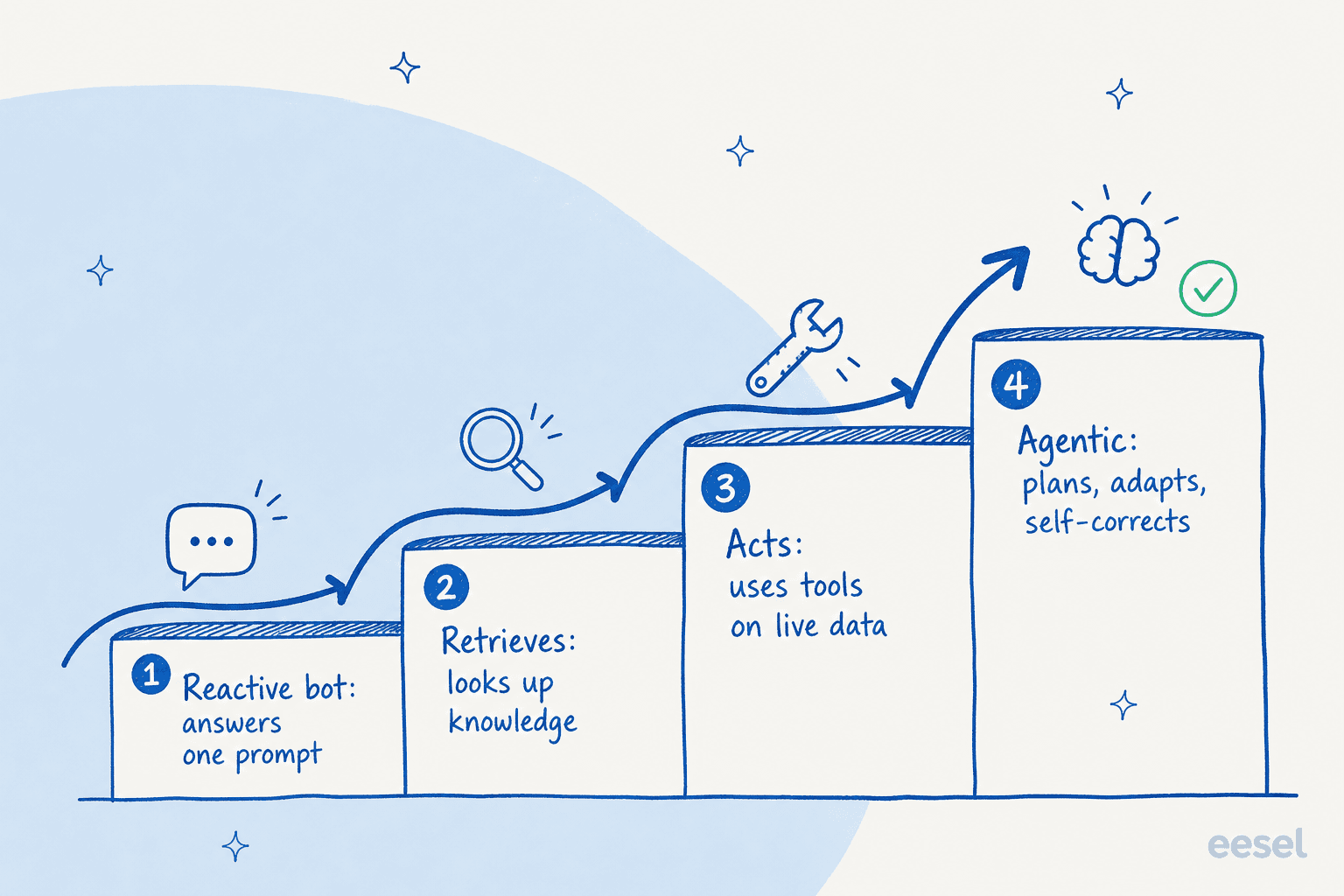
A plain bot sits on the bottom rung, answering one prompt at a time. Climbing up adds knowledge retrieval, then live tool use, and only the top rung is fully agentic: it plans, adapts when a step fails, and checks its own work. Most "AI support" tools stop a rung or two short of the top.
How agentic AI works
Agentic systems are usually built around a large language model wrapped in a control loop:
- Goal interpretation. The system reads the request and decides what success looks like.
- Planning. It breaks the goal into steps and picks the tools or data each step needs.
- Action and observation. It executes a step, reads the result, and decides what to do next.
- Iteration. It repeats until the goal is met or it determines it cannot safely proceed.
- Handoff. It completes the task, or escalates to a person when confidence is low.
In support, an agentic system like eesel AI runs exactly this loop: it reads a ticket, retrieves the right answer from your own knowledge, takes the action you allow inside the helpdesk, and hands off cleanly when it should not act alone.
Agentic AI in practice
The promise of agentic AI is also its risk: a system that acts on its own needs clear boundaries. The teams that get the most from it pair autonomy with strong grounding and explicit guardrails, so the AI is free to act on routine, well-documented work and required to defer on the rest. Start it on a narrow set of actions, prove it against real ticket history, and widen its remit as trust builds.
We go deeper on the distinction in AI agents vs chatbots.
Agentic AI for your helpdesk
eesel AI plans, looks things up, and takes action on tickets, then escalates when it should.