AI guardrails
The rules, limits, and safety checks placed around an AI system to keep its behavior within intended, safe, and accurate bounds.
What AI guardrails mean
AI guardrails are the rules, limits, and safety checks placed around an AI system to keep its behavior within intended, safe, and accurate bounds. They sit between the model's raw capability and what it is actually allowed to do, defining which topics it can address, which actions it can take, what it must refuse, and when it should stop and ask a person. Guardrails can be enforced before a request reaches the model, during generation, or after a response is produced but before it is sent.
In customer support, guardrails are what make an AI safe to put in front of real customers. A capable model left unchecked will answer anything confidently, including questions it has no basis to answer. Guardrails turn that open-ended behavior into something predictable: the agent answers what it should, refuses what it should not, and escalates the rest.
Why AI guardrails matter
- They stop confident wrong answers. A model with no limits will invent a refund policy or a price rather than admit it does not know. Guardrails force it to answer only from approved sources.
- They scope what the agent can do. Reading a ticket is low risk, issuing a refund is not. Guardrails decide which actions need approval and which the agent can take on its own.
- They define refusal boundaries. Legal, medical, account-security, and off-topic questions can be blocked outright so the agent never improvises on sensitive ground.
- They trigger escalation on low confidence. When the model is unsure, a guardrail routes the ticket to a person instead of letting it guess, which protects both the customer and the brand.
- They enforce tone and compliance. Guardrails can keep replies on-brand, redact sensitive data, and meet regulatory requirements that a free-running model would ignore.
It helps to picture guardrails as a funnel that every request has to pass through before the agent commits to anything.
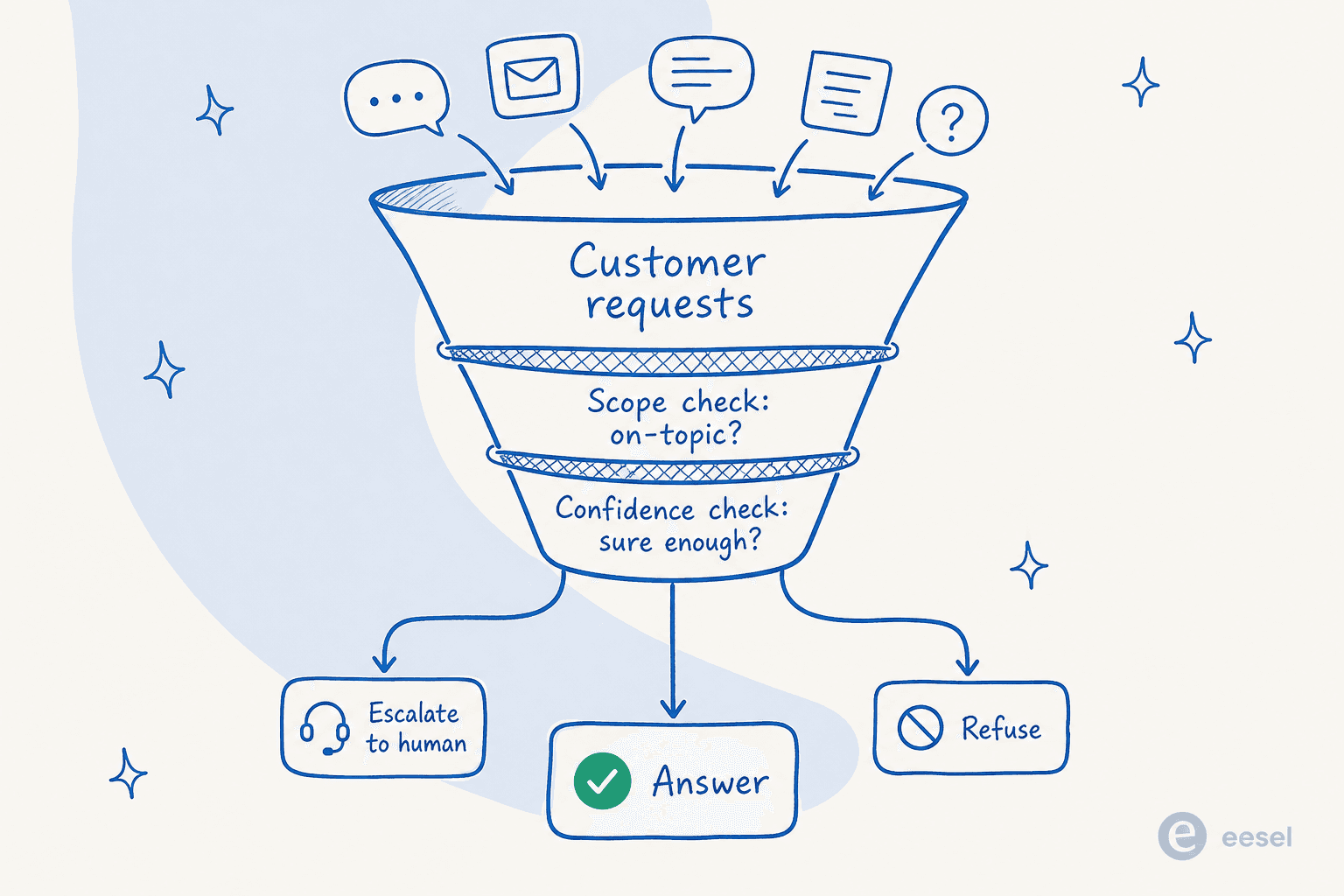
Every customer request drops into the funnel and gets sieved by each layer in turn: is this on-topic, and is the agent sure enough to act? Only requests that clear both checks reach the answer, while the rest get routed to a person or refused outright. The funnel is what turns "answer everything" into "answer what is safe."
How AI guardrails work
Guardrails are usually layered, not a single switch:
- Input checks. The request is screened first, filtering prompt-injection attempts, out-of-scope topics, or anything that should never reach the model.
- Scoped generation. The model is constrained to answer from approved knowledge and within defined rules, often by grounding it in your own documentation.
- Confidence gating. The system scores how sure the model is, and a low score triggers a handoff rather than a reply.
- Output review. The draft is checked before it goes out, for policy violations, leaked data, or actions outside the allowed set.
- Action limits. Any real action, like a refund or an account change, is bounded by explicit permissions and approval rules.
A support agent like eesel AI is built around this pattern: you scope exactly which topics it handles and which actions it can take, it grounds answers in your help center and past tickets, and it escalates cleanly when confidence is low. Many teams also simulate the agent against historical tickets before go-live, which is itself a guardrail: it surfaces where the rules are too loose or too tight before a single customer is affected.
AI guardrails in practice
The hard part of guardrails is calibration, not existence. Set them too loose and the agent strays into territory it should not touch; set them too tight and it refuses things it could safely handle, which frustrates customers and erodes trust in the automation. The teams that get this right start narrow, watch where the agent escalates or refuses, and widen the bounds only once the behavior is proven. Guardrails are not a one-time configuration, they are tuned continuously as the agent's remit grows.
Put guardrails on your support AI
eesel AI lets you scope exactly what the agent can answer and do, and it escalates to a human when it is not confident.