AI agent
An AI system that pursues a goal on its own, understanding a request, deciding what steps to take, calling tools, and completing the task rather than just answering one question.
What an AI agent means
An AI agent is a software system that can pursue a goal on its own: it interprets a request, decides what steps to take, calls the tools or data it needs, and carries the task through to completion without a person directing each move. Where a basic model produces one response to one prompt, an agent reasons across multiple steps, acts on live systems, and adapts when something does not go as expected.
In customer support, an AI agent is the difference between software that points a customer to a help article and software that reads the ticket, pulls up the customer's order, checks the refund policy, issues the refund or escalates with full context attached, and then updates the ticket when it is done. It is an operator, not just a responder.
What makes an AI agent different
Earlier support automation followed fixed decision trees: if the customer says X, reply with Y. An AI agent is a step change from that, because it can:
- Understand intent in natural language across a multi-turn conversation, instead of matching keywords to a script. This usually runs on intent classification under the hood.
- Retrieve and combine knowledge from several places at once, like your help center, internal docs, past tickets, and order systems, to assemble one accurate answer.
- Make decisions based on business rules, customer history, and context, rather than a pre-written branch someone had to anticipate.
- Take real actions, such as processing a refund, updating an account, tagging a conversation, or opening a follow-up ticket.
- Improve over time as it sees more interactions, without an engineer hand-coding every new scenario.
The practical result is that an agent can handle the whole task a request implies, not just the first reply in the thread.
It helps to see an agent as the top rung of a ladder that earlier automation only climbs partway.
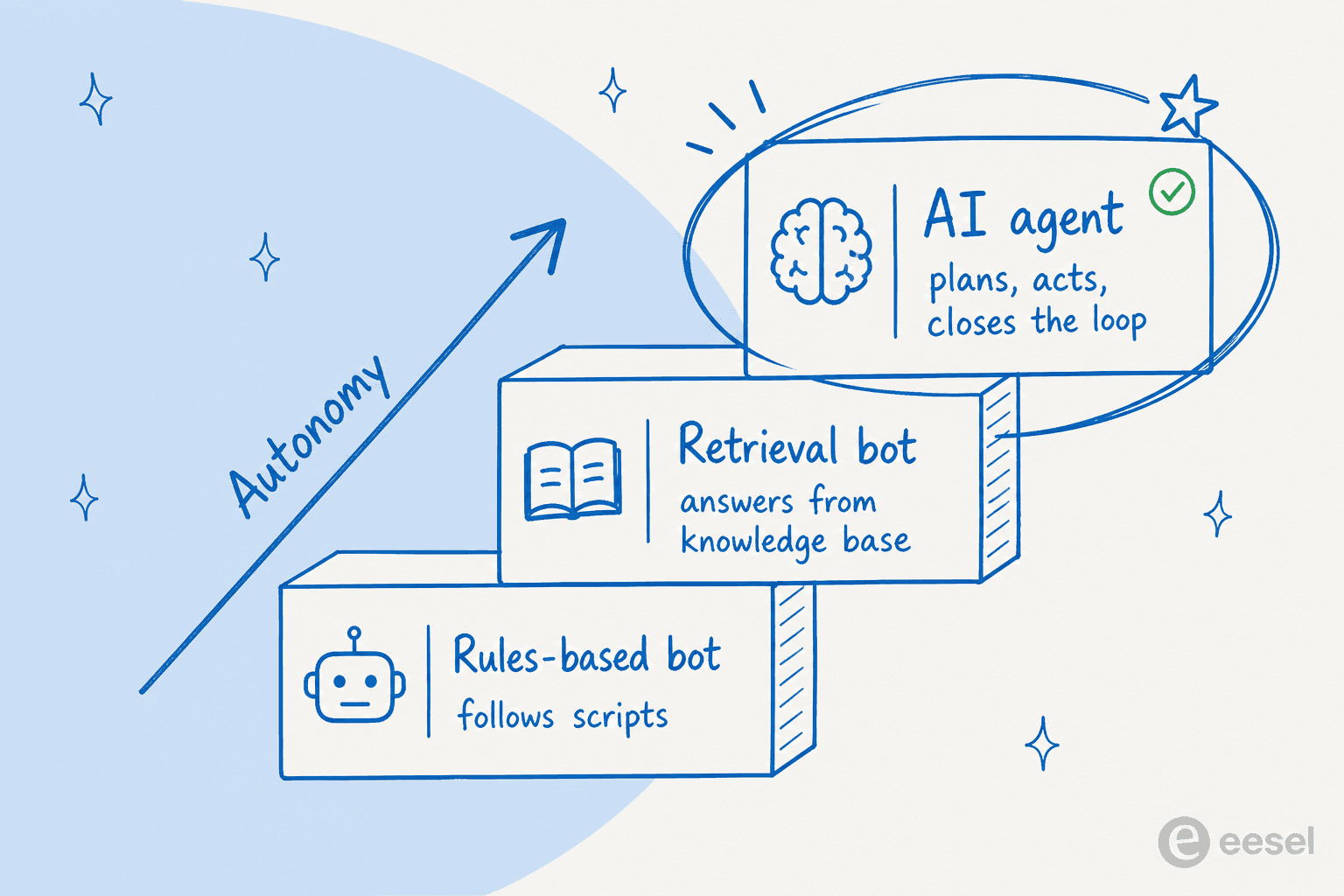
A rules-based bot only follows scripts, and a retrieval bot can answer from a knowledge base but stops at the reply. An AI agent sits at the top because it plans, takes the action, and closes the loop on the whole task.
How an AI agent works
Most agents run a version of the same loop:
- Understand the goal. The agent interprets the request and works out what a successful resolution actually looks like.
- Plan and choose tools. It breaks the goal into steps and decides which tools, integrations, or knowledge sources each step needs.
- Act. It retrieves information, calls an API, or performs an action in a connected system.
- Observe and repeat. It reads the result of that action and loops again if the task is not finished, correcting course if a step fails.
- Resolve or escalate. It completes the task, or hands off to a person with context when confidence is low or the action is out of bounds.
A support agent like eesel AI follows exactly this pattern: it grounds every answer in your help center and past tickets so it replies with your facts, takes the actions you allow inside your helpdesk, and escalates cleanly when there is no safe answer.
AI agents in practice
The reliability of an agent comes down to two things: the quality of the knowledge it can reach, and the guardrails around what it is allowed to do. A well-scoped agent with strong knowledge and clear escalation rules resolves far more, and far more safely, than a powerful model turned loose without either. That is why most teams start by pointing an agent at a narrow, well-documented set of requests, prove it out against real ticket history, and widen its remit from there.
Curious what this looks like in the wild? See our roundup of AI agent examples.
Put an AI agent on your support queue
eesel AI is an agent that reads a ticket, finds the answer in your own knowledge, takes the action, and escalates when it should.