Intent classification
The task of assigning a piece of text to one of a set of predefined intent labels that describe what the person is trying to do.
What intent classification means
Intent classification is the task of assigning a piece of text to one of a set of predefined intent labels that describe what the writer is trying to do. Given a message and a list of possible intents, like "track an order," "request a refund," or "cancel subscription," the classifier picks the label that best fits. It is a specific kind of text classification and a foundational building block of natural language understanding.
In customer support, intent classification is what turns a free-text ticket into something software can act on. A message that says "Where's my stuff, I ordered last week" gets the label "order status," and that single label is enough to trigger the right workflow, route the ticket, or hand it to an AI that knows how to resolve order-status questions.
Why intent classification matters
- It converts messy text into a structured signal. Customers write in their own words, and a clean label is what the rest of your automation can branch on.
- It powers routing and triage. Reliable labels are the input that ticket routing and auto-triage depend on to send each request to the right place.
- It enables reporting by topic. Aggregated intents tell you what customers actually contact you about, which feeds staffing, product, and content decisions.
- It scopes automation safely. Knowing the intent lets you automate the categories an AI handles well and route the rest, instead of automating blindly.
- It catches the cases worth escalating. An "intent unknown" or low-confidence result is itself a useful signal that a human should look.
What sets classification apart from looser kinds of understanding is the fixed menu: every message has to land in exactly one box from a list you defined up front.
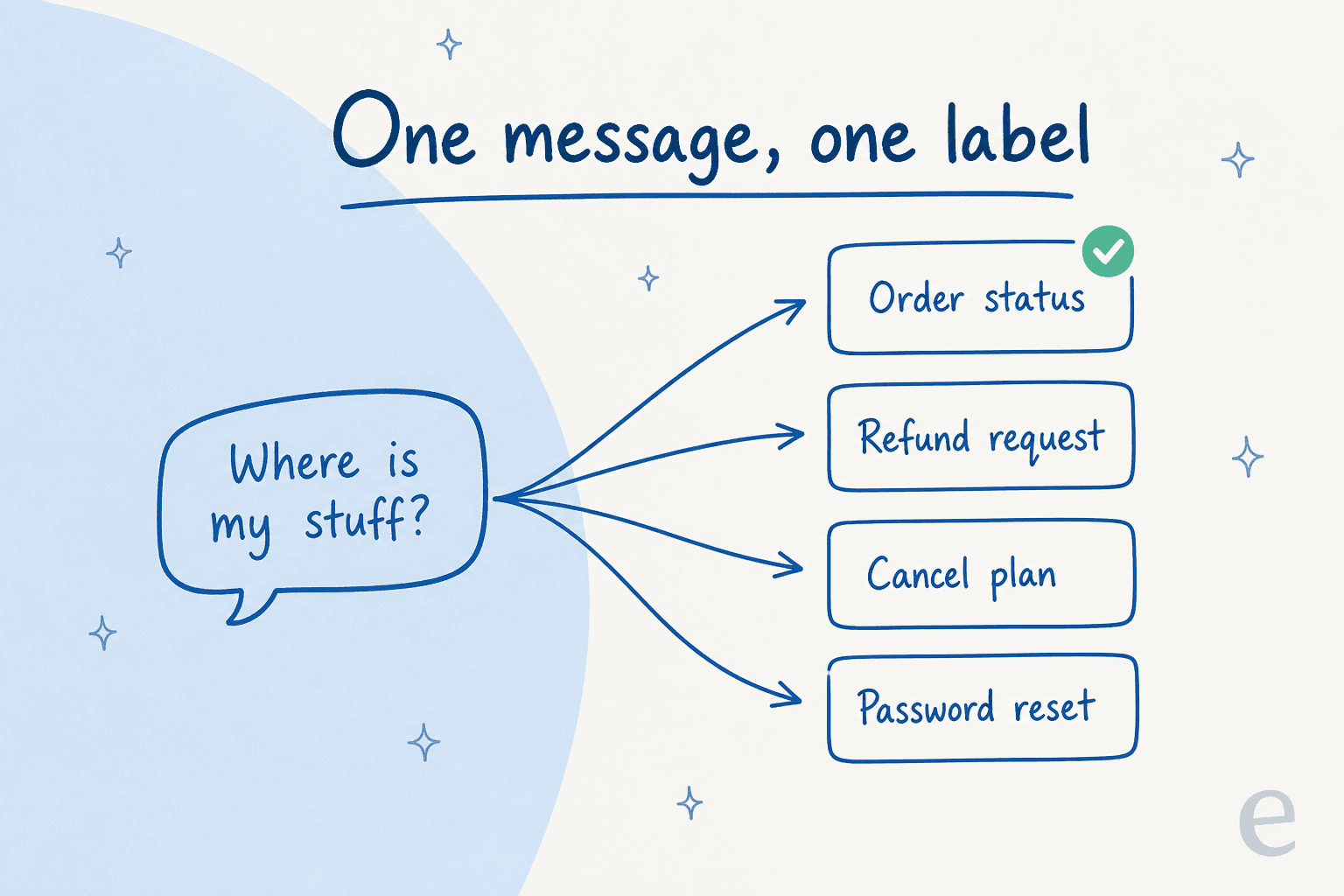
The classifier does not invent a new category for each ticket. It scores the message against a closed set of intents and picks the single best fit, which is exactly what makes the output safe to branch automation on.
How intent classification works
A support agent like eesel AI uses intent classification near the start of handling a message:
- Take the message as input. The raw customer text, plus any context like subject line or channel.
- Compare against the intent set. The model evaluates the message against the defined labels. Classic systems train on labeled examples per intent, while LLM-based ones can match against short label descriptions with few-shot or even zero examples.
- Return a label and a score. It outputs the best-fit intent and a confidence score for how sure it is.
- Act on the label. A high-confidence "refund request" can trigger the refund workflow, while a low-confidence result routes to a human.
The result is that a vague paragraph becomes a single decision-ready signal: this ticket is about X, handle it accordingly.
Intent classification in practice
The quality of a classifier is bounded by how well its label set matches reality. Too few labels and distinct problems get lumped together; too many and the model gets confused between near-duplicates. The teams that get good results keep the intent set tight and grounded in their actual ticket categories, then watch the low-confidence and misclassified cases as the place to refine. A label is only useful if the action behind it is right, so the classifier and the workflow it feeds have to be tuned together, not in isolation.
Classify and resolve tickets automatically
eesel AI reads each ticket, works out the customer's intent, and routes or resolves it from your own knowledge.