Ticket routing
The process of directing an incoming support request to the right person, team, or queue based on its content, priority, or other attributes.
What ticket routing means
Ticket routing is the process of directing an incoming support request to the right person, team, or queue based on its content, priority, or other attributes. It is the traffic-control layer of a support operation: every request that arrives has to go somewhere, and routing decides where.
At its simplest, routing is a set of rules, billing questions to the finance queue, refunds to a senior agent, anything in Spanish to the Spanish-speaking team. The goal is always the same: get each request to whoever can actually solve it, with as little manual sorting as possible. Poor routing is one of the quietest causes of slow support, because a ticket sitting in the wrong queue looks handled while nothing is happening.
Why ticket routing matters
- It sets the floor on response time. A ticket routed wrong waits twice: once in the wrong queue and again after it is re-routed.
- It protects specialist time by keeping simple requests away from senior agents and complex ones off the front line.
- It enables prioritization, since routing can read urgency and push high-priority or angry customers to the front, often informed by sentiment analysis.
- It is the precursor to escalation, because clean first-pass routing means fewer corrective hops later.
- It scales triage, pairing with auto-triage so reading and directing a ticket happen in a single automated step.
The method a team picks largely decides how often a ticket lands with someone who can actually solve it on the first try.
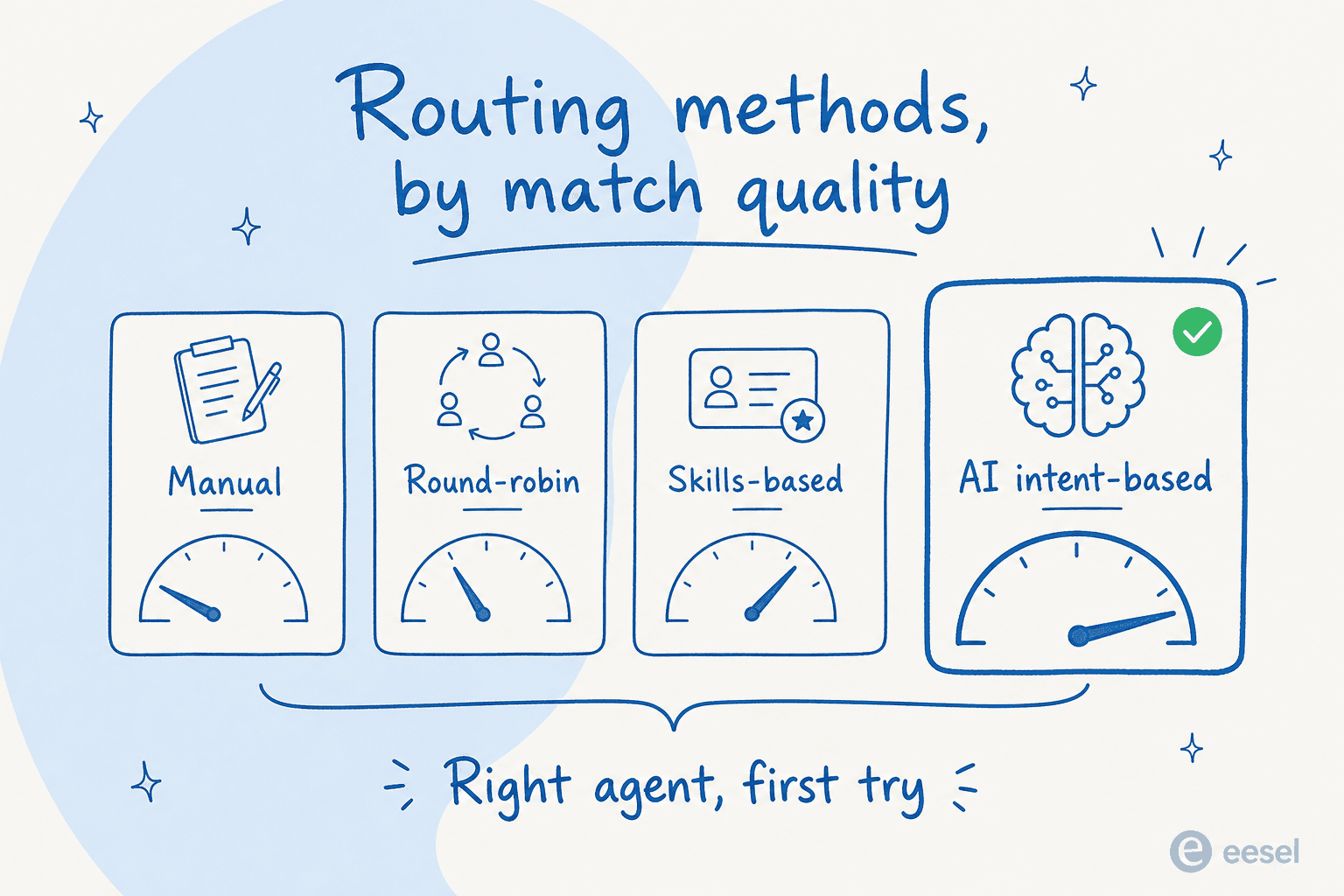
Manual sorting and round-robin spread tickets without reading them, so the match is largely luck. Skills-based routing improves the odds by matching topic to expertise, and AI intent-based routing reads what the customer actually means, giving it the best shot at the right agent first time.
How ticket routing works
An AI agent like eesel AI handles routing as part of resolving the ticket, not as a separate sorting chore:
- Read the request. The system interprets the message in natural language to understand what the customer actually wants.
- Classify it. Using intent classification, it tags the request by topic, urgency, and required action.
- Decide the destination. It checks whether the request can be resolved automatically or needs a specific team or skill set.
- Route or resolve. It either closes the ticket itself or sends it onward with the classification and context already attached.
- Hand off cleanly. When a person is needed, the agent receives the full thread and reasoning rather than a cold, unlabeled ticket.
The shift from keyword rules to intent-based routing is what cuts the misroutes that brittle if-this-then-that rules quietly produce.
Ticket routing in practice
The most common routing failure is not a missing rule but an outdated one. Teams build a tidy rule set, the product changes, new queues appear, and the rules silently send tickets to the wrong place for months. Intent-based routing is more resilient because it reads the request's meaning instead of matching strings, but it still needs review: the practical discipline is auditing where tickets actually land versus where they should, and treating a rising re-route count as the early warning that the routing logic has drifted from reality.
We go deeper on this in our guide to intelligent routing.
Route and resolve tickets automatically
eesel AI reads each incoming ticket, resolves what it can, and routes the rest to the right team with full context attached.