Sentiment analysis
Sentiment analysis is the use of language processing to detect the emotional tone of a piece of text, usually as positive, negative, or neutral.
What sentiment analysis means
Sentiment analysis is the use of language processing to detect the emotional tone of a piece of text, usually classifying it as positive, negative, or neutral. More advanced versions go further and tag specific emotions (anger, frustration, satisfaction) or measure intensity. It turns subjective tone, which a human picks up instinctively, into a structured signal a system can sort, count, and act on.
In customer support, sentiment analysis reads the feeling behind a message, not just its topic. A ticket tagged "billing" tells you what the conversation is about, but sentiment tells you whether the customer is calmly asking a question or about to churn. That extra layer lets a team treat an angry message differently from a routine one, and lets it measure mood across a volume of tickets no manager could ever read by hand.
Why sentiment analysis matters
- It catches frustration early. A negative tone can trigger faster handling or an escalation before a small problem becomes a public complaint.
- It informs prioritization. Upset customers can be pushed up the queue, so the angriest tickets are not sitting behind routine ones.
- It scales empathy. Sentiment can be measured across every conversation, where manual review only ever samples a handful.
- It complements survey scores. It captures tone even from customers who never answer a CSAT survey, filling the gap silent customers leave.
- It feeds the bigger picture. Aggregated sentiment becomes a core input to voice of the customer reporting and product feedback.
A label only earns its keep once it maps to an action, so it helps to see the whole tone scale at once:
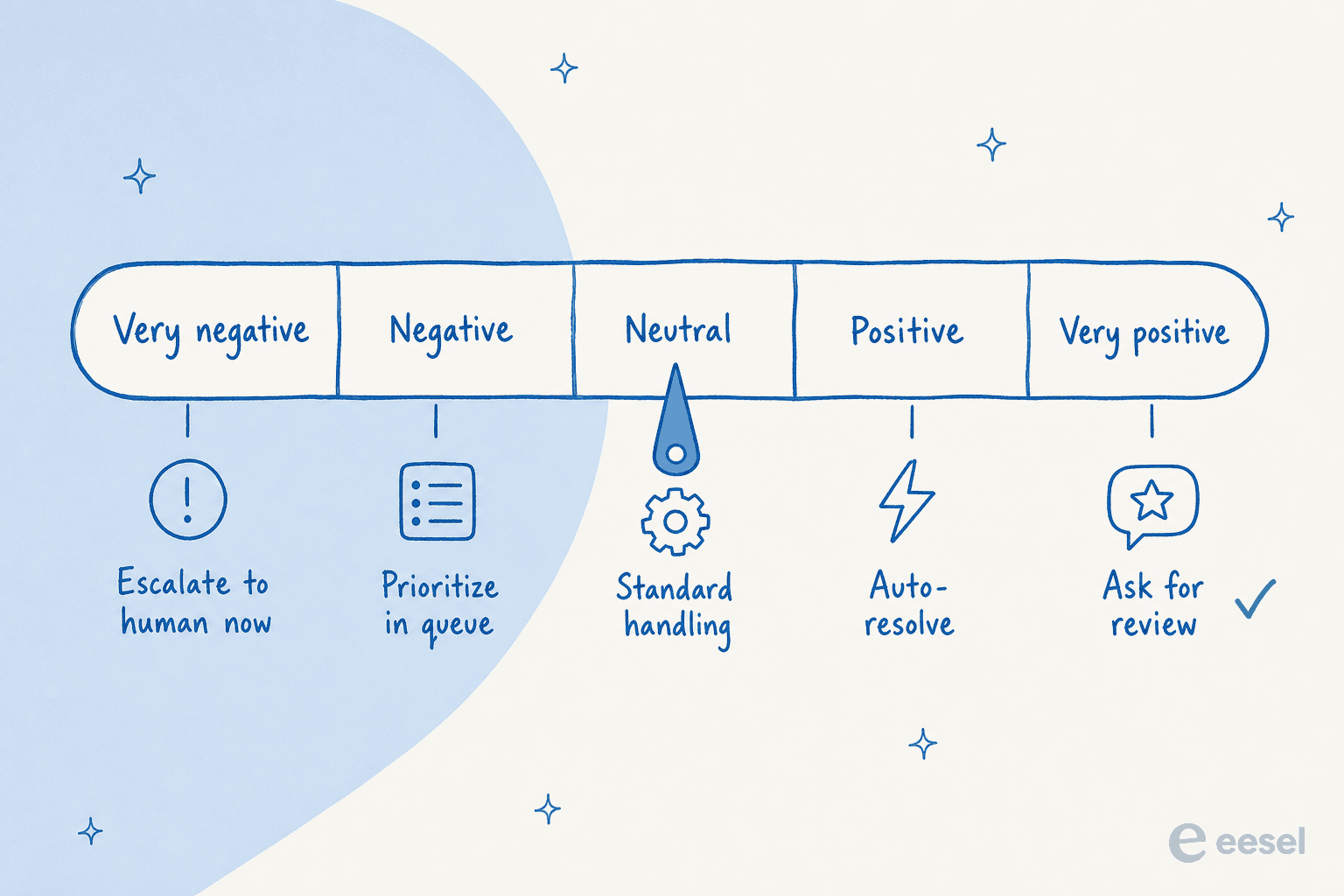
Tone is not just positive or negative, it sits on a scale, and each band can drive a different response. A very negative read tells eesel AI to escalate to a human now, while a positive one can be handled or auto-resolved without anyone stepping in.
How sentiment analysis works
Most systems follow the same broad path, from raw text to an actionable label:
- Ingest the text. The model takes the message, the thread, or a batch of conversations as input.
- Process the language. Using natural language processing, it interprets words, phrasing, and context rather than matching a keyword list.
- Score the tone. It assigns a sentiment label or a numeric score, sometimes per message and sometimes per conversation.
- Act on the signal. The score drives a workflow: routing, prioritization, an alert, or a row in a dashboard.
An AI support agent like eesel AI can use sentiment as a guardrail in its own loop: if a conversation turns clearly negative, it can hand off to a human rather than press on, so the moments that most need a person are exactly the ones that get one. The same reading also helps prioritize which tickets a human should see first.
Sentiment analysis in practice
The honest limitation of sentiment analysis is nuance. Sarcasm, mixed messages, and terse one-line replies trip it up, and treating its label as ground truth leads to overconfident routing. The teams that get value from it use it as one signal among several, strong enough to flag a likely-frustrated customer for faster handling or to spot a rising trend across thousands of tickets, but not strong enough to be the sole basis for a high-stakes decision. Read that way, it is a useful early-warning system rather than a verdict.
Want the full playbook? See our overview of AI sentiment analysis.
Spot frustrated customers in real time
eesel AI reads the tone of each conversation and can escalate or prioritize when a customer is upset, before a bad experience gets worse.