Voice of the customer (VoC)
The structured practice of capturing what customers say about their needs, expectations, and experience, then turning that feedback into action.
What voice of the customer means
Voice of the customer (VoC) is the structured practice of capturing what customers say about their needs, expectations, preferences, and experience, then translating that feedback into decisions and action. It spans both solicited input, like surveys and interviews, and unsolicited input, like reviews, social posts, and support conversations. The point is not just to collect opinions but to build a repeatable loop that turns them into improvements customers can feel.
In customer support, VoC is the bridge between the front line and the rest of the business. Every ticket, chat, and call is a customer telling you, in their own words, what is working and what is broken, and a VoC program is what makes those signals legible instead of letting them disappear into a closed conversation.
Why voice of the customer matters
A working VoC program does more than fill a dashboard with feedback scores:
- It catches problems early. Recurring themes in tickets surface a broken feature or confusing flow long before it shows up in churn numbers.
- It prioritizes the roadmap. When the same request appears across hundreds of conversations, it stops being one opinion and becomes evidence for what to build next.
- It connects to real metrics. VoC links qualitative feedback to hard signals like CSAT, NPS, and customer churn, so teams can see which complaints actually move retention.
- It uses the support queue as a sensor. Support is the highest-volume, most candid feedback channel most companies have, and VoC treats it as primary data rather than noise to clear.
- It closes the loop. Mature programs do not just listen, they tell customers what changed because of their feedback, which builds trust.
Not every feedback channel carries the same signal, and plotting them by how much they produce against how candid they are explains why support sits where it does:
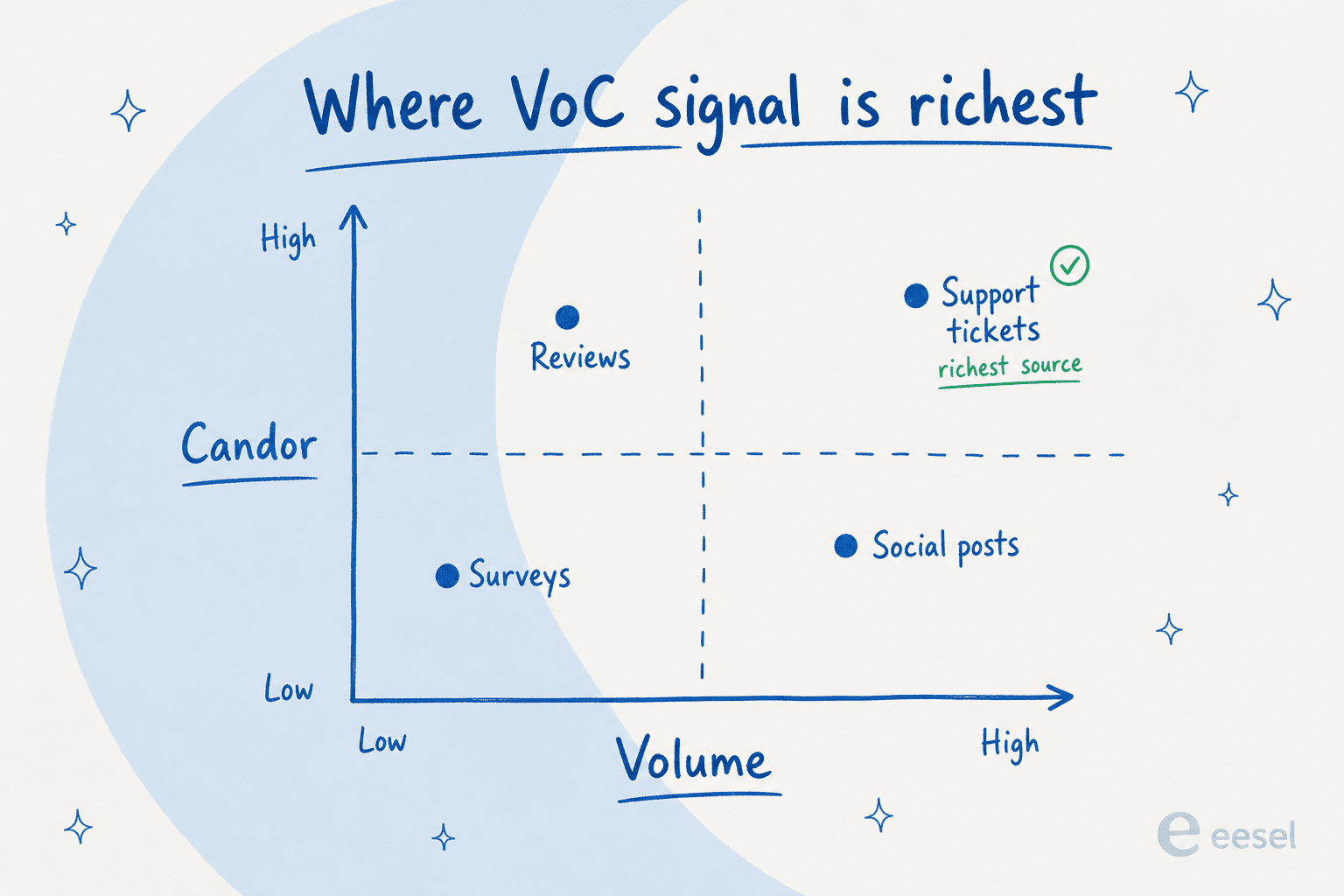
Surveys are solicited and sparse, reviews are honest but lower in volume, and social posts are loud but uneven. Support tickets land in the top-right corner because customers arrive with a real problem and describe it in their own words, at a scale no survey can match.
How voice of the customer works
A VoC program usually runs through a steady cycle:
- Collect. Pull feedback from surveys, reviews, interviews, and especially support tickets and chats.
- Categorize. Tag and group the raw input by theme, product area, and sentiment so patterns can emerge.
- Analyze. Find the recurring issues and rank them by frequency and impact.
- Act. Route findings to the teams who can fix them, whether that is product, engineering, or support.
- Follow up. Tell customers what changed and watch whether the relevant metric moves.
This is where the support channel becomes the engine. An AI support agent like eesel AI works across your real tickets and past conversations, so the themes in what customers actually ask, the same question asked fifty different ways, become visible patterns rather than fifty separate closed threads. That makes the support queue a live VoC feed, not a record to archive.
Voice of the customer in practice
The hardest part of VoC is not collecting feedback, it is acting on it. Plenty of teams run surveys and watch scores tick by without ever changing a thing, which trains customers that giving feedback is pointless. The programs that work treat the support queue as the loudest, most honest VoC channel they have, route the patterns they find to people who can fix them, and measure success by what changed, not by how much feedback was gathered.
For a hands-on walkthrough, read our guide to AI customer feedback analysis.
Turn every ticket into customer signal
eesel AI works across your real tickets, so the patterns in what customers ask become visible instead of buried in the queue.