Customer experience (CX)
Customer experience is the sum of every interaction a person has with a company across the entire relationship, and how those interactions make them feel.
What customer experience means
Customer experience, often shortened to CX, is the total impression a person forms from every interaction they have with a company, and how those interactions make them feel. It spans the entire relationship, from the first ad they see, through buying, onboarding, daily use, billing, and support, all the way to renewal or cancellation.
CX is not one moment or one department. It is cumulative: a brilliant product can be undermined by a confusing checkout, and a great sales pitch can be undone by a support reply that takes four days. The experience is whatever the customer is left with after all of those touchpoints add up.
In customer support, CX is where one bad interaction can outweigh many good ones. A customer who waits on hold, repeats their problem three times, and gets a non-answer remembers that, no matter how polished the rest of the journey was. Support is often the moment that defines the whole experience.
Why customer experience matters
CX is not a soft metric, it tracks closely to revenue, because it shapes:
- Retention. Customers who have an easy, respectful experience stay longer, which lifts customer retention and lifetime value.
- Word of mouth. People tell others about both the best and worst experiences, so CX directly feeds new-customer acquisition.
- Pricing power. A strong experience lets a company charge more, because customers pay for the feeling of being looked after, not just the feature list.
- Churn risk. Friction that never shows up in a feature comparison, slow support, a clumsy refund process, quietly pushes customers toward competitors.
- Differentiation. When products converge, the experience around them becomes the thing customers actually choose between.
The practical upshot is that CX is a competitive asset, not a checkbox, and support is one of its most visible surfaces.
Picture CX as a path rather than a single moment, every touchpoint along the way adds to the impression a customer is left with:
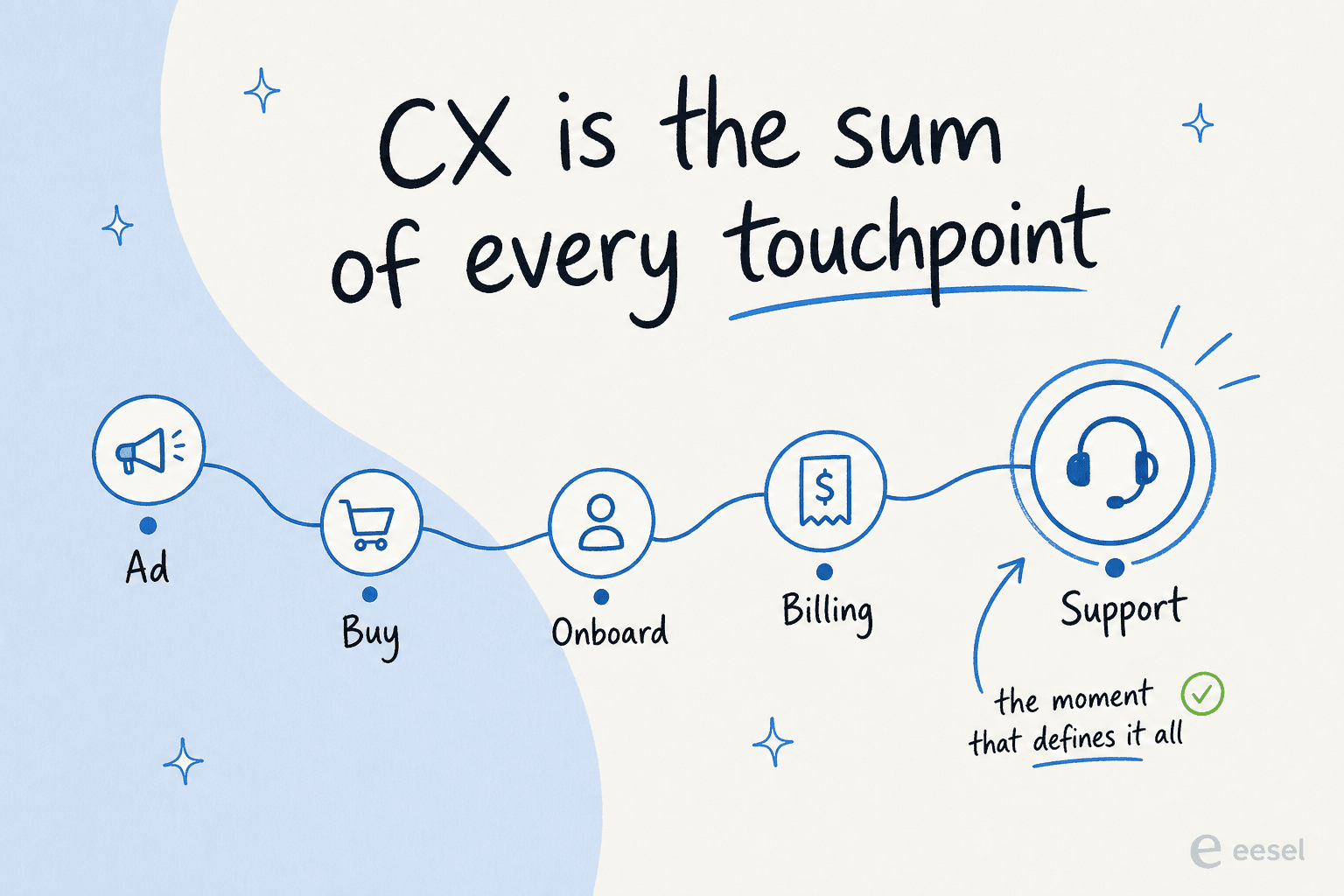
No single stop owns the whole experience, but support tends to carry outsized weight because it is where a problem either gets defused or hardens into a bad memory. Get every other touchpoint right and one slow, wrong support reply can still be the thing the customer remembers.
How customer experience works
Companies improve CX by treating the relationship as a connected whole rather than separate departments:
- Map the journey. They lay out the full customer journey and find the points where customers struggle, drop off, or get frustrated.
- Measure how it feels. They track signals like CSAT, NPS, and effort scores to turn the experience into something they can act on.
- Fix the friction. They remove the slow, repetitive, or confusing steps, especially in support, where bad moments are most memorable.
- Close the loop. They feed what they learn back into the product and the process so the same friction does not recur.
Support is where this gets concrete. A support agent like eesel AI lifts the support part of CX by answering instantly, grounding every reply in your own help center and past tickets so the answer is right, and escalating to a person the moment it is unsure. That removes the slow waits and wrong answers that most often turn one interaction into a lasting bad impression.
Customer experience in practice
The trap with CX is treating it as a single team's job. Experience is made by everyone the customer touches, so the strongest CX programs make the data shared: support sees what marketing promised, product sees where support keeps escalating, and the same friction does not get re-discovered in three different meetings. The teams that move the needle pick a small number of measures, watch them honestly, and fix the one or two journey steps that quietly cost them the most customer satisfaction.
Make support a CX win, not a cost
eesel AI answers fast, accurately, and around the clock, so the support part of the customer experience stops being the weak link.