Customer service
Customer service is the help a company provides to people before, during, and after they buy, so they can use the product and resolve any problems.
What customer service means
Customer service is the assistance a company provides to its customers before, during, and after a purchase, so they can choose the right product, use it successfully, and resolve any problems they hit. It covers answering questions, guiding people through tasks, handling complaints, and making things right when something goes wrong.
The scope is broad. Customer service is the pre-sale question about which plan fits, the how-do-I-do-this question during onboarding, and the something-broke question months later. It can happen over email, chat, phone, social media, or in person.
In practice, customer service is where a company's promises meet reality. Marketing sets an expectation; service is whether the company actually delivers on it when a real person needs help. It is the most direct, human point of contact between a brand and its customers.
Why customer service matters
Customer service is not a back-office cost, it shapes whether the business grows or leaks customers, because it:
- Drives retention. People stay with companies that help them well, which lifts customer retention and lifetime value.
- Protects the brand. A single mishandled interaction gets shared publicly, while a recovered one creates loyalty, so service is reputation management in real time.
- Reduces churn. Many cancellations trace back to an unanswered question or a frustrating support experience, not the product itself.
- Feeds the rest of the company. Service hears the real problems first, so it is an early-warning system for product and operations.
- Converts. Pre-sale answers and post-sale care both turn interest into purchases and purchases into repeat buyers.
The result is that the quality of customer service often decides whether a satisfied buyer becomes a long-term customer.
A useful reminder is that service is not just the help desk after a problem, it runs the length of the relationship:
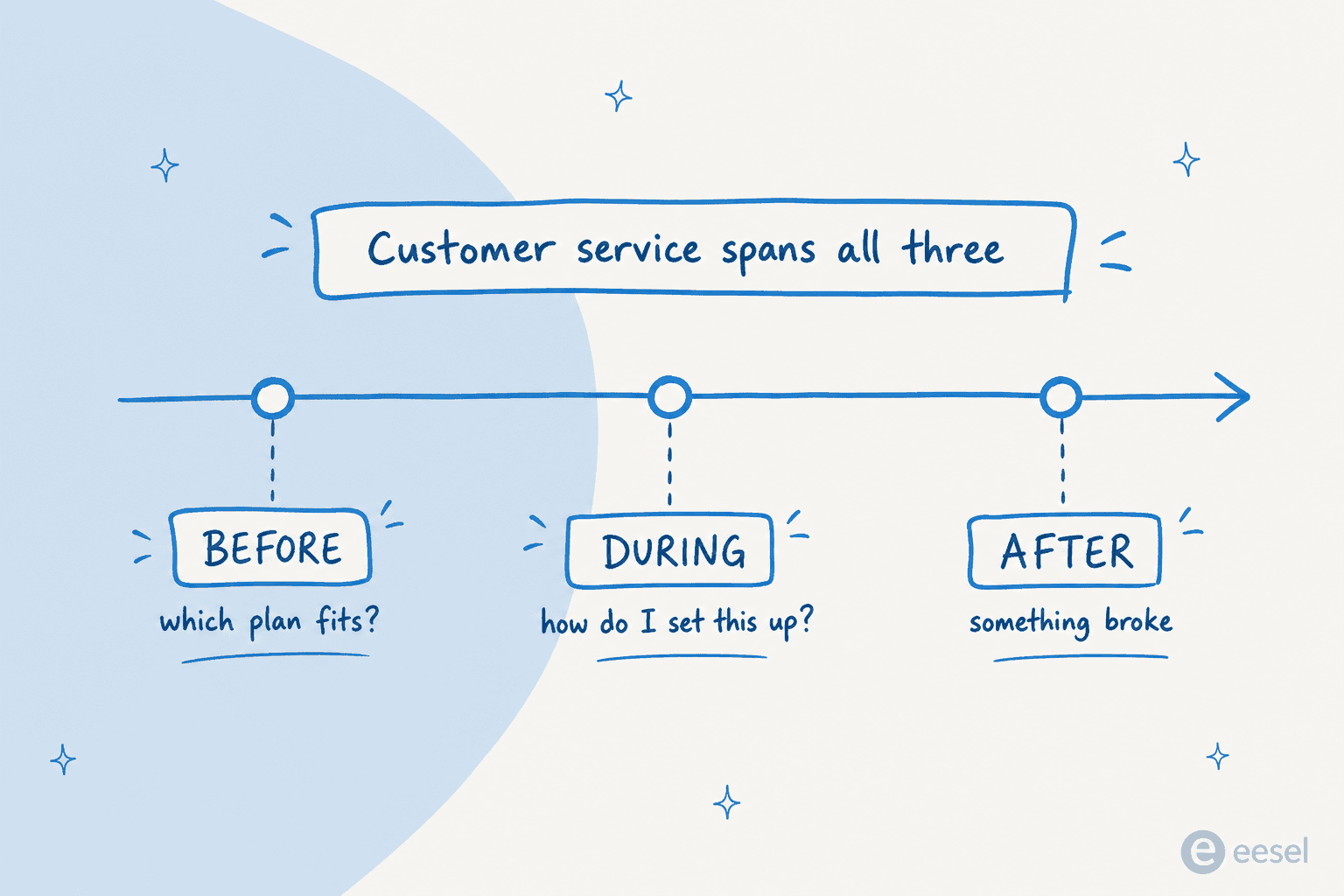
The same function answers the pre-sale "which plan fits", the onboarding "how do I set this up", and the months-later "something broke". Treating all three as one continuous service experience, rather than separate teams, is what keeps the relationship coherent.
How customer service works
A modern customer service operation runs on a few connected pieces:
- Channels. Customers reach the team through email, chat, phone, or social, and the team meets them where they are.
- A help desk and knowledge. Requests flow into a helpdesk, and agents answer using a shared knowledge base so answers stay consistent.
- Triage and routing. Each request is understood, prioritized, and sent to the right person or queue.
- Resolution. The team answers the question, fixes the issue, or escalates it, then closes the loop and learns from it.
This is where AI now does real work. A support agent like eesel AI sits in the helpdesk, reads each incoming request, answers the routine ones instantly from your help center and past tickets, takes allowed actions like tagging or updating a ticket, and hands the rest to a human with full context. The repetitive volume gets handled automatically, and agents spend their time on the conversations that actually need judgment.
Customer service in practice
The hardest part of customer service is not answering questions, it is answering them consistently at volume without burning out the team. As ticket counts grow, quality usually slips first: replies get slower, answers drift from the documentation, and agents get stuck re-typing the same response. The teams that hold quality steady invest in a single source of truth their agents and their AI both draw from, measure the experience with CSAT rather than guessing, and automate the predictable volume so people can do the work only people can do.
For the full playbook, read our AI customer service guide.
Scale customer service without scaling headcount
eesel AI handles the repetitive questions instantly so your team spends its time on the conversations that need a human.