Customer support
Customer support is the help a company gives customers to solve problems and answer questions about a product or service they already use.
What customer support means
Customer support is the help a company provides to customers who are using a product or service, so they can solve problems, get unblocked, and use what they bought successfully. It is the function that fields questions, troubleshoots issues, and resolves complaints after the purchase.
Where the broader idea of service spans the whole relationship, support is more focused on the moment something is unclear or broken. A customer hits an error, cannot find a setting, or gets charged twice, and support is who they turn to.
In day-to-day terms, customer support is the queue of tickets, chats, and calls a team works through, the inbox of people who need an answer now. Its job is to turn a stuck, frustrated customer back into a working one, quickly and accurately, across whatever channel they reached out on.
Why customer support matters
Customer support is the front line of the relationship after the sale, and it carries real weight because it:
- Keeps customers from leaving. A fast, helpful resolution at the moment of frustration is one of the strongest defenses against churn.
- Protects the brand publicly. Support interactions get screenshotted and shared, so each one is a small, visible test of whether the company keeps its word.
- Surfaces product problems first. The support queue is where recurring bugs and confusing flows show up before anyone else notices them.
- Carries a real cost. Every contact takes agent time, so the efficiency of support directly affects the cost of running the business.
- Shapes loyalty. Customers remember how they were treated when something went wrong far more than when everything worked.
The result is that strong support pays for itself, in retention saved and reputation kept, even though it sits on the cost side of the ledger.
Most teams that scale well organize support as a tiered pyramid, where each level handles what the one below it could not:
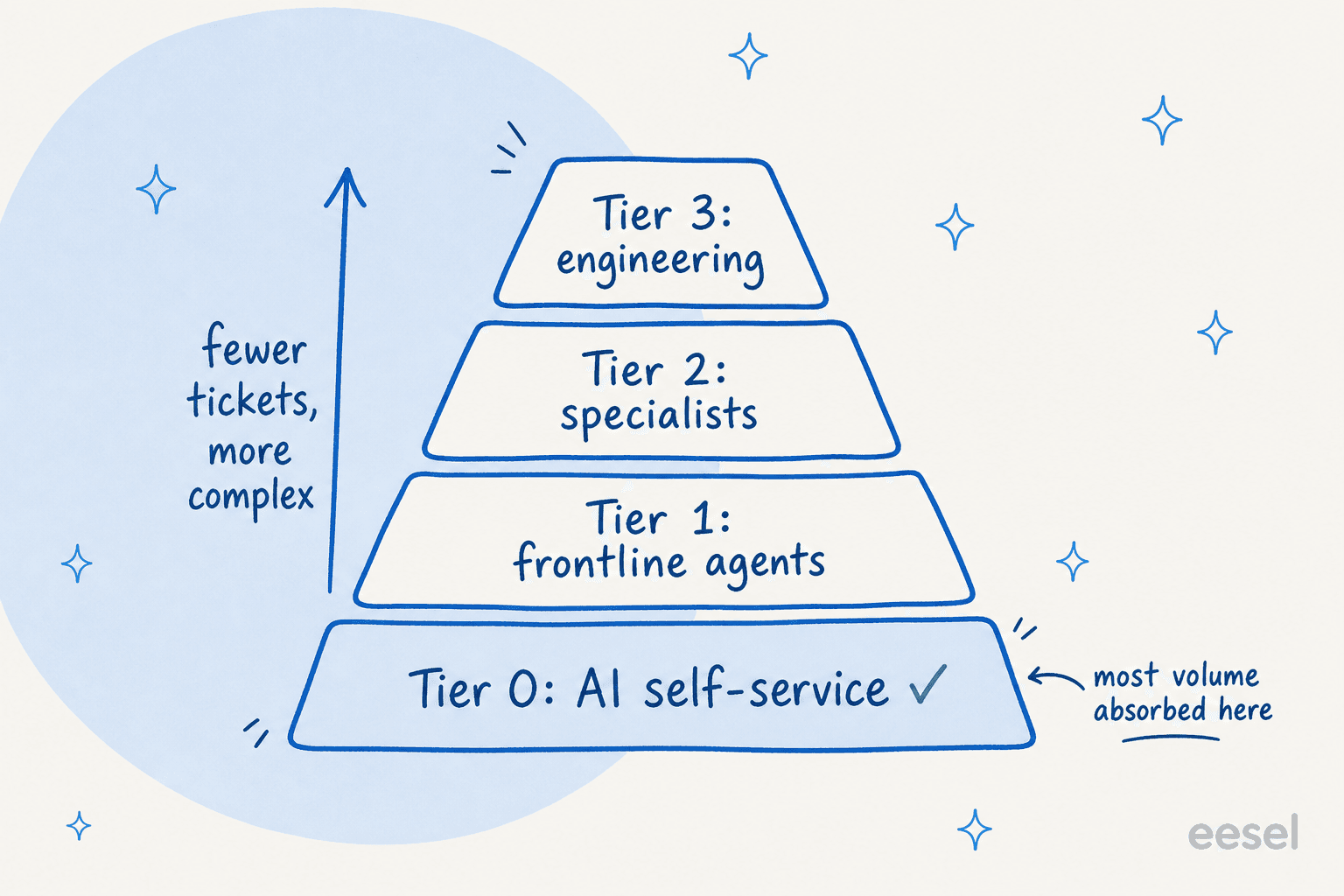
The base layer of self-service and AI absorbs the largest share of repetitive volume, so only the harder, fewer cases climb to frontline agents, specialists, and finally engineering. Keeping that base wide is what stops ticket growth from swamping the people at the top.
How customer support works
A support operation usually runs the same loop on every request:
- Intake. A question arrives through email, chat, phone, or social and lands in a helpdesk as a ticket.
- Triage. The request is understood, prioritized, and routed to the right agent or queue.
- Resolve. An agent answers using a shared knowledge base, takes any needed action, and closes the loop with the customer.
- Escalate when needed. Anything complex or high-stakes goes to a specialist or a manager with context attached.
This loop is where automation now removes the most drudgery. A support agent like eesel AI plugs into the helpdesk, reads each incoming ticket, resolves the repetitive ones instantly from your help center and past tickets, performs allowed actions like tagging or order lookups, and escalates the rest to a person cleanly. Through support automation, the predictable volume clears itself and agents focus on the cases that need a human.
Customer support in practice
The core tension in customer support is volume versus quality: as a company grows, tickets grow faster than the team, and the usual fixes, hire more agents, write more macros, push response-time targets, all have limits. The teams that stay ahead treat their knowledge base as the single source agents and AI both answer from, automate the questions that arrive over and over, and reserve their people for the conversations where judgment, empathy, or a hard decision actually matters.
We go deeper on this in our customer support automation guide.
Clear the support queue faster
eesel AI resolves repetitive tickets in your helpdesk and escalates the rest, so your support team keeps up as volume grows.