Ticket deflection
The practice of resolving a customer's question before it becomes a tracked support ticket, usually through self-service content or an automated answer.
What ticket deflection means
Ticket deflection is the practice of resolving a customer's question before it ever becomes a tracked support ticket, typically through self-service content or an automated answer. The goal is not to push customers away but to answer them at the point of need, so the question is settled without a person in the support queue ever touching it. A well-deflected question and a closed ticket end the same way for the customer, with an answer, but only one of them ever reached an agent.
In customer support, deflection happens at the front door: a help center article that ranks for the customer's search, a chat widget that answers instantly, or an AI agent that replies in the channel. Every truly deflected question is one an agent never has to handle, which is why deflection is one of the most direct levers on support cost and capacity.
Why ticket deflection matters
Deflection is worth getting right because it:
- Reduces handled ticket volume, freeing agents to spend their time on the complex cases that actually need a person.
- Cuts cost per resolved question, since an automated or self-service answer costs a fraction of an agent-handled ticket.
- Gives customers an instant answer, which most people prefer to waiting in a queue for a reply they could have gotten in seconds.
- Scales with demand, absorbing spikes without proportional hiring, because a self-service answer serves a thousand people as easily as one.
- Exposes documentation gaps, since the questions that fail to deflect point straight at what is missing or unclear in your knowledge base.
The catch is that deflection only counts when the customer is actually helped. A customer who abandons the chat in frustration is not a deflected ticket, even if the dashboard records it that way.
It helps to picture where the incoming questions actually go once they hit the front door.
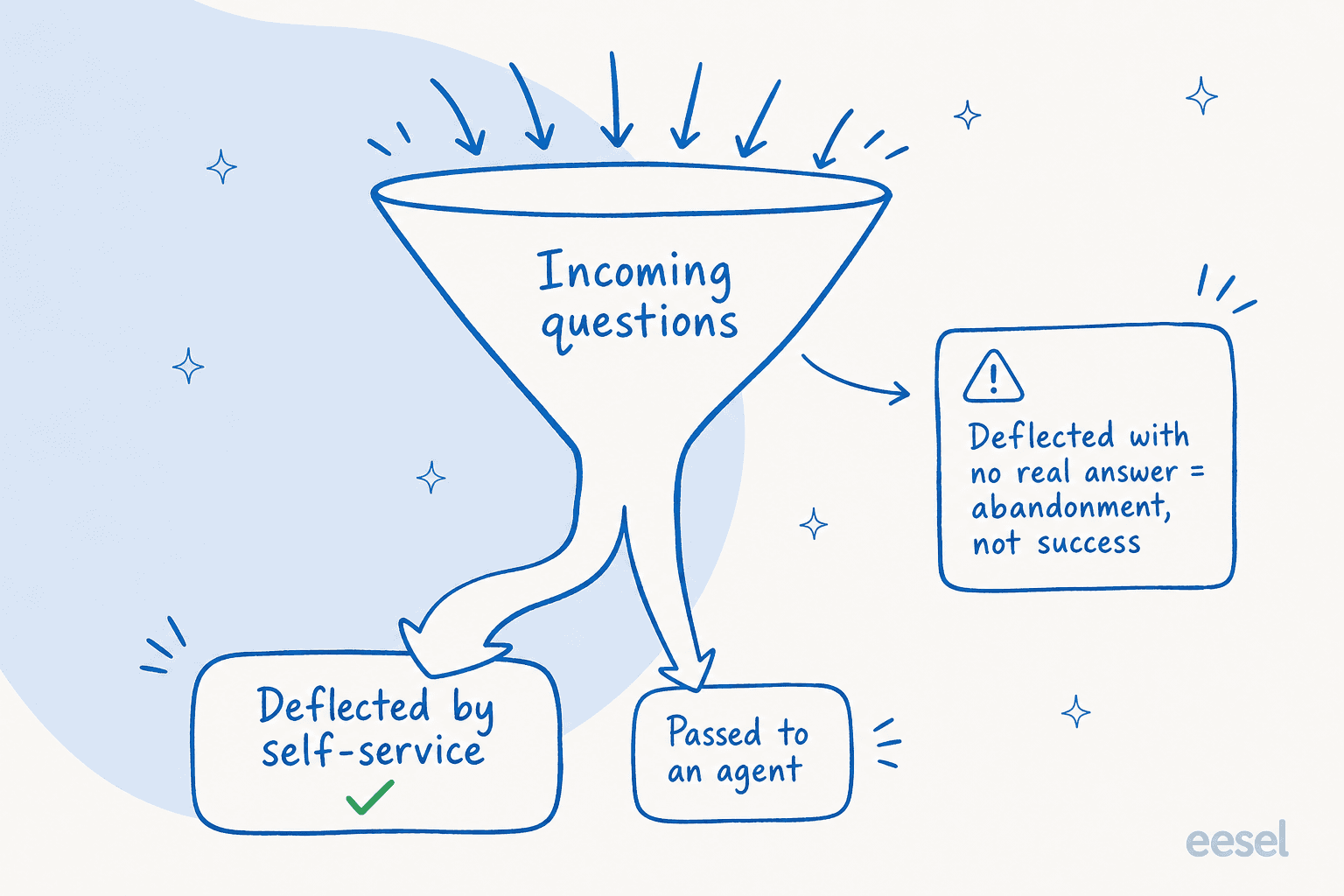
Incoming questions funnel down and split: the well-documented ones get deflected by self-service, the rest pass through to an agent. The trap is the side note: a question that exits without a real answer is abandonment dressed up as a deflection win.
How ticket deflection works
A modern deflection flow usually runs like this:
- Intercept the question early. The customer asks in search, the help widget, or a chat channel before opening a formal ticket.
- Understand what they need. The system interprets the question rather than keyword-matching, so it can find the right answer.
- Answer from trusted knowledge. It retrieves the relevant article, policy, or steps and gives a direct response.
- Escalate the rest. If there is no confident answer, it hands the customer to a person with context attached, so nothing falls through.
An AI agent like eesel AI deflects by grounding every answer in your help center and past tickets, replying instantly when it has a confident match and escalating cleanly when it does not. Because it can be tested against historical tickets first, you can see roughly how much it will deflect before it ever talks to a customer.
Ticket deflection in practice
The number that gets quoted in deflection demos is almost always the optimistic one, and the operator's job is to find the honest one underneath it. A deflection program lives or dies on whether the deflected questions were truly resolved, so the metric worth trusting pairs deflection rate with a satisfaction check on those deflected interactions. The healthiest approach is to deflect the well-documented, repetitive questions confidently, route everything ambiguous to a person, and keep widening the deflected set only as the knowledge base catches up. Deflection that outruns its documentation does not save tickets, it just delays them.
Want the full playbook? See our guide to ticket deflection.
Deflect tickets with grounded answers
eesel AI answers customer questions from your own knowledge before they reach the queue, and escalates the ones that need a person.