Customer self-service
Support resources that let customers find answers and resolve their own issues without contacting a human agent.
What customer self-service means
Customer self-service is the set of support resources that let customers find answers and resolve their own issues without contacting a human agent. It covers anything a person can use on their own: a help center, FAQ pages, a knowledge base, a community forum, a status page, an account portal, or an AI assistant that answers questions directly.
The core idea is to put the answer where the customer already is, at the moment they have the question, rather than routing every question through a queue. In customer support, self-service is the first line: it handles the high-volume, well-documented questions so the support team can spend its time on the issues that actually need a person.
Why customer self-service matters
Self-service earns its place because it works on several fronts at once:
- It scales without headcount. A single help article or AI answer can resolve the same question for thousands of customers at no extra cost per use.
- It is available instantly, around the clock, with no wait time, which matters most for simple, urgent questions.
- It deflects tickets, so the volume reaching agents drops. This is measured as deflection rate.
- It lowers effort for common issues, since a quick answer beats opening a ticket and waiting for a reply.
- It frees agents to focus on complex, high-stakes, or emotional cases where human judgment is worth the most.
Not every self-service channel asks the same amount of the customer, which is worth keeping in mind when you decide where to point them.
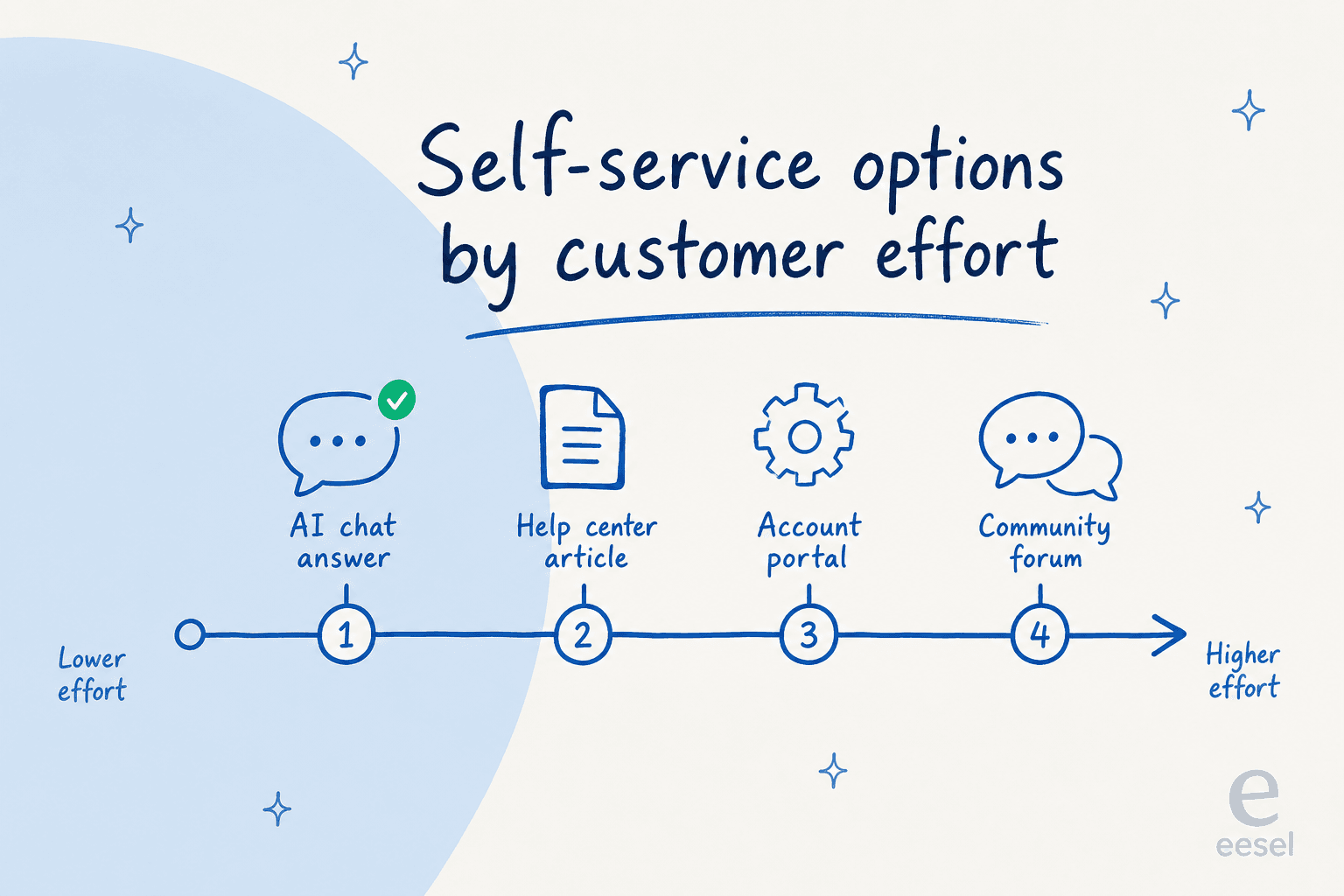
An AI chat answer asks the least of the customer because it reads the question and replies directly, while a community forum sits at the high-effort end where the person has to ask and wait. Help center articles and account portals fall in between, useful but reliant on the customer finding and navigating them.
How customer self-service works
A self-service system generally works in a few moves:
- Capture knowledge. The team documents answers in a knowledge base, help center, or FAQ.
- Make it findable. Customers reach answers through search, in-product help, or a chat widget.
- Match question to answer. The customer describes their issue and the system surfaces the relevant content.
- Resolve or escalate. If the answer solves it, the ticket never opens; if not, the customer is handed to a human.
AI has reshaped step three. Instead of relying on the customer to find the right article, an agent like eesel AI reads the question in plain language, pulls the answer from your help center and past tickets, and replies directly, escalating to a person only when it is not confident. That turns a static help center into something that actually answers.
Customer self-service in practice
Self-service only works if the content behind it is good and kept current, which is the part teams most often underinvest in. A help center full of stale or thin articles deflects nothing and frustrates everyone. The teams that get real value treat their knowledge as a living asset, watch which questions still slip through to agents, and feed those gaps back into the content (or the AI agent's sources) so the self-service layer keeps closing more of the queue over time.
Want the full playbook? See our guide to improving self-service with AI.
Power self-service with an AI agent
eesel AI answers customer questions directly from your help center and past tickets, so people resolve issues without waiting for an agent.