AI chatbot
A software application that uses artificial intelligence to hold a natural-language conversation, understanding what a user means and generating a relevant reply.
What an AI chatbot means
An AI chatbot is a software application that uses artificial intelligence to hold a natural-language conversation, understanding what a user means and generating a relevant reply. Unlike a scripted bot that only recognizes pre-set phrases or menu choices, an AI chatbot interprets free-form language and composes original responses, so it can handle questions it was never explicitly programmed for. Most current AI chatbots are built on a large language model that supplies the language understanding and generation.
In customer support, an AI chatbot is the conversational front door for a lot of teams. A customer types a question the way they would ask a person, and the chatbot understands the intent, finds the relevant information, and replies in plain language. The better implementations do not just answer in the abstract, they answer from the company's own help center, product docs, and policies, so the response reflects how that specific business actually works.
What makes an AI chatbot different
An AI chatbot differs from earlier conversational tools in concrete ways:
- It understands intent, not keywords. It works out what a customer is asking even when the wording is messy or indirect, instead of matching to a fixed phrase list.
- It generates answers rather than retrieving a canned response, so it can phrase a reply to fit the specific question.
- It handles multi-turn context. It remembers what was said earlier in the same conversation and uses it, rather than treating each message as isolated.
- It can be grounded in your knowledge. Connected to a knowledge base and ticket history, it answers from your facts instead of generic web text.
- It improves without rebuilding flows. Adding new knowledge updates what it can answer, with no engineer hand-coding a new decision branch.
The practical upshot is that an AI chatbot covers the long tail of questions a scripted flow would simply miss.
The contrast with an older scripted bot is sharpest when you line the two up trait by trait.
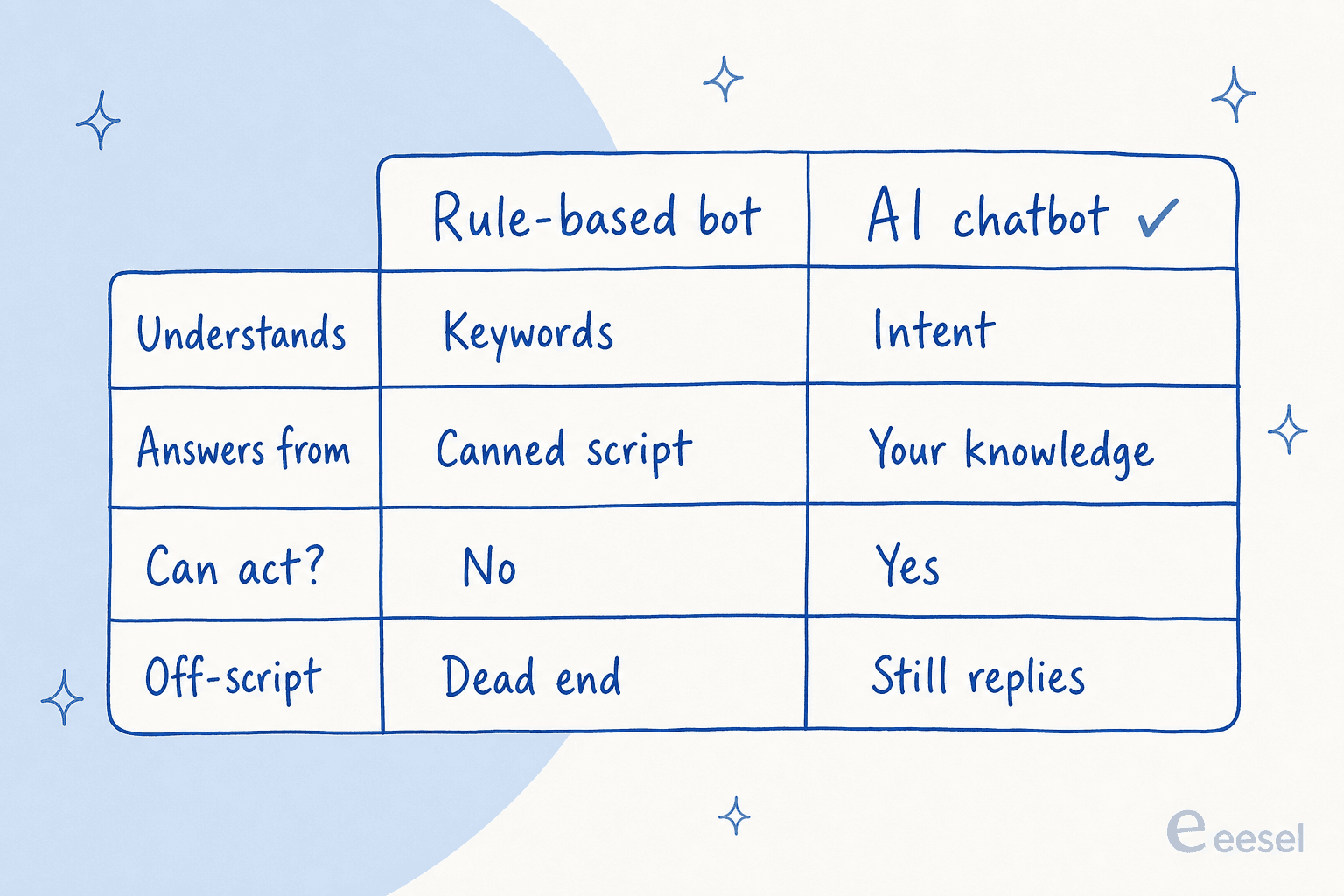
Where a rule-based bot matches keywords, reads from a canned script, cannot act, and hits a dead end off-script, an AI chatbot interprets intent, answers from your knowledge, can take actions, and still replies to questions nobody pre-wrote a flow for.
How an AI chatbot works
A grounded AI chatbot in support typically runs this loop:
- Read the message. It interprets the customer's question and works out intent.
- Retrieve knowledge. It searches your help center, docs, and past tickets for the relevant facts, the retrieval step behind RAG.
- Compose a grounded reply. It generates an answer tied to that retrieved content rather than guessing from general training.
- Act or escalate. Where it can, it takes the action the request implies, otherwise it hands off to a human with context.
A support chatbot like eesel AI works exactly this way: it trains on your existing knowledge, grounds every answer in your own content, and escalates to a person when there is no safe answer. It can also be simulated against historical tickets first, so you see how it would have answered real customers before it goes live.
AI chatbots in practice
The line between a helpful AI chatbot and a frustrating one is almost always grounding and guardrails. A chatbot answering from your real knowledge with a clean escalation path resolves questions quickly and builds trust. A chatbot left to improvise from general training data will eventually answer confidently and wrongly, which is worse than no answer at all. The teams that get the most value scope the chatbot to a well-documented set of questions, prove its accuracy against real history, and widen its reach once it has earned it.
An AI chatbot that actually resolves tickets
eesel AI is an AI chatbot that answers from your own knowledge, takes actions in your helpdesk, and escalates when it is unsure.