Abandonment rate
The percentage of customers who leave a support queue, chat, or call before reaching an agent or getting an answer.
What abandonment rate means
Abandonment rate is the percentage of customers who leave a support interaction, a phone queue, a live chat, or a callback line, before reaching an agent or getting an answer. It is calculated by dividing the number of abandoned interactions by the total number that entered the queue, then multiplying by 100. A call that drops while the caller is on hold, or a chat the visitor closes before anyone replies, both count as abandoned.
In customer support, abandonment rate is a direct read on patience versus wait time. Every abandoned interaction is a customer who needed help, decided the wait was not worth it, and left, which means the metric measures lost resolutions and, often, lost goodwill. It is one of the clearest signals that a queue is moving too slowly for the demand hitting it.
Why abandonment rate matters
Abandonment rate is a small number that points at several larger problems:
- It exposes staffing gaps. A rising rate usually means demand is outrunning the agents available to handle it.
- It quantifies lost help. Each abandoned interaction is a request that went unresolved, which can resurface later as a repeat contact or a complaint.
- It tracks with wait time. Abandonment climbs as first response time and hold times grow, so it is an early warning that the support queue is backing up.
- It hides in channel averages. A blended number can look fine while phone abandonment is painful, which is why it is measured per channel.
- It correlates with effort and churn. A customer forced to wait and then give up records a high customer effort score, and high-effort experiences are a known driver of churn.
The reason the metric is so sensitive is that abandonment is not linear, it hugs the floor while waits are short and then spikes once patience runs out:
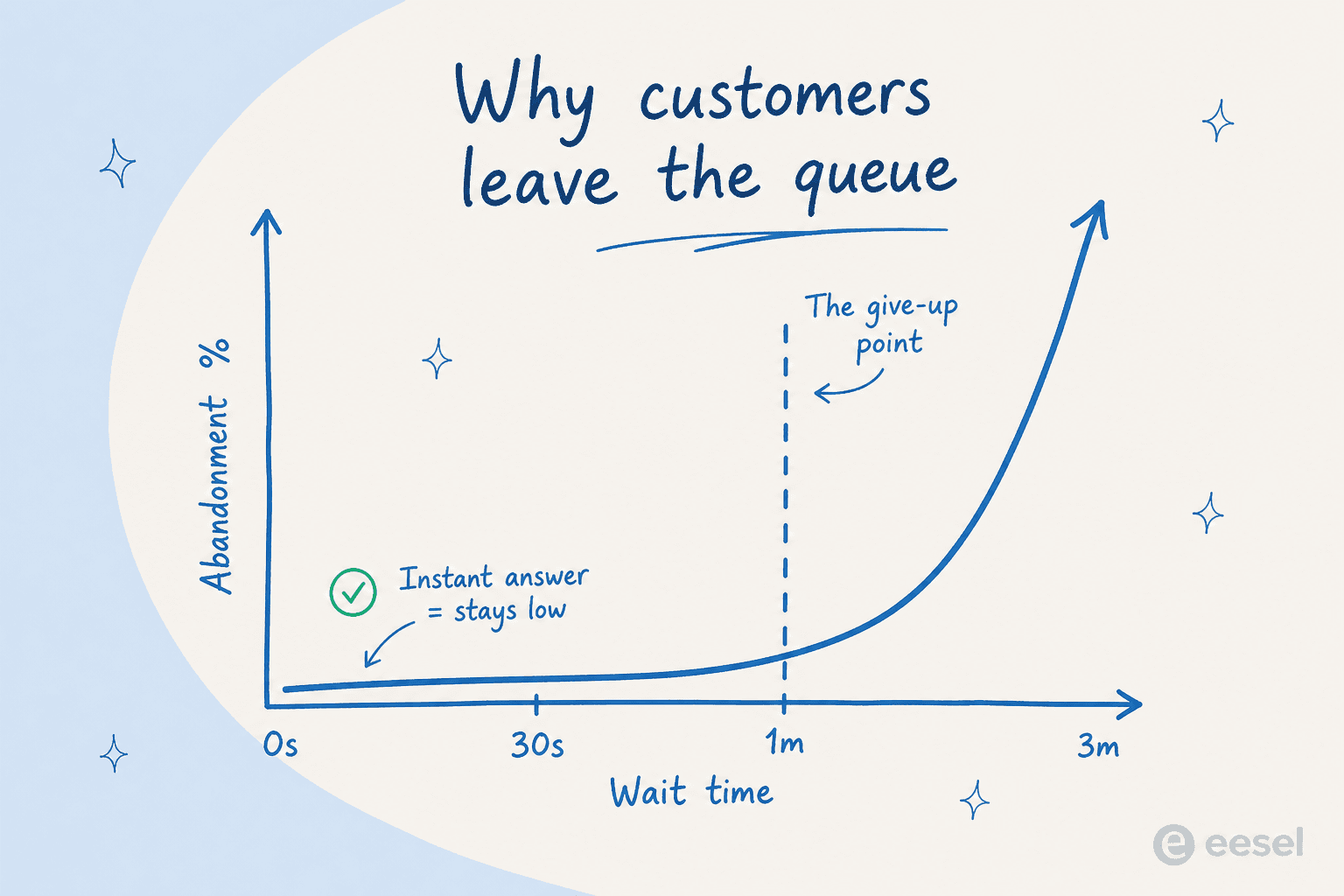
Most customers will tolerate a brief wait, so abandonment barely moves at first. Past a give-up point, though, the curve bends sharply upward and a small jump in wait time produces a large jump in abandonment. That is why shaving seconds off the front of the queue, or removing the wait entirely, pays off so disproportionately.
How abandonment rate works
Tracking and acting on abandonment follows a straightforward path:
- Measure per channel. Count abandoned interactions against total interactions for phone, chat, and any callback line separately.
- Find the threshold. Look at how long customers wait before they tend to leave, which is the window you have to respond.
- Attack the wait. The fix is almost always speed: more capacity, better routing, or automation that answers instantly.
- Deflect routine demand. Resolve the simple, repetitive requests before they queue, so agents are free for the cases that need them.
- Recheck. Watch the rate after each change to confirm the wait actually shortened.
The most durable lever is removing the wait entirely for requests that do not need a human. An AI support agent like eesel AI replies instantly across chat and email and resolves routine requests on its own, grounding answers in your help center and past tickets. That keeps customers from ever sitting in a queue for the questions it can handle, and leaves a shorter line for the cases that do need a person.
Abandonment rate in practice
A high abandonment rate is rarely a customer problem, it is a capacity problem wearing a customer's frustration. Adding agents helps but scales linearly and slowly; the faster move is to take the predictable, high-volume requests out of the queue so the wait shrinks for everyone left in it. The teams that hold abandonment low treat it as a leading indicator, watching it climb during a spike and intervening before the customers who left quietly become the reviews that did not.
Answer before the customer gives up
eesel AI replies instantly across channels and resolves routine requests on its own, so fewer customers abandon the queue waiting for help.