Ticket volume
Ticket volume is the total number of support requests a team receives over a given period, used to size workload, staffing, and demand.
What ticket volume means
Ticket volume is the total number of support requests a team receives within a defined period, such as a day, a week, or a month. It is a raw count of demand: every email, chat, form submission, or call that becomes a tracked request adds to it. On its own it says nothing about how well those requests are handled, only how many there are, which makes it the baseline figure most other support planning is built on.
In customer support, ticket volume is the number you size everything else against: staffing, scheduling, tooling, and budget all flow from how many requests are expected to land. It is usually segmented by channel and topic so teams can see not just how much is coming in but where it is coming from and what it is about.
Why ticket volume matters
- It drives staffing and scheduling. Headcount, shift coverage, and overtime decisions all start from forecasted volume, so a bad forecast means either burned-out agents or idle ones.
- It is rarely flat. Volume spikes around product launches, billing cycles, outages, and seasonal peaks, so the average hides the days that actually break the queue.
- Its composition matters as much as the count. A large share of volume is repetitive, answerable questions, which is the part automation and self-service can absorb.
- It feeds cost per ticket. Total support cost divided by volume gives cost per ticket, so reducing avoidable volume directly improves unit economics.
- It is a product signal, not just a support signal. A sudden spike in tickets about one feature is often the fastest read on a bug or a confusing change, before any other metric catches it.
Plotted over time, that "rarely flat" point becomes obvious, and so does why an average can mislead you:
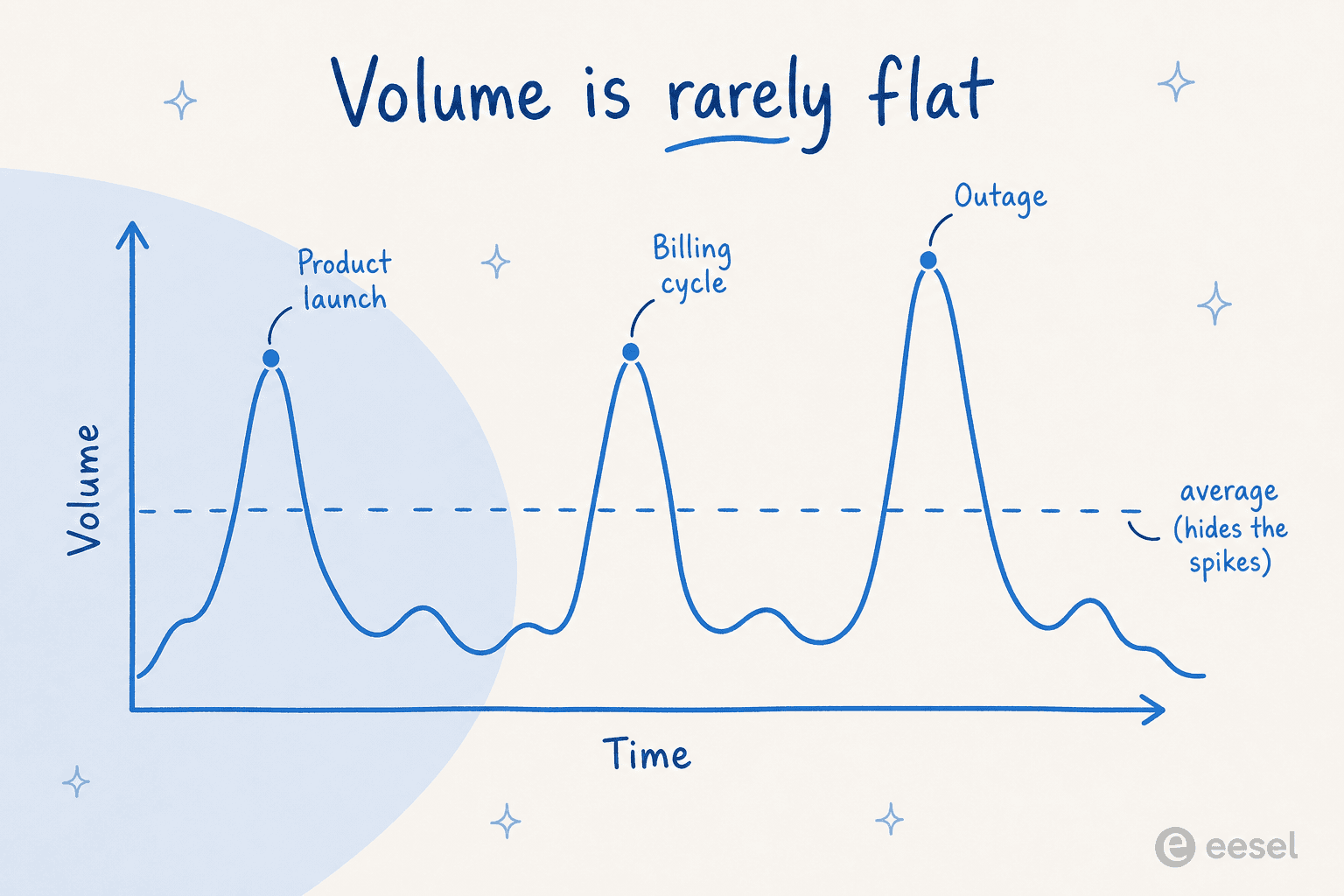
Launches, billing cycles, and outages each throw their own spike, and the days that actually break the queue sit far above the flat average line. Staffing to the average leaves the team underwater on exactly the days that matter most.
How to manage ticket volume
Managing volume usually means working two levers at once:
- Measure and segment it. Count incoming requests per period, then break them down by channel and topic to find the high-frequency, repetitive categories.
- Deflect what is answerable. Strengthen the knowledge base and self-service so customers can resolve common questions before they ever open a ticket.
- Automate the repetitive remainder. Hand the high-frequency tickets that still come in to an AI agent that can resolve them end to end.
- Fix root causes. Feed recurring ticket themes back to product and operations so the underlying issue stops generating tickets.
A support agent like eesel AI works on steps two and three: it answers the repetitive, well-documented questions automatically, so the volume that reaches a human is the volume that actually needs one. That reshapes the queue from a flat wall of tickets into a smaller set of genuinely novel or sensitive ones.
Ticket volume in practice
The instinct when volume rises is to add agents, but raw headcount is the most expensive and slowest lever there is. The more durable move is to ask what fraction of volume is avoidable: tickets that a clearer help article, a fixed bug, or an automated resolution would have prevented. Teams that treat volume as a fixed input staff endlessly against it; teams that treat it as something to actively shrink at the source end up with a smaller, more interesting queue and a lower cost per ticket at the same time.
For a hands-on walkthrough, read reduce ticket volume with AI.
Take the repetitive volume off the queue
eesel AI resolves the high-frequency, repetitive tickets automatically, so human agents only see the volume that needs them.