AI content generation
The use of generative AI models to produce written, visual, or audio content from a prompt, brief, or set of source material.
What AI content generation means
AI content generation is the use of generative AI models to produce written, visual, or audio content from a prompt, brief, or set of source material. The model predicts and assembles content one piece at a time based on patterns learned during training, so a short instruction can expand into a full article, image, or script. The output is original in the sense that it is newly assembled, not copied, though its quality depends entirely on the prompt, the model, and the source material it is given.
In content marketing and SEO, AI content generation usually means turning a topic, keyword, or brief into a draft blog post, landing page, or set of metadata. It removes the blank-page step and the bulk of first-draft writing, leaving the human work of angle, accuracy, and voice. The same idea covers ad copy, social posts, email sequences, and product descriptions produced at scale.
What makes AI content generation different
Earlier content tooling rearranged or spun existing text. Modern generation is a step change because it can:
- Write from a brief, not a template, producing a full draft that follows a specified structure, tone, and keyword set rather than filling slots in a fixed format.
- Ground output in real sources when connected to research, so the draft cites facts instead of inventing them, which lowers the rate of AI hallucination.
- Scale to many pages at once, which is what makes programmatic SEO and large content refreshes practical for small teams.
- Adapt voice and reading level on request, matching a brand's tone of voice instead of producing one generic register.
- Handle the research step, pulling and summarizing source material before drafting, so the writer starts from synthesized facts rather than a blank tab.
Part of the breadth is that the same brief can feed very different formats.
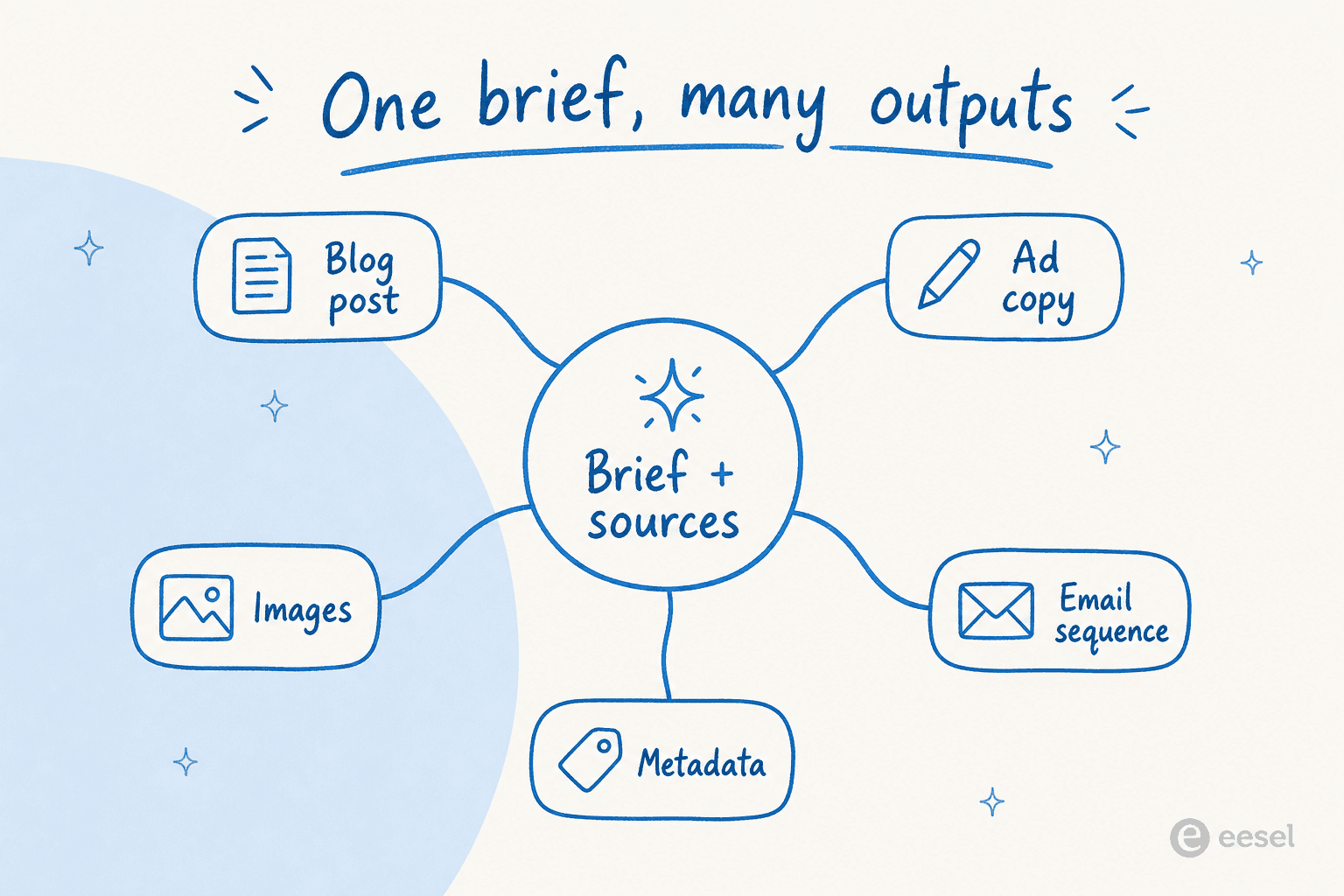
A single brief plus its sources can branch into a blog post, ad copy, images, an email sequence, or metadata. That is why content generation is a category rather than a single tool, and why the brief at the center matters more than any one output.
How AI content generation works
Most content-generation tools run a version of the same flow:
- Take the brief. A topic, keyword, target reader, and structure go in as the instruction.
- Gather sources. Stronger tools research the topic first, pulling real pages and data so the draft is grounded rather than generated from memory.
- Draft. The model writes the content section by section, following the brief's structure and tone.
- Refine. It tightens, reformats, or rewrites passages on instruction, and a human edits for accuracy and voice.
The eesel AI blog writer follows this pattern for long-form SEO content: it researches a topic, drafts a structured post grounded in real sources rather than the model's memory, and produces something an editor finishes rather than a wall of unsourced text. That grounding step is what separates content worth publishing from output a reader bounces off.
AI content generation in practice
The model is rarely the bottleneck. The quality of an AI-generated piece tracks the quality of the brief and the sources behind it far more than the size of the model. Teams that get value treat generation as the draft engine inside an editorial process: a tight brief, real source grounding, a human pass for accuracy and experience, and a check that the result is more useful than the ten pages already ranking for the term. Output that skips those steps is the kind that erodes trust and, eventually, rankings.
Want the full playbook? See our guide to AI content creation.
Generate content grounded in real sources
eesel AI researches a topic, drafts a long-form SEO post grounded in real sources, and keeps the byline yours.