Content brief
A document that tells a writer what a piece of content should cover, including topic, target keyword, audience, structure, and angle.
What a content brief means
A content brief is a document that tells a writer what a piece of content should cover, including the topic, target keyword, intended audience, structure, and angle. It is the instruction set for a single post: not the post itself, but everything a writer needs to produce the right post on the first try. A good brief turns a vague assignment ("write something about X") into a specific one ("write a 1,500-word how-to for first-time buyers, targeting this keyword, structured these five ways, that differs from the top result by Y").
In content marketing and SEO, the brief is where strategy meets the page. It aligns the writer with search intent before a word is written, which is what keeps a draft on-topic and prevents the expensive rework of a piece that missed the point. It typically grows out of keyword research and an analysis of what already ranks.
What a content brief should include
A brief earns its place by being specific. The strong ones cover:
- The target keyword and variants, plus the search volume and difficulty that justify writing the piece at all.
- The search intent, so the format matches what the searcher actually wants, a listicle, a how-to, a comparison, or a definition.
- A suggested structure, with the headings and key points that the top-ranking pages cover and that this piece must address to compete.
- The angle, the single most overlooked part: how this post differs from the ten already ranking, not just what it repeats.
- On-page details, including internal links to place, metadata direction, and a target word count.
It helps to picture a brief as layers wrapped around the bare outline at its core.
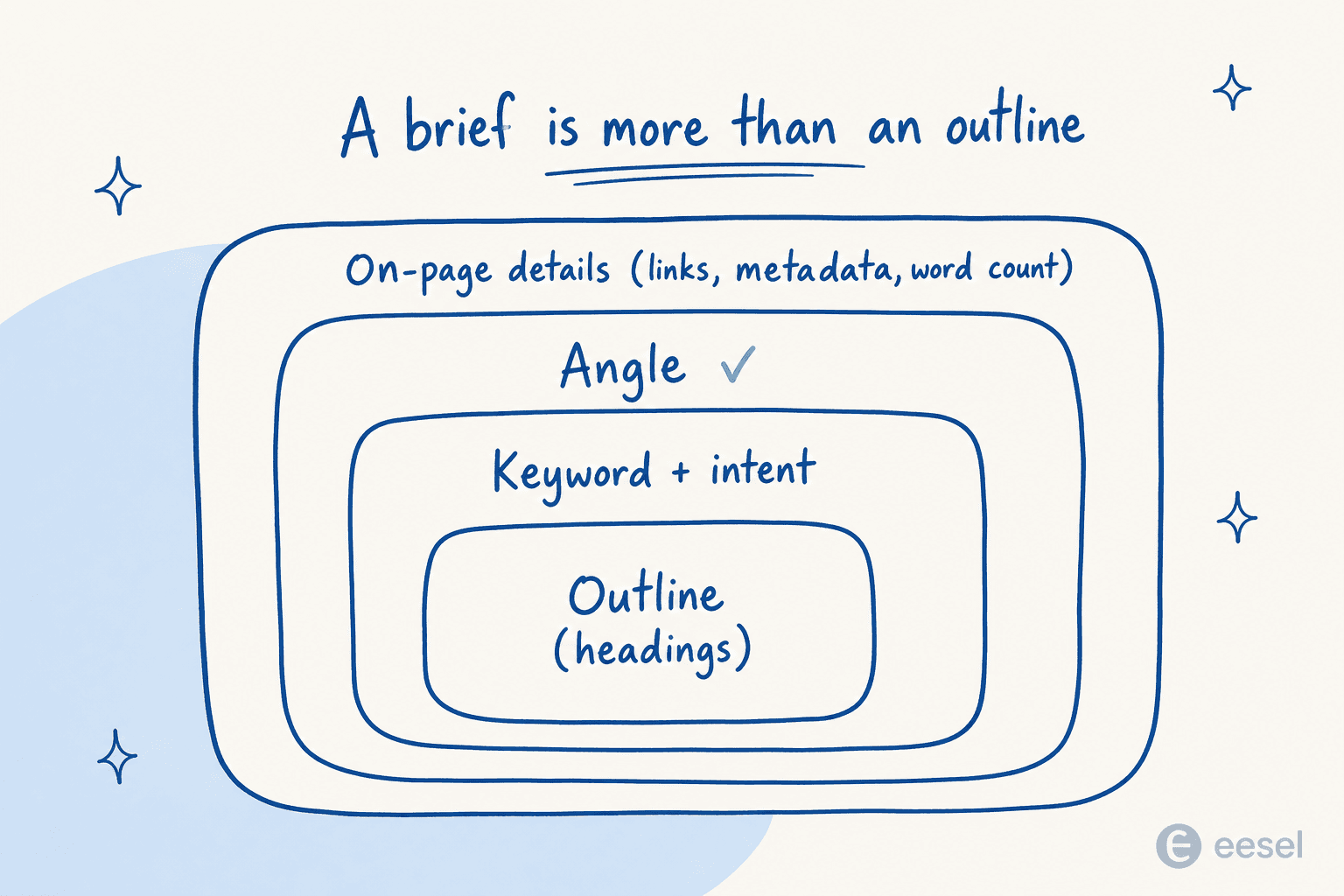
The headings sit in the middle, then keyword and intent wrap them, the angle wraps that, and on-page details form the outer band. An outline is only the innermost layer, which is why a brief carries far more decision-making than a list of headings.
How a content brief works
In practice, a brief moves a post from idea to draft like this:
- Pick the keyword. Research surfaces a term worth targeting and the intent behind it.
- Analyze the competition. The pages already ranking reveal the structure, depth, and points readers expect.
- Write the brief. Structure, angle, key points, and on-page details are captured in one document.
- Draft against it. The writer, or an AI tool, produces the post following the brief.
This is where an AI tool and a brief work together. The eesel AI blog writer takes a brief as its input, researches the topic, and drafts a structured post grounded in real sources, so the quality of the output tracks the quality of the brief far more than the size of the model. A sharp brief produces a draft worth editing; a vague one produces generic text no matter the tool.
A content brief in practice
The brief is the cheapest place to fix a post, before it is written, so it is worth more attention than it usually gets. The most common failure is a brief that lists what to cover but never states the angle, which produces a competent draft that says nothing the existing results do not already say. Teams that rank treat the brief as the moment to decide why this page deserves to exist, then let the writing be the easy part.
Want the full playbook? See our guide to AI content briefs.
Turn a brief into a draft
eesel AI takes a content brief, researches the topic, and drafts a structured post grounded in real sources.