Listicle
A listicle is an article structured as a numbered or bulleted list, where each item is a self-contained entry under its own heading.
What a listicle means
A listicle is an article structured as a list, where the main body is a numbered or bulleted sequence of items, each presented as a self-contained entry under its own heading. The format is signaled in the title ("7 best project tools", "10 ways to cut response time"), and the reader can scan the list, jump to the item they care about, or read straight through. The word is a blend of "list" and "article", and it describes structure, not quality: a listicle can be a shallow filler piece or a deeply researched comparison.
In content marketing and SEO, the listicle is one of the most durable formats because it maps cleanly onto how people search. A large share of queries are implicitly list-shaped ("best", "top", "alternatives to"), and a well-built listicle answers that intent directly while being unusually easy to skim. That combination of matched intent and high scannability is why roundups and "best of" pages are a staple of almost every content program.
Why listicles work
Listicles persist as a format because they line up with both reader behavior and search mechanics. They:
- Match list-style search intent, answering the "best X" and "X ways to Y" queries people actually type.
- Skim cleanly, since consistent headings let a reader scan the list, compare items, and jump to the one they want.
- Compete for the featured snippet, because a clear ordered or unordered list is exactly what search engines pull into list-format snippets.
- Set clear expectations, where a numbered title promises a defined scope and the reader knows what they are getting before they click.
- Support a comparison table, the artefact buyers screenshot, by giving every item the same set of dimensions to line up against.
What separates a roundup that ranks from one that gets ignored is rarely the format itself, it is how much is packed into each item. Setting the two side by side makes the gap obvious.
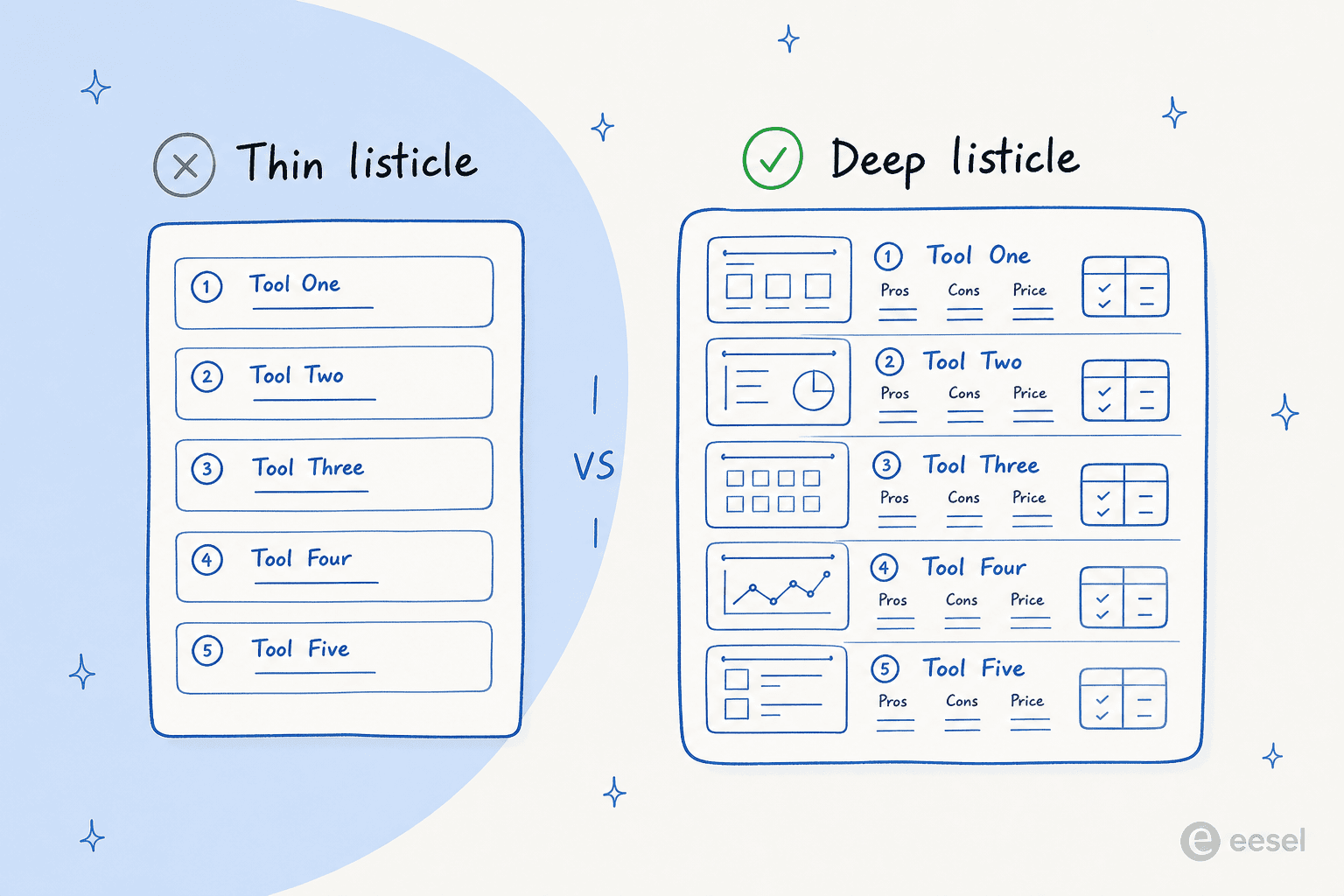
A thin listicle names options with a line each and reads as filler, while a deep one gives every entry a screenshot, the same pros, cons, and pricing template, and a summary table to compare across. The structure is identical; only the depth tells a reader whether the writer actually evaluated the tools.
How a listicle works
A strong listicle follows a repeatable structure:
- Define the angle and scope. Decide what the list is ranking or rounding up, and the criteria each item must meet.
- Research and select the items. Evaluate candidates against real sources, then cut to an honest set rather than padding to a round number.
- Apply one item template. Give every entry the same sub-sections (features, pros, cons, pricing, verdict) so readers can scan across them.
- Add a summary table. Line the items up on shared dimensions for the buyer who wants the answer at a glance.
- Write the intro and verdict. Frame who the list is for and who each option suits best.
An AI blog writer like eesel AI fits this pattern by researching each item against primary sources before drafting, so a listicle reads like genuine evaluation with consistent depth per entry, rather than a quick rewrite of someone else's top-ten.
Listicles in practice
The difference between a listicle that ranks and one that gets ignored is almost entirely depth and honesty. A reader can tell within two items whether the writer actually used the products or just paraphrased marketing pages, and search engines increasingly reward the former. The discipline is to keep the template identical across every item, so if item one has a pricing sub-head, item seven does too, and to cut a weak option rather than pad the count. A tight, well-researched list of five beats a thin list of fifteen on both trust and rankings.
For a hands-on walkthrough, read our take on listicle blog writing.
Draft listicles that hold up
eesel AI researches each item against real sources and drafts a structured listicle, so a roundup reads like analysis rather than a thin top-ten.