Long-form content
Long-form content is in-depth written content, usually well over a thousand words, that covers a topic thoroughly rather than briefly.
What long-form content means
Long-form content is in-depth written content that covers a subject thoroughly, typically running well past a thousand words and often several times that. It is defined less by a strict word count than by intent: a long-form piece aims to be the complete resource on its topic, addressing the main question along with the related sub-questions, edge cases, and context a reader would otherwise have to hunt down across several pages. Comprehensive guides, in-depth comparisons, detailed how-tos, and pillar pages are typical examples.
In content marketing and SEO, long-form earns its place because depth tends to match more of what searchers actually want. A thorough page can answer a primary query and dozens of long-tail variations on the same URL, it gives other sites more reason to link to it, and it signals expertise on the topic. The format is not automatically better than short content; it is the right choice when a topic truly warrants depth, and the wrong one when a query just needs a quick, direct answer.
Why long-form content matters
Long-form is a workhorse of serious content programs for reasons that compound over time. It can:
- Capture many queries at once, answering a head term plus the long-tail and follow-up questions around it on a single page.
- Build topical authority, since exhaustive coverage of a subject signals genuine expertise to readers and search engines.
- Earn more backlinks, because a definitive resource is the page people cite when they reference the topic.
- Anchor a topic cluster, often serving as the pillar page that ties shorter supporting articles together.
- Hold attention, where a well-structured deep piece keeps readers on the page longer than a thin one, a signal of usefulness.
Length is a judgment call, not a default. Plotting a topic against two questions, how much depth it really needs and how much demand it has, makes the call easier.
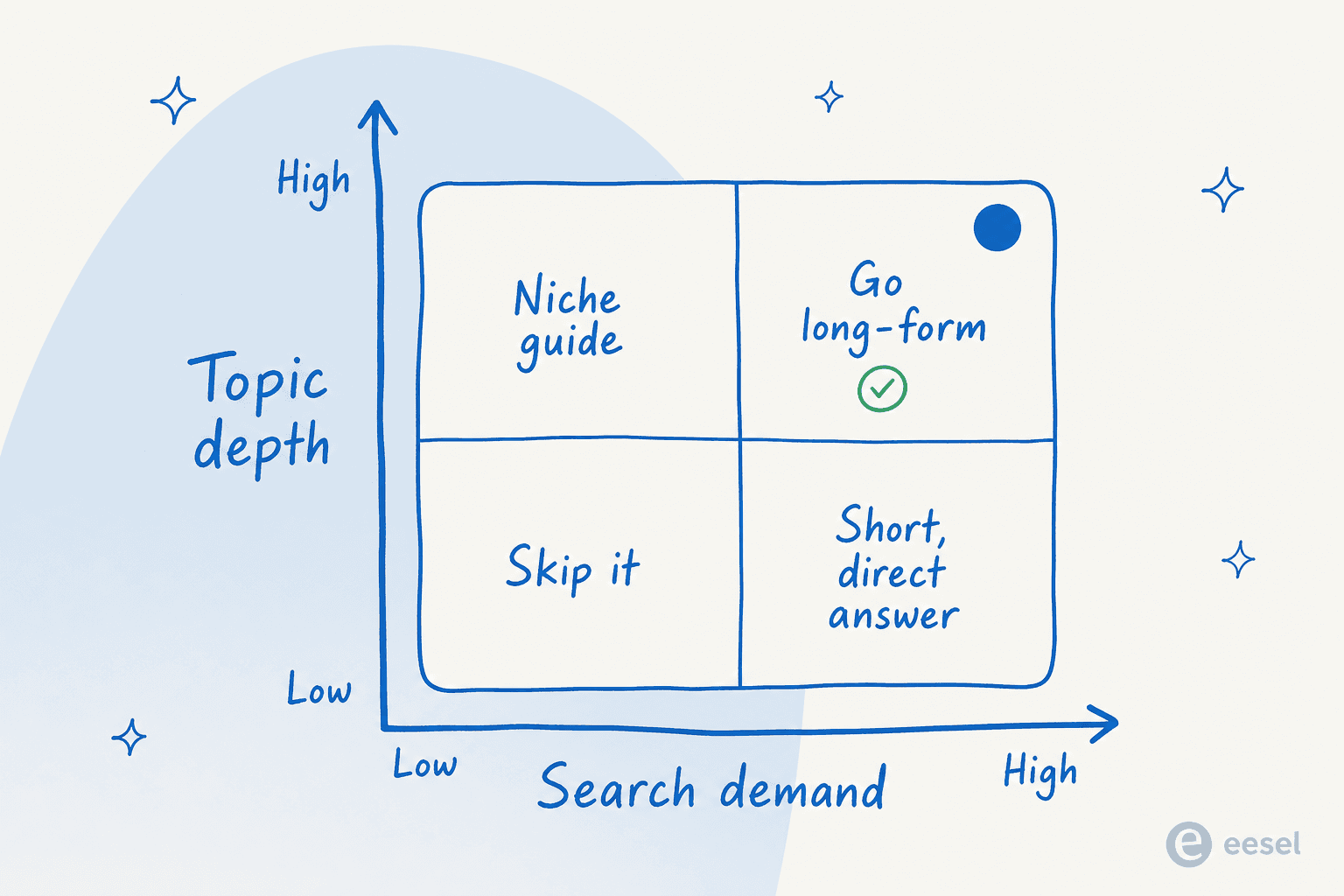
Long-form pays off in the top-right corner, where a topic both warrants depth and has real demand behind it. A high-demand but shallow query just needs a short, direct answer, and a deep topic almost nobody searches for is a niche guide at best. Mapping the topic before you commit keeps you from padding a thin subject to hit a word count.
How long-form content works
Producing long-form well follows a repeatable shape:
- Scope the topic fully. Map the main question and every sub-question, comparison, and objection a thorough reader would have.
- Research the sources. Gather primary and verifiable material so each claim is grounded rather than asserted.
- Structure for skimming. Use clear headings, a logical order, and visual breaks so depth does not become a wall of text.
- Write with substance per section. Make every section earn its length with specifics, not filler that pads the count.
- Maintain it. Refresh the piece as facts change, because a long-form asset is meant to last.
The obstacle is almost always production cost: a 3,000-word researched guide is slow to write at any volume. An AI blog writer like eesel AI helps by researching the topic and drafting a long, source-backed post, so a small team can publish in-depth pieces at a cadence a single writer could not match, then edit for voice and accuracy.
Long-form content in practice
The mistake is chasing word count for its own sake, which produces bloated pieces stuffed with restated points and obvious filler. Search engines and readers both punish that. The better instinct is to let the topic set the length: write until the subject is fully covered, then stop, even if that lands at 1,200 words rather than 3,000. The strongest long-form pieces are long because the topic demanded it, not because a brief specified a number, and they read as complete rather than padded.
We go deeper on this in our long-form AI blog writer guide.
Produce long-form without the slog
eesel AI researches a topic and drafts a long, source-backed post, so a team can publish in-depth content at a pace a single writer could not.