Evergreen content
Evergreen content is material that stays relevant and useful for a long time after publishing, drawing steady traffic without needing frequent rewrites.
What evergreen content means
Evergreen content is material that stays relevant and useful for a long time after it is published, continuing to attract readers without needing frequent rewrites. The name comes from evergreen trees that keep their leaves year-round: the value of the content does not fall away with the season. Typical examples are how-to guides, definitions, foundational explainers, and answers to questions people will keep asking regardless of the calendar year.
In content marketing and SEO, evergreen content is the opposite of time-bound work like news, launch announcements, or "best tools in 2026" lists that lose traffic the moment they age. Because an evergreen page answers a durable question, it can rank in search and earn backlinks for years, which makes it one of the highest-leverage things a content team can produce. The cost is paid once at writing, but the traffic compounds.
Why evergreen content matters
- It compounds instead of expiring. One well-made evergreen guide can keep ranking and pulling visitors long after a news post has gone to zero, so the return keeps growing against a fixed cost.
- It builds link equity over time. Durable reference pages are the ones other sites cite, which feeds domain authority and onward rankings.
- It anchors topic structure. Evergreen explainers are the natural hubs for a topic cluster, giving newer pages something authoritative to link back to.
- It is resistant, not immune, to decay. Even evergreen pages drift as facts change, so the maintenance load is low but never zero, which separates it from truly static content.
- It frees the calendar. A library of evergreen pages means the team is not on a treadmill of replacing traffic that vanished, and can spend effort on new ground instead.
One way to picture the difference is to plot common content types along a shelf-life axis, from the formats that decay almost immediately to the ones that keep earning for years.
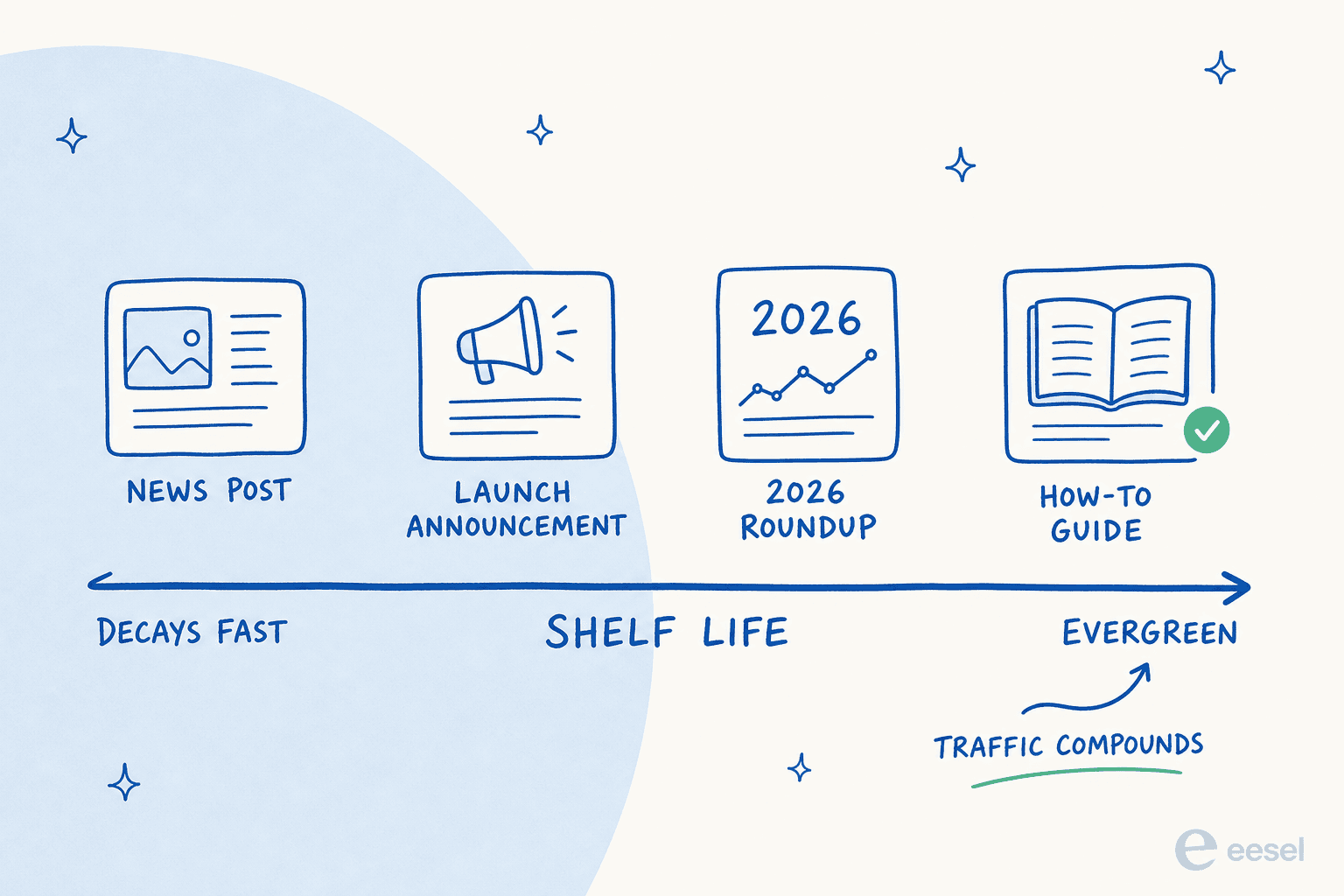
A news post or a dated "2026 roundup" sits on the left and loses traffic as it ages, while a how-to guide or definition sits on the right where the underlying question never expires. The further right a piece lands, the more its traffic compounds against a one-time writing cost.
How evergreen content works
- Find a durable question. Start from a topic with stable, ongoing search demand rather than a spike, often a "what is" or "how to" query that will still be asked next year.
- Answer it completely. Cover the question in enough depth that a reader does not need to leave, which is what earns the ranking and the links.
- Ground it in lasting facts. Lean on definitions, principles, and mechanisms over time-stamped specifics that age quickly.
- Schedule light upkeep. Revisit on a cadence to refresh examples, prices, and screenshots before they slip out of date.
A tool like eesel AI fits the writing step here: its blog writer researches a topic against real sources and drafts the kind of in-depth, structured guide that holds up over time, rather than a thin post that needs replacing in a quarter. The maintenance loop still belongs to the team, but producing the durable first draft at volume is what lets a library reach the size where evergreen traffic compounds.
Evergreen content in practice
The trap most teams fall into is treating evergreen as "publish and forget." The traffic is durable, the accuracy is not. A guide that ranked for two years can quietly start losing positions because a competitor refreshed theirs or because the underlying facts moved. The operators who get the most from evergreen content run a quiet refresh cycle: audit the top pages once or twice a year, fix what aged, and re-promote the ones that slipped. Done that way, an evergreen library behaves less like a set of articles and more like an asset that appreciates.
For a hands-on walkthrough, read evergreen blog writing.
Build an evergreen content library
eesel's AI blog writer drafts the in-depth, source-grounded guides that keep pulling traffic for years, so your library compounds instead of expiring.