Domain authority
A third-party score that predicts how well a whole website is likely to rank in search results, based mostly on its backlink profile.
What domain authority means
Domain authority is a third-party score, on a scale of roughly 1 to 100, that predicts how likely a website is to rank in search results compared with other sites. It was created by the SEO software company Moz, and similar metrics exist under other names, such as Ahrefs' Domain Rating. The score is calculated mostly from a site's backlink profile: how many other sites link to it, and how trustworthy those linking sites are.
The key thing to understand is that domain authority is not a Google ranking factor. Google does not publish or use a single site-wide authority number; these scores are estimates built by outside tools to approximate ranking strength. In content marketing and SEO, they are useful as a relative benchmark, a way to size up competitors and track progress, rather than a metric to optimize for directly.
Why domain authority matters
- It benchmarks competitors. Comparing your score against the sites you compete with shows roughly how steep the climb is for a given keyword.
- It tracks link-building progress. Because the score is link-driven, a rising number over months is a rough proxy for whether link building is working.
- It is relative, not absolute. A score of 40 might dominate one niche and be invisible in another, so the number only means something next to its peers.
- It can be gamed and misread. Bought links can inflate a score without improving real rankings, which is why teams that chase the number rather than the underlying quality often see no traffic lift.
- It is not the same as topical depth. A focused site can outrank a higher-scoring generalist on a specific subject through topical authority.
One quirk worth picturing is the shape of the climb, since the scale is logarithmic rather than even.
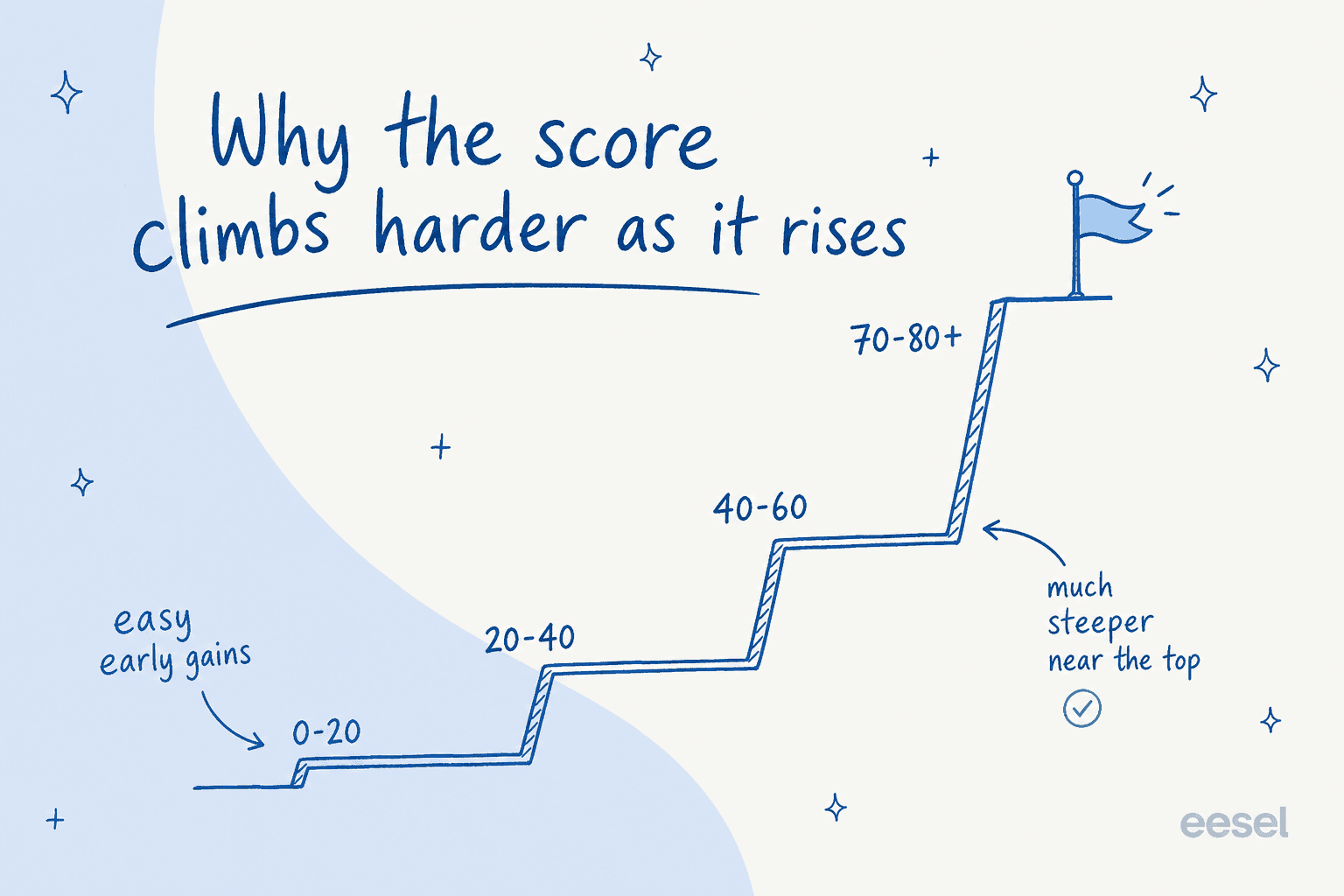
Early gains from 20 to 30 come quickly, but each step toward the top demands far more high-quality links than the one before it. That is why a jump from 70 to 80 is a different order of effort than crossing 20 to 30.
How domain authority works
Third-party tools build the score through a repeatable process:
- Crawl the link graph. The tool maps which sites link to which, building a picture of the web's backlink structure.
- Weight the linking sites. Each linking site contributes based on its own perceived trust, so one link from a respected publication counts far more than dozens from low-quality directories.
- Score and normalize. The tool rolls those signals into a single number on a logarithmic scale, which is why moving from 70 to 80 is much harder than 20 to 30.
- Update over time. Scores shift as the link graph changes and the tool re-crawls.
A blog writer like eesel AI does not move this score by itself, and it should not pretend to. What it does is produce the raw material authority is built from: well-researched, source-grounded posts that other sites are willing to cite and link to. Authority follows from content worth linking to, and that is the part a content engine can actually influence.
Domain authority in practice
Operators get the most value from domain authority when they treat it as a thermometer, not a goal. A team can spend months pushing a third-party score up by acquiring links and see no change in revenue, because the score is a prediction, not the prize. The better move is to use it for competitive context, decide which keywords are realistically winnable given your score versus the incumbents', then invest in the content and the genuine links that move real rankings. The number rises as a side effect of doing the work, not the other way around.
Build the content that earns authority
eesel's AI blog writer drafts source-grounded, topically connected posts, the kind of content that earns links and builds a site's authority over time.