Link building
Link building is the practice of getting other websites to link to your pages in order to improve their authority and search rankings.
What link building means
Link building is the practice of acquiring hyperlinks from other websites to your own, with the goal of improving those pages' authority and search rankings. It is the active, deliberate side of earning links: where a backlink is the link itself, link building is the work you do to make those links happen, through creating link-worthy content, outreach, digital PR, and relationship building.
The logic rests on how search engines value links. Because a link from a trusted, relevant site is read as an endorsement, accumulating high-quality links raises a domain's perceived authority and helps its pages rank. In content marketing, link building is the bridge between publishing something and getting the wider web to acknowledge it; great content that nobody discovers earns no links, and link building is the effort to close that gap. The discipline has shifted over the years from chasing link volume to earning fewer, better links from sites that actually matter.
Why link building matters
- Links remain a top ranking signal. Despite years of algorithm changes, the quantity and quality of links pointing to a page are still among the strongest factors in how it ranks.
- Quality decisively beats quantity. A few editorial links from authoritative, relevant sites outperform thousands of low-quality ones, which are discounted or penalized.
- It compounds with content. Link building and content marketing reinforce each other: the better the asset, the easier the link is to earn, and the easier the next one becomes.
- The wrong tactics carry real risk. Buying links, link farms, and reciprocal schemes are exactly what search engines are built to detect, and they can trigger penalties rather than gains.
- It drives traffic, not just rankings. A link from a well-read page sends real readers, so good link building has value even before any ranking effect.
The tactics people lump under link building are not equal, and it helps to lay them out by how well they hold up over time.
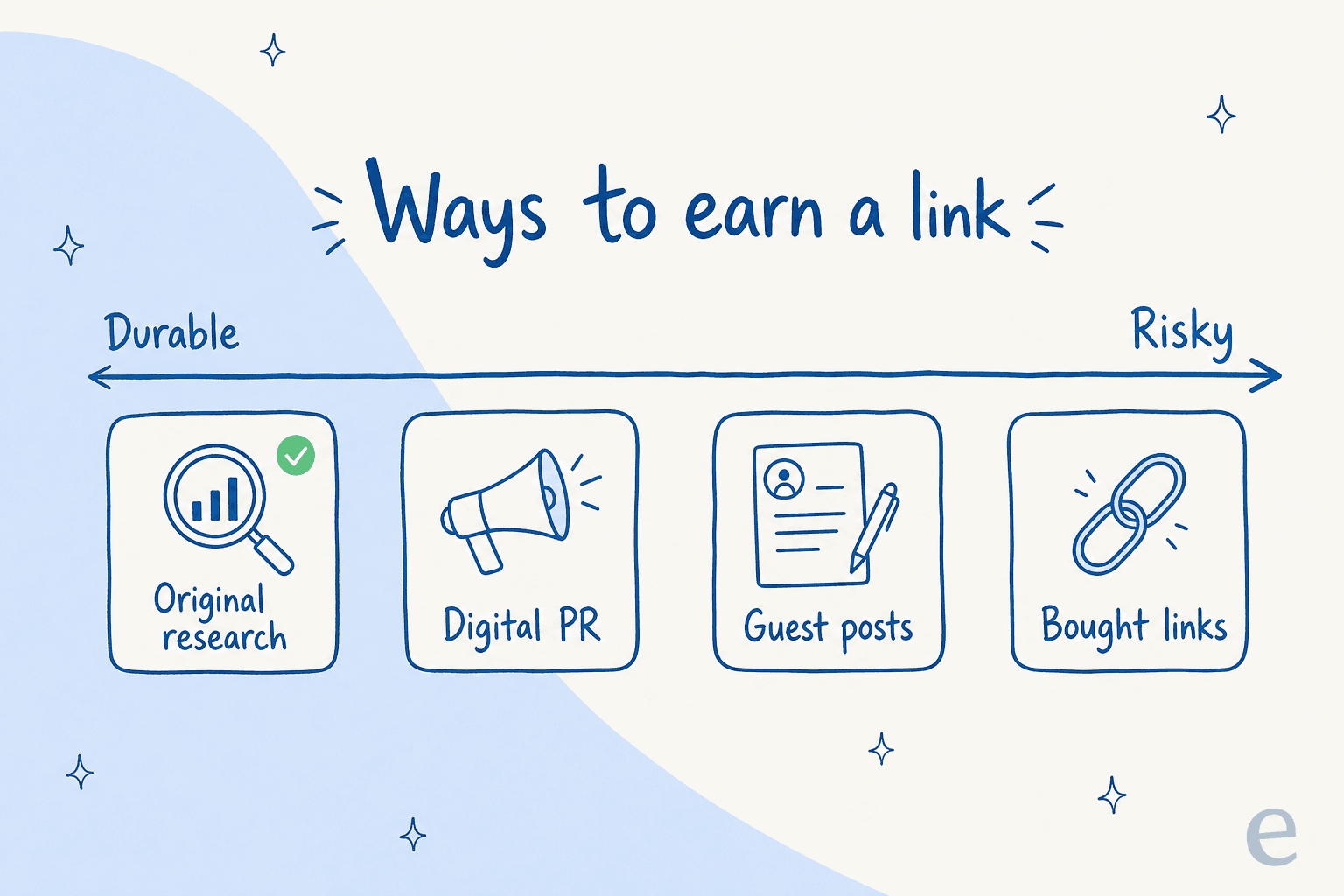
The durable end is built on assets worth citing, like original research, where a single piece can earn links for years. The risky end, bought links and schemes, is exactly what search engines are built to detect, so it tends to cost more than it returns.
How link building works
Effective link building runs as a repeatable loop:
- Create something worth linking to. Original research, a useful tool, a clear explainer, or a data set that other writers would want to cite.
- Find the right sites. Identify publications, blogs, and resource pages whose audience overlaps with yours and where a link would make sense.
- Reach out. Pitch the asset to editors and authors, or earn mentions through PR, partnerships, and real participation in your space.
- Earn and monitor links. As sites link in, track which earn the most authority and traffic, and feed that back into what you create next.
Step one is where content tooling fits honestly. eesel's AI blog writer helps produce the source-grounded posts and data pieces that give outreach something credible to point at; it does not place the links for you, but it shortens the gap between an idea and a publishable asset worth citing.
Link building in practice
The fastest way to waste a link-building budget is to treat links as a commodity to purchase. Bought links rarely survive an algorithm update and can do lasting damage, while the durable wins come from being a source people want to cite. The teams that win at this tend to invest more in the asset than the outreach: a single piece of original research can earn links for years, whereas a hundred cold pitches for a thin post earn almost nothing.
Create the assets link building needs
eesel's AI blog writer drafts source-grounded posts and data pieces that give your link-building outreach something worth citing.