Content marketing
Content marketing is the practice of attracting and retaining an audience by creating useful content rather than directly advertising a product.
What content marketing means
Content marketing is the practice of attracting, engaging, and retaining an audience by creating and sharing useful content (articles, guides, videos, tools) rather than by advertising a product directly. The content earns attention on its own merits: it answers a question, solves a problem, or teaches something, and the brand relationship and eventual sale follow from that usefulness. Done well, each published piece is a durable asset that keeps working long after it goes live.
Content marketing sits at the center of most modern inbound strategies. Instead of interrupting people, a team publishes the things its audience is already searching for, builds trust over repeated visits, and captures demand at the moment someone is researching a purchase. Blog posts, comparison pages, and how-to guides are the workhorses, and search is the main distribution channel for most of them.
Why content marketing matters
Content marketing works because it compounds in ways paid channels do not. Specifically, it can:
- Capture existing demand, meeting buyers who are already searching with a page that answers their exact question.
- Build topical authority, where deep coverage of a subject area makes search engines and readers treat the brand as a credible source.
- Compound over time, since a well-ranked evergreen content piece can bring traffic for years at no incremental cost.
- Lower acquisition cost, because owned content keeps converting after the work is paid for, unlike ads that stop the moment spend stops.
- Feed every other channel, giving sales, social, and email a steady supply of material that already resonates.
The compounding effect is easiest to see when you put content next to paid ads on the same timeline.
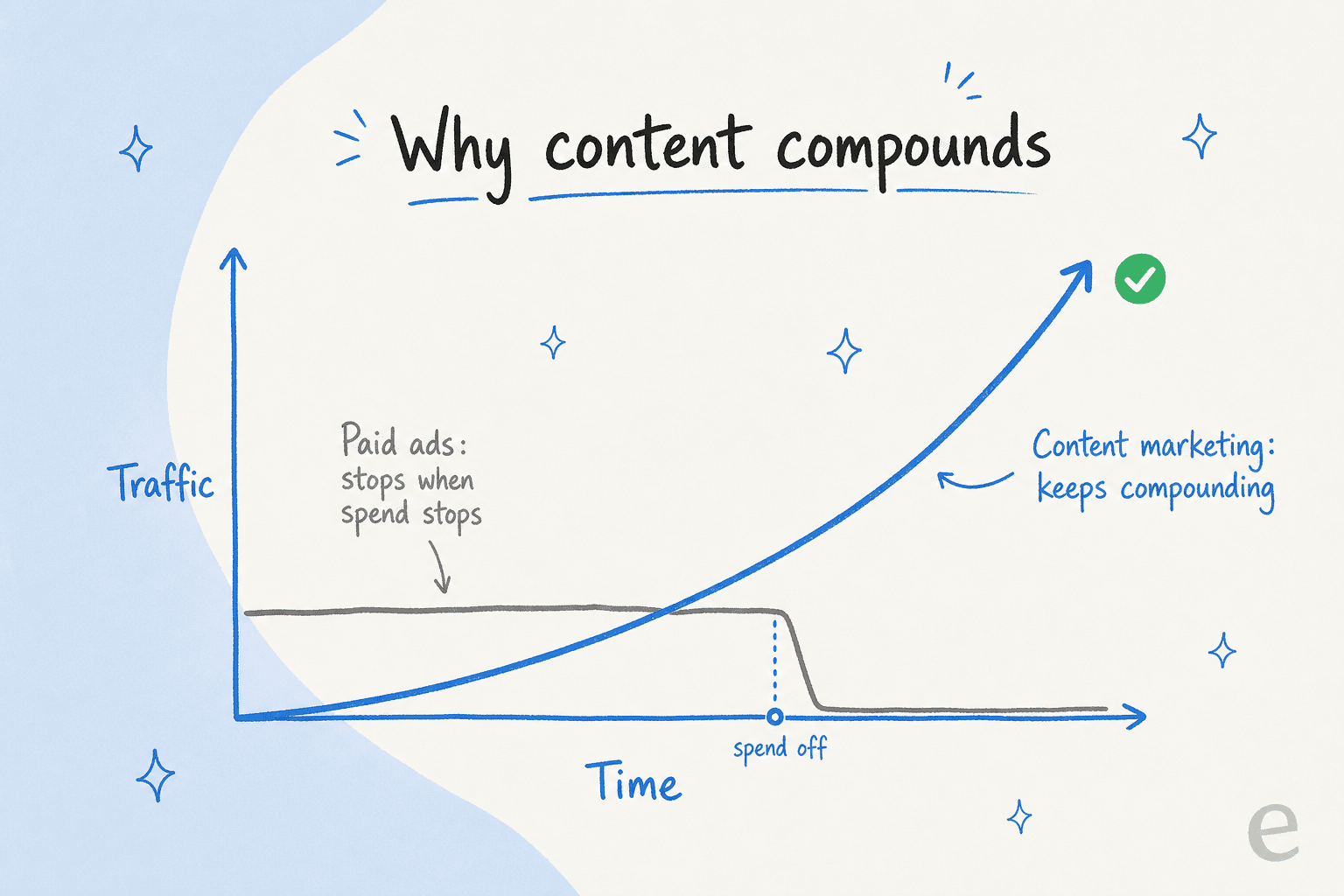
Paid traffic flatlines the moment the budget stops, while a well-ranked piece of content keeps drawing visits month after month. That gap is why content tends to lower acquisition cost the longer a program runs.
How content marketing works
A content marketing program usually runs as a loop:
- Research the audience and demand. Identify the questions, problems, and keywords the target audience actually searches for.
- Plan the topics. Group them into clusters and a pillar structure, then schedule them on a content calendar.
- Create the content. Write, design, or record each piece against a clear brief and target intent.
- Distribute it. Optimize for search, share it across owned channels, and earn links where possible.
- Measure and refresh. Track what ranks and converts, then update or expand the pieces that are slipping.
The bottleneck is almost always step three: producing enough quality content to cover a strategy. An AI blog writer like eesel AI addresses that bottleneck by researching a topic and drafting a grounded, source-backed post, so a small team can keep the calendar full without trading quality for volume.
Content marketing in practice
The programs that win are not the ones that publish the most, they are the ones that publish with focus. A scattershot blog that chases unrelated trending topics rarely builds authority in any single area, while a team that picks a few subjects and covers them exhaustively tends to outrank larger competitors on the topics that matter to it. The practical discipline is saying no to off-strategy pieces, then committing enough depth and consistency to a chosen area that the cluster starts to rank as a whole rather than as a scatter of one-off posts.
Scale the content engine
eesel AI researches a topic and drafts grounded, SEO-oriented posts, so a content marketing program can publish more without dropping quality.