Search engine optimization (SEO)
The practice of improving a website so it ranks higher in unpaid search results and attracts more relevant visitors.
What search engine optimization means
Search engine optimization (SEO) is the practice of improving a website so it ranks higher in unpaid search results and attracts more relevant visitors. It works by aligning a page with the things search engines reward: content that matches what people are searching for, a site structure that is easy to crawl, and signals of trust and authority from across the web. Unlike paid advertising, SEO earns placement rather than buying it, so the traffic continues without ongoing ad spend.
SEO is usually grouped into three areas: on-page work (the content and HTML of a page), technical work (crawlability, speed, indexing), and off-page work (links and reputation from other sites). In content marketing, SEO is what turns a blog post from something only your existing audience sees into a durable acquisition channel, because a well-optimized article keeps surfacing for people searching the topic long after it is published.
Why search engine optimization matters
- It compounds instead of resetting. A ranking page keeps earning visits month after month, so the return on one piece of content grows over time rather than ending when a campaign stops.
- It captures intent at the moment of need. People search when they are actively looking, so a page matching their search intent reaches them at a higher-converting moment than interruptive ads.
- It is the cheapest scalable channel for most teams. Once content ranks, the marginal cost of each visitor is close to zero, which is why content-led companies lean on it.
- It spans the whole site, not one page. Internal links, site speed, and topical depth all feed rankings, so SEO rewards coordinated coverage over isolated posts.
- It increasingly feeds AI answers. Generative answer engines pull from the same well-structured, trustworthy pages that classic search favors, so good SEO carries into newer surfaces too.
It helps to see how those three areas fit together rather than as a flat list of tactics.
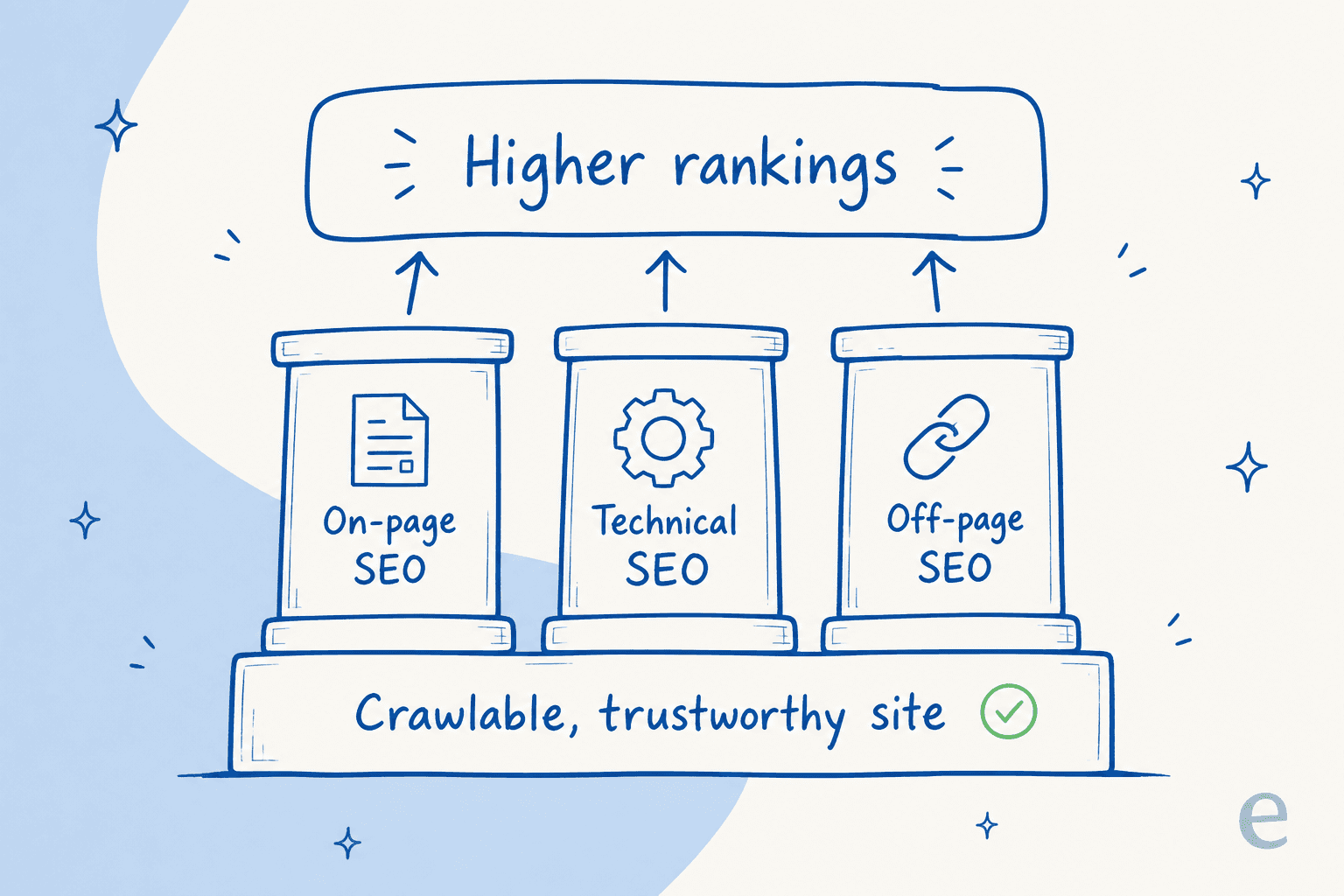
Rankings sit on top of three pillars, on-page, technical, and off-page SEO, and all three rest on a site that engines can actually crawl and trust. Neglect any one pillar and the structure above it gets shaky.
How search engine optimization works
A typical SEO workflow runs in stages:
- Research the demand. Keyword research identifies what people search for and how competitive each query is, which sets the topics worth targeting.
- Match the intent. Each target query is mapped to the right page type and angle, so the content answers what the searcher actually wants.
- Optimize on-page. Titles, headings, internal links, and body copy are written to be clear to readers and legible to crawlers.
- Earn authority. Other sites linking in, plus depth of coverage on the topic, build the trust signals that lift rankings.
- Measure and refresh. Performance is tracked and older pages are updated as rankings and search behavior shift.
eesel AI supports the content side of this loop. The eesel AI blog writer takes a researched topic and produces a long-form, source-grounded draft built around the target query, giving editors a head start on the create-and-optimize stages while the technical and authority work stays with the team.
Search engine optimization in practice
SEO rewards consistency more than cleverness. Sites that win tend to cover a subject thoroughly, keep their best pages current, and structure content so both readers and crawlers can follow it, rather than chasing one-off tactics. SEO is a compounding investment, not a quick fix: the first results often take months, and the temptation to manipulate rankings usually backfires when search engines adjust. The durable approach is to make pages people actually want to read, then handle the technical and structural details that let those pages be found.
Turn SEO research into published posts
eesel AI researches a topic and drafts SEO-oriented long-form content grounded in real sources, ready for an editor to refine and ship.