Keyword research
The process of finding and analyzing the search terms people type into search engines, to decide what content to create and how to rank for it.
What keyword research means
Keyword research is the practice of finding and analyzing the words and phrases people type into search engines, then judging which of those terms are worth targeting with content. It combines three readings of each phrase: how many people search it, how hard it would be to rank for, and what the searcher actually wants when they type it. The output is a prioritized list of topics that maps real demand to content you can realistically create.
In content marketing and SEO, keyword research is the step that decides what gets written at all. Rather than guessing at topics, a team grounds its content calendar in terms that have measurable demand and a clear connection to the product, so every post is aimed at a query someone is already searching.
Why keyword research matters
- It anchors content to real demand. Instead of writing what feels interesting, you write what people actually search, which is the difference between a post that earns traffic and one that sits unread.
- It surfaces difficulty before you commit. Checking keyword difficulty early stops a team from spending weeks on a term that established sites already own.
- It exposes intent mismatches. A keyword with strong volume can still be wrong if its search intent is transactional and you only have an explainer to offer.
- It builds topical structure. Grouping related keywords reveals natural clusters, which feed a topic cluster and a pillar page instead of scattered one-off articles.
- It finds the gaps. Comparing your coverage against the full keyword set highlights a content gap where demand exists but you have nothing ranking.
One way to make those tradeoffs concrete is to plot every candidate term on two axes, how much it gets searched against how hard it is to rank for.
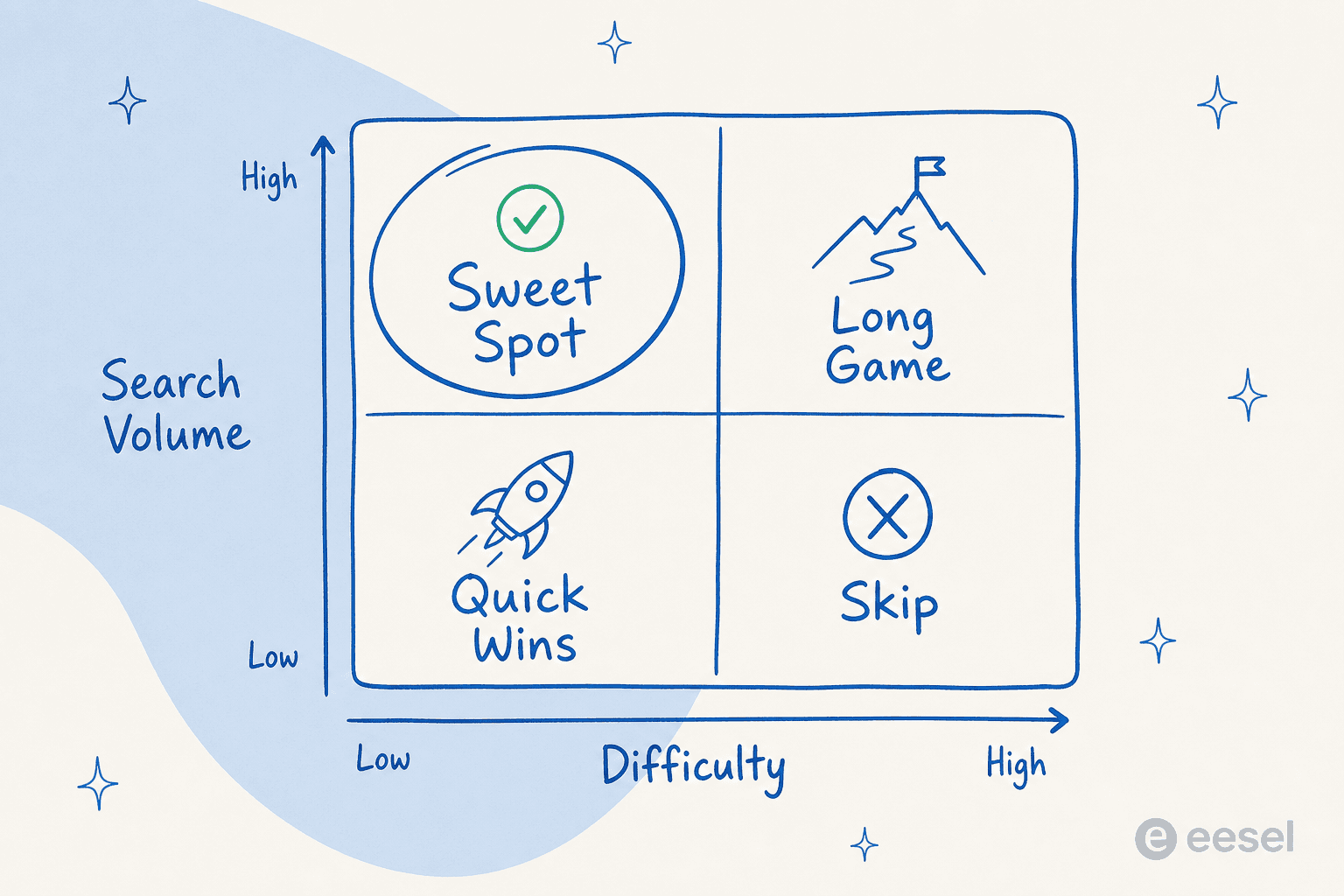
The terms in the top-left quadrant, high demand and low competition, are the ones worth writing first. High-volume terms in the top-right are still worth chasing, but they take longer and need more authority before they rank.
How keyword research works
The process usually runs through the same stages:
- Seed the list. Start from a core topic, the product category, and the questions customers already ask, then expand outward into related queries and variations.
- Pull the metrics. Attach search volume and difficulty to each term so the list can be ranked by opportunity rather than gut feel.
- Read the intent. For each promising term, look at what currently ranks to infer whether searchers want a definition, a comparison, a how-to, or a product.
- Group and prioritize. Cluster terms into topics, then pick the ones with the best balance of demand, winnability, and relevance.
- Brief the content. Turn each chosen term into a content brief that names the angle, the intent, and the supporting subtopics.
An AI blog writer like eesel AI folds these last stages together: you give it a target keyword, it researches the topic against real sources, infers the intent behind the query, and drafts a post structured to answer it, so the research and the draft are connected rather than handed off between tools.
Keyword research in practice
The common mistake is treating the keyword list as a wish list of high-volume terms. The terms that actually pay off are usually the specific, lower-volume queries where intent is unambiguous and competition is thin, because they convert and they rank faster. Experienced teams also revisit the research on a schedule: query behavior drifts, new terms appear, and a list built a year ago will quietly stop matching what people search today.
For a hands-on walkthrough, read using keywords in blogs.
Turn keyword research into published posts
eesel AI takes a target keyword, researches the topic against real sources, and drafts an SEO-ready post built around the intent behind it.