Keyword difficulty
Keyword difficulty is a score that estimates how hard it would be to rank on the first page of search results for a given keyword.
What keyword difficulty means
Keyword difficulty is a score that estimates how hard it would be to rank on the first page of search results for a given keyword. SEO tools usually express it as a number from 0 to 100, where a higher score means stronger, more established pages already hold the top positions and a newcomer faces a steeper climb. It is a planning metric: a way to gauge, before investing in a page, whether ranking for a term is realistic.
The score is an estimate, not a measurement, and it is derived mostly from the competition. Tools look at the authority and backlink profiles of the pages currently ranking, along with signals like content depth and on-page optimization, and roll them into a single number. Because every tool uses its own inputs and scale, a difficulty of 45 in one platform does not equal 45 in another. In content marketing, keyword difficulty is the gut-check that keeps a content plan honest: it tells you which queries are worth writing for now, which to defer until the site has more authority, and which to skip.
Why keyword difficulty matters
- It sets realistic expectations. A high score warns that a page is unlikely to rank without significant authority, saving the effort of writing into a wall.
- It prioritizes the roadmap. Sorting target queries by difficulty surfaces the winnable ones first, so early content earns traffic instead of stalling on page five.
- It pairs with volume to find value. A low-difficulty, decent-volume keyword is the sweet spot, and difficulty is the half of that equation that says whether the volume is reachable.
- It scales with your site. The same keyword gets easier as a domain builds authority, so difficulty is read relative to your own site's strength, not in the abstract.
- It exposes the backlink gap. Because the score leans on the competitors' link profiles, a high number often signals that ranking will take links, not just better content.
A rough way to read the 0 to 100 scale is to map each band to the kind of site that can realistically win it:
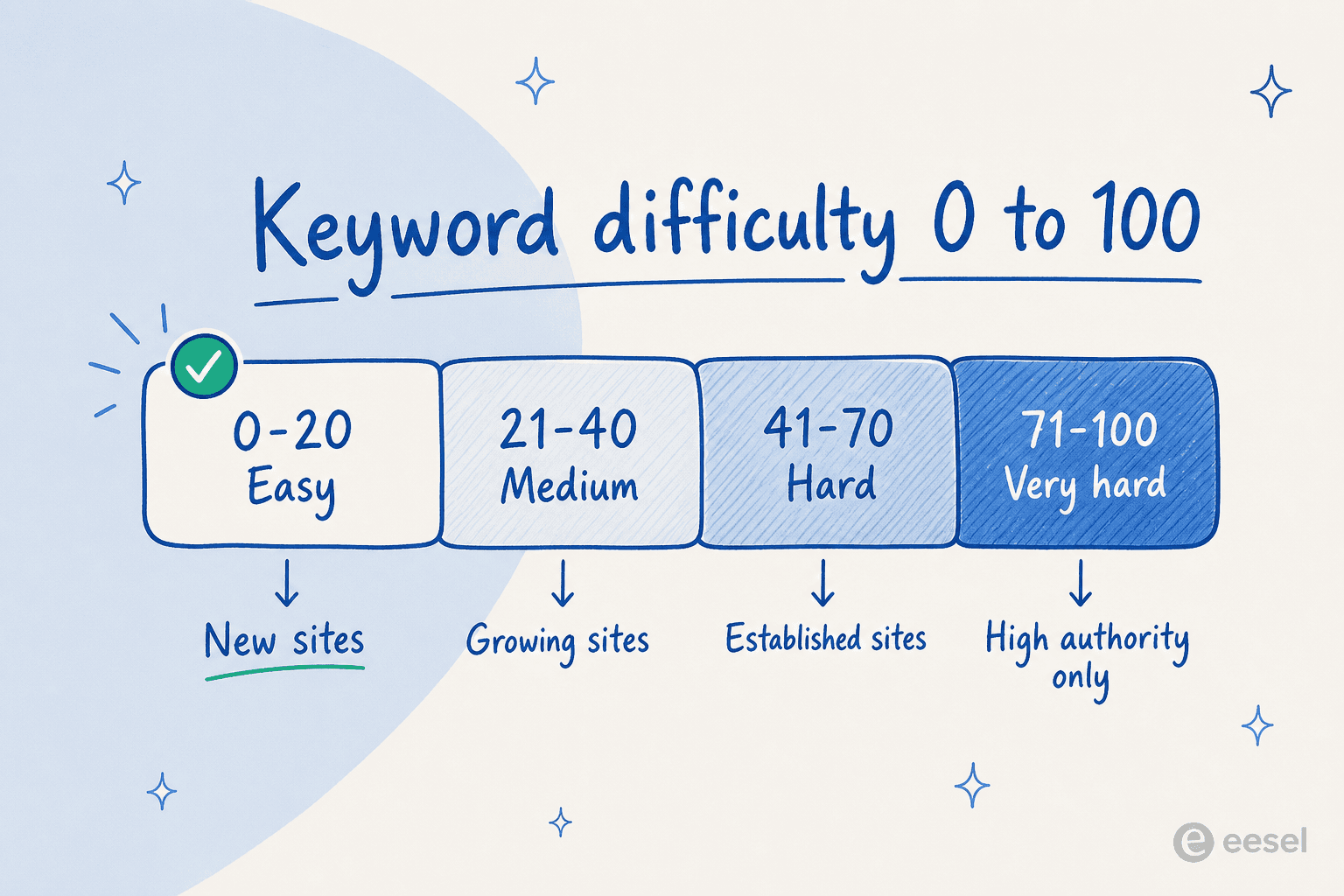
The thresholds are not fixed, since difficulty is always read relative to your own domain's authority, but the shape holds: a brand-new site lives in the lower bands, and the head terms in the top band stay out of reach until the site has built up its own link equity.
How keyword difficulty works
Using keyword difficulty well runs through research, filtering, and matching effort to the score:
- Pull difficulty alongside volume. In keyword research, every candidate query gets both a difficulty score and a search volume estimate, since neither is useful alone.
- Filter to what is winnable. Set a difficulty ceiling appropriate to your domain's authority and shortlist the queries inside it.
- Inspect the live results. The score is a starting point; reading who actually ranks reveals whether the top pages are thin and beatable or deeply authoritative.
- Match content depth to the target. Higher-difficulty terms demand more thorough, better-linked pages to have a chance.
This is where keyword difficulty shapes a content plan in practice. eesel's AI blog writer can produce thorough, source-grounded posts quickly, which lets a team go after slightly harder terms with the depth they require, while still steering the bulk of the plan toward the lower-difficulty queries where a new page can realistically rank.
Keyword difficulty in practice
The most common error is treating the score as gospel and skipping the manual check of the actual SERP. A keyword can show a moderate difficulty while the top results are old, thin, or off-intent, which makes it far easier to win than the number suggests, and the reverse happens too. The other trap is targeting only the easiest terms forever; that wins early traffic but caps a site's ceiling, since the valuable head terms are high-difficulty by definition. The operators who use keyword difficulty well treat it as one input among several, read it relative to their own site's authority, and always sanity-check the score against who is really ranking before committing a page.
For the full breakdown, read keyword difficulty explained.
Win the keywords you can actually rank for
eesel's AI blog writer drafts depth-matched posts for the queries within reach, so your content targets winnable keywords instead of impossible ones.