Long-tail keyword
A long-tail keyword is a longer, more specific search phrase that has lower search volume but usually clearer intent and less competition than a broad head term.
What long-tail keyword means
A long-tail keyword is a longer, more specific search phrase that individually attracts low search volume but usually carries clearer intent and faces less competition than a broad, high-volume head term. The name comes from the shape of the demand curve: a few head terms get enormous search volume, and a very long "tail" of specific phrases each get little, but that tail collectively accounts for the majority of all searches.
The distinction is about specificity, not literal word count, though long-tail phrases do tend to be longer. "Crm" is a head term with huge volume and brutal competition. "Best crm for a two-person real estate team" is a long-tail keyword: far fewer people search it, but the ones who do know exactly what they want and are close to a decision. In content marketing and SEO, long-tail keywords are the backbone of most realistic ranking strategies, because they are where a site can actually compete and where the traffic that arrives is most likely to convert.
Why long-tail keywords matter
- They are winnable. Lower competition means lower keyword difficulty, so a focused page can rank for a long-tail phrase even when the head term is out of reach.
- They carry sharper intent. The more specific the query, the closer the searcher is to acting, which is why long-tail traffic tends to convert better despite lower volume.
- They add up. No single long-tail keyword moves the needle, but a library of them captures the bulk of total search demand that the head terms miss.
- They map cleanly to content. A specific phrase implies a specific question, which makes it straightforward to write a page that answers it directly and matches the search intent.
- They feed topical authority. Covering many related long-tail queries around a theme signals depth to search engines, which helps the harder head terms rank later.
The name makes more sense once you picture the demand curve it comes from:
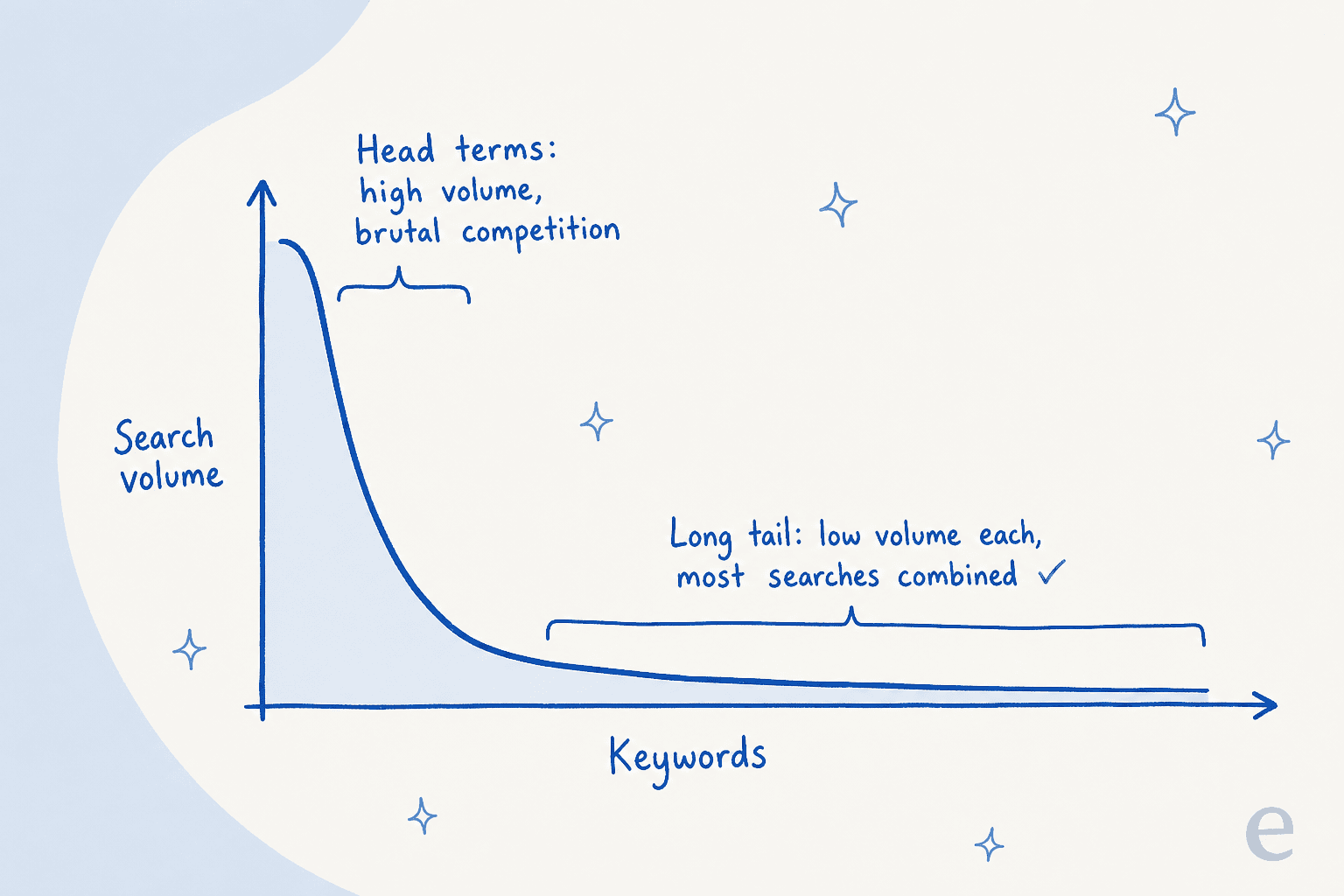
A handful of head terms grab the tall spike of volume and the fiercest competition, while the long flat tail is made of countless specific phrases that each draw little traffic. Add that tail up, though, and it outweighs the head, which is the whole reason a young site builds there first.
How long-tail keyword works
Building a long-tail strategy runs through research, clustering, and coverage:
- Discover the phrases. Keyword tools, search autocomplete, "people also ask" results, and your own query reports surface the specific things people type.
- Cluster by topic. Group related long-tail keywords that share an intent, since several phrases often belong on one well-scoped page rather than a thin page each.
- Write to the intent. Each page answers its target question directly, with the supporting depth a searcher on that exact query expects.
- Track and expand. As pages rank, Search Console reveals more long-tail queries they are catching, which seeds the next round of pages.
The bottleneck is rarely finding the keywords; it is producing enough quality pages to cover the tail. This is where eesel's AI blog writer fits: it researches and drafts a focused, source-grounded post for a specific query, so a team can build out the long tail at a pace that manual writing cannot match, without each page collapsing into thin filler.
Long-tail keyword in practice
The mistake teams make is chasing volume and ignoring the tail, then wondering why a young site cannot rank for its head terms. In reality the long tail is usually where early SEO wins come from, and the head term becomes reachable only after a site has earned authority by covering the tail around it. The other trap is treating each long-tail phrase as its own page, which fragments authority into thin content; the better move is clustering related phrases onto a strong page that answers the whole intent. Long-tail keywords reward patience and breadth, and they are most powerful when read as a portfolio rather than a list of individual targets.
Cover the long tail at scale
eesel's AI blog writer drafts focused posts for specific queries, so you can build out the long tail without writing each one by hand.