AI grounding
Tying an AI's answers to a trusted source of truth, like your help center, docs, and past tickets, so it responds with your facts instead of inventing them.
What AI grounding means
AI grounding is the practice of tying an AI model's answers to a trusted source of truth, like a help center, internal docs, product data, or past tickets, so it responds with verified facts instead of generating plausible-sounding text from its training data alone. It connects the model's fluent output to a specific body of correct, current information, rather than letting it answer from a blurry average of everything it once read.
An ungrounded model answers from that average and fills gaps with whatever sounds right. A grounded model answers from the specific information you have given it, and can point to where each answer came from. In customer support, that difference is the whole game: it is the line between quoting a customer their real refund policy and a confident-sounding answer that happens to be wrong.
Why AI grounding matters
Large language models are designed to produce fluent text, not to be correct, so left alone they will invent details. Grounding closes those gaps and earns its place because of what it changes:
- Accuracy. Answers reflect your actual policies, prices, and steps, not a guess.
- Freshness. When your docs change, grounded answers change with them, so nothing goes stale.
- Traceability. Agents and customers can see the source an answer came from, often as a confidence score plus a citation.
- Safety. A well-grounded system escalates instead of guessing when it has no source.
- Trust. Over time, sourced answers are what make a team comfortable letting AI reply unsupervised.
The split is easiest to see when the same question takes two different routes to an answer.
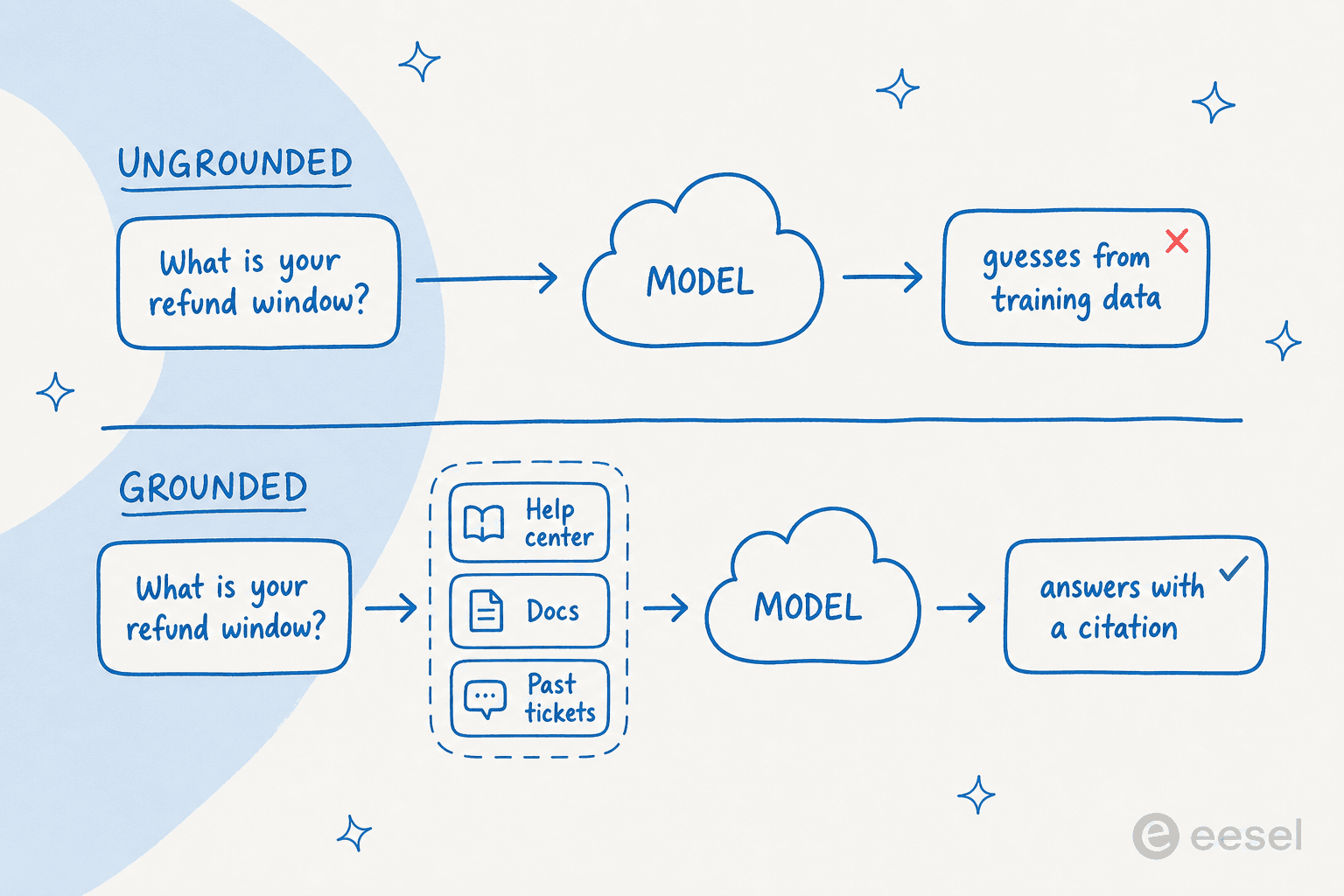
Up top, the ungrounded route sends the question straight to the model, which fills the gap with a plausible guess. Down below, the grounded route passes the same question through your trusted sources first, so the reply comes back with a citation instead of a hunch. Same question, very different answer.
How AI grounding works
Most grounded systems follow a retrieve-then-answer pattern, commonly built as RAG:
- Index your knowledge. Help center articles, macros, docs, and resolved tickets are processed so they can be searched by meaning, not just keywords.
- Retrieve the relevant passages. For each question, the system pulls the handful of passages most likely to contain the answer.
- Generate a grounded answer. The model writes its reply using those passages, and can cite them.
- Defer when unsure. If nothing relevant is found, a good system hands off to a person rather than inventing an answer, a human-in-the-loop safeguard.
A support agent like eesel AI grounds every reply in your own knowledge: it learns from your help center, docs, and past tickets, answers from them, and escalates cleanly when there is no safe source to draw from.
AI grounding in practice
The quality of a grounded AI agent is mostly the quality of what it is grounded in. Thin or outdated documentation produces thin or outdated answers, no matter how capable the underlying model is. That is why teams who get the most from AI support invest in their knowledge sources first, and choose tooling that can learn from the messy, real-world content they already have, including past ticket history, rather than requiring a hand-built decision tree before it can say a word.
Ground your AI agent in your own knowledge
eesel AI learns from your help center, docs, and past tickets, then answers from them rather than guessing.