Confidence score
A confidence score is a number, usually between 0 and 1, that an AI model assigns to a prediction or answer to express how likely it is to be correct.
What a confidence score means
A confidence score is a number, usually between 0 and 1 (or 0 to 100 percent), that an AI model assigns to a prediction or answer to express how likely it believes that output is correct. A score near 1 means the model found a strong, clear match in its data, while a score near 0 means it is uncertain. The score reflects the model's own internal probability, so it is an estimate of reliability rather than a guarantee of truth.
In customer support, the confidence score is the dial that decides how much an AI is trusted to act alone. It is what lets an AI answer the questions it is sure about and step back from the ones it is not, by comparing each prediction against a threshold the team sets. That single mechanism is how support AI can be both automated and safe at the same time.
Why confidence scores matter
The confidence score is small in concept but central to running AI in production safely:
- It governs automation versus escalation, by setting the line above which the AI answers and below which a human takes over. This is the core of safe escalation.
- It is tunable per risk, so a team can set a strict threshold for billing or account changes and a looser one for harmless FAQs.
- It powers triage and routing, because the same scoring approach behind a generated answer also rates how sure an intent classification model is about a ticket's category.
- It makes behaviour measurable, since teams can audit where the AI was confident and wrong versus uncertain and correct, then adjust.
- It limits, but does not erase, risk, because a model can be confidently wrong, so a score works best paired with grounding.
Picturing the score as a bar from 0 to 1 makes it clearer how a single cutoff turns into very different behavior.
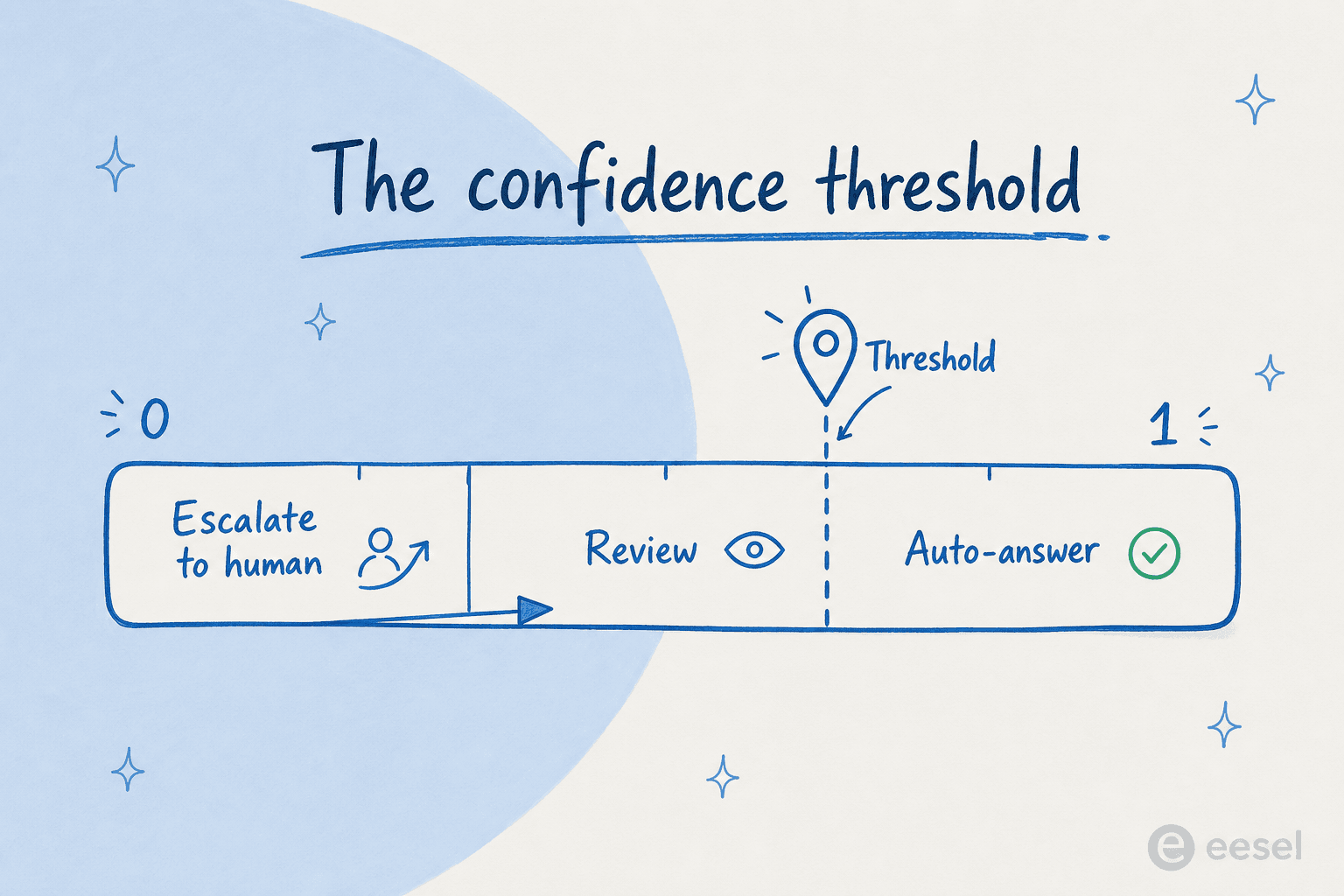
Everything to the right of the threshold gets answered automatically, everything to the left gets handed to a person, and where you place that line is the entire difference between an AI that over-reaches and one that stays cautious. Sliding the threshold left or right is how a team dials trust up for low-risk FAQs and down for billing or security.
How a confidence score works
In a support workflow, a confidence score moves through a few steps:
- Generate and score. The model produces an answer or classification and attaches a confidence value reflecting how strong the match was.
- Compare to a threshold. The system checks the score against the team's configured cutoff for that type of action.
- Act or hold back. Above the threshold, the AI proceeds. Below it, the AI declines to answer and routes the case to a person.
- Combine with grounding. A support agent like eesel AI does not rely on confidence alone, it answers only when it can ground the reply in your knowledge and is confident, and escalates with full context when either is missing, which keeps low-confidence cases from turning into a hallucination.
Confidence scores in practice
The mistake teams make is treating the confidence score as a measure of truth instead of a measure of certainty. The two are not the same: a model can be highly confident about an answer drawn from an outdated article and still be wrong. The practical way to use confidence is as one input among several, paired with grounding in trusted sources and a human-in-the-loop for anything sensitive. The threshold itself is best set empirically by running the AI against historical tickets, seeing where its confidence lined up with correctness, and tightening or relaxing the cutoff before going live rather than guessing a number on day one.
Want the full playbook? See our guide to setting confidence thresholds.
Confidence scores that decide when to escalate
eesel AI answers when it is confident and grounded, and hands off to a human when it is not, so low-confidence cases never get a guess.